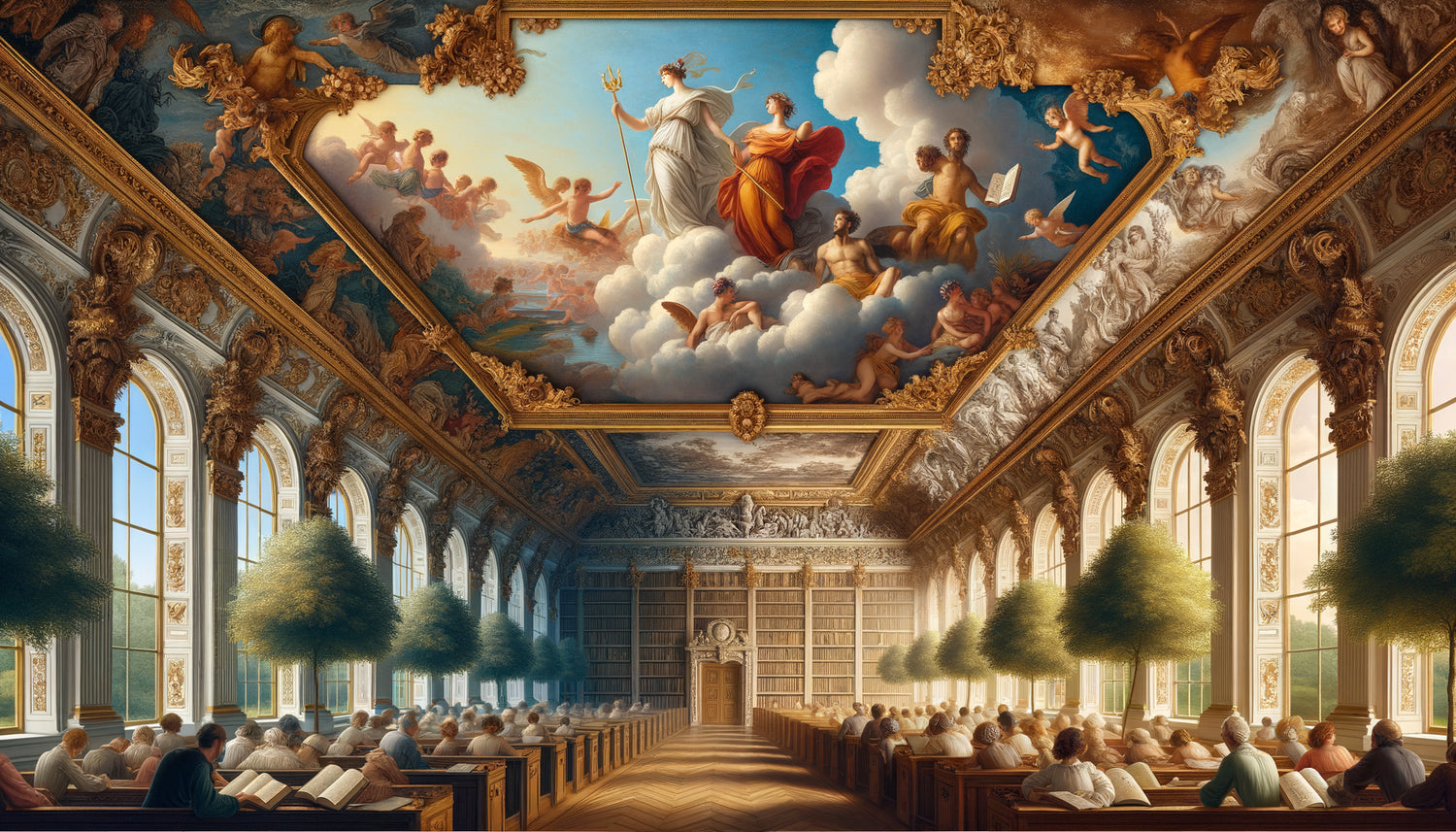
Imagine stepping through the doors of an 18th-century royal library. Your footsteps echo on marble, your gaze gets lost in celestial vaults adorned with mythological frescoes, while gilded globes capture the light of crystal chandeliers. Then, a few streets away, you enter a public library: the atmosphere changes radically. Ceilings lower, decorations become more subdued, and landscapes painted on the walls tell different stories. This is not by chance; it's a codified visual language.
Here’s what landscape art in these places reveals: a social hierarchy inscribed in stone and paint, a diametrically opposed worldview, and a strategic use of iconography to assert power or emancipation. Many believe that all ancient libraries looked alike, decorated interchangeably. Yet, the landscapes adorning their walls, ceilings, and cartouches were distinct visual manifestos. Understanding these differences is deciphering how the elite and the people represented their place in the universe. I invite you on a dive into these parallel universes where every pictorial detail carried a political, philosophical, and aesthetic message.
Royal landscapes: when power paints itself in majesty
In royal libraries, landscapes were never innocent. At the Bibliothèque Mazarine or in the king's apartments at Versailles, frescoes depicted perfectly ordered French gardens, monumental architectural perspectives, or mythological landscapes populated by deities. These compositions translated a worldview: order imposes its law on wild nature.
Idealized landscapes dominated: Arcadian valleys bathed in golden light, ancient ruins suggesting continuity between Rome and the French monarchy, theatrical waterfalls framed by columns. Every element served a narrative of monarchical grandeur. Painters like Charles Le Brun created decorative cycles where landscapes served as settings for royal power allegories. We saw Apollo – solar double of the king – crossing skies painted in trompe-l'œil, overlooking miniature territories conquered.
Aerial perspective was favored: the gaze plunged from celestial heights towards earthly expanses, symbolically reproducing the monarch’s view of his subjects. The colors chosen – golds, deep ultramarine, purples – reinforced this atmosphere of transcendence. Landscapes in royal libraries did not invite intimate contemplation but reverent dazzlement.
The iconography of knowledge reserved for the elite
Royal landscapes were systematically accompanied by erudite references accessible only to scholars. A view of Parnassus immediately identified the nine Muses for those who mastered Greek and Roman mythology. A landscape depicting the gardens of Plato’s Academy spoke to philosophers trained in classical humanities.
These decorations served as markers of social distinction. Understanding the symbolism of a landscape depicting Minerva in her Athenian temple required an education that only the aristocracy received. Ornamental cartouches mixed exotic landscapes – oriental palms, Egyptian pyramids – and Latin inscriptions, creating a hermetic ensemble for the common man.
The cabinets of curiosities attached to royal libraries extended this logic: they exhibited views of distant lands brought back by explorers, panoramas of conquered cities, botanical representations of royal gardens. The landscape became a visual inventory of possessions and accumulated knowledge by the crown. This pictorial geography affirmed the sovereign's territorial and intellectual mastery.

Public spaces: when landscape becomes democratic
When the first public libraries appeared in the 18th century, their landscaping borrowed radically different codes. In the Bibliothèque Sainte-Geneviève in Paris or in the reading rooms of provincial towns, landscapes became more narrative and educational.
One favored country scenes showing idealized rural life: harvests, grape harvests, shepherds in peaceful valleys. These representations celebrated work and virtue, emerging republican values. Urban landscapes showed lively public squares, markets, communal fountains – the space of the people rather than that of power.
The color palette also evolved: less gold and purple, more earthy and natural tones. The deep greens of forests, the warm browns of plowed fields, the accessible blues of clear skies replaced precious azures. This sobriety was not aesthetic poverty but an ideological choice: public landscape should reflect everyday reality rather than exalt it towards an inaccessible ideal.
A geography of shared knowledge
Public libraries developed a universalistic landscape iconography. Rather than exotic lands as trophies of conquest, representations were made of the regions of France in their geographical diversity: the Alps, Brittany by the sea, the cereal plains of Beauce. This choice created a familiar geography where each reader could recognize themselves.
Scientific landscapes also emerged: geological cross-sections, precise botanical representations, cartographic views. These images served a direct educational function, transforming walls into learning supports. Unlike the hermetic allegories of royal libraries, these landscapes were intended to be immediately decipherable.
There were also literary landscapes: scenes inspired by La Fontaine's fables, illustrations of Robinson Crusoe's travels, evocations of pastoral novels. This iconography created bridges between the image and the texts available in the library, encouraging circulation between reading and contemplation. The landscape became an invitation to discovery rather than an affirmation of domination.

Architecture and perspectives: two conceptions of space
The integration of landscapes into the architecture itself reveals opposing philosophies. Royal libraries extensively used architectural trompe-l'oeil: painted columns extending the real space, vanishing perspective creating an illusion of infinity, celestial domes opening onto imaginary skies. These artifices magnified the space, making it theatrical and impressive.
Public spaces adopted a more horizontal and inclusive approach. Landscapes were set within clearly defined frames – paintings, friezes, panels – respecting human scale. Rather than seeking to overwhelm the visitor with grandeur, these compositions accompanied them in their walk. Reading rooms were organized around windows offering views of real public gardens, integrating the real landscape into the reading experience.
This architectural difference expressed two relationships to knowledge: in royal libraries, knowledge descended from above, symbolized by those inaccessible celestial ceilings. In public spaces, it unfolded horizontally, within reach of sight and hand, in a logic of sharing rather than revelation.
Evolution: when codes mix
In the 19th century, a partial convergence occurred. Some public libraries, wanting to legitimize their cultural function, borrowed monumental decorative codes. Ambitious frescoes appeared in places like the National Library, mixing learned allegories and more accessible scenes.
Conversely, after the revolutions, former royal libraries opened to the public retained their opulent decor but accompanied it with explanatory panels. The mythological landscape became a pedagogical tool rather than a symbol of exclusion. This gradual democratization of perspective modified the reception of these works: what intimidated became an object of shared admiration.
Today, when we visit these heritage spaces, we bring a hybrid gaze. The landscapes of historic libraries fascinate us with their virtuosity while questioning us about the hierarchies they embodied. This tension is their richness: they remain major artistic testimonies while documenting inequalities in access to knowledge and beauty.
Transform your interior into a sanctuary of contemplation
Discover our exclusive collection of landscape paintings that capture the timeless majesty of places of knowledge, tailored to your living space.
Inheriting this duality in our contemporary interiors
This history of landscapes in libraries still resonates in our current decorative choices. When you design a personal reading space, you unconsciously reproduce these ancestral codes. Do you opt for imposing reproductions of classic landscapes that elevate the gaze? Or do you prefer intimate scenes, photographs of accessible nature that create a soothing cocoon?
Contemporary libraries continue to explore this tension. Some, like the National Library of France, assume a monumentality inherited from royal codes. Others, such as local libraries, prioritize participatory works where landscapes are documented by residents themselves. This aesthetic debate remains alive: should art elevate through grandeur or accompany through proximity?
In your own interior, playing with these two legacies creates a unique visual richness. A grand majestic landscape in a living room affirms an aesthetic ambition, while more modest compositions in an office promote concentration and introspection. Understanding the history of these choices allows you to make them consciously, creating spaces that tell your own relationship to knowledge, beauty and the world.
Frequently asked questions about landscapes in historic libraries
Why did royal libraries favor mythological landscapes?
Mythological landscapes served several strategic functions in royal libraries. Firstly, they established a prestigious continuity between the monarchy and classical antiquity, legitimizing power through cultural lineage. Secondly, their iconographic complexity functioned as a social filter: only those educated in classical humanities could decipher their references, creating a community of initiates. Finally, these landscapes allowed for sophisticated political allegories: depicting the king as Apollo traversing a celestial landscape conveyed messages of divine power without resorting to overtly political portraits. This visual strategy transformed walls into codified dynastic manifestos, where each landscape element – Greek temple, Mount Parnassus, mythological river – carried meanings that aristocratic education taught one to recognize.
Did ancient public libraries also feature landscape artworks?
Absolutely, but with radically different intentions. Public libraries, which developed mainly after the 18th century, integrated landscapes with a pedagogical purpose. There were regional representations of France allowing readers to visualize national geography, rural scenes celebrating work and rural virtues, or precise botanical illustrations serving as learning aids. Unlike the hermetic allegories of royal spaces, these works were intended to be immediately understandable by all. Their artistic quality varied according to municipal resources: some cities commissioned ambitious frescoes from regional painters, others settled for framed engraved reproductions. But the principle remained constant: landscape should democratize access to beauty and knowledge, not intimidate or exclude. This inclusive approach made the decor itself a political act of cultural emancipation.
How can we draw inspiration from these traditions to decorate our personal reading space?
The history of landscapes in libraries offers valuable lessons for arranging your reading corner. If you have a generous space, you can borrow from royal codes: a large classic landscape painting above a bookcase creates majestic verticality and elevates the gaze. Choose reproductions of idealized landscapes, architectural views or mythological scenes that invite contemplation. For a more intimate space, draw inspiration from public libraries: prioritize familiar landscapes, regional scenes, soothing compositions that accompany concentration. Lighting also plays a crucial role: as in historical spaces, indirect light enhances the works without creating disturbing reflections. Finally, do not hesitate to mix codes: an imposing composition associated with smaller works creates a rich visual dynamic that tells your own relationship to culture and knowledge, hybrid between aspiration and accessibility.