I spent fifteen years traversing the ancient Silk Road routes, sketchbook in hand, capturing the vestiges of these forgotten architectures. In each caravanserai explored, from Iran to Turkey, I discovered a fascinating truth: these millennial stops faithfully reflected the landscapes they traversed. Caravanserais did not only shelter travelers; they embodied the very soul of the trade routes they lined. Today, this revelation transforms our way of thinking about hospitality architecture and landscape integration.
Here's what the diversity of caravanserai landscapes teaches us: deep adaptation to climatic and geographical contexts, architectural translation of cultural identities, and timeless inspiration for creating spaces in harmony with their environment. You may have always wondered why some ancient architectures seem so naturally rooted in their territory. This exploration of caravanserais will reveal how visionary builders transformed every geographic constraint into an aesthetic strength, creating visual oases adapted to scorching deserts, steep mountains or endless steppes.
When the desert dictated architecture: Persian Silk Road Caravanserais
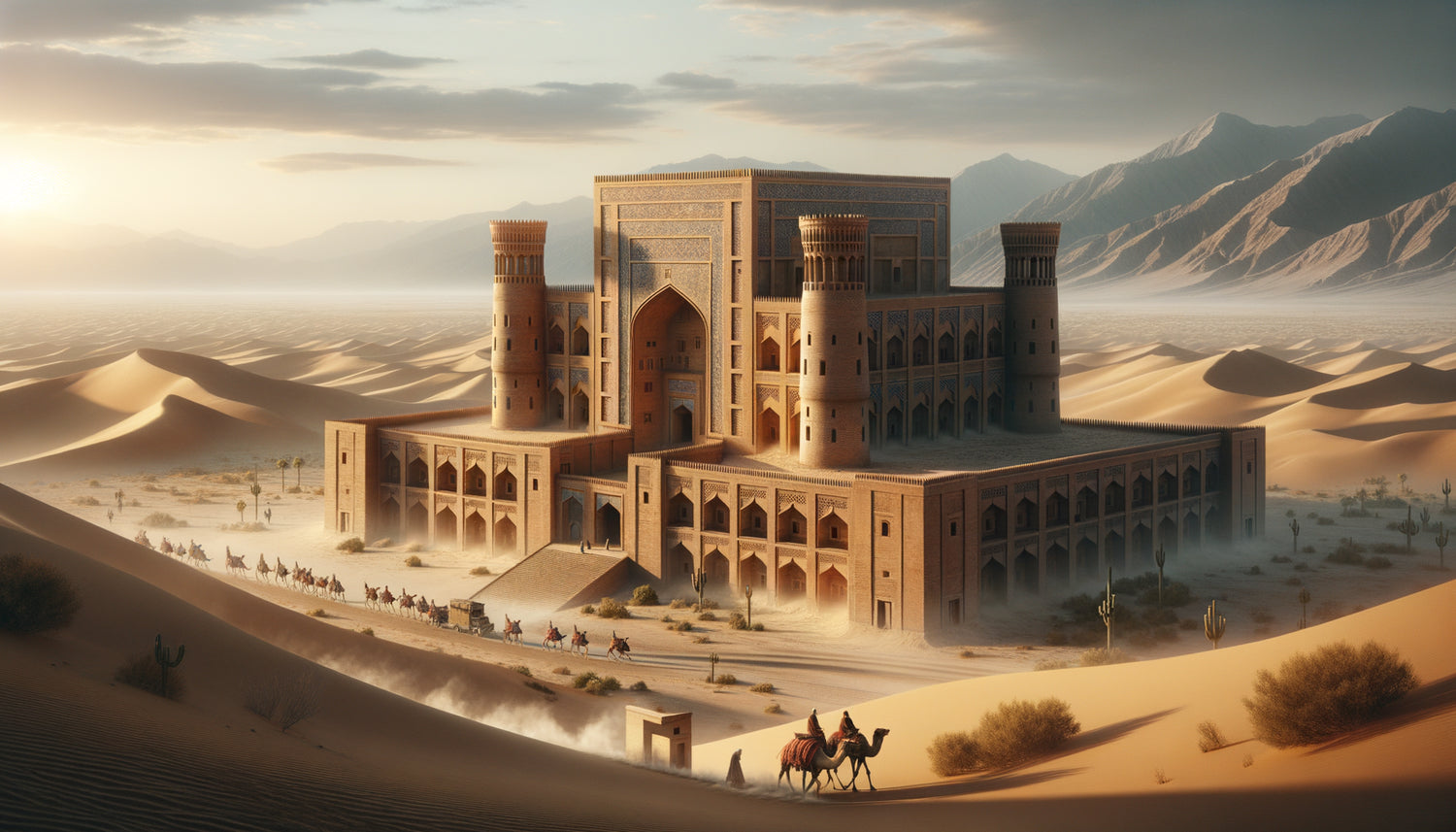
On the road linking Isfahan to Shiraz, Persian caravanserais rose like mineral fortresses in the heart of merciless desert landscapes. Their ocher rammed earth walls blended into the sandy expanses, creating a striking chromatic continuity. Builders exploited local soil to erect these monumental structures whose interior courtyards offered oases of coolness protected by thick walls.
Arid landscapes influenced every architectural detail: minimal openings limited the intrusion of the scorching sun, while central basins captured precious water and created refreshing microclimates. Persian artisans decorated the iwans (monumental portals) with turquoise and emerald blue tiles, rare colors in these monochromatic landscapes, offering exhausted travelers a comforting visual explosion. This artificial polychromy deliberately contrasted with the uniformity of the surrounding desert.
Caravanserais in the Dasht-e Kavir integrated badgirs, these traditional wind towers that channeled nocturnal breezes to naturally ventilate resting areas. Architecture thus intimately dialogued with the thermal cycles of the desert, transforming climatic constraints into avant-garde bioclimatic solutions. These commercial stops created architectural landscapes that seemed to emerge organically from the ground, as if the desert itself had shaped them.
The symphony of mountains: Caravanserais of Anatolia
In eastern Turkey, Anatolian caravanserais embraced radically different mountainous landscapes. Built from black volcanic stone along routes traversing the high plateaus, they reflected the geological harshness of their environment. The renowned Sultan Han near Kayseri perfectly illustrates this adaptation: its massive basalt walls rise like natural extensions of the surrounding rock formations.
These structures adopted pitched roofs to drain heavy rains and support winter snow loads, unlike the flat terraces of desert caravanserais. Monumental gates sculpted with complex geometric motifs created dramatic transitions between the wild exteriors and the organized inner courtyards. Seljuk artisans integrated stylized vegetal elements into their decorations, evoking the pine forests and alpine meadows traversed by the caravans.
The spatial organization also changed: mountain caravanserais often included semi-buried vaulted stables to protect animals from the biting cold, while living areas rose over several levels to maximize insulation. The steep landscapes also dictated their layout: these halts clung to slopes, offering strategic views of commercial valleys while protecting themselves from glacial winds.

Green oases: caravanserais of the fertile routes
Along the Persian Royal Road traversing the irrigated regions of Gilan and Mazandaran, caravanserais adopted a radically different aesthetic. Nestled in lush landscapes, these establishments integrated precious woods and abundant vegetation into their design. Inner courtyards transformed into paradisiacal gardens where palm trees, pomegranates, and roses created enchanting atmospheres.
These caravanserais of the fertile areas prioritized openness and transparency, with open galleries and mashrabiya allowing for constant natural ventilation. Materials varied spectacularly: glazed bricks, carved woods, delicate stucco replaced the raw stone of mountainous regions. The architecture celebrated the surrounding abundance rather than protecting itself from it.
Pools were no longer simple utilitarian reservoirs but sophisticated ornamental elements, fed by nearby rivers and embellished with fountains and decorative canals. The surrounding lush greenery inspired the abundant plant motifs that adorned the walls: climbing vines, slender cypresses, paradise birds. This profusion of decoration contrasted sharply with the mineral sobriety of desert caravanserais, proving that each trade route imprinted its distinctive landscape signature on architecture.
When steppes inspire horizontality
On trade routes crossing the vast Central Asian steppes, caravanserais adopted a resolutely horizontal morphology, embracing the infinite flatness of the landscape. These low structures, often built with fired bricks, stretched widely rather than vertically, creating architectural compositions that dialogued with the distant horizon.
The Uzbek and Turkmen caravanserais reflected this particular geography: their endless facades rhythmically punctuated by regular niches mimicked the undulations of grassy steppes. The absence of surrounding relief allowed for more sprawling plans, with vast courtyards capable of accommodating several caravans simultaneously. Multiple domes punctuating these roofs created a undulating skyline reminiscent of nomadic yurts scattered across the prairies.
The light of the steppes, particularly intense and changing, inspired sophisticated games of shadow: deep porticoes and shaded galleries offered refuge from constant glare. Builders used glazed bricks whose azure and turquoise reflections evoked the immense sky dominating these open landscapes. These caravanserais thus created essential visual anchors in territories lacking significant natural landmarks.

Cultural identity engraved in stone
Beyond geographical constraints, the landscapes of caravanserais translated the cultural identities of the territories traversed. On the maritime Silk Road, coastal caravanserais in the Eastern Mediterranean integrated Byzantine and Venetian influences: elegant arcades, marble columns, peristyle courtyards evoking Roman villas.
Syrian and Lebanese khans harmoniously married local limestone with multiple architectural influences, creating unique built landscapes. Their courtyards paved with geometric mosaics, their central fountains adorned with Kufic calligraphy, their facades alternating light and dark stone seats testified to a distinct cultural richness different from Persian or Anatolian caravanserais.
This architectural diversity also reflected the various dynasties controlling the routes: Safavid caravanserais differed radically from Seljuk or Ottoman structures. Each power imprinted its aesthetic mark, transforming these commercial stops into visible political manifestos. Travelers crossing several kingdoms read in the successive architectural landscapes the complex geopolitical history of the Silk Road.
The contemporary legacy: reinventing landscape harmony
This millennial adaptation of caravanserais to their landscapes offers valuable lessons for contemporary architecture. Designers are rediscovering these principles of contextual integration: use of local materials, dialogue with the climate, respect for the landscape scale. Several boutique hotels in the Middle East brilliantly reinterpret these ancestral codes.
In our modern interiors, this philosophy translates into a renewed attention to visual connections between interior spaces and exterior landscapes. Just as caravanserais created oases contrasting or harmonizing with their environment, we can design atmospheres that consciously dialogue with the views offered by our windows. An urban apartment can thus evoke an oasis of serenity in the mineral desert of the city.
The artistic representations of these historical architectures are experiencing a resurgence of interest. Collectors and decorators seek works capturing this harmony between built and landscape, those games of colors and textures that made caravanserais memorable visual landmarks on trade routes. These images inspire color palettes and spatial compositions resolutely contemporary but deeply rooted in a millennial architectural wisdom.
Let yourself be transported on the legendary Silk Road
Discover our exclusive collection of landscape paintings that capture the magic of distant horizons and transform your walls into windows on the extraordinary.
Create your own visual oasis
The teachings of historic caravanserais invite us to rethink our living spaces as personalized refuges, adapted to our immediate environment. Whether you live in a vertical metropolis, a verdant suburb or a coastal region, your interior can intentionally dialogue with its context, creating that same harmonious resonance that characterized the most beautiful trading stops.
Start by carefully observing the dominant colors of your daily landscape: stone tones, vegetal nuances, urban palette. Subtly integrate these shades into your decor to create a soothing visual continuity. If your environment lacks greenery, create a vivifying contrast with generous plant elements, as desert caravanserais transformed their courtyards into paradisiacal gardens.
Artistic representations of landscapes then become strategic escape routes, offering visual escapes to horizons complementary or contrasting with your daily life. A desert horizon in a humid urban interior, a majestic mountain in a plain apartment: these juxtapositions create a visual richness comparable to that experienced by merchants crossing changing landscapes.
Imagine yourself, in a few weeks, contemplating your transformed interior: each element harmoniously dialogues with your environment, creating that feeling of anchorage and escape simultaneously that caravanserais provided for weary travelers. You have created your own restorative stop, an aesthetic refuge that honors its context while opening windows to elsewhere. Start today by identifying the landscape essence of your place of life, then let this knowledge guide your decorative choices towards a deep and inspiring coherence.