The first time I contemplated a Song painting scroll at the Guimet Museum, I thought it was an error. These majestic mountains floated in an ocean of white. No frame, no background, just... emptiness. My gaze desperately sought to fill these spaces, before understanding that they were the work itself.
Here's what those empty areas bring to mountain landscapes: a breath that invites meditation, a depth that transcends Western perspective, and an age-old wisdom that transforms absence into presence.
You may admire these Chinese prints in decorating magazines, fascinated by their minimalist elegance. But this intimidating white seems inaccessible to you, almost unsettling in its austerity. How can emptiness create so much emotion? Why did these painters refuse to fill their canvases as our Western masters did?
Rest assured: this apparent simplicity hides a profound but accessible philosophy. By understanding the meaning of these spaces, you will discover an approach to art and life that can transform your view of beauty. I invite you on a journey into the universe of shan shui, where emptiness becomes the silent master of composition.
Qi, the vital breath that inhabits the void
In classical Chinese thought, emptiness is never an absence. The painters of the Tang and Song dynasties did not leave white areas due to negligence or lack of pigments. They invited the qi – this vital breath that animates all things – to circulate freely in their mountain landscapes.
Imagine these spaces as the lungs of the composition. Without them, the mountains would suffocate in their own density. The master painter Guo Xi, in the 11th century, explained that mountains must breathe to live on paper. These empty areas are therefore reservoirs of energy, spaces where the gaze can rest before resuming its ascent towards the summits.
This conception overturns our Western habit of saturating pictorial space. Where a European painter would have added detailed clouds, a worked sky or an architectural background, the Chinese painter offers white. But this white vibrates with a paradoxical presence: it suggests morning mist, the infinity of the sky, the immeasurable distance between peaks. It becomes simultaneously fog, light and eternity.
The art of suggesting rather than showing
The empty areas in Chinese mountain landscapes embody a fundamental aesthetic principle: suggestion always surpasses demonstration. Literati painters, often also poets and calligraphers, mastered the art of allusion.
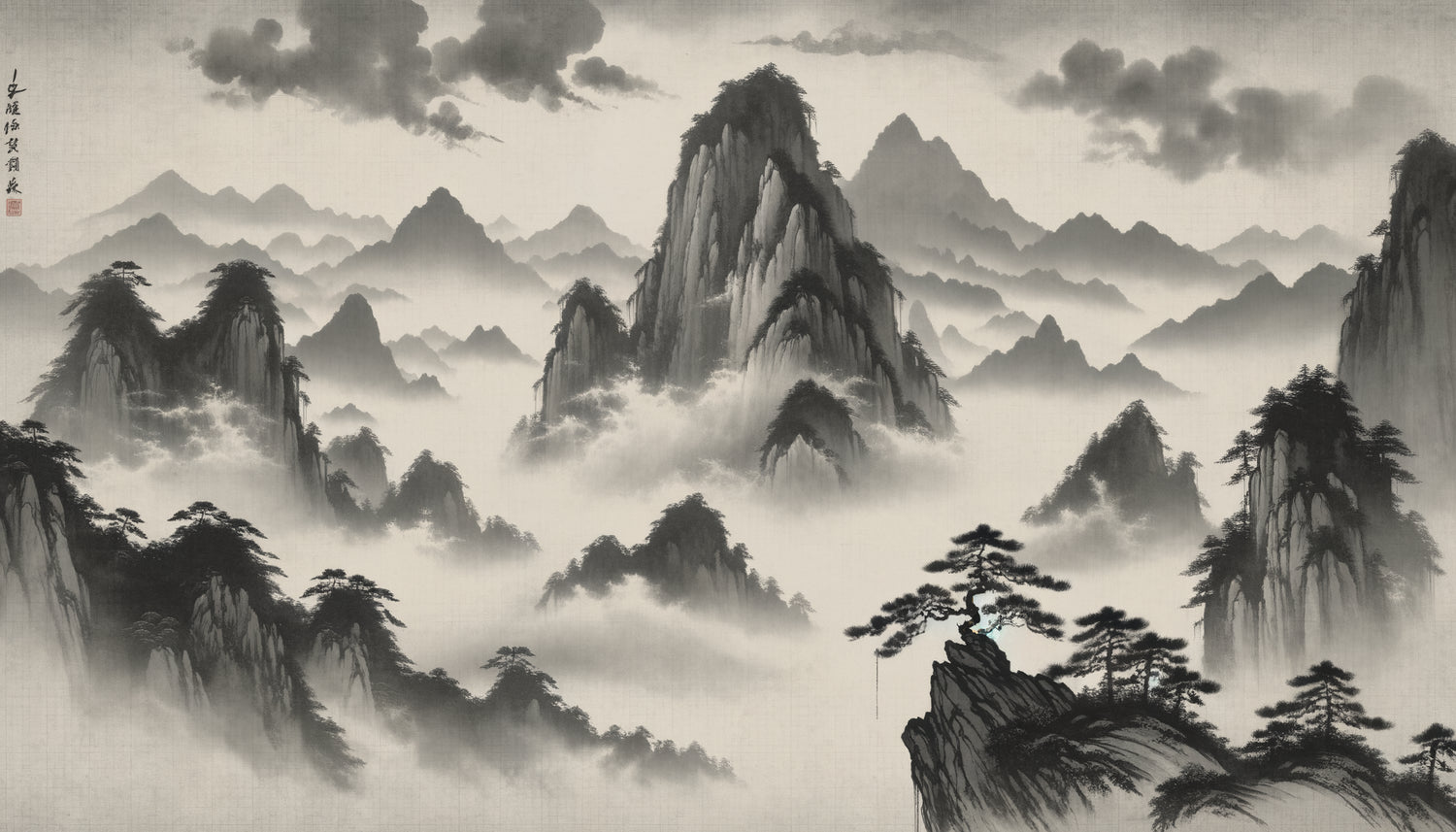
Take a horizontal scroll depicting a mountain range. You may see three or four massifs emerging from the white, separated by vast blank areas. These spaces are not intervals to be filled mentally – they are real distances, deep valleys, kilometers of mist. The painter invites you to feel the immensity rather than measure it with your gaze.
This approach reflects the Taoist philosophy of wu wei, action by non-action. By doing less, the artist accomplishes more. Each ink stroke gains power precisely because it emerges from emptiness. Mountains become majestic not despite the white that surrounds them, but thanks to it.
The role of the viewer as co-creator
These empty spaces challenge you because they require your participation. Unlike a Western painting that firmly guides your eye along a predefined path, the Chinese mountain landscape offers you dizzying freedom. Your imagination must bridge these white chasms, mentally construct bridges between rocky islets.
You thus become a co-creator of the work. Each contemplation generates a slightly different landscape, depending on your mood, your experience, your inner state. It is precisely this openness that fascinates contemporary decor enthusiasts today: these works breathe with you, evolve with daylight, never impose themselves but constantly dialogue.

The three distances and atmospheric perspective
Guo Xi theorized in his treatise Linquan gaozhi the three distances that structure any successful mountain landscape: the high distance (from the bottom of the mountain to its summit), the deep distance (from the foreground to the background), and the flat distance (from one side of a mountain to another).
Empty spaces are essential for creating these three dimensions. Without them, it is impossible to differentiate the planes, to suggest atmospheric depth. The white gradually becomes mist, and this mist eats away at contours, softens details, creates that sense of distance that our eyes instinctively recognize.
Observe how the nearby mountains are rendered with dark and precise ink strokes, while those in the background barely emerge from the white, almost ghostly. This subtle gradation, impossible without emptiness, creates a depth that Western geometric perspective sometimes struggles to equal in poetry.
When emptiness becomes spiritual contemplation
For Buddhist and Taoist literati painters, these white spaces in mountain landscapes carried a profound meditative dimension. The void represents the wuji, the primordial state from which all creation emerges, or Buddhist śūnyatā, this emptiness that is not nothingness but infinite potential.
Painting a mountain landscape with vast empty areas was therefore as much a spiritual act as an artistic one. The artist was not simply representing a geographical location – they were creating a space for meditation, a support for inner contemplation. These works were often unfurled in private, during moments of withdrawal from the world, accompanied by tea and poetry.
This dimension explains why these paintings retain their soothing power today. In our interiors saturated with visual information, a landscape painting
The influence on Japanese aesthetics
This philosophy of emptiness has profoundly influenced Japanese art, giving rise to the concept of ma, this interval charged with meaning. The prints of Hokusai or Hiroshige, which you probably know, directly inherit from this Chinese tradition. Mount Fuji emerging from a sea of white mist perpetuates this celebration of the unpainted.

Integrating this wisdom into your contemporary decor
Understanding these empty areas transforms your approach to interior decoration. A landscape painting
In a modern living room, these mountain landscapes with large white beaches play an architectural role. They aerate the space without weighing it down, bring depth without cluttering the walls. Unlike saturated works that capture attention, they create a resting point for the eye, a visual silence that enhances the rest of your decor.
Choose a strategic location: above a sleek sofa, facing your desk for contemplative breaks, or in a bedroom where their serenity will promote sleep. These works dialogue wonderfully with a minimalist contemporary aesthetic, but also bring a touch of timeless elegance to more eclectic interiors.
Harmonize with your color palette
The neutral tones of these mountain landscapes – deep blacks of ink, subtle grays of washes, bright whites of the paper – blend with any palette. They bring a discreet sophistication that never rivals your color choices, but enhances them with elegance.
Give your walls the breath they deserve
Discover our exclusive collection of landscape paintings that capture this timeless elegance of inhabited emptiness.
Emptiness as a signature of excellence
Knowing how to leave space required extraordinary mastery. Each ink stroke became definitive on the absorbent traditional paper – impossible to correct, overlay, or hide an error. The empty areas paradoxically testified to the painter's virtuosity: only a master could afford this economy of means.
This technical constraint joined the aesthetic ideal. As an artist progressed in their practice, their compositions became more refined. Young painters filled their mountain landscapes with meticulous details; venerable masters suggested an entire universe with a few strokes and plenty of white.
This progression towards simplicity strangely resonates with our time. After decades of maximalist decor, we are rediscovering the power of austerity. These millennial mountain landscapes teach us that elegance and restraint are inseparable.
The white surrounding the Chinese mountains is therefore never a passive void. It is an active, vibrant, essential space to the composition. It carries the vital breath, suggests infinity, invites meditation and testifies to the artist's mastery. By understanding this philosophy, you will never look at these works the same way again – and perhaps even your own interior differently.
These white spaces remind us of a truth that our saturated era too often forgets: sometimes what we choose not to say, not to show, not to fill, carries more meaning than any accumulation. In your home as in art, emptiness deserves its place of honor.
Let these silent mountains teach you their millennial wisdom. Welcome the void not as an absence, but as a subtle presence that will transform your relationship with space, beauty, and the essential.