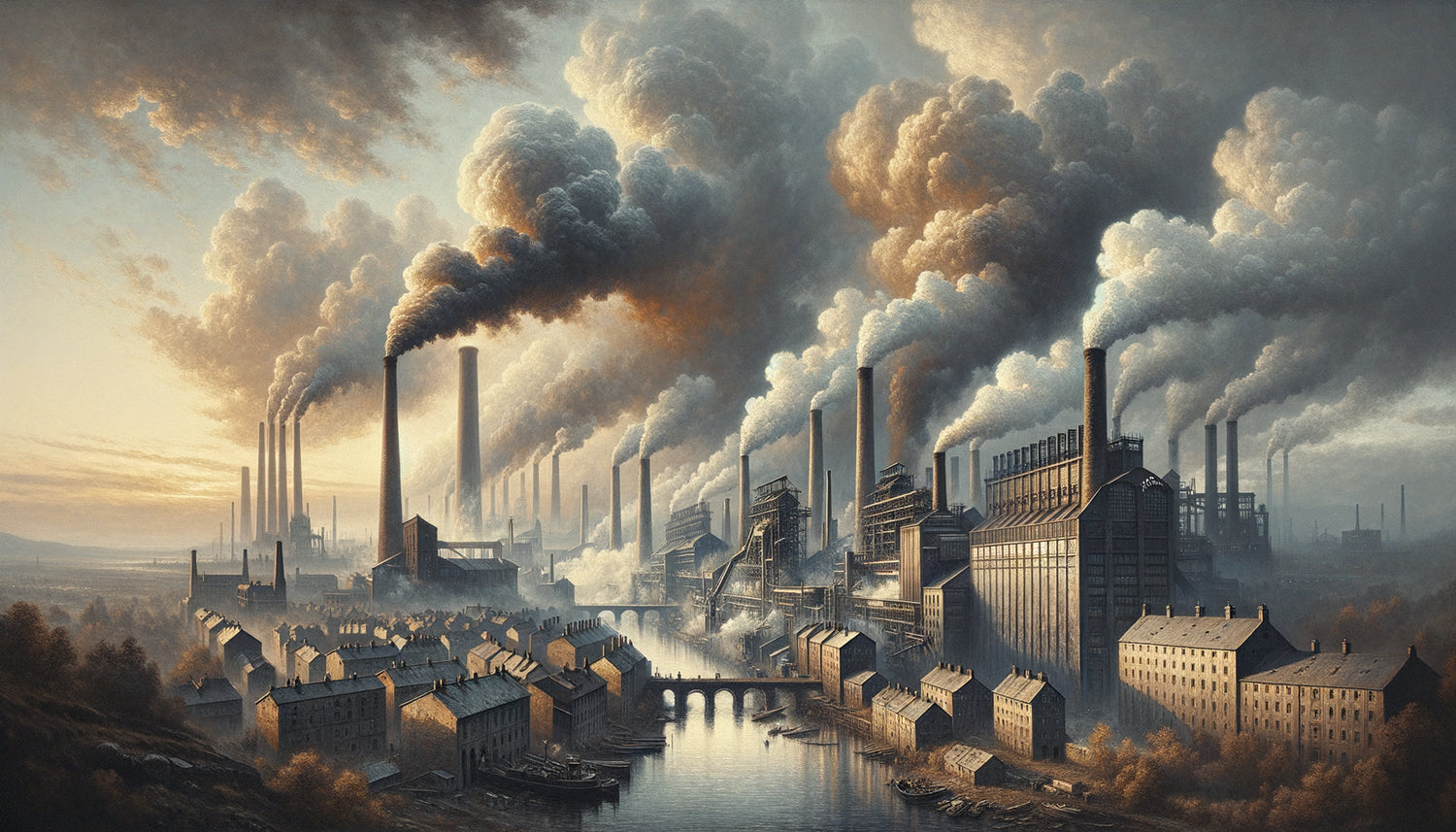
One foggy evening in London, in 1859, an art critic named John Ruskin stopped dead in his tracks before a canvas that revolted him. Chimneys belching black smoke, gloomy factories, a leaden sky. How dare one call this art? Yet, this aesthetic revolution would forever transform our way of looking at the modern world. Industrial landscapes – these imposing chimneys, these titanic factories, these halos of smoke – entered the history of art not in silence, but in a whirlwind of controversy and fascination. Today, these works vibrate with authenticity and unexpected poetry in our contemporary interiors.
Here's what these industrial landscapes bring to your world: a historical depth that tells the story of human endeavor, a powerful aesthetic that magnifies contrasts, and an emotional connection with the transformation of the world. Are you perhaps looking to infuse your interior with this creative tension between nature and progress? Do you wonder how factory chimneys could become artistic icons? Rest assured: this fascinating story reveals how artists have managed to transform industrial chaos into timeless beauty. I promise you that by the end of this article, you will never look at a chimney in the same way again.
The 1760 Revolution: When Smoke Became an Artistic Subject
It all begins in the British Midlands, at the heart of the Industrial Revolution. Before 1760, painted landscapes exclusively celebrated idyllic nature, romantic ruins, pastoral countryside. But when the first textile factories emerge in Manchester and Birmingham, a few pioneering artists dare the unthinkable: they point their brushes towards these brick cathedrals.
Joseph Wright of Derby becomes the first visionary to capture this mutation. In 1780, his painting An Iron Forge captures the orange glow of a forge, the sweat of the workers, the palpable heat of molten metal. This is not yet an urban industrial landscape, but the seed has been planted. Wright intuitively understands that these production sites possess a dramatic, almost theatrical beauty, with their contrasts of light and their raw power.
Factories gradually become monuments worthy of being immortalized. Chimneys, symbols of economic prosperity, begin to punctuate the horizon of canvases. This period marks a fundamental shift: art no longer turns away from industrial modernity, it confronts it.
The 1830s-1850s: The Golden Age of Industrial Sublime
Let's fast forward a few decades. The 1830s saw an explosion in the representation of industrial landscapes. Why this specific moment? Because industrialization reaches its peak in England, and artists realize that they are witnessing an unprecedented historical transformation.
J.M.W. Turner, the undisputed master of British Romanticism, painted his revolutionary work Rain, Steam and Speed in 1844. A train rushing through fog, a locomotive spewing steam, a metal bridge spanning the Thames. Turner does not naively glorify progress; he captures its dizzying energy, its devouring speed. His factory chimneys and smoke become atmospheric elements as poetic as clouds.
At the same time, lesser-known artists meticulously document factories. John Wilson Carmichael paints the docks of Newcastle with their forests of chimneys. William Wyld immortalizes Manchester in 1851, a city transformed into an industrial metropolis where textile mills dominate every neighborhood. These canvases serve as valuable testimonies: they show how factory chimneys literally redraw urban silhouettes.
The social dimension of the industrial landscape
What distinguishes this period is a growing social awareness. Artists no longer paint chimneys simply as technical curiosities. They incorporate working-class neighborhoods, pollution, and living conditions. The industrial landscape becomes a commentary on modern society, with its promises and disillusionments.

French Impressionism: manufacture becomes light
When industrialization crosses the Channel, French artists adopt a radically different approach. For the Impressionists of the 1870s-1890s, factories and manufactures are not social symbols but laboratories of light.
Claude Monet paints in 1875 his series on Coal Loaders, where the chimneys of industrial barges are reflected in the Seine. But it is especially in 1877, with his series on the Gare Saint-Lazare, that he revolutionizes the genre. The smoke from locomotives becomes translucent sails, the metal structures cathedrals of modernity. Monet transforms industrial steam into pictorial, almost abstract matter.
Camille Pissarro continues this exploration with his views of Rouen in the 1890s. His canvases show factory chimneys rising between Gothic steeples, creating a fascinating temporal superposition. The industrial landscape becomes for him a palimpsest where several eras coexist.
This French approach marks a major aesthetic turning point: the industrial landscape is no longer documentary or critical, but becomes a pretext for exploring color, light, and atmosphere. Chimneys are neither ugly nor beautiful; they simply exist, an integral part of the visible world.
The 20th Century: From Critique to Nostalgia
The early 20th century saw the emergence of a darker vision of manufactories and factories. German expressionists like Ludwig Meidner painted apocalyptic, prophetic industrial landscapes of World War I. Chimneys become menacing towers, smoke a harbinger of destruction.
But paradoxically, from the 1920s-1930s, a certain nostalgia set in. American Precisionists like Charles Sheeler celebrated the functional aesthetics of Ford factories. Their industrial landscapes resemble geometric symphonies, where each chimney and building finds its place in a rigorous composition.
Today, as deindustrialization transforms our territories, historic industrial landscapes acquire a heritage dimension. Former factories become sought-after lofts, chimneys protected urban landmarks. Art has played a crucial role in this aesthetic reevaluation: by teaching us to see beauty in these structures, artists have preserved our collective memory.

Why Incorporate These Industrial Landscapes into Your Decor Today
This fascinating story explains why industrial landscapes resonate so powerfully in our contemporary interiors. A reproduction of a Turner with its smoking chimneys brings an incomparable narrative depth. These works tell of human ambition, the transformation of the world, and the price of progress.
In a loft industrial space, obviously, these canvases create perfect stylistic coherence. Metal beams and exposed brick naturally dialogue with painted factories. But their power goes far beyond that: in a minimalist interior, an 19th-century industrial landscape creates a dramatic focal point, anchoring the space in a rich temporality.
Factory chimneys, with their imposing verticality, visually structure a wall composition. They guide the eye, create guidelines, and give height to a room. And their palette – these grays, browns, and ochres – harmonizes perfectly with current trends in natural interior design.
The raw emotion of authenticity
What touches deeply is the authenticity of these scenes. Unlike idealized rural landscapes, industrial landscapes bear the mark of experience, sweat, and labor. They honor the memory of workers, celebrate technical ingenuity, and question our relationship with nature. In an increasingly smoothed-out world, this emotional roughness feels good.
Transform your space with the soul of landscapes that shaped our modern world
Discover our exclusive collection of landscape paintings that capture the power and poetry of the industrial revolution to infuse character and depth into your interior.
The timeless lesson of painted chimneys
This artistic epic teaches us something fundamental: beauty is not a matter of subject, but of perspective. The first artists who turned their brushes towards factories were mocked, criticized, and rejected. Today, their works are displayed in the most important museums and inspire our most sophisticated interiors.
Industrial landscapes remind us that every era leaves visual traces worthy of preservation and celebration. The factory chimneys of the 19th century speak to us as much as medieval cathedrals spoke to the romantics. They embody our collective ability to transform the world, for better or worse.
By hanging such a landscape in your home, you are not simply decorating a wall. You take a position on what it means to be modern, you recognize the complexity of our heritage, and you celebrate the courage of artists who dared to see differently. Look at the chimneys rising into the painted sky, let their smoke tell you forgotten stories, and feel your space fill with this vibrant memory. The industrial landscape awaits you to reveal its unsuspected poetry.