In the dim light of an auction room, I once observed two collectors fiercely arguing over the attribution of a 16th-century landscape. One swore it was a work painted outdoors, the other saw it as a copy of a Flemish print. I have relived this scene dozens of times in my career as a curator. Distinguishing a landscape copied from a print from a landscape painted on location in the 16th century is more than just an expert's curiosity: it is the key to understanding the value, authenticity, and very soul of a work. Here’s what this distinction brings: it reveals the artist’s creative process, guarantees the authenticity of your acquisition, and transforms your view of Renaissance art. Many passionate enthusiasts feel overwhelmed by these technical subtleties, fearing they will miss the essential or make mistakes in their judgments. Rest assured: with a few precise guidelines and an attentive eye to the details that I am going to share with you, you will be able to decode these clues that old masters have left in their compositions. I promise you that at the end of this reading, you will never look at a 16th-century landscape the same way again.
The invisible signatures of working on location
A landscape painted on location carries an irreplaceable spontaneity. The artist who settles down facing nature captures details that no engraver can convey through a print. First, look at the light: in a work painted outdoors, it has a particular atmospheric coherence. Shadows follow a single direction, contrasts reflect a specific moment of the day. I have learned to spot this luminous unity that runs throughout the composition, from the foreground to the horizon. Color variations are a second major clue. Facing the real landscape, the painter observes infinite nuances: that blue-green of foliage in the morning light, that grey-mauve of distant mountains. These colorful subtleties disappear in the black and white translation of the print, then are often lost during coloring after engraving. Finally, observe the accidents of the terrain: a rock with irregular shapes, a tree twisted by the winds, a path that meanders in an apparently illogical way. These 'imperfect' details betray direct observation, where copying from a print tends to regularize, idealize forms.
When the print dictates its geometry
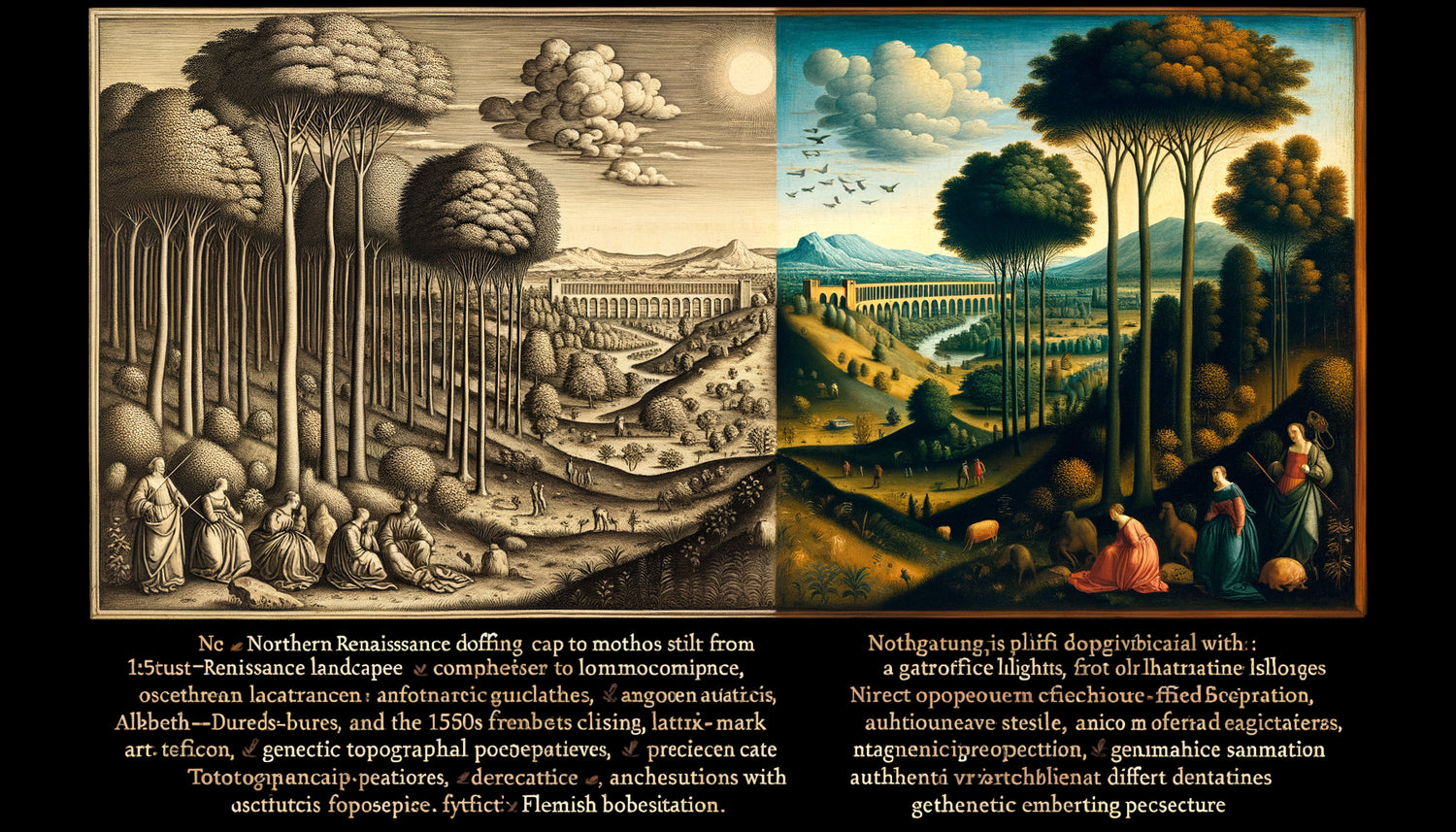
A landscape copied from a print reveals a completely different genesis. The engraving imposes its technical constraints: parallel lines, cross-hatching, areas of black and white sharply contrasted. Even when a talented painter transposes these engravings into paint, some habits persist. I have noticed that the composition in these works often presents a very structured structure: a repoussoir tree perfectly placed on the left, a luminous escape in the center, clearly defined successive planes. This organization, inherited from Flemish and German prints, creates landscapes of undeniable elegance but also of a certain rigidity. The repetitive details are a decisive clue. In the engravings circulating in the 16th century, some motifs become standardized: these small houses with pointed roofs, these groups of stylized trees, these rocks piled up in a characteristic way. When you find these elements in a painting, reproduced almost identically, you have proof that the artist worked from an engraved source. The linear treatment also persists: even translated into paint, the copied landscape retains a predominance of line, emphasized contours, where painting on the spot favors masses, volumes, soft transitions.
The most copied source prints
In the 16th century, some series of engravings experienced extraordinary diffusion. The landscapes of Albrecht Altdorfer, the alpine views of the Master with Monogram, the compositions of Pieter Bruegel the Elder circulate in all European workshops. These engravings become models, copied, adapted, combined. Recognizing these sources makes it possible to immediately identify a landscape copied. Over the years, I have created a real mental library of these matrix compositions, which allows me, in seconds, to spot a lineage.

The pictorial material reveals everything
Approach the artwork, scrutinize the painted surface. This step is crucial to distinguish a copied landscape from one painted on location. In an outdoor painting, the brushstroke often bears the marks of a certain urgency. The artist works quickly, the light changes, the wind blows. Brushstrokes can be freer, less refined than in the studio. Of course, in the 16th century, this spontaneity remains relative – we are not yet in the Impressionist era! – but it exists. Look particularly at the skies: in a landscape painted on location, clouds exhibit a diversity of shapes and densities that reflects real observation. In a print copy, clouds often follow conventional formulas, repeating learned patterns. The material itself can differ: an artist working from a print has all the time in the world, can multiply glazes, refine every detail. The result is often smoother, more 'finished'. Conversely, some areas of a landscape painted on location may seem less accomplished, almost sketched, because the artist had to adapt to external conditions.
Geographic clues never lie
The actual topography versus invented topography: this is a determining criterion. When an artist paints on location, they represent a specific place with its geological, botanical, and architectural peculiarities. Even stylized according to the conventions of the time, these characteristics remain identifiable. I have been able to authenticate several landscapes by finding the exact site represented, sometimes thanks to a distinctive rock formation or a particular church steeple. On the other hand, a landscape copied from a print often presents a composite geography, impossible. The artist assembles elements borrowed from different engravings: Alpine mountains in the background, a Rhine castle in the middle, Mediterranean trees in the foreground. The result is picturesque but geographically inconsistent. This hybridization was also sought after: it created 'ideal' landscapes, more beautiful than nature, corresponding to the taste of the time. Also examine the vegetation: an artist painting on location represents local species with a certain fidelity. In a print copy, trees become generic, impossible to identify botanically.

The sense of composition reveals the origin
Spatial depth is constructed differently depending on whether the artist works from nature or after a print. Faced with the real landscape, the painter perceives the succession of planes in an organic, natural way. This perception shines through in the work: the transition between different planes occurs smoothly, and overlaps are subtle. In a landscape copied from a print, depth results from a more intellectual, almost schematic construction: dark foreground with repoussoir, middle ground illuminated, background paler. This formula, inherited from treatises on perspective and learned prints, works wonderfully but lacks the variety observed in nature. Proportions also deserve attention. A print, especially reproduced and recopied, can undergo deformations. A landscape painted after such a source sometimes presents strange scale relationships: a character too tall for the house he is next to, a bridge disproportionate to the river it spans. These inconsistencies, which a trained eye immediately recognizes, signal work after engraving.
The presence of humans as a revealer
Observe the characters and animals: in 16th century prints, they often follow standardized types, conventional poses. When you find exactly the same figures in a painting – this traveler seen from behind with his stick, these washerwomen bent over the river – you identify a copy. Conversely, in an on-site landscape, even if characters are added later in the studio, their integration into the environment seems more natural, less stereotyped.
Dive into the fascinating world of ancient landscapes
Discover our exclusive collection of landscape paintings that capture the essence of pictorial tradition and will transform your interior into an art gallery.
Summary: develop your expert eye
Distinguishing a landscape copied from a print from a landscape painted on the spot in the 16th century requires cross-referencing several clues. No criterion taken in isolation is absolutely decisive, but their convergence draws a faithful portrait. Always start with the overall impression: does the work convey atmospheric coherence, a unity of light? Or does it present that somewhat rigid elegance of constructed compositions? Then examine the details: look for repetitive elements, standardized patterns, conventional formulas that betray the print source. Do not forget the material: texture, touch, degree of finish speak to the creative process. Question the geography: could this landscape actually exist or is it the result of a fanciful assembly? Over time, these analyses will become intuitive. You will develop what I call 'the eye of the curator': this ability to perceive in seconds the origin of a work. This expertise greatly enriches your pleasure as a collector or enthusiast. It also helps you savor the particular beauty of landscapes copied from prints, true exercises in technical virtuosity, reflections of the circulation of images in Renaissance Europe.
Frequently Asked Questions
Does a landscape copied from a print have less value than a landscape painted on the spot?
This is a question I am constantly asked, and the answer is more nuanced than it appears. In the 16th century, copying prints was a perfectly legitimate practice, taught in workshops. Some paintings after engravings, executed by great masters, possess considerable artistic and commercial value. The difference lies mainly in rarity: landscapes painted on the spot are exceptional at this time, therefore particularly sought after. But a magnificent landscape copied from a print by a talented artist deserves all your respect and admiration. The essential thing is to know exactly what you are looking at or acquiring. Transparency about the origin of the work guarantees a fair and informed appreciation.
Can you really identify the source print of a landscape copied?
Yes, absolutely, and it's even one of the most exciting aspects of this research! Thanks to the formidable digital databases developed in recent years, it is becoming increasingly easy to find the original prints. I myself have solved puzzles that have bothered me for years by suddenly discovering, on an online catalog, the exact engraving that served as a model for a painting. This identification completely transforms our understanding of the work: it reveals the liberties taken by the painter, his personal additions, his creativity in adaptation. It also informs us about the networks of image circulation and artistic exchanges between regions. Finding the original print is reconstructing an entire chain of cultural transmission.
Could an artist combine working from nature and using prints?
Excellent question that shows a real understanding of artistic practices! Yes, many 16th century painters adopted a hybrid approach. They could sketch from nature certain elements – a particularly picturesque group of trees, an interesting rock formation – then, back in the studio, complete their composition by borrowing motifs from prints. This method allowed them to create landscapes that were both rooted in real observation and enriched by iconographic tradition. For the expert, these hybrid works are the most delicate to analyze: they present areas of great spontaneity alongside more conventional passages. It is precisely this that makes them fascinating: they embody the complexity of artistic creation, this permanent dialogue between direct observation and shared visual culture.