I felt that vertigo for the first time in the cold gallery of the museum – that feeling of being suspended between heaven and earth before a thousand-year-old ink scroll. The mountains rose from the mist, immense, overwhelming, yet with an almost immaterial lightness. For fifteen years I have been traveling between Beijing and Paris to build up collections of Asian art, and this fascination has never waned. Mountain landscape paintings from the Song dynasty (960-1279) exert a magnetic, inexplicable attraction on contemporary collectors and interior decorators.
Here's what these Song Dynasty mountain landscapes bring to our modern interiors: a contemplative depth that slows down time, a dramatic verticality that structures space, and a mineral poetry that instantly soothes. Three rare qualities in our world saturated with images.
Many hesitate to incorporate these works into their decoration. Too austere? Too culturally distant? Difficult to harmonize with Western furniture? I understand these reservations. But it would be missing out on one of the most sophisticated pictorial traditions in history, whose modernity still speaks intimately to us today.
The truth is that understanding why Song artists obsessively painted mountains completely transforms our relationship to these works. And above all, it gives us the keys to integrate them properly into our contemporary living spaces.
The Song Empire: when the mountain becomes philosophy
To grasp the dominance of mountain landscapes in Song painting, one must first understand the political and spiritual context of this extraordinary era. The Song dynasty represents a golden age of culture in China, marked by a class of scholar-officials of unparalleled sophistication.
These scholar-officials – erudite bureaucrats, poets, and painters – cultivated a worldview deeply imbued with Neo-Confucian philosophy and Taoist principles. For them, the mountain was not simply a decorative element. It embodied the cosmic principle li, that fundamental structure which organizes the universe.
Painting mountains was therefore much more than an aesthetic exercise. It was a form of meditation on natural order, a spiritual quest to understand one's place in the cosmos. The dizzying peaks, the misty valleys, the tumultuous waterfalls: each element participated in a sophisticated visual cosmology.
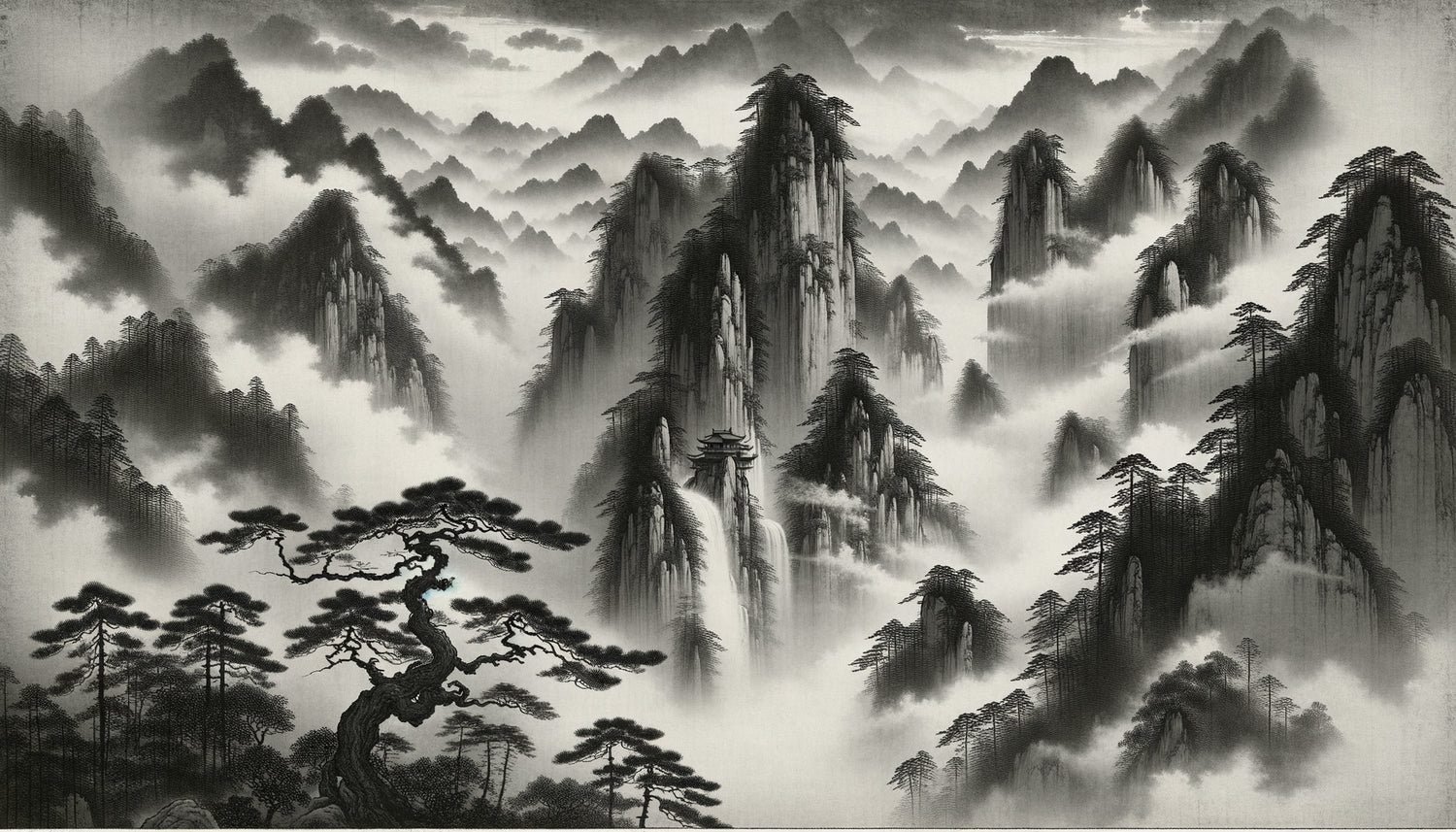
I have had the chance to examine original scrolls in the reserves of the Taipei Palace Museum. What immediately strikes you is the crushing verticality of these compositions. The mountains sometimes occupy 80% of the painted surface, relegating human dwellings to tiny, fragile presences. This visual hierarchy is not accidental: it translates the Song conception of man facing the immensity of nature.
The three aesthetic reasons for this mountainous obsession
The mountain as the perfect compositional structure
Masters of the Song dynasty such as Fan Kuan, Guo Xi or Li Tang understood that mountain landscapes offered infinite compositional possibilities. The mountain allows to create successive planes which guide the eye through the pictorial space: a rock in the foreground, a misty valley in the middle, distant peaks merging into the sky.
This technique, called sanceng (three distances), structures the painting in depth without resorting to Western linear perspective. The result? Compositions of architectural sophistication that work wonderfully in our contemporary interiors, creating visual windows onto infinity.
Ink and stone: a sublime technical alliance
The mineral textures of the mountains allowed Song painters to fully exploit the possibilities of Chinese ink and brush. Techniques of strokes (cun) specifically developed to render rock formations – rat's tail, hemp fiber, axe stroke – represent major pictorial innovations.
Each type of mountain required its own technique. The granite peaks of the North needed angular and vigorous strokes. The eroded hills of the South called for softer and more sinuous touches. This technical diversity made the mountain landscape an unparalleled field of aesthetic experimentation.
Mist: an essential dramatic element
Observe any Song mountain landscape painting carefully: you will notice that mist and clouds occupy almost as much space as the mountains themselves. These empty areas (liu bai, literally 'leaving white') are not absences but active presences.
Mist created this mysterious atmosphere, this yi jing (kingdom beyond the visible) that Song painters sought. It allowed to suggest immensity rather than show everything, inviting imagination to complete what the eye only sees halfway. It is precisely this restraint, this economy of means, that gives Song mountain landscapes their contemplative power.

When landscape becomes spiritual portrait
Here’s something few people realize: for the Song literati, painting a mountain landscape was a form of spiritual self-portrait. Each artist developed their own 'mountain style,' instantly recognizable.
The mountains of Guo Xi, with their organic forms and swirling clouds, reflected his dynamic vision of nature as a living organism. The monumental compositions of Fan Kuan, crushing in austere majesty, translated his solitary personality and rigorous Taoist practice. Li Tang, court painter then hermit after the fall of the North, developed an angular, almost aggressive mountain style that expressed the traumatic rupture of his time.
This autobiographical dimension transforms each mountain landscape painting into a personal statement. That’s why these works still resonate today: they are not simply representations of nature, but pictorial meditations on human existence in the face of immensity.
The Song legacy in our contemporary interiors
Fifteen years of advising collectors has taught me one thing: Song-inspired mountain landscapes work exceptionally well in contemporary minimalist interiors. Their dramatic verticality, their restricted palette (ink nuances, subtle touches of color), their airy composition: all naturally dialogue with modern aesthetics.
I’ve seen large-format reproductions of Fan Kuan's 'Travelers Among Mountains and Rivers' transform industrial lofts into contemplative spaces. The monumental scale of these mountain landscapes – the original scrolls are often more than two meters high – imposes an architectural presence that visually structures space.
The secret? Treat these works not as mere decorations, but as visual and spiritual anchors. A Song mountain landscape needs space around it, clean walls that allow its composition to breathe. It naturally creates a zone of calm, an invitation to slow contemplation that slows the frenetic pace of our urban lives.
The most discerning interior designers have understood this: these millennial mountain landscapes are surprisingly modern. Their relative abstraction, their sophisticated play between full and empty, their rejection of decorative overload anticipate the principles of contemporary design by centuries.
Want to bring this monumental serenity into your home?
Discover our exclusive collection of landscape paintings that captures the contemplative spirit of the Song masters in compositions adapted to modern interiors.

How to View a Song Mountain Landscape
Let me share a technique taught to me by a curator at the Guimet Museum: to truly see a Song mountain landscape, you must abandon our Western way of looking.
Don't try to grasp the whole scene at once. These paintings were designed to be 'traveled' slowly, as one does on a mental hike. Start at the bottom of the scroll, where there is often a stream or path. Follow it with your eye, let your gaze gradually climb through successive planes, stopping in isolated pavilions, getting lost in the mists, then rising towards the peaks.
This temporal experience of painting – a visual journey rather than a fixed image – explains why Song mountain landscapes work so well in everyday living spaces. They never run their course. Each look reveals new details: a tiny bridge, a solitary tree clinging to the cliff, the texture of an eroded rock.
This is also why these works harmonize perfectly with a slow lifestyle. In a world that constantly accelerates, having at home a mountain landscape that requires – and rewards – slow attention becomes a rare luxury.
Beyond Decoration: Living with the Mountains
After all these years spent studying and collecting these works, I realize that Song mountain landscapes dominated their era for a fundamental reason: they offered urban scholars a spiritual refuge from the constraints of social and political life.
These sophisticated bureaucrats spent their days in court intrigues, imperial examinations, protocol obligations. The mountains represented an impossible escape – those hermitages in misty peaks where they dreamed of retiring to cultivate their inner garden.
Isn't that exactly what we need today? Faced with our hyper-connected, overscheduled, constantly solicited lives, these millennial mountain landscapes offer the same promise of contemplative retreat. No need to actually go into the mountains: the work creates this mental space for rejuvenation in your home.
That is why I continue to recommend these mountain landscapes to my most stressed clients, those who live in urban apartments with no view of nature. A quality reproduction of a Song scroll, installed facing their workspace or in their bedroom, becomes a meditative window they can open at will.
Conclusion: The Everlasting Relevance of Song Mountains
Mountain landscapes dominate Song Chinese painting because they perfectly embodied the worldview of a civilization at its cultural peak – a vision that sought harmony between humanity and the cosmos, that valued contemplation over action, that found in the wilderness a mirror of the human soul.
A thousand years later, these mountains have lost none of their power. They invite us to slow down, to truly look, to rediscover this capacity for wonder before the immensity that escapes us in our busy lives. Choosing a Song-inspired mountain landscape for your interior is more than just a decorative choice: it's installing within your home a daily call to depth.
Start simply. Find a reproduction that speaks to you – not the one that will impress your guests, but the one before which your gaze naturally stops. Give it a clean wall. And let these millennial mountains slowly do their work in your space and your mind.
FAQ : Your questions about Song mountain landscapes
Are Song mountain landscapes too austere for a warm interior?
This is a concern I often hear, and I understand it. At first glance, these ink wash paintings may seem cold or severe. But in reality, their apparent austerity creates a sophisticated contrast with warm materials like wood, linen, or wool. I have seen cozy Scandinavian interiors enhanced by a large Song mountain landscape above a velvet sofa. The secret? Let the work breathe in a clean environment, then warm the space with natural textures and soft lighting. The austerity of the mountain then becomes a visual anchor that enhances the warmth of other elements rather than contradicting it. Think of it as a moment of musical silence in a melody: it is what gives full value to the warm notes surrounding it.
Do you need to know Chinese culture to appreciate these landscapes?
Absolutely not, and that's precisely what makes these works universal. Of course, knowing Song philosophy enriches the experience – just as knowing Van Gogh’s life enriches the contemplation of his sunflowers. But Song mountain landscapes first operate on a purely visual and emotional plane. Their dramatic verticality, their interplay of full and empty spaces, their invitation to slow contemplation: all of this speaks directly to our contemporary sensibility, regardless of our cultural background. I have clients who have never set foot in Asia and who find in these mountains an immediate resonance with their need for calm and depth. Truly great art always transcends its cultural origins to touch something universal within us. Just let the work speak to you without intellectualizing: your feeling is the best compass.
How to integrate a Song mountain landscape into a modern interior without creating dissonance?
The good news is that Song mountain landscapes are surprisingly compatible with modern aesthetics. Their natural minimalism, their restricted palette and their clean composition anticipate the principles of contemporary design. To achieve successful integration, follow three simple rules. Firstly, choose a fairly imposing vertical format that asserts its presence – small formats lose the monumental impact which is the essence of these works. Secondly, offer it a wall free from any clutter: no gallery wall, no overloaded shelves nearby. The mountain needs space to breathe, as in the original painting. Thirdly, work with a neutral interior palette - whites, grays, beiges, blacks - that naturally dialogues with the ink nuances. Avoid competitive bright colors. The result? A harmonious fusion where old and modern enhance each other, creating that timeless balance sought by the most sophisticated interiors.