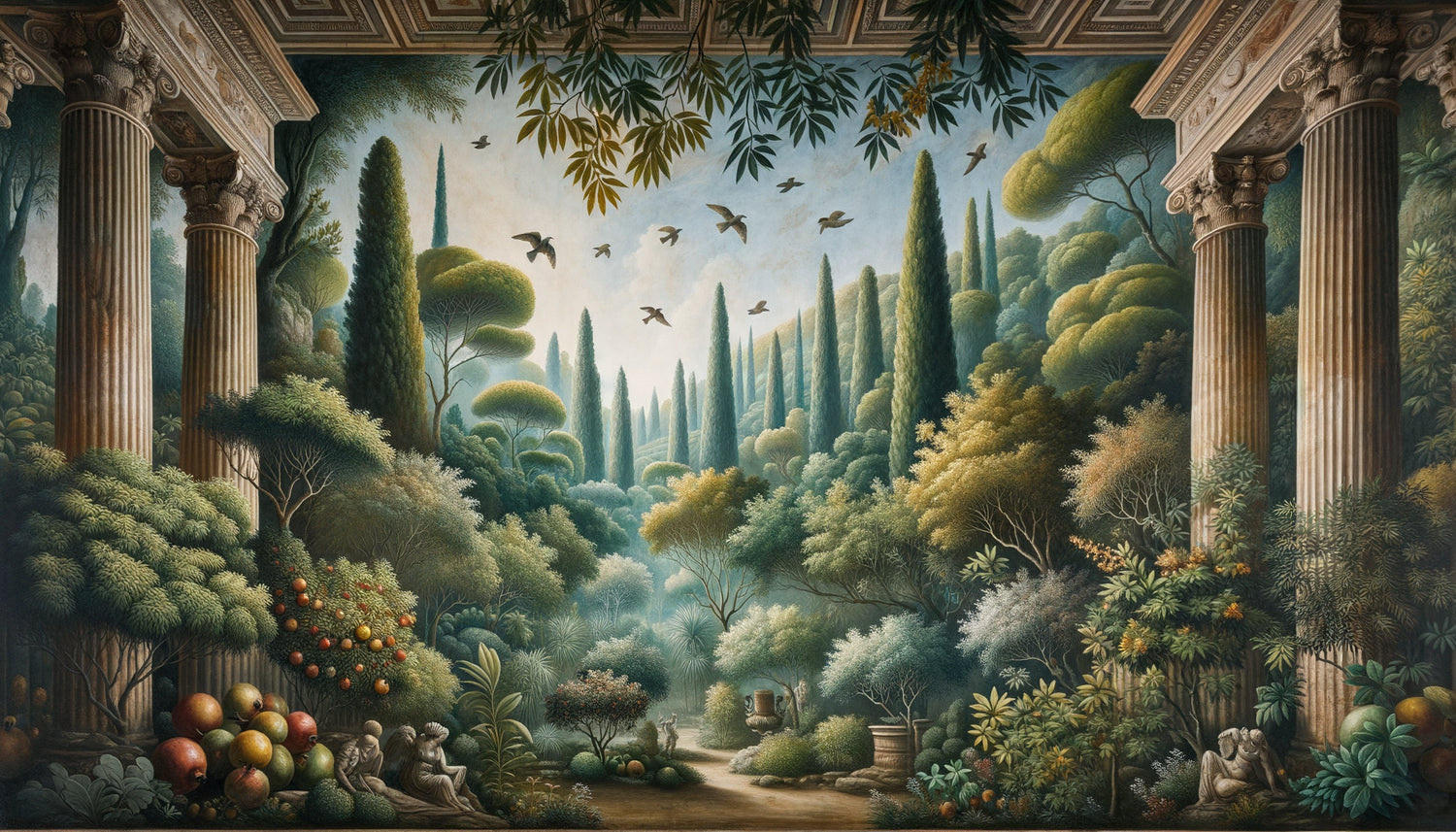
Imagine yourself in a room without windows, buried within the bowels of a Roman villa, and yet... you are surrounded by a lush garden where birds sing, where pomegranates bend under their ripe fruit, where daylight filters through dense foliage. This magic, I felt it the first time I entered the underground triclinium of Villa Livia, this summer refuge designed for Augustus' wife in the 1st century BC. How did Roman artists manage to transform a closed space into an open window onto infinity?
This is what the atmospheric perspective technique of the frescoes at Villa Livia reveals: it creates an extraordinary illusion of spatial depth through chromatic gradation, it generates a feeling of air and light in a confined space, and it establishes a permanent dialogue between painted architecture and lived space. This technical feat, two millennia old, continues to inspire contemporary designers and decorators.
Many admire Roman art without understanding the mechanisms that make these frescoes so vibrant, so breathing. They are often simply described as « beautiful » without grasping the visual sophistication operating before our eyes. This misunderstanding deprives us of a major source of inspiration for our modern interiors.
Yet, the principles implemented in this ancient masterpiece are perfectly decodable and transferable. By analyzing the layers of this ingenious composition, we can not only appreciate the intelligence of Roman painters, but also nourish our own decorative creativity.
I propose that we explore together the secrets of this illusion of depth which transforms four walls into a limitless horizon, and discover how these millennial principles still resonate in our contemporary aspirations.
Atmospheric perspective: when air becomes painting
The fundamental technique used in the frescoes of Villa Livia is based on a principle that art historians call atmospheric perspective. Unlike linear geometric perspective developed during the Renaissance, this Roman approach imitates the natural effects of the atmosphere on our visual perception.
Specifically, artists observed a phenomenon that we all experience: distant objects appear paler, bluer, less contrasted than those in the foreground. The air separating us from them acts as a progressive filter. In the triclinium of Villa Livia, this scientific observation becomes pictorial strategy.
The plants in the foreground are painted with intense and deep greens, precise botanical details, marked shadows. As we progress towards the back of the composition, the tones gradually lighten, the outlines become more blurred, the colors turn to bluish and gray hues. This systematic chromatic gradation deceives our brain which automatically interprets these variations as real distance.
What fascinates about this depth technique, is its ability to create multiple distinct spatial planes on a perfectly flat surface. Roman painters thus generated four to five levels of reading: the palisade in the foreground, the intermediate shrubs, the large trees in the mid-distance, the distant groves, and finally a band of sky barely suggested.
The architecture of sight: composing space in visual layers
The spatial construction of frescoes is nothing to chance. It obeys a rigorous orchestration that guides the viewer's gaze in a perfectly calculated visual journey.
The composition begins with a low vegetation barrier that runs along the entire perimeter of the room: this flowered wall creates the first break between the real space of the triclinium and the illusionist garden painted. Once this limit is crossed, our eye enters a stratified garden where each element occupies a precise position in the simulated depth.
Birds play a crucial role in this illusion of depth. Painted at different scales according to their supposed position in space, they create dimensional landmarks that our brain decodes instantly. A bird detailed in the foreground, another smaller and less defined in the middle, a third barely sketched in the distance: the variation in scale reinforces the feeling of distance.
Roman artists also exploited superposition of forms. A tree partially hides one behind it, a branch masks a trunk, dense foliage obscures more distant elements. This strategy of progressive covering, combined with atmospheric perspective, multiplies the three-dimensional effect.
The spatial continuum: abolishing boundaries
What makes the Villa Livia fresco truly exceptional is that it runs along all four walls without narrative interruption. The painted garden forms a continuous environment that completely envelops the viewer. This circularity abolishes the notion of wall and creates a total immersive experience, transforming architecture into a transparent membrane.
The angles of the room are treated with remarkable skill: trees continue from one wall to another, branches naturally extend, maintaining spatial coherence. This visual continuity considerably amplifies the effect of depth by suggesting that the garden extends far beyond the physical limits of the room.

The chromatic palette at the service of illusion
The colorful strategy deployed in these frescoes reveals an intuitive understanding of optics that science will not formalize for centuries.
Roman painters worked with a chromatic range dominated by greens, but in an extraordinary variety of shades. From deep olive green almost black to washed-out turquoise, through yellowish greens, bluish greens, brownish greens... This tonal richness creates its own impression of volume and plant thickness.
The touches of ochre, red and white introduced by the flowers, fruits and birds create focal points that structure the reading of space. These colored accents, more saturated in the foreground and gradually attenuated towards the background, reinforce the depth gradient.
Painted light also plays a decisive role. The artists simulated a diffuse and uniform lighting, characteristic of a veiled day, which minimizes shadows that are too marked. This soft luminosity contributes to the serene atmosphere and the feeling of open space, as if external light were actually penetrating the underground room.
When illusion becomes a sensory experience
Beyond the simple technical feat, the fresco from Villa Livia creates a true multisensory experience. The botanical realism is so precise that we identify the species represented exactly: parasol pines, green oaks, grenadiers, poppies, chrysanthemums, irises...
This naturalistic precision does not stem from an encyclopedic concern, but from a desire to activate our sensory memory. Each plant evokes olfactory, tactile and auditory memories. By recognizing these plants, our brain unconsciously summons their sensory attributes: the scent of flowers, the rustling of leaves, the coolness of shade.
The birds perched or in flight introduce an implicit sound dimension. Our imagination populates this silent garden with songs and chirps. This auditory suggestion reinforces the impression of life and therefore the reality of the scene represented.
The original function of this space explains this quest for total immersion: this triclinium served as a summer dining room, a refuge from the Roman summer heat. Deprived of real windows, diners nevertheless benefited from all the psychological benefits of a garden: feeling of space, impression of coolness, connection with nature.
A technical innovation at the service of well-being
The depth technique employed here is not a simple demonstration of skill. It responds to a specific functional need: to transform a confined and potentially oppressive space into a place of relaxation and pleasure. This utilitarian dimension of Roman art particularly resonates with our contemporary concerns about restricted urban spaces.

From Rome to Our Interiors: Contemporary Relevance
Two thousand years after its creation, the lesson of Villa Livia remains strikingly relevant for anyone considering interior design.
The principle of atmospheric perspective directly inspires contemporary panoramic wallpapers that are experiencing a spectacular resurgence in popularity. These wall decorations use the same strategies of chromatic gradation and layering to create an illusion of depth in our urban apartments.
Interior designers also exploit the technique of visual strata by playing with different decorative planes: a foreground of detailed and colorful objects, a background in softer, more neutral tones. This spatial hierarchy visually expands small rooms.
The thematic continuity between multiple walls, inherited directly from Villa Livia, transforms spaces into coherent environments rather than a succession of decorated surfaces. This holistic approach creates a richer and more immersive spatial experience.
More fundamentally, these Roman frescoes remind us that wall art is not merely decoration, but an architectural tool capable of radically altering our perception and experience of space. This understanding opens up infinite perspectives for rethinking our interiors.
Be inspired by the magic of perspective and depth
Discover our exclusive collection of landscape paintings that capture this same illusion of infinite space and will transform your walls into windows onto enchanting horizons.
The Invisible Legacy of a Visual Revolution
The atmospheric perspective technique of Villa Livia represents much more than an isolated technical feat. It testifies to a sophisticated understanding of visual perception and the psychological impact of our environment.
These anonymous Roman artists solved a challenge that we still face today: how to create a sense of space, light, and connection with nature in enclosed places? Their answer, based on careful observation of natural optical phenomena and exceptional technical mastery, remains an inexhaustible source of inspiration.
The next time you contemplate a blank and bare wall, imagine it as a potential window into an infinite garden. The principles of chromatic gradation, plan layering, and spatial continuity that transformed an underground triclinium into a vegetable oasis can still today metamorphose your own living space.
The illusion of depth is not a deception, it's an invitation to see beyond physical limits, to let your gaze and imagination travel. Perhaps this is the true genius of these frescoes: they remind us that space is not only an objective measurement in square meters, but a subjective experience that art can shape, amplify, transcend.