I spent fifteen years restoring old paintings in the reserves of major European museums. One day, facing a view of Dresden signed Bellotto, I had a disturbing experience: by superimposing modern aerial photographs on reproductions of his landscapes, the correspondences were perfect. Every facade, every turret, every bridge fell exactly into place, as if the painter had used a GPS three centuries before its invention.
Here's what Bellotto’s topographical precision reveals: a revolutionary method of working that transforms painting into an architectural document, a scientific gaze ahead of its time that anticipates photography, and an invaluable resource for today's historians and urban planners.
You may be admiring reproductions of landscapes in your interior without really understanding what distinguishes a banal work from a documentary masterpiece. You feel that there is something different about certain old city views, an authenticity that transcends mere decorative effect, but you don’t know how to identify this quality.
Rest assured: understanding Bellotto's method requires no artistic training. It is a fascinating story of rigor, technical innovation and passion for visual truth. By discovering his secrets, you will never look at a painted landscape the same way again.
I promise you that by the end of this article, you will know how to recognize the signs of true topographical precision in a work, and understand why these paintings are worth much more than their aesthetic beauty.
The Canaletto Legacy: When an Uncle Transmits More Than Just a Brush
Bernardo Bellotto was born in Venice in 1721, nephew of the famous Canaletto. But unlike what one might think, he does not simply copy the family style. In his uncle's workshop, he discovers a tool that will revolutionize his approach: the camera obscura.
This optical device, a distant ancestor of the camera, projects an image of the real landscape onto a flat surface thanks to a system of lenses and mirrors. But where Canaletto uses it as a simple aid to drawing, Bellotto makes it an instrument of measurement. He spends hours understanding the laws of linear perspective, calculating exact proportions, checking every angle.
I was able to examine preparatory sketches by Bellotto at the Dresden Drawing Cabinet. The difference from other vedutisti is striking: his sketches are covered with numbered annotations, geometric construction lines, and distance markers. It's not an artist who draws what he sees; it’s a cartographer who paints what he measures.
The Camera Obscura: Between Art and Science
Imagine a large portable black box, equipped with a lens at the front. Bellotto installs this device in public squares of Warsaw, Vienna or Dresden, sparking the curiosity of passers-by. The image of the landscape is projected upside down onto a translucent screen, allowing contours to be traced with millimeter fidelity.
But Bellotto doesn’t simply copy blindly. He understands the optical distortions of the lens and corrects them. He notes variations in light according to the hours. He returns to site at different times to observe shadows and verify his perspective calculations.
This hybrid method explains why Bellotto's landscapes possess this unique quality: the mathematical precision of the topographic survey combined with the chromatic sensitivity of the great painter. Architects of the time considered him as much a colleague as an artist.

Dresden, Warsaw, Vienna: an urban reportage before the term was invented
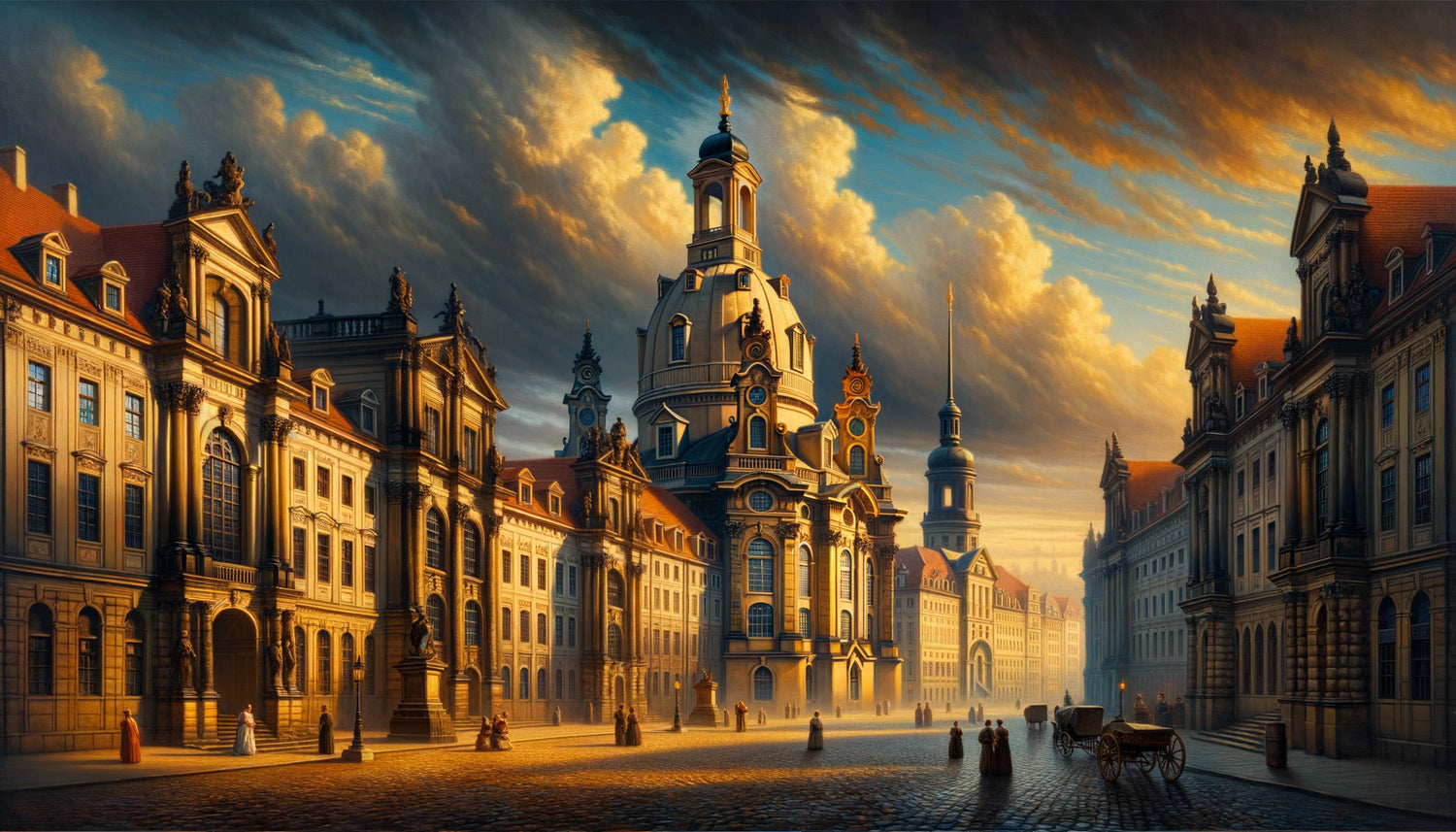
In 1747, Bellotto arrived in Dresden as a court painter for Augustus III. His mission? To immortalize the city in all its Baroque splendor. But he went far beyond that: he created a comprehensive visual inventory of Saxon urban planning.
Each canvas becomes an archival document. The windows are the correct number. The ornaments on the facades respect their actual location. The paving stones follow their authentic arrangement. When Dresden was razed by the bombings of 1945, it was Bellotto's paintings that served as reconstruction plans.
I had the chance to participate in a conference with German urban planners who were still using his works to debate the restoration of the historic center. They projected the canvases onto giant screens, zoomed in on architectural details, debated the exact height of a pediment. Bellotto's landscapes were treated like legal photographs, not artistic interpretations.
In Warsaw, the same story. His views of the Royal Castle and Old Town, painted between 1770 and 1780, made it possible to reconstruct 85% of the heritage destroyed during World War II. Historians speak of the 'Bellotto miracle': without him, the historic center of Warsaw as we know it today would not exist.
The technique of the single viewpoint: a silent revolution
Unlike other vedutisti who assemble multiple viewpoints in a single composition to create a spectacular effect, Bellotto imposes a radical constraint on himself: a single fixed viewpoint per painting.
This decision, which may seem trivial, changes everything. It transforms painting into scientific testimony. If you place yourself exactly where Bellotto installed his camera obscura (some of these locations are now marked with memorial plaques), the correspondence between reality and painting is astonishing.
I experienced this in Prague, facing the Charles Bridge. Holding a reproduction of his painting 'View of Prague from the Left Bank of the Vltava,' I was able to align every element: the curve of the river, the spacing of the bridge arches, the relative position of the steeples. Three hundred years later, despite some urban modifications, the fundamental geometry of the landscape was identical.

Why this obsession with accuracy?
One might wonder: why so much rigor? Why didn't Bellotto allow himself the artistic freedoms taken by his contemporaries?
The answer lies in his vision of the role of the painter. For him, representing a place was not simply creating a beautiful image, but preserving the visual memory of an era. He knew that cities change, buildings collapse, wars destroy. His paintings were time capsules.
This approach resonates powerfully today, in the age of hyper-photographic documentation. We better understand his approach: Bellotto was the first 'urban photographer,' armed with brushes instead of a camera. His topographically precise landscapes anticipated our contemporary need for exhaustive visual archiving.
In my years of restoration, I also discovered that this precision served a diplomatic function. European courts exchanged his canvases as luxury postcards, but also as strategic intelligence: seeing the exact layout of a foreign city, its fortifications, its accesses, had military and political value.
The contemporary eye facing Bellotto: what does his method teach us?
Today, as we decorate our interiors with reproductions of landscapes, Bellotto's lesson resonates differently. His works remind us that an image can be simultaneously beautiful and true, artistic and documentary.
This dual quality creates a particular emotional depth. When you contemplate a view of Warsaw by Bellotto, you are not looking at a romantic interpretation: you see exactly what an 18th-century resident saw when leaving their home. It's a direct temporal connection, a visual bridge between eras.
For interior design enthusiasts sensitive to historical authenticity, this dimension transforms a simple landscape painting into a window onto the past. It is no longer a generic decorative element, but a fragment of reality preserved with scientific rigor.
Seasoned collectors know: reproductions of Bellotto landscapes bring a particular gravitas to a space. They embody values of precision, methodological excellence, and respect for visual truth. In an office, library, or living room, they signal a taste for intellectual rigor as much as for beauty.
Transform your interior into a cabinet of historical curiosities
Discover our exclusive collection of landscape paintings that capture the documentary and artistic essence of the great masters.
The legacy of a method: from Bellotto to drone
Bellotto's topographic precision did not remain a historical curiosity. It directly influenced the development of architectural photography in the 19th century, and then aerial cartography in the 20th.
The first photographers who documented European cities in the 1850s were familiar with his works. They consciously sought his exact viewpoints to create before-and-after comparisons. These photographic series, confronted with Bellotto landscapes, made it possible to precisely measure urban transformations over a century.
Today, with 3D modeling technologies and drones, we are rediscovering Bellotto with new tools. Computer vision researchers have digitized his canvases to create three-dimensional reconstructions of lost cities. The accuracy of his measurements allows these virtual reconstructions with an error margin of less than 5%.
It is fascinating to think that a painter from the 18th century, armed with a rudimentary camera obscura and his keen eye, produced data exploitable by our most sophisticated algorithms. His method transcends eras because it rests on universal geometric principles.
Recognizing a true Bellotto: the signs that don't deceive
If you visit a museum or are looking for a quality reproduction, here’s how to identify Bellotto’s visual signature:
First, human scale. His characters are always proportioned exactly to the architecture. No exaggeration for dramatic effect. A man measures approximately one-tenth of the height of a standard door, consistently.
Next, shadow consistency. Bellotto calculates the angle of the sun and rigorously applies this luminous geometry to all elements of the painting. Shadows are parallel; their length respects the laws of trigonometry.
Finally, sharpness of architectural details even in depth of field. Unlike painters who blur the background to create depth, Bellotto maintains a nearly uniform clarity, as would a photograph taken at a small aperture.
These characteristics make Bellotto’s landscapes immediately recognizable works. Once your eye is trained, you will never confuse them with other Venetian or Roman views, however beautiful they may be.
Living with a precise landscape: the daily experience
I installed a reproduction of 'View of Vienna from the Belvedere' in my office three years ago. Every morning, I discover a new detail: a window I hadn’t noticed, the perfect alignment of a row of trees, the logic of a street layout.
This is the magic of topographically accurate landscapes: they never run out. Unlike a purely aesthetic composition that gives everything at once, these works reveal their richness gradually, because they contain an extraordinary density of information.
Living with a Bellotto (even in reproduction) is like having a living antique map on your wall. It’s a daily invitation to time travel, to reflect on urban permanence and change, on how our ancestors inhabited the same places as us.
For children, it's a fabulous educational tool. You can play counting windows, imagine life behind each facade, understand how things were built before cranes and concrete. The documentary precision stimulates curiosity in a way that fanciful images cannot match.
The future belongs to the precise: why Bellotto speaks to us today
In the age of fake news and manipulated images, Bellotto’s approach resonates with a troubling current events. His commitment to visual truth, his rejection of easy arrangements, his methodological rigor embody values that we desperately seek to rediscover.
Art historians now speak of 'documentary realism' to qualify his approach. It is neither photorealism (which did not exist), nor social realism (which will come later), but a third way: representation as legal testimony, art as proof.
In our contemporary interiors, often dominated by abstraction and purely formal decoration, integrating a Bellotto landscape creates a powerful historical anchor. It affirms that beauty does not exclude rigor, that aesthetic emotion can be born of accuracy rather than fantasy.
Every time I contemplate one of his landscapes, I think of a sentence that a curator once said to me: 'Bellotto painted as if he knew the cities would disappear.' He was a prophet of heritage preservation, a century before the concept existed.
The topographic precision of Bellotto’s landscapes was not a limitation on his creativity, but his fuel. It gave him a framework within which to deploy his chromatic genius, his sense of composition, his mastery of light. It's a valuable lesson: constraints nourish excellence.
Today, as we rediscover the value of authenticity, traceability, and source verification, Bellotto teaches us that one can be both rigorous and inspiring, precise and poetic. His urban views are not cold technical documentations: they are celebrations of architectural splendor, made even more moving by their accuracy.
When you choose your next landscape painting, consider this double dimension. Ask yourself: does this image transport me while respecting a certain truth? Does it take me on a journey through space and time with honesty?
If the answer is yes, you may be holding a worthy heir to the spirit of Bellotto. And your wall will not simply bear a decoration, but an authentic window onto a lost world, preserved with love and rigor by a painter who believed that beauty and truth are one.
Frequently asked questions about the topographic accuracy of Bellotto
How could Bellotto be so precise without modern technology?
Bellotto combined several tools and methods to achieve this remarkable accuracy. First, he used a perfected camera obscura, an optical device that projected the real image of the landscape onto a flat surface, allowing him to trace the contours accurately. But unlike other artists who simply used it as a drawing aid, Bellotto used it as a measuring instrument. He supplemented this work with traditional topographic surveys, noting distances, angles and proportions. His sketchbooks show numerical annotations and complex geometric calculations. He also spent weeks on site, observing changes in light, checking his measurements from different angles. This combination of optical technology and rigorous scientific method allowed him to achieve accuracy comparable to that of the first photographic surveys, nearly a century before the invention of photography.
Can Bellotto's paintings really be used for architectural reconstructions?
Absolutely, and that's precisely what happened after World War II. Bellotto’s landscapes served as blueprints for the reconstruction of the historical centers of Dresden and Warsaw, destroyed by bombing raids. Architects and urban planners used his paintings as archival documents, extracting exact building dimensions, the number of windows, facade decorations, street layouts. In Warsaw in particular, approximately 85% of the Old Town's reconstruction was based on his paintings. Modern comparative studies using photogrammetry and 3D modeling have confirmed that Bellotto’s margin of error was less than 5%, which is extraordinary for an 18th-century manual work. Even today, researchers use his works to study urban evolution, understand ancient construction techniques, and debate heritage restoration projects. His paintings are treated as legal photographs in historical archives.
What’s the difference between Bellotto and his uncle Canaletto in terms of accuracy?
Although Bellotto was trained by his uncle Canaletto and they share common techniques, their approaches differ significantly. Canaletto, a famous Venetian painter, used the camera obscura but took artistic liberties to make his compositions more spectacular: he sometimes exaggerated heights, narrowed spaces, added or moved elements for dramatic effect. His vedute were idealized views, beautiful but not strictly accurate. Bellotto, on the other hand, imposed a constraint of absolute fidelity. He painted what existed, exactly as it existed, from a unique and fixed viewpoint. His compositions are less theatrical but infinitely more reliable as documents. Where Canaletto was an urban poet, Bellotto was an artist cartographer. This difference explains why Bellotto’s works have documentary value that Canaletto’s do not, even though both artists produced magnificent works. In summary: Canaletto embellished reality, Bellotto preserved it with accuracy while sublimating it.