I’ve spent fifteen years advising homeowners on how to arrange their living spaces, and one constant has always fascinated me: during presentations of art collections, eyes invariably turn to landscapes where water is revealed. A lake in the distance, a river meandering, a cascade trickling... It's never random. This universal attraction to landscapes with visible water reveals something deeply ingrained within us.
Here’s what an aquatic landscape brings to your interior: a feeling of immediate tranquility that transforms the atmosphere of a room, a natural focal point that harmoniously structures your space, and a vital connection with nature that nourishes our daily well-being.
Yet, many hesitate. Why this instinctive preference? Is it simply aesthetic or are there deeper reasons? How to choose the right aquatic landscape for your interior without making a mistake?
Rest assured: this attraction is not a decorative whim. It draws from our biology, our collective history and our most essential psychological needs. Understanding these mechanisms will allow you to transform your space into a true haven of peace.
In this article, I reveal the scientific and emotional reasons for our fascination with landscapes featuring water, and how to use this knowledge to create an interior that breathes serenity.
Water in our DNA: a matter of survival become a source of beauty
Our attraction to landscapes with visible water is not random aesthetic. It’s rooted in millennia of human evolution. Our ancestors survived by systematically seeking proximity to sources of water: rivers, lakes, oases. Water meant life, food, safety.
This preference has become so deeply ingrained in our brains that it persists today, even when water flows freely from our taps. Studies in environmental psychology show that we instinctively evaluate a landscape with water as more habitable, more safe, more desirable.
When you hang a canvas depicting a mountain lake or a coastline in your living room, you’re not just making a decorative choice. You are responding to an ancestral call, creating a visual link with what allowed humanity to prosper. This biological dimension explains why a simple aquatic landscape can transform the energy of an entire room.
Savannah theory and the biophilia hypothesis
Biologist Edward O. Wilson developed the hypothesis of biophilia: we possess an innate tendency to seek connections with nature and other forms of life. Landscapes featuring visible water perfectly cater to this biophilia by combining several elements our brains instinctively seek: the water itself, but also often the vegetation that accompanies it, the play of light on its surface, the promise of life it conveys.
In savanna theory, the environments we find most beautiful are those that offered the best chances of survival: semi-open spaces, elevated observation points, and above all, the presence of visible water. That's why a panorama with a river running through the frame seems more complete, more balanced than a terrestrial landscape alone.
The soothing effect: when water calms our nervous system
Beyond evolution, landscapes with a water feature have a measurable effect on our physiology. Numerous studies in neuroscience show that the mere sight of water activates brain areas associated with reward and well-being.
In my experience as a consultant, I have observed remarkable transformations. A client suffering from chronic anxiety replaced a dynamic abstract artwork with a large painting depicting a peaceful lake in her bedroom. She confided to me that her heart rate seemed to naturally slow down whenever she contemplated this scene.
This was not a subjective impression. Studies using biometric sensors confirm that watching aquatic landscapes reduces blood pressure, decreases cortisol (the stress hormone), and slows the heart rate. Water possesses this unique power to bring us back to calm, almost instantly.
The phenomenon of gentle fascination
Psychologists Rachel and Stephen Kaplan have identified what they call gentle fascination: a state of relaxed attention where our mind regenerates. Landscapes with a water feature visible are particularly effective in inducing this state.
Unlike intense fascination (an action movie, an animated discussion) which stimulates and exhausts us, gentle fascination captivates us without draining us. Observing the changing reflections on a lake, following the course of a river with your gaze, contemplating the maritime horizon... These visual experiences allow our directed attention (the one we constantly use at work) to rest.
That's why placing an aquatic landscape in an office or workspace is not just about aesthetics: it's about offering your brain regenerative micro-breaks throughout the day.

The symbolic dimension: water as a universal metaphor
Our preference for landscapes with a body of water goes beyond biology to touch on the symbolic. In all cultures, water represents renewal, purification, transition. It evokes both permanence (the immutable oceans) and change (rivers that flow endlessly).
This symbolic richness explains why the same water landscape can speak differently to each person. For some, a mountain lake evokes tranquility and contemplation. For others, a stormy sea symbolizes strength and freedom. A waterfall inspires dynamism and vitality, while a pond reflects introspection.
When you choose a landscape painting with water for your interior, you are not simply selecting an image: you are inviting a particular energy, an emotional resonance that will subtly influence your daily life.
The power of suggested movement
A fascinating aspect of landscapes with a visible body of water is their ability to suggest movement in stillness. Even on a fixed canvas, our brain perceives the potential for movement of the water: the waves about to break, the river continuing its course beyond the frame, the clouds reflected and drifting.
This dynamic perception creates a form of visual life in your space. Unlike a purely terrestrial or mountainous landscape, which can seem static, a water landscape breathes, evolves in our imagination. It introduces movement without agitation, fluidity without chaos.
The unique aesthetic qualities of water in a landscape
From a purely visual point of view, landscapes with a body of water offer aesthetic qualities that no other natural element can reproduce. Water acts as a natural mirror, doubling the beauty of the sky, trees, mountains it reflects.
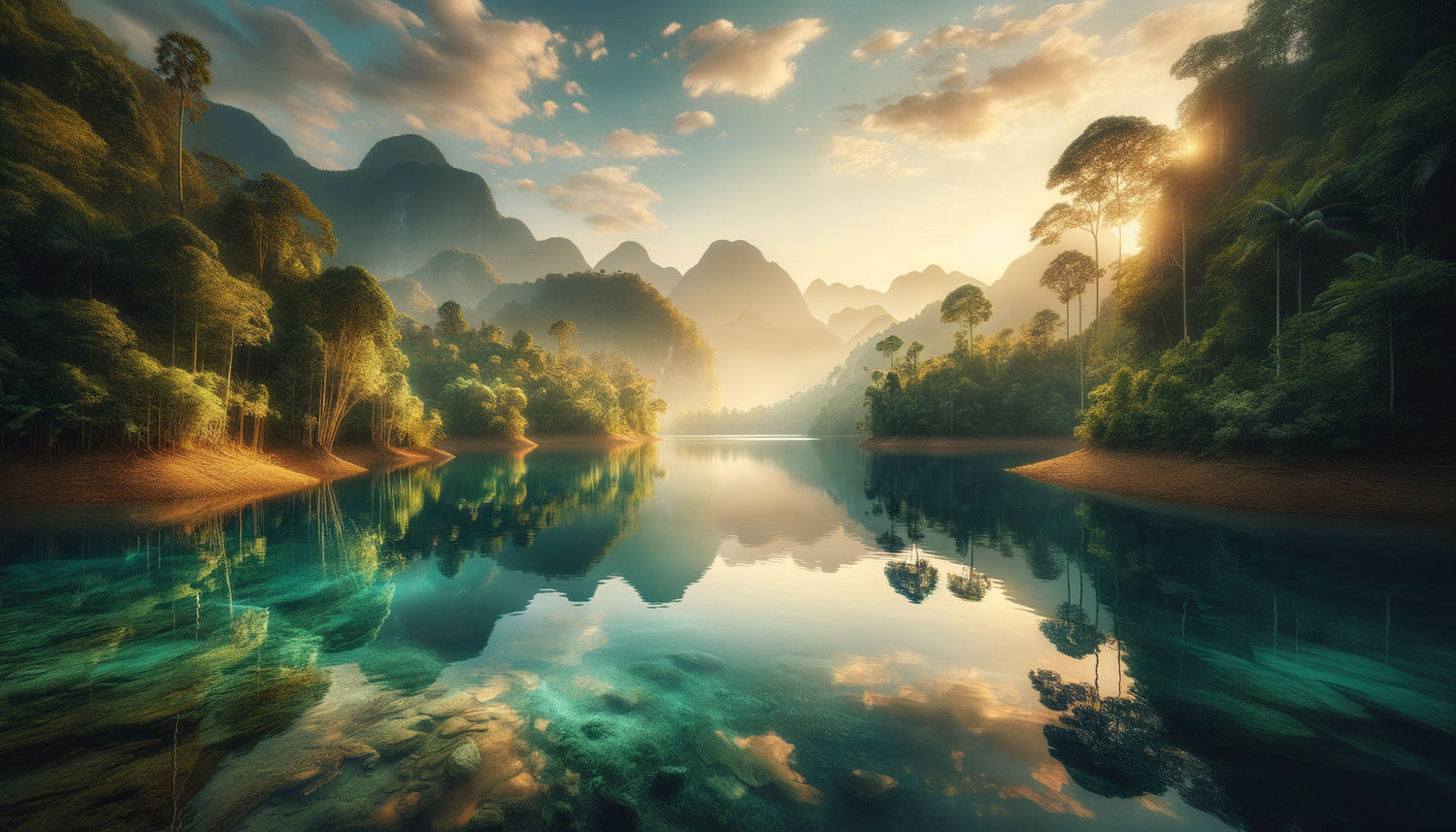
This reflective ability creates an extraordinary visual depth. A landscape with a lake immediately has two planes: the real and its reflection, multiplying the compositional richness of the work. Painters have always understood this power: from Monet to Turner, the masters of light exploited water to create impossible color combinations.
Water captures and transforms light in a unique way. It shimmers, glistens, and displays changing hues depending on the time of day and atmospheric conditions. A water landscape in your interior therefore brings an almost living dimension: the artwork appears different depending on the natural light in your room, creating a visual experience that never fully freezes.
The balance between sky and earth
Landscapes with a visible body of water naturally create a remarkable compositional balance. Water acts as a transition zone between the land and the sky, offering a visual resting point that harmoniously guides the eye through the entire scene.
This balancing function explains why these landscapes work so well in different interior styles. Whether it's a minimalist modern decor or a more traditional space, a water landscape brings a visual coherence that unifies the surrounding elements without dominating them.

How to integrate a water landscape into your interior
Understanding why we prefer landscapes with a body of water is one thing; knowing how to integrate them harmoniously into your space is another. Here are the principles I consistently apply in my design advice.
First, consider the energy of the room. A space where you seek calm (bedroom, reading corner) will benefit from a peaceful water landscape: mountain lake, forest pond, calm sea at dusk. For an office or gym, you can opt for something more dynamic: waterfall, ocean in motion, torrential river.
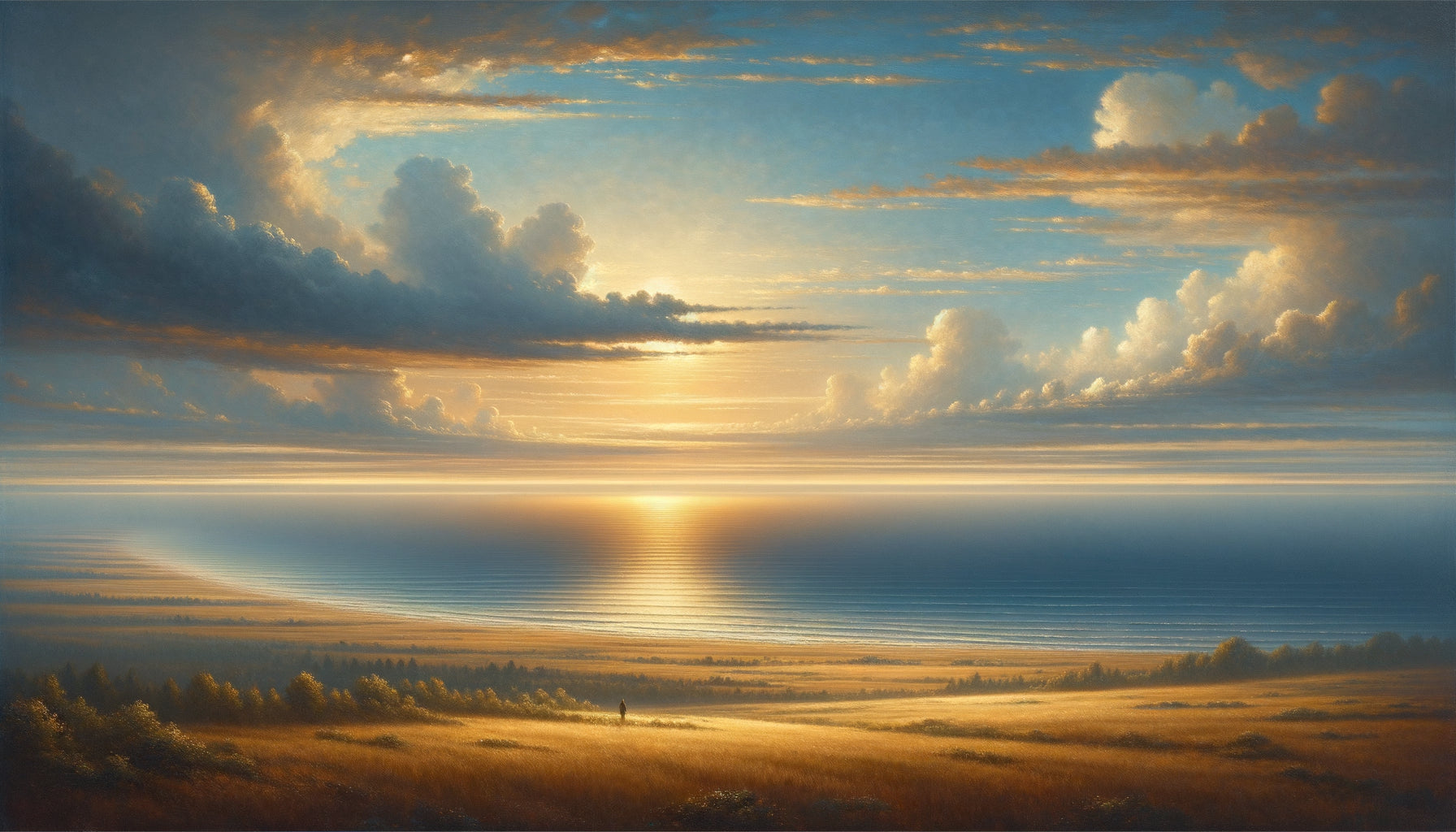
The size of the body of water in the composition also counts. A vast ocean will create a feeling of openness and freedom, ideal for confined spaces. A small stream or fountain will bring a touch of intimacy and discovery, perfect for creating a cozy corner.
Also think about the dominant colors. Deep blues evoke serenity and depth, turquoises bring luminous energy, gray-blues create a contemplative atmosphere. Harmonize these tones with your existing palette for an overall coherence.
Strategic placement
The placement of your water landscape painting amplifies or diminishes its effect. Ideally, place it facing your usual resting position: opposite the sofa, visible from your bed, facing your desk. This way you will maximize the beneficial visual contact moments.
Avoid cluttering the wall with other works too close together. A landscape with a body of water deserves breathing room around it, just as water needs its banks. Give it space to fully deploy its soothing effect.
Transform your interior into a haven of peace
Discover our exclusive collection of landscape paintings that capture the soothing beauty of water in all its forms, to create the serene atmosphere you deserve.
Your space, a reflection of your deep needs
Our universal preference for landscapes with visible water is not just an aesthetic taste. It reveals deeply rooted biological, psychological and symbolic needs. By choosing to integrate a water landscape into your interior, you are not decorating: you are responding to an ancestral call, creating the conditions for daily well-being.
Water in a landscape brings this rare combination of calm and vitality, permanence and change, emotional beauty and functionality. It transforms a wall into a window onto serenity, an ordinary space into a regenerating refuge.
So tomorrow morning, observe the spaces where you spend most of your time. Ask yourself: where is this soothing presence lacking? Where could you invite the fluidity of water? The answer could transform your daily experience of your home, that place which should always be restorative to you.
Frequently Asked Questions
Why am I instinctively drawn to landscapes with water?
Your attraction to landscapes with visible water is perfectly normal and even universal. It can be explained by our evolution: for millennia, our ancestors survived by seeking water, an essential source of life. This preference has been imprinted in our DNA. Even today, our brains instinctively assess aquatic landscapes as safer, more habitable and more desirable. Moreover, the sight of water activates brain areas associated with well-being and measurably reduces stress levels. This attraction is therefore not an aesthetic whim but a deep biological response to a vital element. Trust this intuition when choosing a work for your interior: it reveals your authentic needs for connection with nature.
Can a water landscape painting really reduce my stress?
Absolutely, and it's scientifically proven. Neuroscience research shows that contemplating landscapes with a body of water produces measurable physiological effects: reduced blood pressure, decreased cortisol (stress hormone), slower heart rate. This phenomenon is called soft fascination: your gaze is naturally captured by the water without mental effort, allowing your directed attention (the one you use at work) to regenerate. Unlike other visual stimuli that can tire you out, a water landscape offers micro-mental pauses throughout the day. That's why many of my clients notice an improvement in their well-being after incorporating this type of artwork into their bedroom or office. The effect is subtle but cumulative, gradually creating a more peaceful atmosphere in your daily life.
What type of water landscape should I choose for my bedroom or living room?
The choice depends on the energy you want to create in each space. For a bedroom where you are looking for calm and restorative sleep, prioritize peaceful water landscapes: mountain lake at sunrise, calm sea at dusk, misty forest pond. Soft hues (pastel blues, grey-blues, soothing turquoise) promote relaxation. For a living room where you entertain and live actively, you can opt for something more dynamic: coastline with light waves, river winding through a bright landscape, energizing waterfall. The important thing is that the landscape with its body of water resonates with you emotionally. In my consultations, I always ask: what feeling are you looking for when entering this room? The answer naturally guides you to the right type of water landscape. Trust your initial feeling: it reveals your authentic needs.