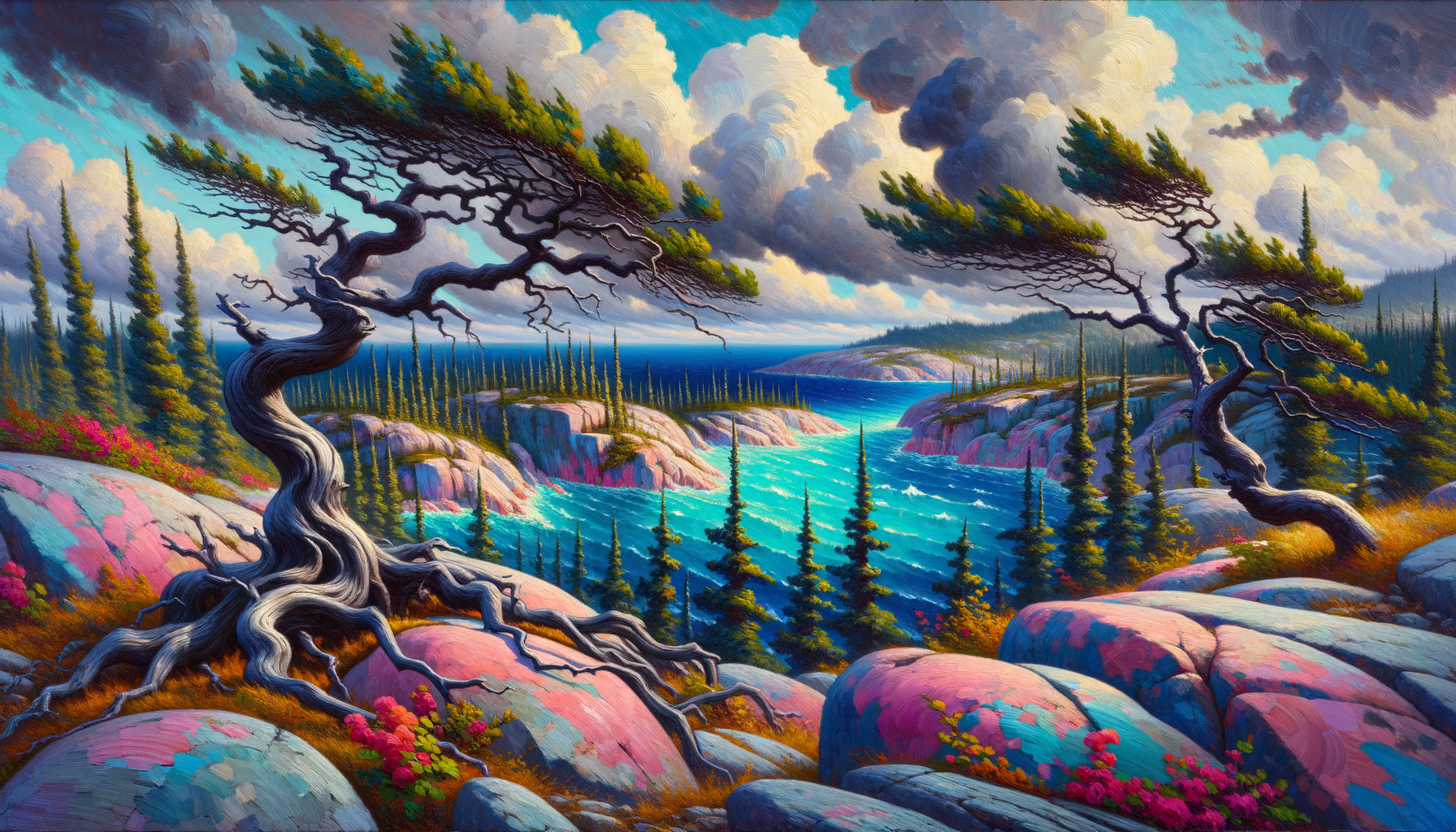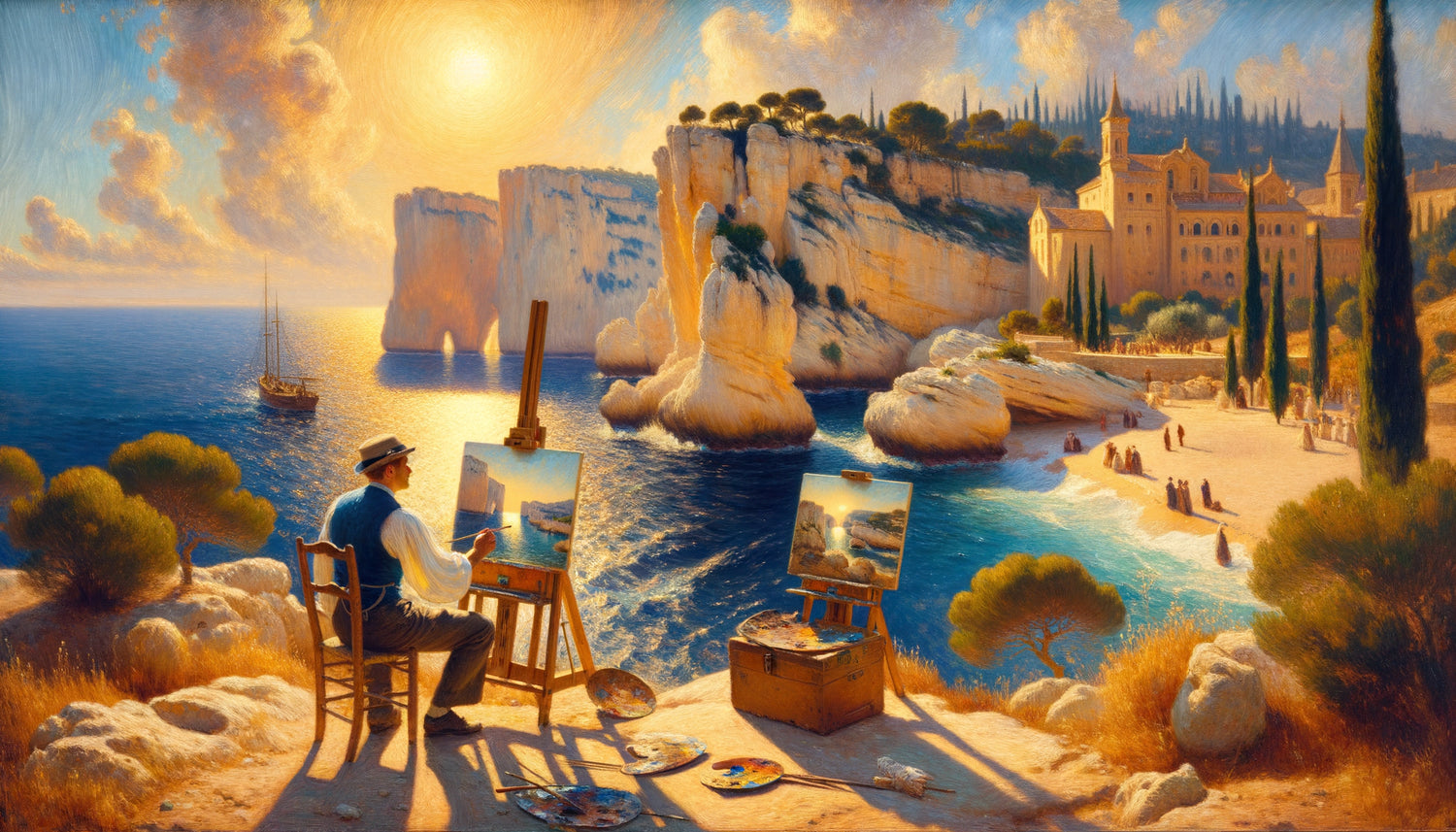
I still remember that January morning in Stockholm, when I organized the exhibition of Lars Bergström's Mediterranean watercolors. Outside, it was -12°C, night had already fallen by 3 p.m. Inside, his canvases burst with golden light, warm ochres, intense blues. Visitors stopped dead, as if hypnotized. One woman whispered: 'This is exactly what I need right now.' This scene sums it all up: the Mediterranean is not just a landscape for Nordic artists, it's a sensory revelation that transforms their palette and their view of the world.
Here's what the Mediterranean landscape brings to Northern painters: a harsh light that redefines colors, a natural architecture that structures space differently, and a chromatic intensity that frees artistic expression. When you spend your life under low, gray skies, this encounter with the South becomes a creative rebirth.
Have you ever wondered why so many Scandinavian, German or Flemish masters have migrated to Provence, Tuscany or the Greek islands? Why this persistent fascination from the 19th century to today? The answer goes far beyond simple art tourism.
In my gallery specializing in contemporary Nordic art, I regularly welcome artists who return transformed from their Mediterranean stays. Their testimonies, combined with the history of art that I have been studying for fifteen years, reveal fascinating constants. Let me take you on this luminous journey that changed European painting.
The light shock: when the sun reinvents color
The first time a Nordic painter sets up their easel facing the Mediterranean, it's an optical shock. The Southern light doesn't illuminate: it reveals. In Stockholm or Amsterdam, the average annual sunshine barely reaches 1600 hours. In Nice or Barcelona, we cheerfully exceed 2700 hours. This mathematical difference translates into an artistic revolution.
Nordic painters discover that Mediterranean shadows are not gray or black, but violet, blue, sometimes even pink. The zenithal sun creates sharp contrasts, bright edges that sculpt forms with a precision unknown at northern latitudes. The Danish artist Anna Ancher, after her trip to Italy, radically changed her palette: her subtle grays gave way to vibrant yellows and intense reds.
This Mediterranean light transforms the perception of colors. The white of Greek houses becomes a mosaic of nuances: warm white in the sun, bluish white in the shade, golden white at dusk. The cypresses are no longer simply green, but oscillate between deep emerald and dark blue depending on the time. This chromatic complexity fascinates painters accustomed to Nordic gradations.
The architecture of the landscape: natural geometry and composition
In my gallery, I often exhibit Scandinavian landscapes alongside Mediterranean scenes by the same artist. The structural difference is immediately apparent. The Mediterranean landscape offers a natural spatial organization that Nordic painters find infinitely inspiring.
The Tuscan hills follow one another in clear planes, perfect for composition. Olive trees punctuate the space with a regular rhythm. Perched villages create obvious focal points. This natural geometry contrasts with the flat expanses of Holland or the dense forests of Scandinavia, where the artist must seek their structure.
The Swedish painter Karl Nordström, after discovering Provence, wrote: 'Here, every view is already a composed painting. Nature does half the work.' Cultivated terraces, dry stone walls, rows of vines create guidelines that naturally guide the eye. This architectural clarity of the Mediterranean landscape becomes a composition master for artists from the North.

The color palette: from grey minimalism to a colorful explosion
I have noticed a recurring phenomenon among Nordic artists that I accompany: their palette literally enriches by 30 to 40% after an extended Mediterranean stay. It's not a metaphor, I measured it by counting the tubes of paint in their suitcases.
The Mediterranean landscape imposes colors that Northern painters almost never use: the red ochre of Provençal lands, the intense turquoise of the Aegean Sea, the pure cadmium yellow of Sicilian lemons. These saturated hues, almost garish under the harsh midday light, become necessary to transcribe the truth of the place.
The Norwegian painter Edvard Munch, accustomed to the cold blues and dark greens of his native fjord, discovered Southern France in 1891. His Mediterranean canvases explode with sunny yellows and passionate reds. This chromatic liberation subsequently influenced all his work; even his Norwegian landscapes gained color intensity.
The Mediterranean teaches Nordic painters that color can be emotional rather than descriptive. The French Fauves had understood this, but for a Scandinavian artist raised in chromatic sobriety, it is a shocking revelation.
Psychological escape: painting the light when you come from the shadows
Beyond technical aspects, there is a deep psychological dimension to this attraction. Organizing exhibitions has taught me to read the unspoken behind canvases. For a painter who endures six months of winter darkness, the Mediterranean landscape represents an existential promise: life is possible elsewhere, differently.
The long polar nights, vitamin D deficiency, seasonal depression deeply affect Nordic populations. When these artists discover a place where the sun shines 300 days a year, where you can paint outdoors almost all year round, it's liberating. The Finnish painter Akseli Gallen-Kallela spent several winters in Italy to 'recharge his soul with light', according to him.
This quest for brightness is not superficial. It translates into canvases with a palpable joy, an energy that contrasts with traditional Nordic melancholy. The Mediterranean landscape becomes a pictorial antidote to Nordic identity.

The historical heritage: tracing the masters
There is also an initiatory dimension to this pilgrimage to the South. Since the Grand Tour of the 18th century, every serious Nordic artist must make their Mediterranean journey. It's a rite of passage, a validation of their status.
When I advise young Scandinavian painters, I always encourage them to undertake this trip. Not out of conformity, but because the Mediterranean landscape has been the laboratory where so many artistic revolutions were invented: Monet's Impressionism in Antibes, Matisse's Fauvism in Collioure, Picasso's Cubism in Horta de Ebro.
Walking where Van Gogh set up his easel in Arles, painting the same cypresses as Cézanne in Aix-en-Provence, is to dialogue with the history of art. For a Nordic artist, often geographically distant from major European artistic centers, this Mediterranean connection is an anchor in Western pictorial tradition.
The lasting transformation: when the South permeates the North
What's most fascinating about this phenomenon is that it doesn't stop on return. Nordic painters bring the Mediterranean back with them. In my gallery, I often present Scandinavian landscapes painted with a Mediterranean sensibility: bolder colors, more contrasting light, more structured compositions.
The Mediterranean landscape acts as a chemical developer on artistic vision. Once the eye has learned to see these nuances, these intensities, it can no longer return to its first innocence. The Swedish painter Bruno Liljefors, after his stay in Italy, began to paint Scandinavian snows with blue and mauve shadows, directly inspired by his Mediterranean observations.
This hybridization creates a unique style: Nordic sensitivity (melancholic, introspective, subtle) enriched by Mediterranean vitality (sunny, sensual, direct). Perhaps this is where the true magic of this age-old attraction lies.
Let yourself be transported by this light that fascinates artists
Discover our exclusive collection of landscape paintings that capture the luminous and colorful essence of the Mediterranean, to bring this solar energy into your Nordic interior.
Bringing the Mediterranean home: more than a decoration, a philosophy
After fifteen years observing how Nordic collectors choose their artworks, I understood something essential: hanging a Mediterranean landscape at home is offering yourself a permanent window on light.
In a Copenhagen apartment or an Amsterdam loft, these canvases create a vital counterpoint during the long dark months. They are not mere decorations, but daily reminders that the sun exists somewhere, that color is possible, that life can be vibrant.
Nordic painters know this intuitively: they paint the Mediterranean not to document a place, but to capture a state of being. And that's exactly what these works offer those who contemplate them. A Mediterranean landscape painting becomes a form of artistic light therapy.
Imagine your living room transformed by this luminous presence. Every glance towards the canvas reminds you that there is a place where the sky is an impossible blue, where shadows dance in violet, where light sculpts the world with inexhaustible generosity. This simple presence can change your daily perception of space and time.
The attraction of Nordic painters for the Mediterranean landscape is not a tourist whim. It's a vital necessity, a quest for light that transcends mere pictorial representation. It’s proof that art can be a bridge between two worlds, two sensibilities, two ways of inhabiting space and time. And this magic, you can now invite into your home, to transform your daily life into a permanent dialogue between the North and the South, between shadow and light.
Frequently Asked Questions
Which famous Nordic painters were influenced by the Mediterranean?
The list is impressive and spans the entire history of modern art. Edvard Munch, the Norwegian master of expressionism, stayed in Nice and on the French Riviera, where his palette was considerably warmed. The Skagen painters, this mythical Danish group, all made their Italian pilgrimage. Karl Nordström and Richard Bergh, pillars of Swedish modernism, spent months in Provence. More recently, the Finnish Akseli Gallen-Kallela found in Italy a winter refuge that transformed his colorful vision. Even contemporary artists perpetuate this tradition: many Scandinavian painters maintain a studio in Spain or Greece. This attraction is not a passing fad but a constant in Nordic art for two centuries. Each of these artists returned transformed, with an enriched palette and a new understanding of light.
How to recognize a Mediterranean landscape painted by a Nordic artist?
It is precisely this hybridization that makes these works so fascinating! A native Mediterranean painter paints his landscape with a certain obviousness, almost a nonchalance. The Nordic artist, on the other hand, paints the Mediterranean with a palpable sense of wonder. You will often notice more marked contrasts, as if the painter wanted to capture every last drop of light. Shadows are worked with particular attention, as they constitute a discovery for someone accustomed to diffused lights. The palette tends towards a slightly higher saturation, a chromatic enthusiasm that betrays fascination. Paradoxically, you may also detect a certain Nordic melancholy, even in the sunniest scenes: a contemplation, a poetic distance that contrasts with the exuberance of the subject. It is this creative tension that makes these paintings so rich.
Why integrate a Mediterranean landscape into a Nordic interior?
Beyond pure aesthetics, it is a question of psychological and sensory balance. Nordic interiors, with their minimalist design, clean lines, and neutral palettes, create soothing but sometimes austere spaces. A Mediterranean landscape painting introduces visual warmth without breaking the harmony. It acts as a chromatic counterpoint that awakens the space. During long winters, this pictorial window on the South becomes a real benefit: it reminds you that spring will return, that color exists, that the world can be bright. It is also a way of honoring this Nordic artistic tradition of traveling south, of participating in this centuries-old quest for light. Functionally, these paintings naturally attract the eye and create a focal point that structures the decoration. Emotionally, they nourish the soul during dark periods. It's an investment that goes far beyond simple wall decor.