Imagine an afternoon in 1867, on the outskirts of Paris. A man carefully observes a field where the last haystacks stand alongside a nascent factory chimney. He doesn't photograph; he paints. Brushstroke after brushstroke, he captures this fragile moment when France shifts from one world to another. Camille Pissarro becomes the privileged witness of a silent revolution: the radical transformation of the French rural landscape.
Here's what this pictorial documentation brings: a visual chronicle of rural industrialization, a sensitive testimony to social metamorphosis, and an artistic heritage that intimately dialogues with our own contemporary questions about the evolution of territories.
Many think Pissarro was simply another Impressionist painter, capturing pretty countryside scenes. This vision completely misses his profound project: to document with almost ethnographic rigor the deep mutations of the French countryside. Unlike his contemporaries who idealized the rural world, Pissarro chose to show reality in all its complexity.
The good news? Through his work, we now possess an irreplaceable testimony from this pivotal era. Each painting becomes a living archive, a historical document as valuable as it is moving. His canvases allow us to understand how rural spaces have transformed and how that transformation continues to influence our current landscapes.
The methodical gaze of the visual chronicler
What distinguishes Pissarro from his Impressionist contemporaries is his systematic method. Between 1866 and 1903, he developed a true documentary strategy. He returns to the same places year after year, observing the progressive changes. In Pontoise, Louveciennes, Éragny-sur-Epte, he establishes observation posts as a scientist would install measuring instruments.
His approach resembles that of an archivist. Pissarro documents the transformations of the rural landscape with remarkable consistency. He paints the same orchard at different seasons, observes how a road transforms, notes the appearance of new constructions. This repetition is never monotonous: it reveals the micro-evolutions that, one by one, constitute a revolution.
Take his views of Pontoise in the 1870s. We discover rural roads gradually widening, dirt paths being paved, fields receding before houses. The transformation of the French rural landscape unfolds before our eyes, canvas after canvas, with fascinating documentary precision.
Gentle industrialization: when chimneys meet steeples
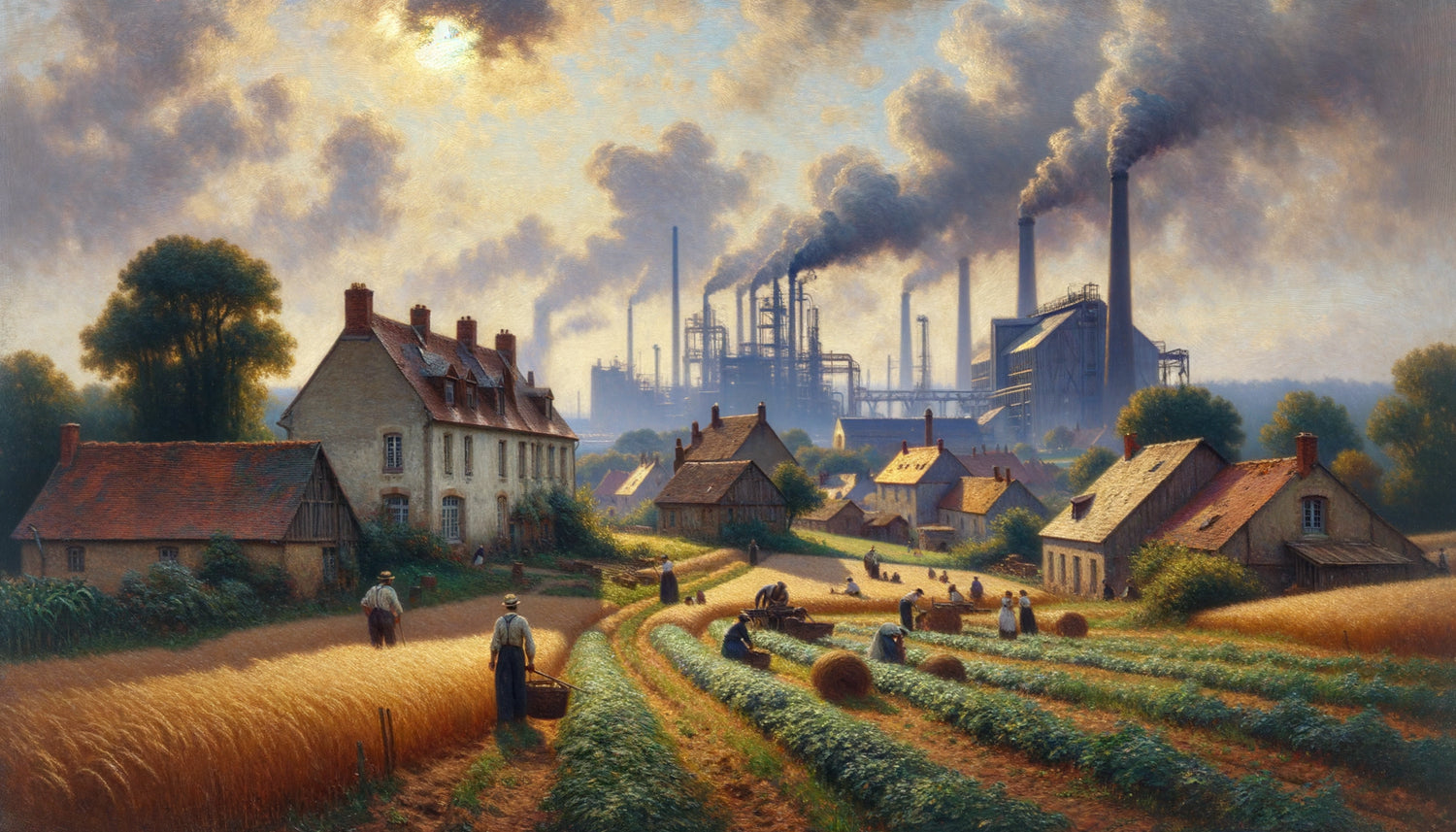
One of the most striking aspects of this documentation concerns the arrival of industry in rural areas. Pissarro doesn't dramatize or condemn; he shows. In his compositions, factory chimneys gradually appear on the horizon, first timidly in the background, then increasingly present.
His painting 'The Factory near Pontoise' from 1873 perfectly illustrates this new coexistence. Industrial smoke rises into the sky above ancestral roofs. The tones remain harmonious, almost soothing. Pissarro documents the transformation without aesthetic judgment, but with total honesty. He shows that this mutation does not abruptly erase the old world: it superimposes itself on it, creating hybrid, transitional landscapes.
This approach reveals something essential: the industrialization of the rural landscape was not a sudden rupture but a gradual infiltration. Factories are established along rivers, railways cross fields, metal bridges replace stone structures. Pissarro's documentation of the French countryside shows this metamorphosis as a geological phenomenon, slow but inexorable.
The detail that speaks: the small signs of change
Pissarro's eye excels at capturing revealing details. An abandoned cart in favor of a modern one. Telegraph poles piercing the horizon. Vegetable gardens transformed into buildable parcels. These micro-observations constitute the documentary strength of his work. They tell the story that historical frescoes forget: that of everyday life evolving.

Agricultural mutations under the brush
Beyond industry, Pissarro documented the transformation of agricultural practices themselves. His scenes of harvesting, plowing, and gathering span nearly forty years. We observe the evolution of tools, the modification of gestures, the change in work organization.
In his works from the 1880s, plowing scenes still show traditional techniques, with horses pulling wooden plows. Twenty years later, compositions incorporate new equipment and different methods. The French countryside is not only transforming in its physical structures but also in its rhythms and practices.
Paintings depicting rural markets are particularly eloquent. We see how products evolve, how costumes modernize, how exchanges transform. These market scenes in Gisors or Pontoise become veritable sociological snapshots, capturing the clothing, postures, and interactions of an era in transition.
When the city gains ground
Perhaps the most prophetic aspect of this documentation concerns urban expansion. Pissarro captured the transformation of the suburban landscape with remarkable acuity. He paints the sprawling suburbs, the growing villages, the intermediate spaces that are born between city and countryside.
His views of Louveciennes in the 1870s show this transition zone, this no man's land where bourgeois villas still border traditional farms. The roads come alive with new traffic: Sunday strollers, Parisian families seeking fresh air, residents making the daily commute to the capital.
The documentation of this transformation reveals the birth of a new way of life: the suburb. Pissarro captures the first signs of reverse urban exodus, when the city begins to spill over into the countryside. His canvases show newly built houses with standardized architecture, enclosed gardens replacing open fields, fences and hedges materializing private property.
The train as a protagonist of change
The railway appears regularly in this visual chronicle. Not as the main subject, but as a disruptive element of the landscape. The fumes from locomotives pierce the rural horizon, rails cross the compositions, stations become new centers of life. Pissarro documents how this infrastructure radically modifies the perception and use of rural space.

A palette that embraces atmospheric mutations
Aspect often overlooked: the transformation of the rural landscape was not only physical, but also atmospheric. Pissarro understands this intuitively. His palette evolves with his subject. The clear and pure tones of his early rural works are gradually enriched with grays, browns, more complex and less saturated tones.
This chromatic evolution is not merely stylistic: it objectively documents the increasing pollution, the change in light due to industrial fumes, the very change in atmosphere. His skies, increasingly veiled in his later works, bear witness to a new environmental reality.
Compare his skies of Louveciennes in 1870 with those of Éragny in 1895: the difference is striking. The bright azures give way to more opaque celestial vaults, crisscrossed with smoke and mists. The documentation of the landscape becomes that of an invisible but fundamental transformation: that of the very air breathed by the inhabitants.
Transform your interior with the poetry of changing landscapes
Discover our exclusive collection of landscape paintings that capture the essence of these territories between two eras, where nature and modernity dialogue in harmony.
The legacy: seeing our own era through the eyes of Pissarro
When we contemplate this documentary work today, we receive much more than a historical testimony. Pissarro bequeathed us a gaze, a method for observing and understanding the transformations of our own time. His patient approach, attentive to detail, open to contradictions, remains strikingly relevant.
Our contemporary landscapes are experiencing equally profound changes: urban sprawl, intensive agriculture, soil sealing, climate change. Pissarro's lesson reminds us of the importance of documenting these transformations without complacency or catastrophism, but with lucidity and sensitivity.
His paintings also teach us that change never completely erases what came before. In the transformation of the French rural landscape that he documented, the old and the new coexist, overlap, create temporary balances. This lesson in nuance resonates particularly today, in our debates on land management and heritage preservation.
Imagine yourself in fifty years, looking at photographs of our current landscapes with the same fascination we feel for Pissarro's canvases. What transformation will you see? What details will strike you? This projection helps us measure the importance of his work: he offers us this retrospective gaze, this temporal distance that transforms the mundane into the precious, the ordinary into the extraordinary.
The invitation that Pissarro extends to us through his work is simple but profound: really look. Observe the places we pass every day, note their subtle evolutions, understand that we too are witnesses of an era tipping over. Hang a reproduction of his landscapes in your home, and you will see: your view of your own environment will transform. You will begin to see the temporal strata, the signs of change, the complex beauty of evolving spaces.
Frequently asked questions about landscape documentation by Pissarro
Why is Pissarro considered a documentarian rather than simply an Impressionist painter?
Pissarro stands out through his systematic method and consistency. Unlike Monet, who sought spectacular light effects, or Renoir, who favored leisure scenes, Pissarro returned to the same locations year after year to observe their transformations. He wasn't looking for a magical moment but temporal progression. His series of paintings function as comparative studies, showing the same place at different times. This methodical, almost scientific approach makes him a true visual chronicler of his time. He noted changes in infrastructure, architecture, agricultural practices, and even the atmosphere itself, creating an archive of visual richness unparalleled in its documentary value. His work becomes a tool for historians, sociologists, and geographers studying territorial transformations of the 19th century.
How to incorporate Pissarro’s documentary spirit into my interior decoration?
The approach is more subtle than it appears. Rather than simply hanging a reproduction, think in terms of spatial storytelling. Create a wall dedicated to transforming landscapes: combine different views of rural areas from various eras to tell a story of evolution. Mix reproductions of Pissarro’s work with contemporary photographs of rural areas, creating a temporal dialogue within your space. Choose frames that respect the authenticity of the works: natural woods, subdued tones, nothing too ornamental. The idea is to create a contemplative atmosphere conducive to attentive observation. Position these artworks in passageways where you will encounter them daily, just as Pissarro returned daily to his motifs. Accompany them with natural elements: branches, stones, raw textiles that recall the materiality of the represented landscapes. This approach transforms your interior into a space for reflection on time, change, and the memory of places.
Which of Pissarro’s works are most representative of this documentation of rural transformations?
Several paintings particularly well embody this documentary dimension. 'The Factory near Pontoise' (1873) masterfully shows the coexistence of rural and industrial worlds. 'The Road to Louveciennes' in its various versions illustrates the evolution of the same road over several years. The views of Eragny-sur-Epte from the 1890s capture the process of suburbanization with extraordinary finesse. 'The Côte des Bœufs at l'Hermitage' (1877) documents topographical changes and urban expansion. His series of rural markets, particularly those in Gisors, are veritable sociological snapshots. To discover these works, focus on the periods 1870-1880 and 1890-1900, times of intense territorial transformations. Pay particular attention to the backgrounds: it is often there that Pissarro slips in the clues of change, the subtle signs of modernization infiltrating the traditional landscape.