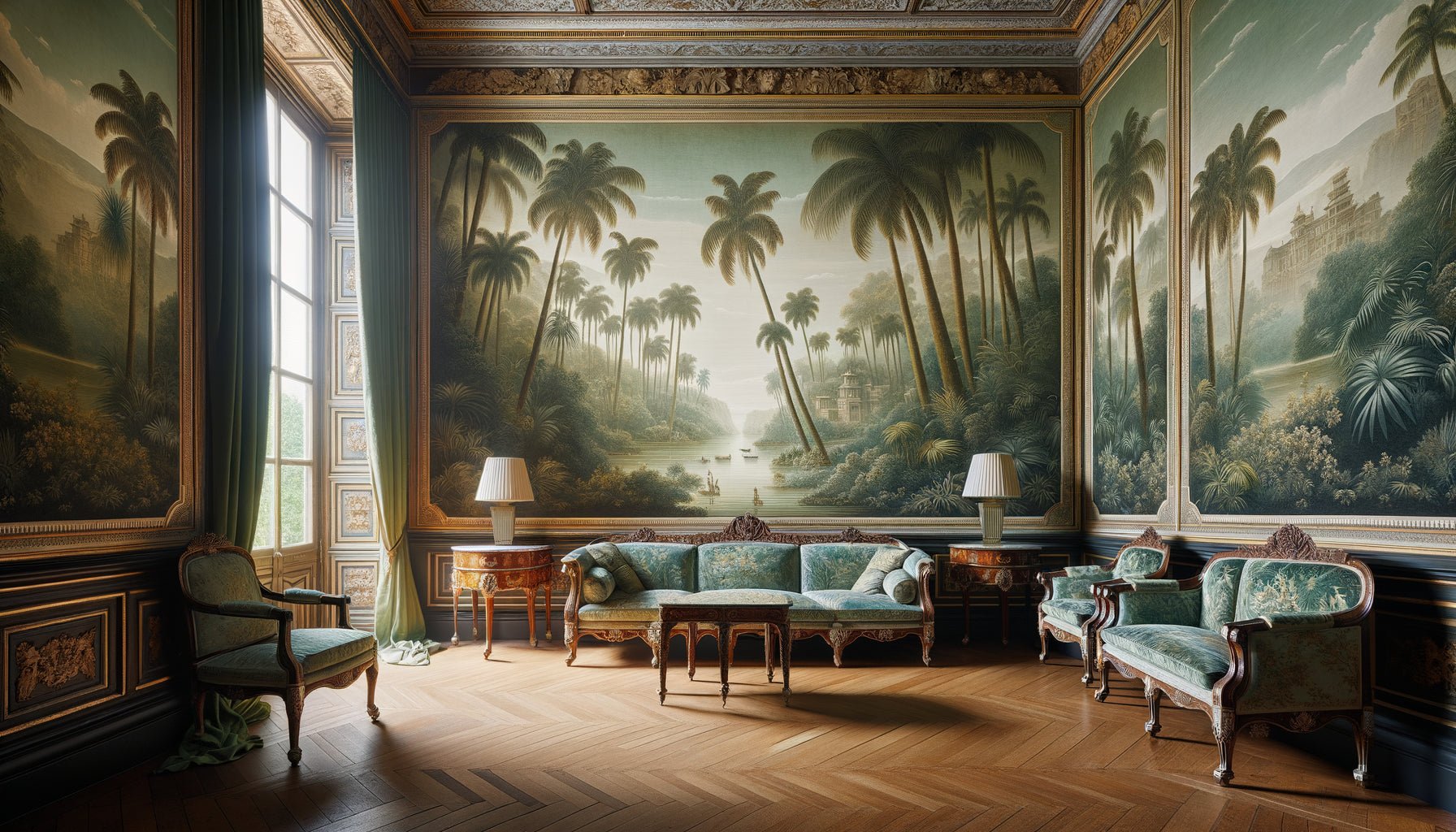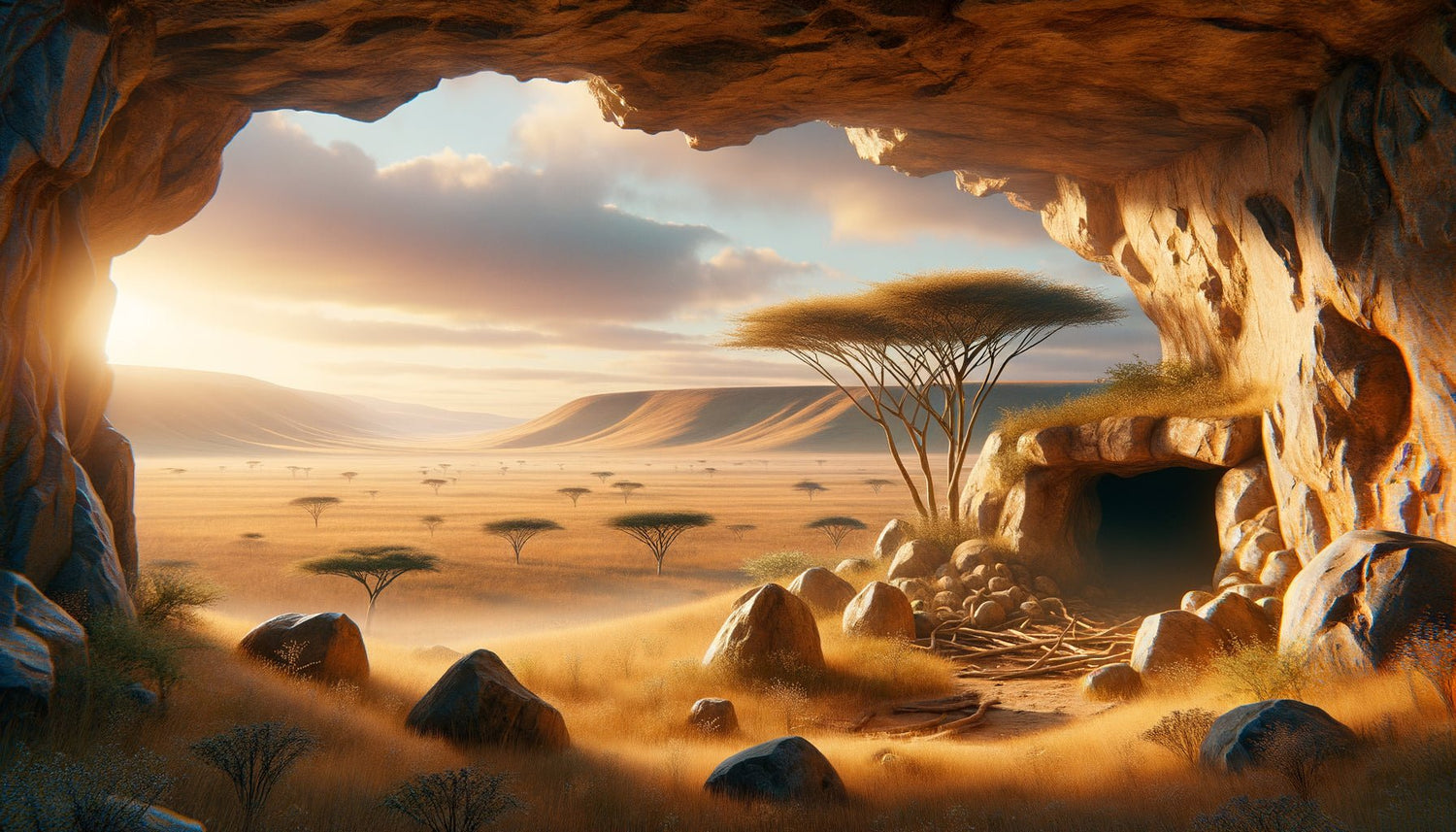
Why do you feel this irresistible attraction to a painting depicting a clearing bordered by trees with a view of the horizon? Why does your gaze linger on these wall landscapes where one can make out a natural shelter overlooking a valley? It's not a coincidence. Your ancestral brain instinctively recognizes the environments that allowed our ancestors to survive for millennia.
Here’s what Prospect-Refuge theory brings to your interior decoration: a scientific understanding of our innate visual preferences, a key to creating soothing and secure spaces, and an infallible guide to choosing wall landscapes that deeply resonate with our human nature. This theory developed by British geographer Jay Appleton in the 1970s reveals how our aesthetic choices are shaped by instincts dating back 300,000 years.
You may have already wondered why some works touch you immediately while others leave you indifferent, despite their technical beauty. You hesitate in front of a wall landscape, unable to rationally explain your attraction or reluctance. This misunderstanding of our own aesthetic reactions can turn the choice of decoration into a real puzzle.
Rest assured: this visceral reaction is not an inscrutable mystery. It is explained by fascinating evolutionary mechanisms that we will decipher together. By understanding how Prospect-Refuge theory works, you will have a powerful framework for analyzing your preferences and making decorative choices that truly transform your relationship with your interior space.
I invite you on a journey at the intersection of neurobiology, evolution, and aesthetics to discover how your prehistoric brain still dictates today's choices in wall landscapes.
Prospect and Refuge: the two pillars of our ancestral survival
The Prospect-Refuge theory is based on a simple but revolutionary principle: the environments we instinctively find beautiful are those that offered our hunter-gatherer ancestors the best chances of survival. Jay Appleton identified two fundamental needs that have shaped our visual preferences since time immemorial.
The prospect refers to the ability to see without being seen, to monitor the environment for opportunities (game, fruit, water) and threats (predators, hostile groups). In the African savanna where humanity evolved, a good viewpoint could make the difference between life and death. This vital necessity has been inscribed in our aesthetic DNA: we are naturally drawn to landscapes offering an unobstructed view of the horizon, distant perspectives, open panoramas.
The refuge, for its part, represents our need for protection, shelter, and security. Our ancestors sought out caves, rocky overhangs, dense thickets where they could hide from dangers. This ancestral need explains why we appreciate partially enclosed spaces, alcoves, natural frames that suggest a protective place. In a wall landscape, elements of refuge manifest as trees framing the scene, caves, structures offering symbolic protection.
The balance between these two dimensions creates what we perceive as an ideal environment. A wall landscape combining prospect and refuge simultaneously activates our neural circuits for safety and exploration, generating that ineffable feeling of well-being that we all seek in our interior decoration.
Why your living room prefers the savanna to the ice floe
Research in environmental psychology has confirmed Appleton's intuitions with compelling data. Studies conducted on thousands of participants across different cultures show an almost universal preference for certain types of landscapes, regardless of the environment where the people surveyed live.
Savanna-like landscapes consistently top the preferences, even among people who have never left urban or forest environments. These landscapes perfectly combine the principles of Prospect-Refuge theory: scattered trees offering potential shelter, vast grassy expanses allowing you to spot movements, the presence of water, moderate relief offering viewpoints.
Conversely, environments lacking these characteristics – arid deserts, endless plains without relief, forests too dense obstructing the view – unconsciously generate a slight anxiety. These wall landscapes can create a subtle malaise in your interior without you understanding the reason. Your prehistoric brain identifies them as risky environments: impossible to see danger coming, nowhere to hide.
This evolutionary programming explains why a painting depicting a clearing with a lake in the distance, framed by a few majestic trees, provokes such a positive emotional reaction. Your limbic system immediately recognizes: water for survival, visual clearance for safety, trees for refuge, open space for mobility.

Discover this inspiring artwork
The visual codes your unconscious instantly deciphers
Your brain analyzes a wall landscape in milliseconds, before your consciousness intervenes. This rapid assessment seeks specific clues inherited from our evolutionary past. Understanding these codes allows you to decipher your reactions and refine your decorative choices.
Depth of field: your safety radar
Wall landscapes offering multiple planes – foreground, midground, background – are systematically favored. This spatial stratification allowed our ancestors to assess distances and plan their movements. A painting with this depth creates a feeling of space and breath in your interior, as if the walls receded symbolically.
Paths and waterways: invitation to travel
Your ancestral brain loved paths winding through the landscape and rivers tracing their way. These elements signaled safe routes, explored by others, potentially leading to resources. In a wall landscape, a path that recedes into the scene creates mystery and invitation, two powerful drivers of visual engagement.
High points: the power of overhang
Views from above, from a hill or cliff, intensely activate our prospect system. These wall landscapes provide a feeling of control and mastery over the environment. They are particularly effective in spaces where you want to reinforce a sense of confidence and quiet power.
How to apply Prospect-Refuge theory to your decor
Now that you understand the underlying mechanisms, how do you translate this theory into concrete choices for wall landscapes? Here are the guiding principles that will transform your decorative approach.
Prioritize balanced compositions where refuge and prospect coexist harmoniously. A landscape showing a panoramic view from the entrance of a cave, a lake glimpsed between the trunks of a clear forest, an alpine panorama from a chalet terrace – these compositions simultaneously activate both of your ancestral needs. Your nervous system interprets: I am protected AND I maintain visual control.
Adapt your choices to the function of each room. In a bedroom, where the need for refuge predominates, opt for more intimate wall landscapes: peaceful undergrowth, enclosed garden, valley sheltered by mountains. In an office or living room, prioritize prospect: open horizons, sea views, mountain peaks. This consistency between spatial function and landscape type subconsciously reinforces psychological comfort.
Consider scale and framing. A large format representing a Prospect-Refuge landscape creates a true virtual window, multiplying the effect of spatial opening. The frame itself becomes an architectural element that structures your refuge (the room) while offering the prospect (the view). This mise en abyme resonates deeply with our psyche.

Discover this inspiring artwork
When biophilia meets our prehistoric instincts
The Prospect-Refuge theory is part of a broader scientific movement: biophilia, our innate affinity for living things. Biologist Edward O. Wilson has demonstrated that visual contact with nature, even virtual, reduces stress, improves concentration and accelerates physical recovery.
Wall landscapes that respect the principles of Prospect-Refuge are not just decorations: they are tools for psychological well-being. Studies conducted in hospitals have shown that patients whose rooms overlook green spaces or contain representations of balanced natural landscapes recover faster, consume less pain medication and express greater satisfaction.
In your interior, a landscape painting well chosen acts as a silent emotional regulator. Your gaze naturally rests on it during moments of tension, and your reptilian brain recognizes signals of safety: viable environment, resources present, shelter available. This recognition triggers a micro-relaxation, imperceptible but real, which accumulates over time.
Modernity has cut us off from the environments that shaped our species. Our urban apartments, our windowless offices, our digital lives create a sensory deficit that our nervous system perceives as an anomaly. Visually reintroducing these ancestral landscapes through wall art partially compensates for this deprivation, restoring a balance that our biology demands.
Your ancestral brain deserves what it has desired for 300,000 years
Discover our exclusive collection of landscape paintings that reconcile your prehistoric instincts with your contemporary aesthetic.
From the African savanna to your wall: a continuity of 300,000 years
There is something deeply moving about this revelation: when you contemplate a mural landscape that touches you, you activate the same neural circuits as your ancestors scanning the horizon at dawn of humanity. This dizzying continuity connects your modern living room to the plains of East Africa where Homo sapiens emerged.
The Prospect-Refuge theory does not diminish the beauty of art or the sophistication of your tastes. On the contrary, it reveals the unsuspected depth of our aesthetic reactions. Your attraction to that mountain painting with its perched chalet is not superficial: it plunges its roots into the very history of your species.
This understanding transforms your relationship with your interior decoration. You are not simply hanging a decorative object: you are creating a bridge between your condition as a modern human and your fundamental nature. You honor the needs of that part of you that has not changed since your ancestors painted the walls of caves.
Trust these visceral intuitions when choosing a mural landscape. If a work provokes in you this inexplicable resonance, this shiver of recognition, listen to this voice. It is your prehistoric brain whispering:
Frequently asked questions about the Prospect-Refuge theory
Does the Prospect-Refuge theory only apply to natural landscapes?
No, and that's fascinating! Although the theory was developed to explain our preferences for natural environments, its principles also apply to urban and architectural landscapes. You can feel the same attraction for a view of Paris from a terrace (prospect) framed by Haussmannian buildings (refuge), or for an Italian alleyway opening onto a sunny square. Your brain simply seeks balance between visual openness and protection, whatever the environment. That's why some urban landscape murals work so well: they unconsciously respect these ancestral principles by offering depth of field, protective framing and clear perspective. Architecture itself has incorporated these principles: think of bow-windows, loggias, verandas – all devices that create a refuge from which to observe the outside world.
Can my personal tastes contradict this theory?
Excellent question! The Prospect-Refuge theory describes general trends, not absolute rules. Your personal history, your culture, and your experiences also shape your aesthetic preferences. If you grew up in the mountains, alpine landscapes will resonate differently than for someone who lived by the sea. However, even within this diversity, the fundamental principles remain operative: you will probably seek compositions that balance openness and protection, even if the specific environments vary. Some people prefer dense forests (dominant refuge), others vast marine horizons (dominant prospect) – these preferences may reflect different temperaments or psychological needs of the moment. The important thing is to recognize these mechanisms in order to make conscious choices that truly suit you, rather than blindly following decorative trends.
How to tell if a wall landscape respects the Prospect-Refuge theory?
It's simpler than you think! Ask yourself three questions in front of a wall landscape: Can I see far into this image? (prospect), Are there elements that suggest shelter or protective framing? (refuge), and Does the composition make me want to explore visually? If you answer yes to these questions, the landscape probably respects the principles of the theory. Specifically, look for multiple planes of depth, natural elements that frame the scene without completely obstructing it, the presence of water or paths that guide the eye, and a balance between open spaces and structuring elements. Also trust your visceral feeling: if a work gives you simultaneously a sensation of openness and security, if you find yourself imagining that you could enter this scene, then it is probably activating harmoniously your prospect and refuge instincts. Your body knows, even when your mind does not yet conceptualize.