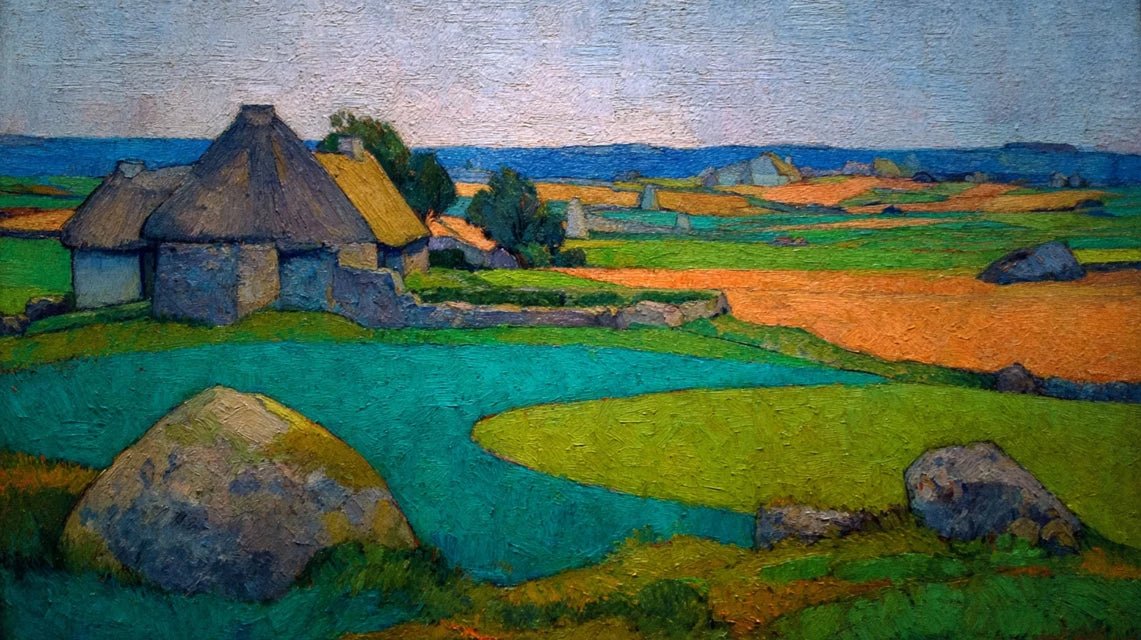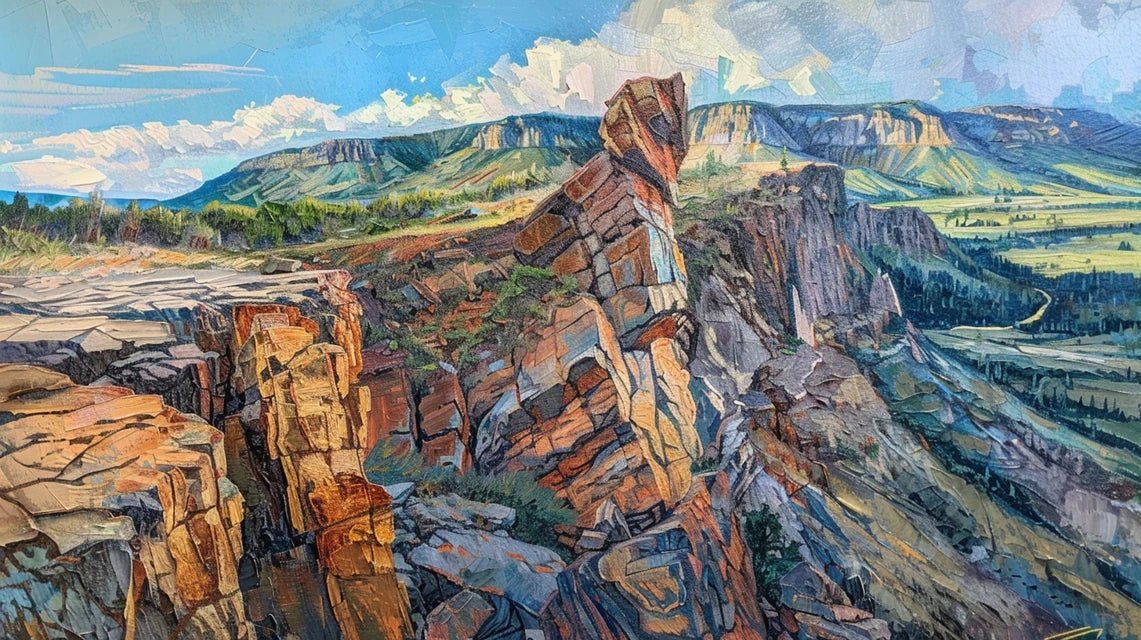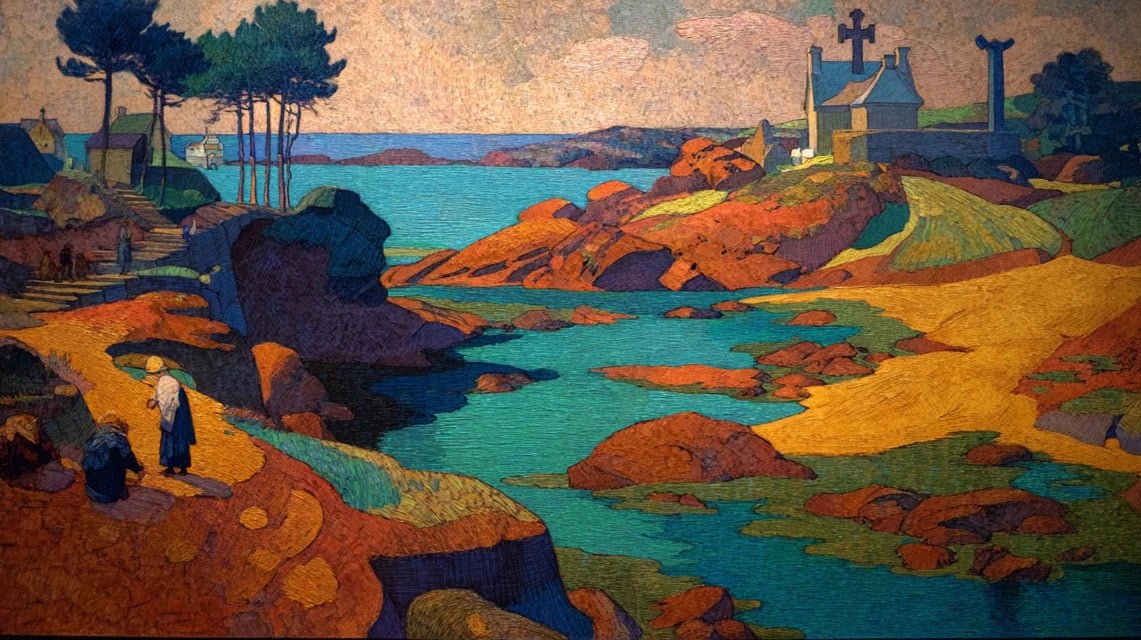
In 1886, a man arrived in the small Breton town of Pont-Aven. Paul Gauguin was then seeking an inexpensive place to paint, far from the bustle of Paris. He had no idea that he would transform this village of 1,500 inhabitants into the cradle of modern art.
Two years later, everything changed. His meeting with the young Émile Bernard triggered a pictorial revolution. Together, they invented synthetism – an approach that radically broke with the dominant Impressionism. There was no longer a question of faithfully reproducing nature: now, synthetist landscapes expressed raw emotion, the painter's inner vision.
Gauguin himself said it: "When my clogs fall back on this granite soil, I hear the muffled, dull and powerful sound that I seek in painting." This sentence sums it all up. Breton landscapes became for him not subjects to copy, but sensations to translate. The moors, the crosses, the rocky coasts were transformed into colorful symphonies where reality bends to the demands of art.
Techniques that revolutionize the landscape
How to paint a landscape when you reject established rules? Artists from the Pont-Aven school invented radical solutions. Cloisonnisme became their signature: black outlines delineate areas of pure color, like in medieval stained glass windows. The result? Compositions of unprecedented visual power.
Colors explode, freed from all naturalist constraints. A field can be bright red, a tree entirely blue. "Pure color! We must sacrifice everything to it," proclaims Gauguin. Emotional intensity takes precedence over optical plausibility. It is a total liberation for these painters who were stifled by academic conventions.
The fundamental principles of synthetist landscapes :
- Blocks of pure colors : suppression of gradations in favor of uniform and intense colored areas
- Cloisonnisme : dark outlines delineating each form, inspired by stained glass windows and Japanese prints
- Geometric shapes : radical simplification favoring circles, triangles and straight lines
- Suppression of perspective : stepped planes without traditional atmospheric depth
- Creative memory : mental reconstruction of the landscape rather than faithful copying of the motif
- Symbolic color : chromatic choices guided by emotion rather than observed reality
Traditional perspective also disappears. The planes are stacked like theater sets, creating symbolic depth rather than realistic depth. Superfluous details? Removed. Only the essentials remain: simple geometric shapes, straight lines that rhythmize space, blocks of color that structure the composition.
Another major innovation: the painterly technique of creative memory. Instead of setting up their easel facing the subject, artists reconstruct the landscape in their studio, retaining only the most striking elements. This approach transforms each canvas into a synthesis between observation and imagination. To discover landscape paintings that perpetuate this creative spirit, contemporary works still draw inspiration from these revolutions initiated on the Breton coast.
Iconic artworks that mark history
Some canvases perfectly embody this revolution. The Moulin David (1894), painted after Gauguin's return from Tahiti, shows a unique fusion between Polynesian influences and Breton synthetism. Forms reach radical simplicity, colors a new boldness characteristic of post-impressionism.
Scenes of kelp gatherers particularly fascinate Gauguin. In 1889, he painted these coastal workers in marine environments with intense hues – ochres, deep blues, saturated greens. Human figures merge into the landscape, participating in the same plastic rhythm as rocks and waves.
The adventure continues in Pouldu. In 1889, fleeing the tourist influx in Pont-Aven, Gauguin settled in this isolated hamlet with Sérusier, Filiger and the Dutchman de Haan. The landscapes created there push the synthetist logic even further. Colors become saturated to the extreme, geometric shapes towards abstraction.
Each painting seeks to capture the primitive soul of Brittany. Calvaires, granite moors, cliffs battered by winds are no longer simple decorative motifs. They become symbols charged with spirituality, fragments of an archaic world that Gauguin idealizes in his modern painting.
A school that attracts all of Europe
The movement quickly seduces beyond French borders. Paul Sérusier becomes the evangelist of synthetism, transmitting Gauguin's lesson to future Parisian Nabis. His painting Le Talisman (1888), painted under Gauguin's dictation in the Bois d'Amour, becomes the visual manifesto of the movement.
Between 1888 and 1890, techniques evolve at a lightning speed. The earliest works still retain a link with observed reality. Gradually, the School of Pont-Aven totally emancipates itself. In Pouldu, synthetism reaches its peak: maximum simplification, vibrant colors, assumed geometrization.
Artists from all over Europe join the adventure. The Polish Wladyslaw Slewinski adopts Gauguin's principles in his still lifes and landscapes. The Dutchman Meijer de Haan creates Landscape with blue tree (1889-1890), where a tree of an unreal blue dominates a dreamlike composition. Each brings their personal sensitivity while respecting the fundamental synthetist principles.
Maxime Maufra perfectly embodies this transmission. Arriving after Gauguin's departure, he discovers the decor of the Marie Henry inn. Discussions with Filiger transform his painting: from a wise post-impressionism, he switches to a bold synthetic approach.
A legacy spanning a century
The impact of synthetic landscapes extends far beyond Brittany. In 1889, the exhibition at Café Volpini in Paris, organized on the sidelines of the Universal Exhibition, presented the works of the « Impressionist and Synthetist Group ». The public was astonished by these canvases with violent colors, simplified forms, announcing symbolic art.
The critic Albert Aurier became the theoretical spokesperson for the movement. His articles disseminated the principles of synthetism among young Parisian artists. The group of Nabis – Sérusier, Maurice Denis, Vuillard, Bonnard – seized these ideas and extended them in new directions.
Maurice Denis formulated the principle that sums it all up: « A painting, before being a battlefield, a nude woman or any anecdote, is essentially a flat surface covered with colors ». This famous sentence foreshadows all the revolutions of the 20th century. All modern art bears the mark of Pont-Aven.
Henri Matisse and the Fauves directly inherited this liberation of color. Pablo Picasso recognized the importance of formal simplification initiated by Gauguin. The German Expressionists, the abstract artists, all are part of this lineage. The landscapes of the Pont-Aven school have opened a path that generations of artists will continue to explore.
Today, the Musée de Pont-Aven, located since 2016 in the former Hôtel Julia, preserves more than 5,000 works (Source: Musée de Pont-Aven) testifying to this artistic epic. Visitors discover how a small Breton village became the laboratory of modernity. The synthetic landscapes of Gauguin continue to fascinate with their timeless audacity, their ability to transcend simple representation to reach the very essence of artistic vision.
FAQ: The Pont-Aven school and synthetic landscapes
What distinguishes a synthetic landscape from an Impressionist landscape?
The synthetic landscape rejects the faithful reproduction of light and atmospheric effects dear to the Impressionists. It favors flat colors, marked outlines and geometric simplification of forms. Where the Impressionist captures the fleeting moment, the synthetist reconstructs the landscape from memory to retain only its emotional essence.
Why did Gauguin choose Pont-Aven to develop his style?
Gauguin arrived in Pont-Aven in 1886 initially for economic reasons – Brittany was then known to be cheap. But he also found an environment conducive to artistic experimentation: authentic Breton landscapes, a community of artists open to innovations, and a « primitive » atmosphere that nourishes his spiritual quest. His meeting with Émile Bernard in 1888 catalyzed the birth of synthetism.
What is the legacy of the synthetist landscapes of the Pont-Aven school?
Synthetist landscapes revolutionized modern art by freeing color and form from the obligation of faithful representation. They directly influenced the Nabis, Matisse's Fauvism, and foreshadowed 20th century abstraction. The principle of Maurice Denis – “a painting is essentially a flat surface covered with colors” – summarizes this legacy that continues to irrigate contemporary art.