Imagine the scene: 1786, two men reach the top of the Alps for the first time. Jacques Balmat and Michel Paccard don't yet know it, but their feat will change the course of European art. This first ascent of Mont Blanc opens a new era where two worlds will meet: that of mountaineers who carve into the summits, and that of painters who seek to capture their beauty.
19th-Century Mountaineering as a Visual Revelation for Painters
For centuries, mountains inspire fear. Artists view them from afar, from safe valleys. Their canvases show threatening peaks, often shrouded in mist and legends. But everything changes in the 1850s. Ascents multiply, summits fall one after another. And with them, artistic certainties.
For the first time, painters climb up there. Really up there. They discover alpine panoramas that no one has ever seen before. The light plays differently at 4000 meters. Glaciers reveal unsuspected ice architectures. Seracs sculpt ephemeral cathedrals. It is impossible to paint these wonders from a Geneva studio.
In 1874, the French Alpine Club is founded. Twenty-four years later, it sponsors an Independent Painting School. The message is clear: art and mountaineering now go hand in hand. Across the Channel, the British of the Alpine Club open their doors to French artists. These exchanges greatly enrich the alpine vision.
Mountain Painting Techniques Adapted for Mountaineers
How do you paint when the wind freezes your fingers? How do you fix a color before the sun disappears behind a ridge? Painter-mountaineers have to reinvent everything. Fortunately, the 1840s bring a decisive innovation: tubes of paint. No more fragile and cumbersome pots. Colors now travel in backpacks, alongside ice axes and ropes.
On glaciers, a new technique emerges: pochade. These small formats capture the essentials in a few quick brushstrokes. There's no time to refine when the weather changes every ten minutes. This spontaneity gives outdoor paintings a striking freshness, reminiscent of the Barbizon School.
Pictorial realism becomes the golden rule. Painter-mountaineers observe, analyze, transcribe:
- The mists that rise from the valleys at dawn
- The gaping crevasses that crisscross the glaciers
- The violet shadows that slide over the snow in the late afternoon
- The thousand shades of white, from the dirty gray of the névés to the blinding flashes of séracs
This approach contrasts with the Romantic movement. No more invented dramas, no more apocalyptic skies. Just the mountain, as it is.
19th-Century Painter-Mountaineers, Pioneers of a New Realism
Gabriel Loppé is the archetype of these artist-adventurers. In 1846, at the age of 21, he discovered his vocation during a hike: at the top of a Languedoc mountain, he met painters at work. The click is immediate. Three years later, he sets his gaze on Chamonix. It's love at first sight.
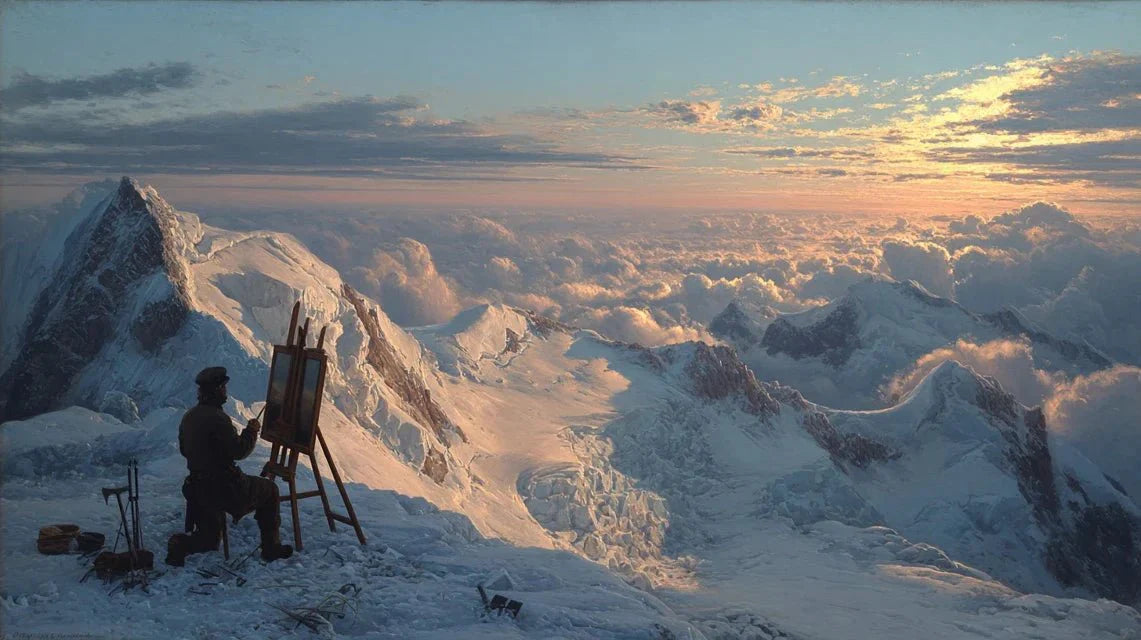
Between 1849 and 1912, Loppé engraved Mont Blanc forty times. Forty! With each ascent, his painting equipment accompanied him. He set up his easel on glaciers, bivouacked for several days at altitude to observe the light. He even painted at the summit of Mont Blanc, creating panoramas impossible to imagine from the valley.
The first foreigner admitted to the Alpine Club of London, Loppé bridged France and England, between alpinism and art. His paintings exude a particular atmosphere, this spontaneity that is only found in on-site work. In 1870, he even opened a gallery in Chamonix: "Alpine Painting Gabriel Loppé". Every summer, sixty paintings are exhibited, some monumental with their 4 meters high.
The Geneva school, with Alexandre Calame and François Diday, lays the first stones. But it was the Loppés who really engraved the summits, brush in hand.
If you appreciate these authentic representations of the mountain, discover our wall art landscapes collection which celebrates the beauty of alpine panoramas.
The influence of alpinism on the pictorial representation of glaciers and summits in the 19th century
Alpinism transforms the gaze of painters. When you have walked on a glacier, you understand its mechanics. You know how to spot dangerous areas, you read the snow like an open book. This intimate knowledge is reflected in the painting. Crevasses are no longer vaguely worrying blue lines. They become precise abysses, with their depth, their geometry, their real threat.
Snow, above all, becomes a subject in its own right in alpine landscapes. Before mountaineer-painters, it was just a white backdrop. Loppé and his peers develop a sophisticated palette. They capture the blue shadows of morning, the pink reflections of sunset, the silvery glints of noon. This technical mastery foreshadows Impressionism, while remaining faithful to reality.
The skies also change. Exit the dramatic clouds of Romanticism. Mountaineer-painters prefer clear skies that reveal geology. Why invent spectacle when the mountain naturally offers it? A well-lit rock face, a jagged ridge against the blue, a dizzying crevasse: these elements are enough to create emotion.
This legacy carries over into the 20th century. It influences even mountaineering photography which emerges at the end of the 1800s. The principle remains the same: authenticity takes precedence over artifice. Lived experience is worth all special effects. Perhaps this is the most beautiful legacy of mountaineer-painters: having proven that the truth of the mountain surpasses all fictions.
FAQ: Alpinism and Mountain Painting in the 19th Century
Q1: Why is Gabriel Loppé considered the founder of mountaineer-painters?
Gabriel Loppé was the first artist to systematically paint at high altitude during his alpine expeditions. Between 1849 and 1912, he made more than 40 ascents of Mont Blanc with his painting equipment, creating works directly from the summits and glaciers. This innovative approach established the foundations of the mountaineer-painters' school.
Q2 : How did the invention of paint tubes facilitate mountain painting?
Paint tubes, invented in the 1840s, revolutionized painting at altitude. Unlike traditional pots, they allowed artists to easily transport their colors during ascents without risk of drying out. This technical innovation made it possible to paint on location in high mountains.
Q3 : How did the approach of mountain painters differ from Romanticism?
Mountain painters of the 19th century favored a rigorous realism based on direct observation, unlike Romantics who dramatized the mountain with stormy skies and theatrical effects. Their practical knowledge of the terrain (glaciers, crevasses, rock formations) allowed them to provide an authentic and documentary representation of high mountains.