At the turn of the 20th century, a French artist revolutionized landscape representation by imbuing it with an unprecedented mystical dimension. Maurice Denis, a major figure in the Nabi movement, transforms nature into a true visual sanctuary where every natural element becomes a carrier of spiritual meaning. His sacred landscapes do not seek to faithfully reproduce reality, but to reveal the invisible divine presence in creation. This revolutionary approach to Christian landscape marks a break with Impressionism and opens the way to a deeply symbolic painting, where nature becomes the very language of faith.
Nature as Theophany in Maurice Denis
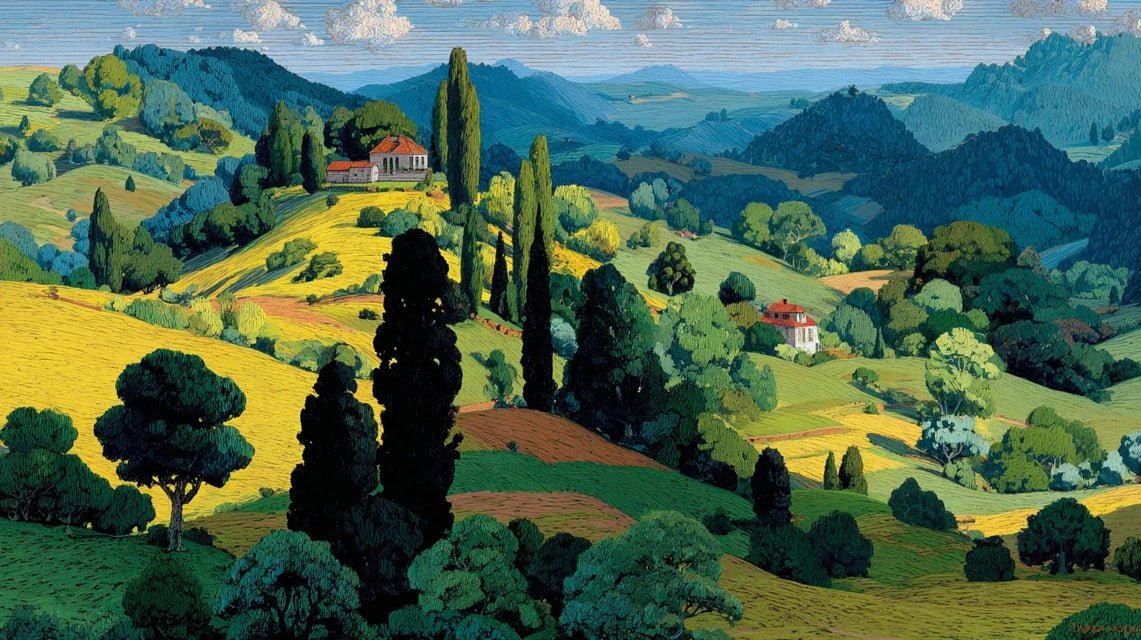
For Maurice Denis, the landscape is never neutral. Every tree, every hill, every ray of light participates in a divine revelation. This vision is rooted in an ancient Christian tradition where creation bears witness to its Creator. In his compositions, Denis uses simplified forms and symbolic colors to transform natural scenes into spaces for spiritual contemplation.
His gardens in Brittany or at the Priory become revisited Eden gardens, where plant harmony evokes divine order. The stylized trees stand like cathedral columns, creating a sacred natural architecture. Light, omnipresent, is never simply atmospheric: it symbolizes the transcendent presence that bathes all things. This approach transforms his landscapes into true modern icons, where nature becomes support for meditation and visual prayer.
Christian Symbolism in Landscape Compositions
Denis integrates a rich palette of Christian symbols into his landscapes which dialogue with the natural elements. Water, omnipresent in several of his works, refers to baptism and spiritual purification. Winding paths evoke the soul's journey towards redemption, while enclosed gardens recall the hortus conclusus, par excellence the Marian symbol.
The colors themselves carry a deliberate symbolic charge. Blue, the Marian color, dominates many skies and draperies integrated into rural scenes. Green represents hope and eternal life, while the gold of twilight lights evokes celestial glory. This chromatic coding transforms each landscape into a silent theological narrative. For those who wish to discover how landscape can become a carrier of meaning, contemporary landscape paintings sometimes offer this same search for symbolic depth.
The Influence of Catholic Spiritual Renewal
Denis’s spiritual landscapes are set within the context of the French Catholic renewal of the late 19th century. Converted to Catholicism, the artist actively participates in debates on modern sacred art. He seeks to reconcile artistic modernity with Christian tradition, rejecting both rigid academicism and materialistic realism.
His landscapes reflect the concerns of Catholic intellectuals of his time, particularly those around journals such as L'Art sacré. Denis defends the idea that modern Christian art must be both authentically contemporary and deeply rooted in faith. His landscape compositions thus become visual manifestos of this possible synthesis:
- Formal simplicity inspired by the Italian primitives he admires
- Flat, decorative colors inherited from Japonism and Synthetism
- Rhythmic compositions creating a quasi-musical harmony
- Integration of holy figures into everyday natural settings
- Elevation of the mundane to a transcendent dimension
Decorative cycles: landscapes and sacred narrative
Maurice Denis excels in the art of decorative cycles, where landscapes become the setting for biblical and hagiographic stories. His frescoes and decorative panels for churches and chapels show how Christian landscape can carry a complex spiritual narrative. In these monumental ensembles, nature is no longer simple decoration but an actress in the sacred drama.
The chapel of the Priory in Saint-Germain-en-Laye, which he decorates entirely, perfectly illustrates this fusion between landscape and mystical narrative. Scenes from the life of Christ unfold in stylized gardens where every plant element amplifies the emotional and spiritual charge of the moment represented. The Annunciation takes place in a walled garden, the Crucifixion on a stylized mount that evokes both Calvary and a timeless hill. This approach transforms the landscape into visual liturgy, where the viewer is invited to enter a space of spiritual communion.
Legacy and posterity of the spiritual landscape
Denis's approach to Christian symbolic landscape has profoundly influenced sacred art of the 20th century. His rejection of naturalistic reproduction in favor of a spiritualized vision of nature has inspired many artists seeking to express the invisible through the visible. The Workshops of Sacred Art, which he founded with Georges Desvallières in 1919, perpetuate this vision of a landscape charged with spiritual meaning.
This conception of landscape extends beyond the strictly religious realm to question more broadly the ability of art to reveal a transcendent dimension of reality. Even today, Denis's landscape work invites us to look at nature not as a simple aesthetic spectacle, but as an open book on mystery. His compositions demonstrate that a tree, a garden, a hill can become, through the grace of art, windows onto eternity. This search for spiritual depth in the representation of nature continues to inspire contemporary creators who refuse to reduce landscape to its mere material appearance.
Conclusion
Maurice Denis’s landscapes represent a unique synthesis between artistic modernity and Christian spiritual tradition. By transforming nature into symbolic language, he created a form of modern sacred landscape that transcends simple representation to become visual prayer. His legacy reminds us that art can elevate the gaze beyond appearances to reveal the spiritual dimension of the visible world, a valuable lesson for our often materialistic era.
Frequently Asked Questions
What Christian symbols does Maurice Denis use in his landscapes?
Denis integrates many symbols: water evokes baptism and purification, enclosed gardens represent the Virgin Mary (hortus conclusus), paths symbolize the spiritual journey of the soul. Colors are also symbolic: Marian blue, green of hope, gold of divine glory. Each natural element becomes a carrier of profound theological meaning.
How does Denis renew the tradition of religious landscape?
Denis breaks with academic realism by simplifying forms and using flat decorative colors. He transforms the naturalist landscape into a symbolic composition where nature reveals a divine presence. This approach synthesizes artistic modernity (influence of Japonism and the Nabis) and Christian spiritual tradition, creating an authentically contemporary sacred art.
What is the spiritual influence on Denis’s landscapes?
Having converted to Catholicism, Denis participates in the French spiritual renewal of the late 19th century. His theological vision considers creation as divine revelation. Influenced by the Italian primitives and Thomistic thought, he conceives art as a means of spiritual elevation. His landscapes become spaces for contemplation where the visible reveals the invisible, nature testifying to the Creator.