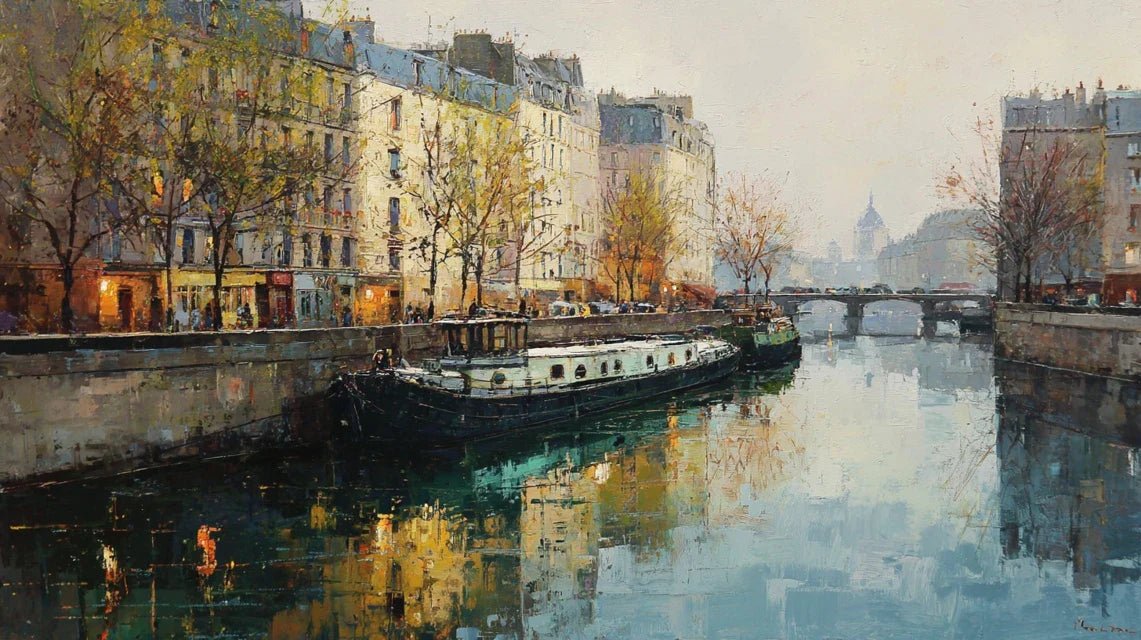
Urban river landscapes hold a unique place in art history. Where the river meets the city, a captivating visual tension is created: liquid nature traverses the space built by man. This coexistence has fascinated artists for centuries, giving rise to representations that evolve with urban transformations and artistic movements. From the Seine in Paris to the Venetian canals, via the Thames in London, these urban aquatic scenes tell more than just picturesque views. They bear witness to the changing relationship between humanity and its environment, between modernity and contemplation, between industry and poetry. Following the evolution of urban river landscape representation is to retrace the history of our cities and our gaze upon them.
From classical veduta to early romantic visions
In the 18th century, urban river landscape representation is part of the tradition of veduta, this art of precise and documentary urban views. Canaletto immortalizes Venice and its canals with an almost photographic accuracy, transforming the Grand Canal into an architectural theater. Rivers then serve as reflective mirrors, amplifying the splendor of the palaces and churches that border them. This approach favors clarity, balanced composition and uniform light that highlights urban order. But with romanticism, the gaze changes. Artists begin to explore atmosphere, light variations and the emotion that these hybrid spaces evoke. Turner, in his views of the Thames, introduces a dramatic dimension where the river becomes as much a protagonist as a backdrop. Mist, trembling reflections and stormy skies herald a new sensibility: the urban river landscape is no longer just a subject to be documented, but an experience to be felt.
Impressionism and the revolution of the river gaze
The years 1860-1880 mark a radical turning point in the representation of urban river landscapes. Impressionism makes the river its preferred field of experimentation. Monet tirelessly paints the Seine at Argenteuil, capturing the infinite variations of light on moving water. What fascinates artists now is no longer the reflected urban architecture, but the very substance of the water, its colored vibrations, its atmospheric effects. Bridges become recurring motifs: modern industrial structures that cut through space and create geometric patterns. To discover how these works continue to inspire contemporary decoration, the landscape paintings offer a varied selection of these aquatic universes. Impressionist painters work outdoors, directly on the banks, prioritizing fleeting impressions over academic compositions. Renoir, Sisley, Pissarro: all explore these intermediate zones where the emerging industrial city still dialogues with almost rural spaces. The urban river landscape becomes the symbol of modernity being invented.
Industrialization and contrasting visions of the urban river
As the 19th century progresses, the representation of urban river landscapes confronts a new reality: massive industrialization of the banks. Factory chimneys, barges loaded with goods, port cranes invade the compositions. Some artists, like the post-impressionists, embrace this transformation. Signac and the neo-impressionists paint industrial ports with a fascination for modern geometry and the chromatic contrasts offered by new metallic structures. Others adopt a more critical or nostalgic gaze. Urban river landscapes then become the scene of a visual tension between:
- The liquid and organic nature of the river
- Vertical and angular industrial architecture
- Smokes and pollution that cloud the atmosphere
- Remnants of an older, more picturesque urbanity
- New human activities related to river trade
This period sees the emergence of an aesthetic of contrast where beauty no longer resides in classical harmony, but in the sometimes violent coexistence of heterogeneous elements. The urban river becomes a social document as much as an artistic subject.
The 20th century: abstraction and new perspectives
With the advent of modernism, the representation of urban river landscapes explodes in a thousand directions. The Fauves saturate the colors of Parisian quays, Derain transforming the Seine into a scarlet ribbon bordered by electric greenery. German Expressionism loads fluvial views with a new psychological intensity, bridges becoming almost menacing structures. Then abstraction seizes the subject: fragmented reflections in the water inspire Cubist compositions, while the rhythms of the river nourish the research of lyrical abstractions. Artists of the CoBrA movement, in the 1950s, reinvent urban river landscapes through a gestural spontaneity that evokes more the vital energy of the river than its actual appearance. Photography and then video also offer new ways to explore these spaces. Perspectives multiply: aerial views, close-ups on details, time sequences that capture the very flow of time. The urban river landscape becomes a field of unlimited formal experimentation.
Contemporary issues and ecological renewal
Since the 2000s, the representation of urban river landscapes has experienced a revival stimulated by environmental concerns. Contemporary artists question the relationship between city and aquatic nature from the perspective of sustainability, pollution and urban resilience. Olafur Eliasson creates installations that transform our perception of urban waterways, while photographers document the ecological renaissance of rivers long considered dead. Urban planning projects now integrate an artistic dimension, making rehabilitated riverbanks veritable collective landscape works. This evolution reflects a profound change: the urban river is no longer only an aesthetic subject, but an ecological and political issue. Artists actively participate in debates about the place of water in cities, about urban biodiversity, about permeability between built spaces and natural environments. The representation of urban river landscapes thus becomes an engaged act, a way of rethinking our habitat and our environmental responsibility through image and sensory experience.
The evolution of the representation of urban river landscapes ultimately draws a fascinating trajectory: from topographic document to impressionistic experience, from modernist celebration to contemporary ecological questioning. Each era has projected its own questions, hopes and fears onto these hybrid spaces. Today, as our cities rethink their relationship with water in the face of climate challenges, these artistic representations remind us that the urban river remains a mirror of our civilization, a place of creative tension between nature and culture, permanence and transformation.
Frequently Asked Questions
Why did the Impressionists favor urban river landscapes?
The Impressionists found in urban river landscapes an ideal ground for exploring the effects of light and changing reflections. The Seine, in particular, offered endless atmospheric variations, modern motifs such as industrial bridges, and allowed capturing contemporary life while working on the pure visual sensations that defined their artistic movement.
How did industrialization transform the representation of urban river landscapes?
Industrialization introduced new visual elements into urban river landscapes: factory chimneys, commercial barges, port cranes, and metal structures. Artists oscillated between fascination for this geometric modernity and nostalgia for a more harmonious past, creating an aesthetic of contrast where liquid nature and industrial architecture coexist, beauty and pollution.
What are the current issues in representing urban river landscapes?
Contemporary representations of urban river landscapes now integrate ecological and environmental concerns. Artists question pollution, urban biodiversity, climate resilience, and participate in debates about sustainable bank management. The river landscape becomes a tool for raising awareness and reflection on our relationship with nature in an urban environment.