In the lively alleyways of Edo in the 18th century, a street vendor offered prints for a few coins. Next to him, a chic shop displayed polychrome ukiyo-e behind closed display cases, accessible only to bourgeois and wealthy collectors. This scene perfectly summarizes the economic reality of a two-tiered print market, where color created an invisible border between popular art and luxury art.
Here's what the black and white print market offered: democratic accessibility thanks to reduced production costs, massive distribution among the working classes, and time savings allowing for quick responses to urban cultural demand.
You are fascinated by these Japanese graphic works that adorn today's most refined interiors, but you wonder why some pieces reach astronomical prices while others seem surprisingly affordable? This disparity finds its roots in the technical processes of the Edo period, where each additional color represented not only an aesthetic choice, but also a heavy economic decision. Rest assured: understanding these mechanisms will allow you to fully appreciate the historical richness of these engravings and perhaps even guide your own collecting choices. I take you to Japanese printing workshops to discover why black and white was for a long time the most democratic artistic expression in Japan.
The invisible cost of each additional color
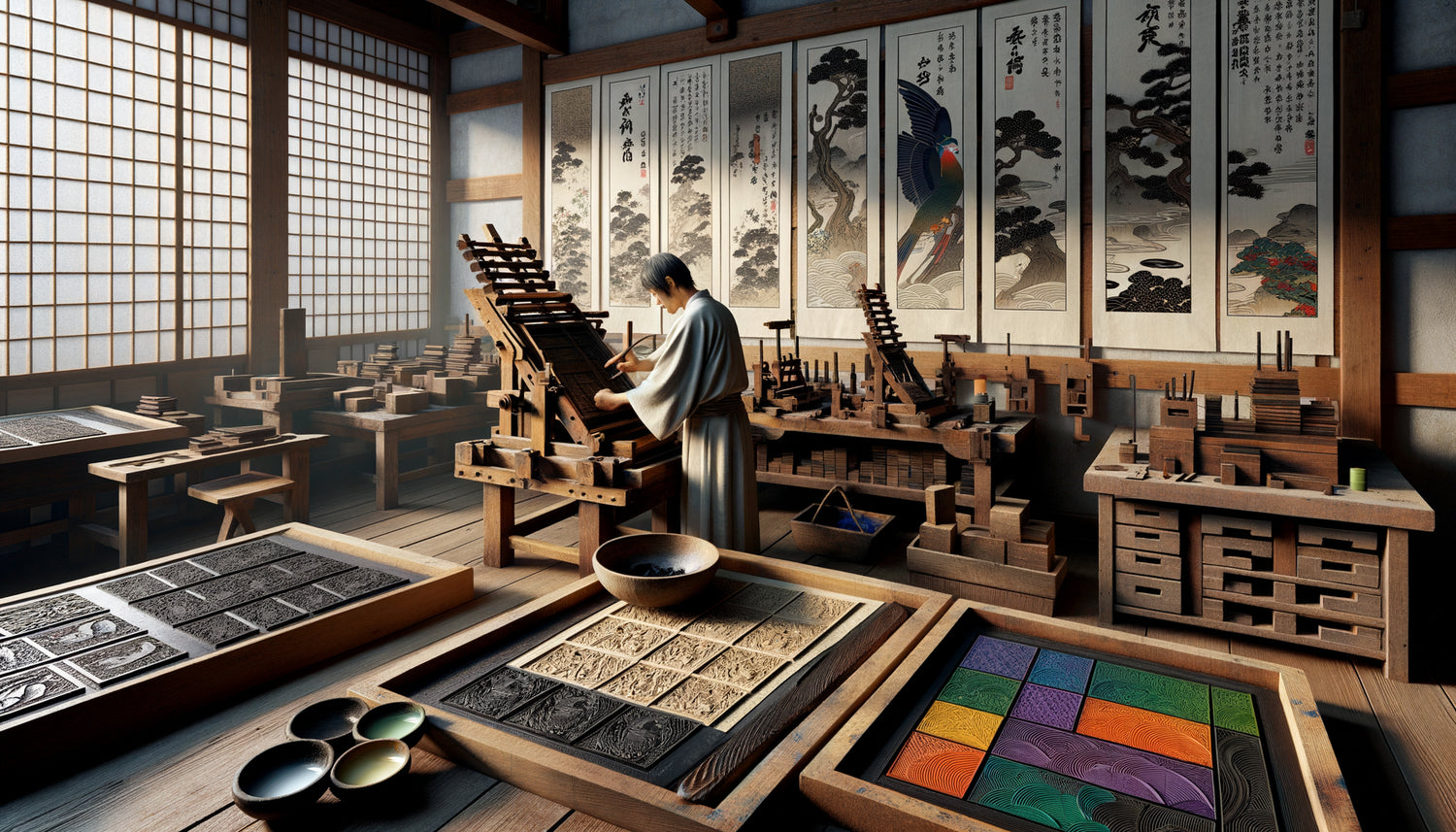
In the workshop of a master engraver, each shade of a polychrome print required the creation of a separate wood block. Imagine the process: for a single ukiyo-e with five colors, the artisan had to meticulously carve five different blocks, each corresponding to a specific chromatic area. This multiplication of supports represented hours, sometimes days of extra work.
Black and white prints, called sumizuri-e, required only one engraved block. The engraver carved the lines into cherry or boxwood, then the printer applied black ink before pressing the paper. A linear, fast, economical process. Conversely, colored ukiyo-e imposed a complex technical ballet: millimeter alignment of successive blocks, drying between each pass, constant adjustments to avoid disastrous chromatic misalignments.
This technical complexity translated directly into the final price. Where a monochrome print could be sold for a few mon (the currency of Edo), equivalent to the price of a bowl of noodles, an elaborate polychrome composition sometimes cost ten to twenty times more. The Japanese print market naturally structured itself around this relentless economic reality.
When pigments dictated the price of art
Beyond the engraving work, the pigments themselves represented a considerable expense. Prussian blue, imported from Europe in the early 19th century and which revolutionized the aesthetics of Japanese prints, cost a fortune. Carmine reds, vegetable yellows, greens obtained by mixing pigments: each color had its price on the raw materials market.
Black ink, on the other hand, was made locally from pine soot mixed with animal glue. Its mass production and negligible cost allowed publishers to offer black and white prints at prices that defied all competition. Workshops could print hundreds of copies in a day, fueling an insatiable popular market for images.
This economy of means did not imply any artistic compromise. Masters like Sharaku or the early works of Hokusai demonstrate that black and white possessed its own expressive power. Variations in tones, obtained by diluting the ink or superimposing prints, created subtle effects of depth. The market for Japanese black and white prints was not a second-class market, but a fully fledged aesthetic tradition, made accessible by its technical simplicity.

Cultural democratization through monochrome imagery
In Edo period Japan, a time when reading remained the preserve of educated classes, prints were the ultimate mass medium. Black and white prints circulated in all popular neighborhoods: scenes from kabuki theater, portraits of famous actors, urban landscapes, erotic illustrations. Their negligible price allowed an artisan, a merchant or even a servant to acquire these windows onto the collective imagination.
Print publishers had perfectly understood this logic of volume. Rather than selling one hundred polychrome copies at a high price, they preferred to sell a thousand monochrome prints with a small margin. The calculation was simple: the accessible market generated more overall profits than the luxury market. This commercial strategy enabled the emergence of a true popular visual culture, where art no longer remained confined to elites.
Colored ukiyo-e, on the other hand, targeted a different clientele: wealthy collectors, enriched merchants, cultured samurai. These finely colored works adorned the
Time as a determining economic factor
An often-neglected aspect in the analysis of the print market concerns production speed. In a culturally vibrant urban society, the ability to react quickly to events constituted a major competitive advantage. A kabuki actor triumphed in a new role? Publishers had to offer their portrait within three days to capitalize on popular enthusiasm.
Black and white prints enabled this responsiveness. Thanks to their simplified process, a workshop could design, engrave and print a new composition in a few days. Colored ukiyo-e, with their multiple plates and prolonged drying times, required several weeks of production. In Edo's attention economy, this time difference translated into opportunities gained or lost.
This production velocity explains why the first actor portraits, event announcements or news illustrations almost systematically adopted monochrome format. The accessible market was also a market of instantaneity, where temporal relevance took precedence over chromatic sophistication. Polychrome versions sometimes followed, several weeks later, intended for collectors wishing to own a luxury version of an already famous image.

The contemporary legacy of an image economy
Today, this historical distinction between black and white prints and colored ukiyo-e continues to influence the Japanese art market. Monochrome compositions from the past, produced in greater quantities, remain generally more accessible to novice collectors. Their numerous prints have better survived the centuries, creating a more abundant supply on the current art market.
Paradoxically, some rare black and white prints now reach prices comparable to polychromes, especially when they bear the signature of recognized masters or represent unique preparatory states. The Japanese print market today values rarity and provenance as much as the original technical complexity. A monochrome trial proof by Hokusai can be worth more than a standard colored ukiyo-e by a minor artist.
This evolution reflects an aesthetic reassessment: black and white is no longer perceived as a impoverished version of printmaking art, but as a legitimate artistic expression, possessing its own codes and power. Contemporary collectors seek out these works for their graphic purity, their compositional strength stripped of chromatic artifices, qualities particularly in resonance with current minimalist sensibilities.
Why This Story Informs Our Current Decorative Choices
Understanding the historical economy of the print market allows us to appreciate these works differently when we consider integrating them into our interiors. A black and white print carries within it this history of cultural democratization, this desire to make art accessible to all. It embodies a philosophy where beauty does not depend on lavish means, but on the accuracy of the line and composition.
In a contemporary setting, these pieces bring a subtle sophistication, a visual balance that perfectly dialogues with the clean palettes of modern interiors. Their radical graphic design, their frank contrast create powerful visual anchors without the chromatic saturation that can sometimes weigh down a space. The accessible market of yesterday meets today's aesthetic concerns: doing more with less, prioritizing the essential, celebrating the strength of simplicity.
Contemporary reproductions of these works perpetuate this tradition of accessibility. Where original antiques now reach prohibitive prices in galleries, modern editions allow you to acquire this timeless Japanese aesthetics for reasonable budgets, in the very spirit that presided over their original creation: making beauty accessible to all.
Extend this story of purity and elegance in your interior
Discover our exclusive collection of black and white paintings that capture this timeless graphic power and transform your walls into accessible art galleries.
Imagine your living room where a black and white Japanese print reproduction dialogues with your contemporary lines. This work, which three centuries ago adorned the modest home of an Edo craftsman, now finds its place in your interior, carrying with it generations of artistic history. The Japanese prints market has crossed the ages while retaining this essential lesson: true elegance does not lie in abundance, but in the relevance of choice.
Start by identifying what type of print resonates with your personal sensitivity. Do you prefer clean landscapes, theatrical portraits, urban scenes? Explore the different masters and periods, let yourself be guided by your eye before considering technical or commercial aspects. The historical accessibility of black and white prints still offers you this freedom today: that of choosing first with the heart, without budget becoming a deterrent to beauty.
Frequently Asked Questions About the Japanese Prints Market
Do black and white Japanese prints have less artistic value than colored versions?
Absolutely not, and that's a misconception to debunk. Black and white prints represent an aesthetic tradition in their own right, sometimes even predating polychromes. Many masterpieces of Japanese art were conceived in monochrome by artistic choice, not economic constraint. Masters exploited variations in tones, paper textures, the strength of the line to create compositions of remarkable expressive power. Today, discerning collectors seek out these pieces for their graphic purity and dialogue with contemporary aesthetics. The artistic value of a print depends on the quality of its composition, its condition, the reputation of its creator and its rarity, much more than its number of colors. A monochrome work by Hokusai possesses infinitely more value than a mediocre polychrome by a minor artist.
Can I start a Japanese print collection with a modest budget?
Absolutely, and it is precisely the legacy of this tradition of accessibility that makes it possible. The contemporary Japanese prints market offers several entry levels. Museum-quality modern reproductions offer an excellent starting point for just a few dozen euros, allowing you to familiarize yourself with different styles and artists. Original prints from the 20th century, less sought after than Edo or Meiji period pieces, remain affordable for intermediate budgets. Even some black and white prints from older series, when they come from large print runs and have minor defects, can be purchased for a few hundred euros. The key is to start by educating your eye: visit exhibitions, consult specialized books, observe auction sales. Passion and knowledge are the best initial investments, long before the first purchase.
How to integrate a black and white Japanese print into a modern interior?
Black and white prints possess that rare quality of being both steeped in history and perfectly contemporary in their visual expression. To integrate them harmoniously, prioritize a restrained frame: a matte black frame or light natural wood, with a generous mat that gives the composition room to breathe. Avoid overly ornate gold frames that would create a stylistic dissonance. Position the work at eye level, in a space where it can breathe, without excessive visual competition. These prints dialogue wonderfully with minimalist interiors, neutral palettes, and natural materials such as linen, raw wood or ceramics. They bring this touch of cultural sophistication without weighing down the space, creating a graphic focal point that visually structures the room. Don't hesitate to play on contrasts: a Japanese print with delicate lines on a concrete wall creates a particularly successful aesthetic tension, this dialogue between tradition and modernity that defines contemporary elegance.