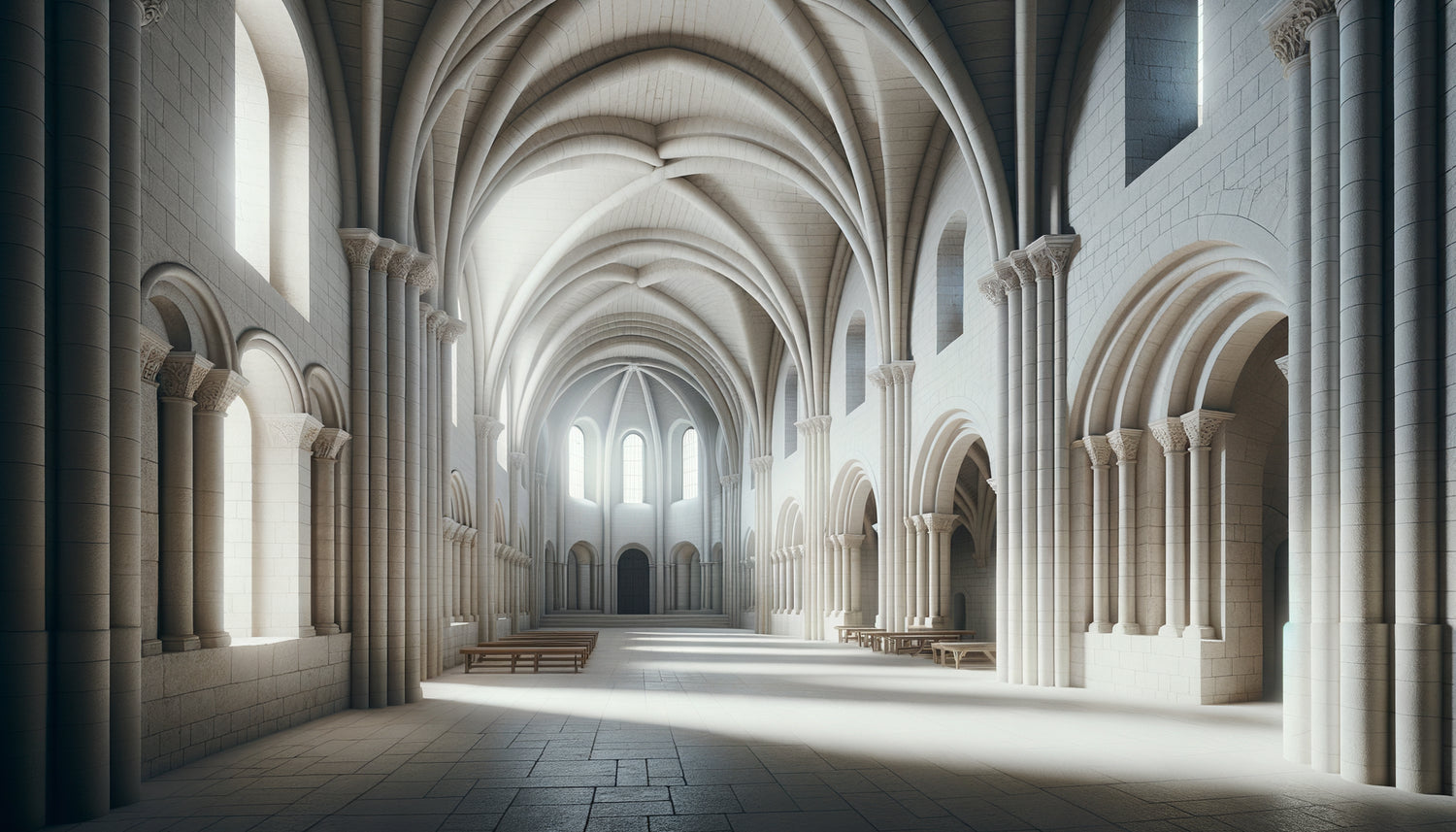
Imagine stepping through the heavy door of a Cistercian abbey. No gleaming gold, no multicolored frescoes, no shimmering decorations. Just bare stone, natural light gliding over walls of pristine white, silence resonating against stripped surfaces. This austerity was not an oversight, nor even a budgetary constraint. It was an manifest architectural, a spiritual revolution etched in stone.
Here's what the Cistercian prohibition of color revealed: a radical philosophy of stripping away, a redefinition of luxury through absence, and above all, a vision of the sacred that strangely resonates with our contemporary quest for simplicity. In the 12th century, when churches competed in opulence, the monks of Citeaux dared to assert that true beauty lay in emptiness. Are you perhaps, like many today, seeking to understand how minimalism can become meaningful? The Cistercians left us a legacy of white stone that answers this question with unparalleled power.
In a world where wall decoration was synonymous with prestige, where every painted surface affirmed a status, this prohibition seemed incomprehensible, almost provocative. Yet, behind this radicality lay a thought of fascinating depth. Let me tell you why these monks banned color from their walls, and what their choice still teaches us today about the very essence of our living spaces.
Bernard of Clairvaux's anger at gold and pigments
In 1124, Bernard of Clairvaux wrote an incendiary letter that would transform monastic architecture for centuries. His target? The Benedictine abbey of Cluny, a temple of magnificence where walls disappeared beneath golden paintings, where every surface told a story in vibrant colors. For Bernard, this decorative profusion constituted a spiritual betrayal.
The founder of the Cistercian order did not mince words. He denounced these ridicula monstruositas, these ridiculous monstrosities that diverted the soul from its divine contemplation. Colored murals, he believed, transformed places of prayer into distracting spectacles. His central argument was of an implacable logic: how could a monk meditate on the invisible when his eyes were constantly being solicited by the visible?
This radical position was part of a theology of stripping away. For the Cistercians, color on the walls represented a form of spiritual visual pollution. Each pigment applied distanced the mind from its contemplative vocation. Polychrome wall decorations belonged, according to them, to the world of earthly vanity, incompatible with the quest for God.
An aesthetic of voluntary poverty
The prohibition of color in wall decorations stemmed directly from a vow of poverty. Pigments were expensive in the Middle Ages. Lapis lazuli for blue came from Afghanistan, purple from rare shells, gold shone on the walls of wealthy abbeys. Refusing these colors was asserting an economic choice that became a spiritual principle.
But beyond cost, there was an ethical dimension. The Cistercians considered spending resources to embellish walls a scandalous diversion of means that should have served the poor. This relentless logic transformed each white wall into an moral statement, a testament to a redistribution of priorities.
Light as the sole ornament of walls
When color is forbidden, what remains? The Cistercians discovered a sublime answer: light itself. By refusing pigments on their walls, they created perfect surfaces to welcome the natural variations of daylight. Blonde limestone, left bare, became a living screen where the sun projected its own spectacle.
This revolutionary approach transformed architecture into an instrument of temporal contemplation. White walls recorded each hour, each season. Dawn deposited pale roses that no fresco could equal. Midday engraved blinding whites. Twilight slid golds that no painter had applied. This natural palette, infinitely more subtle than any wall decoration, constantly renewed the spiritual experience of the place.
The Cistercians understood something fundamental: emptiness is not absence, but availability. A colorless wall is not a poor wall, it is a wall offered to all possible lights. This philosophy of the neutral support anticipated, seven centuries before them, the reflections of modernist architects on purified space.
Stained glass: the only controlled exception
Curiously, the Cistercians allowed a form of color: that of grisaille stained glass. But even this concession followed a strict logic. Colored glasses did not decorate the walls, they filtered divine light. Their abstract geometric patterns avoided any narrative, any figurative distraction.
This subtle distinction reveals the coherence of their thinking. Color was banned from wall decorations because it added a human, artificial layer between the believer and the sacred. But color passing through glass, transformed by light, became acceptable because it remained immaterial, elusive, divine.

White as a theological color
For the Cistercians, white was not the absence of color, but the color of the absolute. Their immaculate walls embodied a theology of original purity, a return to essence. In their cosmology, white represented the Edenic state before the fall, before the world fragmented into chromatic multiplicity.
This symbolism of white permeated their entire existence. Their undyed wool robes, their pigment-free walls, their austere altars formed a coherent visual ecosystem. The prohibition of color in wall decorations was part of a global asceticism where each element reinforced the others.
Saint Bernard wrote that colors excited the concupiscence of the eyes, this insatiable desire for new visual stimuli. White, on the other hand, soothed the gaze, bringing it back to unity. On a white wall, the eye ceases to search, to compare, to desire. It finally settles, finds rest. This contemplative psychology made stripped walls a spiritual technology.
When architecture becomes manifest
The Cistercian prohibition of color went beyond the simple decorative rule. It structured space, dictated proportions, and influenced every architectural decision. Without the possibility of correcting or embellishing walls with paint, builders had to achieve perfection in the stone itself.
This constraint produced an architecture of absolute accuracy. Proportions became essential, as nothing would come to mask them. The quality of the stone cutting was crucial, since it would remain visible. Light, thought from conception, because it would constitute the only ornament. Cistercian abbeys have bequeathed us masterpieces where beauty is born from pure structure, without decorative artifice.
This creative discipline resonates powerfully with our time. How often do we try to correct a poorly designed space with added wall decorations? The Cistercians remind us that a well-thought-out space does not need ornaments. Well-proportioned emptiness is worth all decorations.
Texture rather than color
Deprived of pigments, the Cistercians explored the richness of raw material. Their walls revealed the diversity of stones: smooth limestone, rough granite, striated sandstone. This tactile palette replaced the chromatic palette. The eye, accustomed to reading colors, learned to perceive nuances of grain, variations in texture.
This approach transformed spatial perception. A colored wall captures the gaze, stops it at its surface. A bare stone wall, with subtle variations in material, invites the eye to travel, to explore depths, reliefs, and plays of shadow. The prohibition of color in wall decorations revealed an alternative richness, deeper.

The contemporary heritage of this radicality
Seven hundred years after Bernard of Clairvaux, architects like Le Corbusier rediscovered Cistercian abbeys with wonder. Their use of white walls, their rejection of superfluous ornamentation, their trust in natural light anticipated the principles of the modern movement. What was once religious asceticism became a manifest aesthetic.
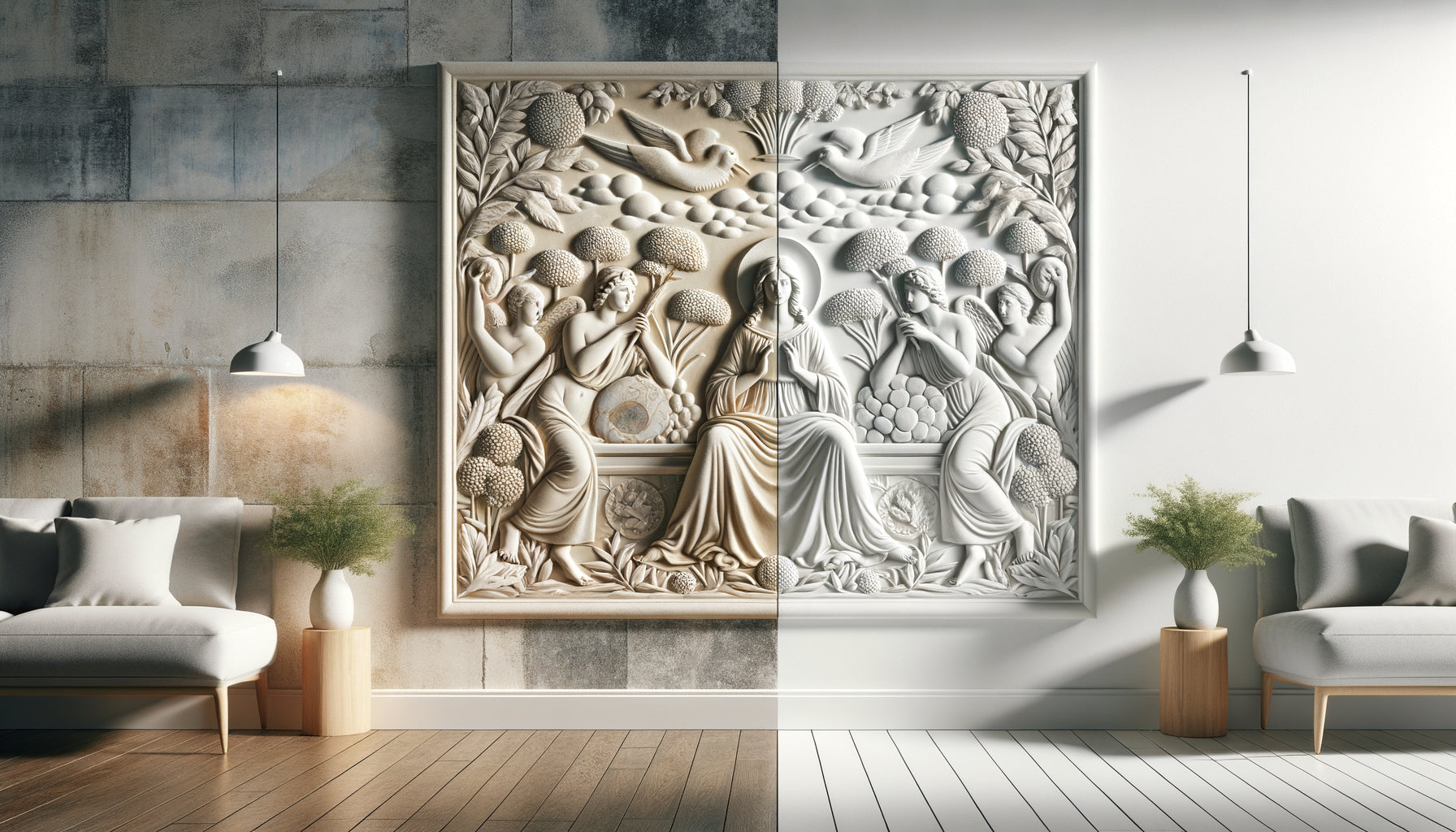
Today, in our contemporary interiors, the attraction to immaculate walls, to refined decoration, to monochromatic spaces is not a fleeting trend. It is the resurgence of an ancient wisdom: that which understands that visual sobriety liberates the mind. Our apartments with white walls, our galleries with neutral benches, our minimalist spaces dialogue, unknowingly, with this Cistercian tradition.
The Cistercian justification for the prohibition of color still speaks to us. In our era saturated with visual stimuli, multicolored screens, and garish advertisements, the white wall offers what the monks sought: a refuge for attention. A space where the gaze can finally settle without being solicited, compared, distracted.
And if true luxury resided in sobriety?
Discover our exclusive collection of black and white artworks that celebrate the power of pure contrast, without chromatic artifice, in the tradition of this timeless aesthetic.
Living with walls that breathe
The Cistercians bequeathed us an essential lesson: a wall does not need decoration to exist fully. It can be, simply, in its raw materiality. This philosophy of the undecorated support invites us to rethink our interiors not as surfaces to fill, but as volumes to inhabit.
When you look at a blank wall in your home, you may see emptiness, or you may perceive what the Cistercian monks saw: a promise of mental space, a visual breath, an invitation to inner silence. The absence of color does not impoverish the space; it clears it, purifies it, and makes it available for the essential.
This approach is not austere; it is liberating. It reminds us that we do not need to multiply wall decorations to create a rich interior. Sometimes, true wealth lies in the ability to say enough, to let emptiness exist, to trust natural light to animate our spaces.
The Cistercians justified the prohibition of color by a quest for the divine. We can, on a secular scale, find a quest for mental clarity. In an overloaded world, the restrained wall becomes an act of resistance, a conscious choice, an affirmation that our visual environment shapes our inner peace.