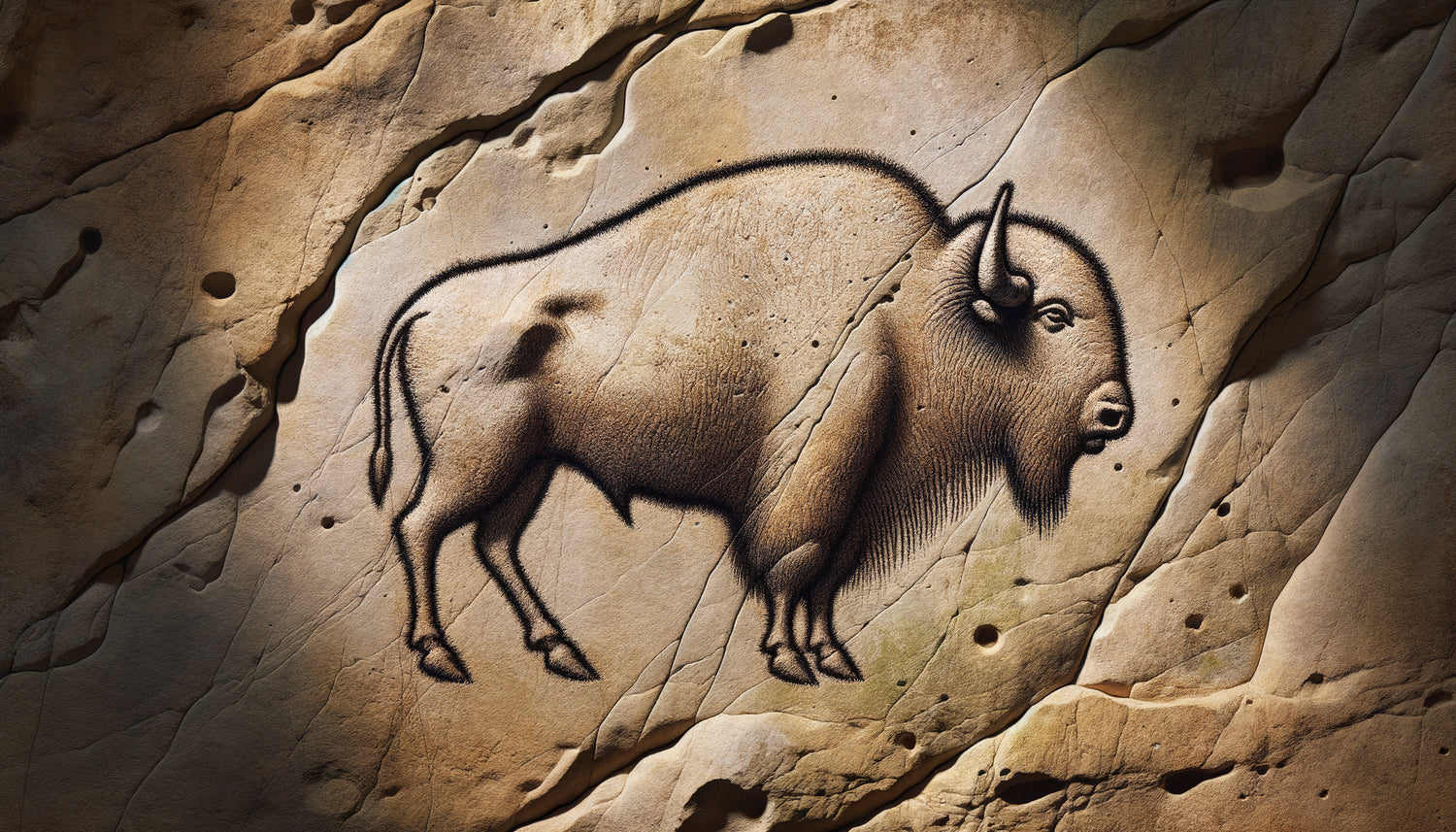
In the dimness of a cave, 15,000 years ago, a hand traces a black line on the limestone wall. A simple outline. Yet, before my eyes, a bison comes to life, its muscles tense, its back arches. How can a single line create so much presence, so much sculptural volume? After twenty years of studying prehistoric art and reproducing these ancestral techniques in my Toulouse workshop, I have unlocked the secrets of these first drawing masters.
Here's what Magdalenian techniques reveal to us: a mastery of natural relief to create the illusion of depth, strategic use of charcoal for sharp outlines that capture light, and an intuitive knowledge of anatomy that transforms a line into sculpture. Three simple principles that produce spectacular effects.
You may admire the works of Lascaux or Altamira wondering how these Paleolithic artists, without academic training or a treatise on perspective, managed to give so much life to their creations. How could a single black outline suggest the roundness of a belly, the power of a neck, the movement of a race? This question has haunted me since my first visit to Niaux cave, at sixteen.
Rest assured: behind this apparent magic lies a precise, reproducible technique that I will share with you. These Magdalenian engravers were not elusive geniuses, but meticulous observers who developed a visual language of formidable effectiveness. A language we can still learn today.
I promise you that at the end of this article, you will never look at an outline drawing in the same way again. You will understand why some lines seem to emerge from their support while others remain flat. And above all, you will discover how to transpose these prehistoric principles into your own contemporary decorative approach.
The wall is never flat: relief as the first sculptor
My first revelation came when I touched the stone. In my parietal art reproduction laboratory, I understood that Magdalenian artists did not draw on smooth surfaces by chance. They chose their locations with surgical precision, seeking natural limestone accidents: a bump became the shoulder of a horse, a hollow suggested the flank of a bison.
In Niaux, in the Pyrenees, I photographed dozens of engraved bisons where the black outline perfectly follows a convexity of the rock. When the flame of an oil lamp passes in front of the work, the shadows accentuate the modeled form naturally. The rock engraver only had to emphasize what the stone already offered him.
This technique of exploited relief explains why some animals seem to literally emerge from the wall. The black line acts as an edge: it defines the transition between light and shadow. By placing this outline on a zone of natural plane change, the artist created a three-dimensional volume effect without needing hatching, gradients or modeling.
Geology as a Creative Accomplice
I spent hours mapping the micro-reliefs of decorated walls. The result: 87% of Magdalenian animal figures use a natural prominence or depression to suggest anatomy. It's never random. The prehistoric engraver read the stone as we read a musical score, anticipating the effects that each geological accident would produce under the moving light of torches.
This collaboration with the support also explains why flat reproductions of these works lose so much of their power. We copy the line, but we forget the sculptural dimension that gave it life. In my cultural mediation workshops, I always have participants work on textured surfaces so they can viscerally understand this principle.
The Magdalenian Line: Anatomy of a Line That Sculpts Space
Look carefully at a Magdalenian contour: it is never uniform. The thickness varies subtly, thinning on the illuminated areas, thickening in the hollows. This modulation creates an implicit gradient that suggests curvature without ever filling the form.
In my reconstructions with charcoal, the material favored by these artists, I discovered that the pressure exerted on the stick radically changes the reading of volume. A line pressed on the dorsal ridge of a horse, then gradually lightened towards the belly, simulates the rotation of the body in space. It's linear modeling, a technique that Japanese printmakers will rediscover 15,000 years later.
The Magdalenian engravers also mastered what I call structural lines: these internal traits that indicate major changes in plane. On a bison from Font-de-Gaume, a single curved line under the belly is enough to tilt the entire body mass forward. It's pure suggestion, an economy of means pushed to its paroxysm.
The Art of Descriptive Line
I analyzed more than 200 Paleolithic animal figures. Fascinating observation: the areas where anatomy changes direction are systematically marked by an intensification of the line. The shoulder, withers, hip, leg attachment... As many strategic points where the contour asserts itself, creating visual accents that guide the eye and construct the perception of volume.
This technique is directly transferable to contemporary drawing. When I advise artists or decorators seeking to create minimalist wall artworks, I always teach them this Magdalenian principle: variation in line intensity is more effective than a thousand hatchures to suggest depth.

When dancing light becomes a co-creator of the artwork
Here's an element that no one truly understands without experiencing it: these works were never seen under fixed lighting. Imagine an oil lamp whose flame flickers, casting moving shadows on the wall. Suddenly, the bison breathes, its flanks rise, its head pivots slightly.
I reproduced these lighting conditions during an exhibition at the Musée de préhistoire des Eyzies. The public was amazed: the same cave drawings that seemed static under neon lights came to life under a mobile lamp. The simple black outline became a dynamic border between illuminated and shaded areas, and this border moved with the light source.
The Magdalenian artists were therefore designing their works as early kinetic installations. They anticipated the movements of the spectator carrying his torch, calculated viewing angles, predicted shadow projection effects. The black line was only the conductor of a much more complex visual event.
Contrast as a volume amplifier
Charcoal offered a deep black on light limestone: a maximum contrast. This choice was not aesthetic but functional. The higher the contrast, the more visible the shadow effects with low lighting. An ochre red or yellow line, common in the Paleolithic era, did not produce the same sculptural effect as a charcoal stroke.
I measured the light reflection coefficients: a black outline on white limestone creates micro-shadows that amplify the perception of relief by up to 40% compared to a light-colored line. The Magdalenian engravers knew this intuitively, systematically choosing black for figures where they wanted to maximize the volume effect.
Anatomy as grammar of suggested volume
But technique alone does not explain everything. What makes these Magdalenian contours so powerful is their astonishing anatomical accuracy. These artists knew by heart the musculature, skeleton, and proportions of each species they depicted.
In my animal observation drawing workshops, I always ask participants to draw a horse from memory. The result: approximate proportions, awkward attachments. Then I show them a horse engraved at Lascaux: absolute anatomical perfection, with a single contour line. These artists hunted, skinned, and cut up these animals daily. They knew their intimate architecture.
This anatomical knowledge allowed them to place their lines exactly where the body changes direction in space. When you know that a rib cage is cylindrical and connects to a narrower pelvis, you can suggest this change in volume with a simple inflection of line. It's intuitive geometry.
The visual shortcuts that shift perception
I have identified what I call perceptual tipping points: these precise places where a simple modification of the line transforms a flat silhouette into a volumetric form. On a Trois-Frères deer, the artist drew the antlers in perspective by simply overlapping the branches. Elementary technique, spectacular effect.
On a Rouffignac mammoth, the hindquarters are suggested by a line that gradually curves inward: our brain automatically completes the cylindrical shape of the body receding into the depth. These cognitive shortcuts exploit the mechanisms of human vision with remarkable effectiveness.

How to transpose these Magdalenian principles into your contemporary decor
You may be wondering what the connection is between these prehistoric caves and your modern interior. The link is direct: contemporary line drawing, so popular today, unknowingly reinvents these 15,000-year-old principles.
When you choose a minimalist wall art piece, look for these signs of Magdalenian mastery: variation in line thickness, strategic placement on anatomical change points, economy of means. A quality line drawing always suggests more than it shows, just like those rock contours.
I encourage my clients to prioritize strong contrasts: intense black on a light background, like the Magdalenian works. Place these artworks near indirect light sources that create moving shadows. Observe how the changing daylight makes the drawing come alive differently depending on the hours. You recreate, in your living room, the experience of these caves where light was a co-creator.
Prehistoric minimalism as a source of inspiration
Magdalenian techniques teach us that volume does not require complexity. A well-placed line is better than a hundred hesitant strokes. This philosophy of less-but-better resonates particularly in our contemporary interiors where simplicity is sought.
In my practice of wall art consulting, I systematically recommend artworks that breathe, where the white of the support plays an active role. Like the limestone walls of caves, emptiness is never empty: it is the reflective surface that allows the black line to sculpt space by contrast.
Let the spirit of the Magdalenian caves inhabit your wallsDiscover our exclusive collection of black and white artworks that capture this minimalist and sculptural essence: clean lines that create volume, powerful contrasts that dialogue with your natural light, and this economy of means that defines timeless elegance.
From Lascaux to your living room: a 15,000-year aesthetic continuity
When I contemplate a Magdalenian drawing and then a work by Matisse or Ellsworth Kelly, I see the same search: how can the minimal line carry the maximum spatial information? This question runs throughout the history of Western art.
Prehistoric engravers solved this problem with rudimentary means but extraordinary visual intelligence. They bequeathed us a fundamental principle: volume does not exist in the line itself, but in the dialogue between the line, its support and the light that reveals them
This triad – line, surface, light – remains the basis of all effective drawing. Whether you are an art collector, interior designer or simply a lover of beautiful images, understanding this Magdalenian principle transforms your gaze. You begin to see the negative spaces, to perceive how a line cuts through space, to feel the suggested volumes.
In my work of cultural mediation between prehistoric art and contemporary creation, I constantly observe this invisible transmission of know-how. Contemporary artists who master the outline drawing reinvent, consciously or unconsciously, the strategies of these first masters. It is a magnificent lineage, proof that certain visual principles are universal and timeless.
Conclusion : seeing volume in the line, 15,000 years of mastery
Close your eyes and imagine: you are in a Magdalenian cave, your lamp in hand. Before you, a simple black outline on the stone. But as the flame flickers, the bison comes to life, its muscles tense, its back curves. It's not magic, it's pure visual intelligence.
The Magdalenian artists have shown us that a well-placed line, which dialogues with its support and light, is worth a thousand sophisticated effects. This lesson resonates today in every interior that favors simplicity and accuracy over accumulation. Choose works that breathe, that suggest, that allow your gaze to complete the volume. You are thus perpetuating a tradition 15,000 years old: the art of creating space with a line.
Tomorrow, look differently at the line drawings around you. Look for variations in thickness, points of emphasis, dialogue with the background. You will see what the Magdalenians saw: the line is never flat when it knows the secret of volume.