New York, 1953. A young artist of 28 years climbs the steps of a downtown studio, a bottle of whiskey under his arm. His mission? To convince Willem de Kooning, venerated figure of abstract expressionism, to give him a drawing to erase. This seemingly sacrilegious audacity would become one of the most controversial works of the 20th century.
Here's what this radical gesture reveals to us: artistic creation can be born from destruction, emptiness possesses a tangible presence, and questioning artistic authority opens up unexplored territories. This white work embodies the fascinating paradox between absence and fullness.
We admire the great masters with reverence, convinced that touching their work is sacrilege. The very idea of erasing a work of art to create another makes us uncomfortable. Yet, this audacious gesture by Rauschenberg poses an essential question: where does creation truly begin?
This story reminds us that art is not frozen in the marble of tradition. Understanding why Rauschenberg erased De Kooning's drawing is exploring the very foundations of what constitutes a work of art in the contemporary era.
The context of a calculated provocation
Robert Rauschenberg evolves in the artistic New York of the 1950s, a period of intense creative effervescence. Abstract expressionism reigns supreme, with its tutelary figures like Jackson Pollock and Willem de Kooning. These artists celebrate the pictorial gesture, the energy of the line, the controlled violence of creation.
But Rauschenberg, trained at Black Mountain College alongside avant-garde figures like John Cage, seeks something else. He is already exploring the White Paintings, these entirely white canvases that anticipate conceptual art. For him, these immaculate surfaces are not empty: they capture shifting shadows, changing light, the passage of time.
The idea gradually germinates: if erasing one's own work constitutes an easy exercise, erasing that of a recognized master would transform the act into a true artistic statement. It would no longer be a simple nihilistic gesture, but a profound questioning of authority, value and the very nature of art.
De Kooning, surprised by the request, nevertheless understands the conceptual stakes. He does not give just any drawing to Rauschenberg. He deliberately chooses a complex work, combining pencil, charcoal, ink and greasy chalk – a piece that he likes and which will be difficult to erase completely. This choice transforms the undertaking into a true physical and conceptual ordeal.
Erasing as a creative act
For nearly two months, Rauschenberg works with relentless dedication. Armed with about forty different erasers, he rubs, scratches, systematically erases De Kooning's drawing. It is not an impulsive destruction, but a laborious and thoughtful process.
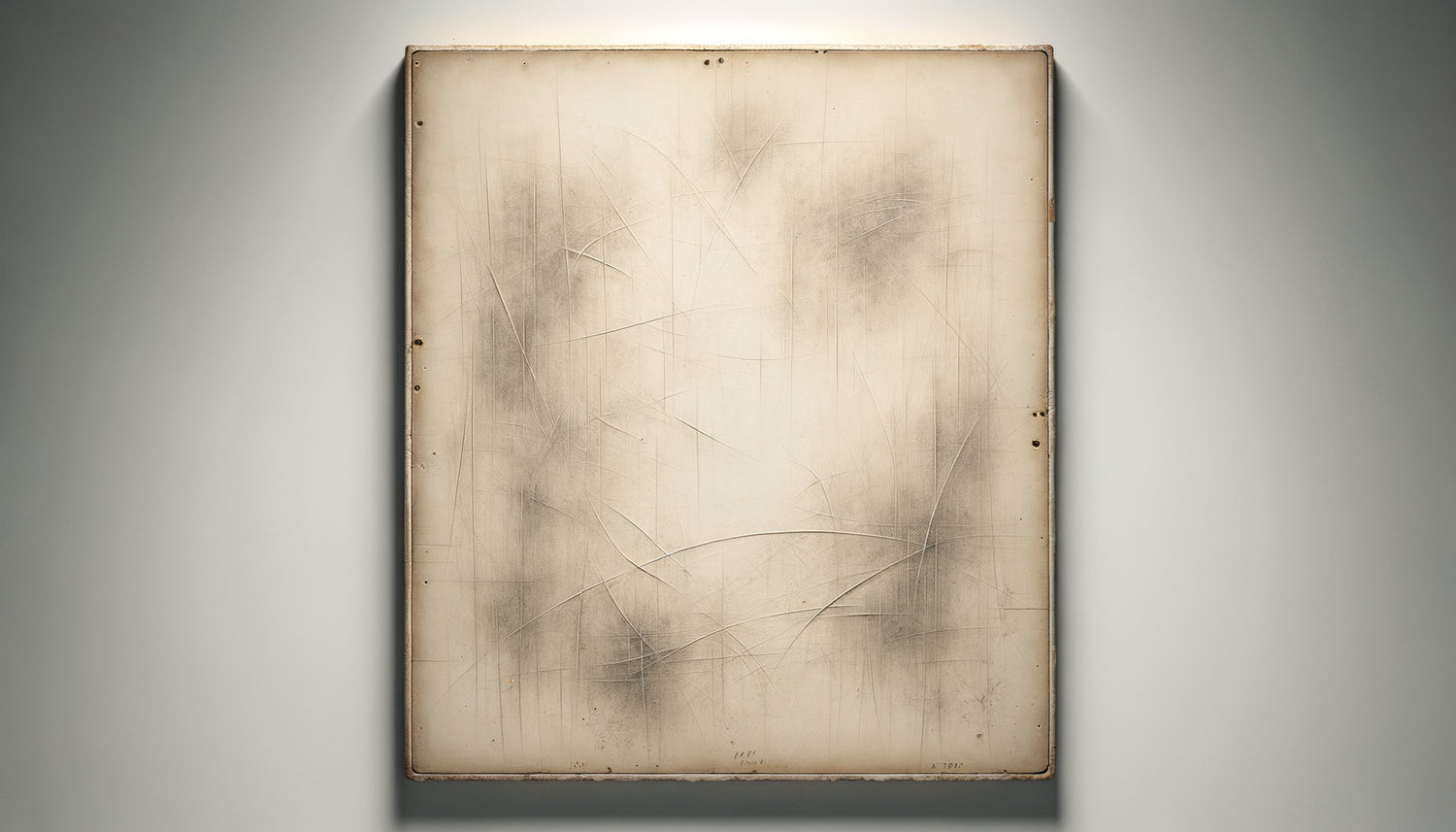
Each eraser stroke becomes a creative gesture. Rauschenberg doesn't simply destroy a work: he creates a new one through the very act of erasing. The surface that emerges is not blank, but bears the ghostly traces of what once was. Shadows persist, spectral lines remain, testifying to the artistic palimpsest that the work has become.
This performative dimension was essential. The final work, titled Erased De Kooning Drawing, exists only because it documents its own paradoxical creation. Without the title, without the gilded frame chosen by Rauschenberg, without the explanatory label, it would be nothing more than an almost white sheet of paper. It is the conceptual context that confers on the object its status as a work of art.
The dialogue with the emerging minimalism
This work is part of a broader movement that questions the materiality of art. While Rauschenberg erases, Yves Klein creates his blue monochromes in Europe, John Cage composes 4'33'' of silence. All explore the presence of absence, the fullness of emptiness.
Erasing becomes a form of creation as much as addition. This idea resonates particularly in our contemporary interiors, where white space is no longer synonymous with sterile void but with creative potential. A clean wall does not necessarily need to be filled: it can exist fully in its simplicity.

Questioning artistic authority
Beyond the technical gesture, Rauschenberg poses a fundamental question: who decides the value of a work of art? By erasing the drawing of a recognized master, he democratizes the creative act. He suggests that art does not belong exclusively to established figures, that each generation must reinvent its own codes.
This transgressive dimension was crucial in the context of the 1950s. Abstract expressionism had become institutionalized, almost academic in its status. By soliciting De Kooning's complicity himself, Rauschenberg created a symbolic consensual patricide: the artistic father authorizing the son to surpass him.
The work also questions the notion of originality. Is it more or less original than a drawing by De Kooning? It literally contains the master's work while being irreducibly different. This paradox foreshadows contemporary debates on artistic appropriation and reinterpretation.
A lesson for our living spaces
This philosophy of detachment resonates in our decorative choices. Accepting that a space can breathe, that a white wall possesses its own eloquence, that a clean room offers more possibilities than an accumulation of objects – this is the living legacy of this paradoxical white work.
The presence of emptiness: aesthetics of absence
What fascinates about Erased De Kooning Drawing is its ability to make the invisible visible. The almost white surface is not neutral; it vibrates with its history, bears the scars of erasure, reveals phantom traces of the original drawing.
Rauschenberg demonstrates that emptiness is never absolute. Even erased, De Kooning's drawing persists in collective memory, in the title of the work, in the stories surrounding it. This spectral presence gives whiteness a particular density.
The work becomes a meditation on time and memory. It documents a process of transformation rather than a final state. Each visitor who contemplates it mentally reconstructs the gesture of erasure, imagines the disappeared drawing, actively participates in the creation of meaning.
This participatory dimension was revolutionary. The nascent conceptual art placed the viewer at the center of the work, not as a passive observer but as a co-creator of meaning. White becomes a screen for projecting our own questions about creation and destruction.

The contemporary legacy of a radical gesture
Seventy years later, Erased De Kooning Drawing retains all its relevance. It foreshadows contemporary artistic practices that prioritize the process over the result, the concept over the material object.
In our interiors, this philosophy translates into a renewed appreciation of minimalism. Not as punitive austerity, but as mental breathing space. A nearly white painting on a clean wall does not signal a lack of taste, but a sophisticated understanding of the power of simplicity.
Rauschenberg's work reminds us that subtracting can be as creative as adding. In a world saturated with images and information, erasure becomes a political and aesthetic gesture. It affirms our right to simplicity, to contemplation, to visual silence.
Contemporary creators continue to explore these territories. Artists erase digital data, delete images from the internet, create voids in saturated information. They perpetuate Rauschenberg's radical intuition: sometimes, removing reveals more than adding.
Integrate this philosophy into your decor
Understanding this work transforms our relationship with spaces. It allows us to leave walls bare, to prioritize a clean composition rather than decorative accumulation. It validates the idea that a single well-chosen painting can have more impact than an overloaded gallery.
White is no longer an absence to be filled but a presence to be celebrated. Shades of white, light games on an immaculate surface, shadows – all these elements become active components of our visual environment.
Let the void reveal its fullness
Discover our exclusive collection of black and white paintings that celebrate the power of minimalism and transform every space into a contemporary gallery.
Conclusion: The audacity of subtraction
Robert Rauschenberg did not erase De Kooning's drawing out of nihilism or gratuitous provocation. He created a fundamental conceptual work that redefines the boundaries of art. By transforming erasure into a creative act, he teaches us that conscious destruction can be as fertile as construction.
This almost white surface invites us to reconsider our own spaces. It allows us to trust the void, to appreciate simplicity, to understand that sometimes, less reveals infinitely more. In your next decorative choice, dare radical simplicity. Let your walls breathe. A purified work, like this erased drawing, can contain all possibilities.
FAQ: Understanding Rauschenberg's Erased Work
Why did De Kooning agree to give a drawing to be erased?
Willem de Kooning understood the conceptual stake of Rauschenberg's approach. Far from being offended, he recognized that this proposal constituted a legitimate questioning of the nature of art. As a truly avant-garde artist, De Kooning even deliberately chose a complex and valuable drawing, transforming the gesture into a true artistic challenge rather than an ease. This complicity between the two creators is evidence of a rare and precious intergenerational dialogue in the history of art. De Kooning knew that his work would survive through his disappearance even, which constitutes a fascinating paradox.
Is this work really considered important in art history?
Absolutely. Erased De Kooning Drawing is held at the San Francisco Museum of Modern Art and appears in all contemporary art history textbooks. It marks a major conceptual turning point by asserting that the idea behind a work can have as much – or more – importance than its material realization. This piece has influenced generations of conceptual and minimalist artists. It foreshadows entire movements that prioritize process, documentation, and the immaterial. Its value lies not in its visual beauty but in the fundamental questions it raises about creation, artistic authority, and the very nature of the artwork.
How can I integrate this philosophy of emptiness into my decor?
Start by identifying the overloaded spaces in your interior. Rauschenberg's philosophy teaches us that subtracting can enrich rather than impoverish. Prioritize a single impactful painting over several mediocre pieces. Leave zones of visual breathing – a white wall is not a decorative failure but a sophisticated choice. Opt for works that play with white, minimalism, subtle nuances. In your interior composition, think in terms of balance between presence and absence. A clean space highlights each element it contains, just as Rauschenberg's erasure paradoxically enhances the disappeared drawing of De Kooning.