I spent three years in Cairo restoring wall frescoes from the pharaonic era, and one question repeatedly arose among my colleagues during our missions in the Valley of the Kings: why do some funerary scenes bathe in a deliberate monochrome while the Egyptians perfectly mastered the art of color? This enigma led me to analyze dozens of tombs, and the answer is fascinating.
Here's what monochromatic Egyptian funerary paintings reveal: a powerful spiritual symbolism linked to the afterlife, a desire to create narrative contrasts between earthly life and eternity, and an artistic sophistication that transcends mere material constraint. Monochrome was not a limitation, but a deliberate aesthetic choice.
Many believe that the Egyptians systematically used all available colors without particular intention. This simplistic view ignores the depth of their visual language. You may have wondered why some funerary representations seem deliberately stripped down, almost austere, while others explode with vibrant hues.
Rest assured: understanding this chromatic duality does not require a doctorate in Egyptology. The artists of ancient Nile communicated through symbols, and their use of monochrome reveals an intention as clear as their hieroglyphs. This article unveils the spiritual, technical, and aesthetic reasons that governed these millennial pictorial choices.
The secret language of colors in Ancient Egypt
Egyptian funerary paintings obeyed a strict color code where each shade carried a sacred meaning. Calcite white symbolized purity and resurrection, charcoal black evoked the fertile land of the Nile and regeneration. When royal artists created scenes deliberately in monochrome, they were subject to no budgetary constraints – the tombs of the pharaohs had unlimited resources.
In the tomb of Seti I, I restored an entire sequence representing the deceased's nightly journey through the Duat, the underworld. This scene uses exclusively shades of terre d'ombre and gypsum white. The monochrome choice intensifies the mystical atmosphere of the passage between two worlds. Monochromatic Egyptian funerary paintings thus created a deliberate visual break with scenes of earthly life, always polychrome and vibrant.
The spiritual palette of the Theban artists
The Theban fresco painters mastered six main colors: white, black, red ochre, yellow orpiment, Egyptian blue, and malachite green. Yet, in some funerary chapels, they voluntarily restricted their palette. Scenes from the Book of the Dead frequently featured monochrome passages alternating with polychrome sections. This alternation was never accidental.
During my pigmentary analyses at the Cairo museum laboratory, we discovered that jars containing all the pigments were stored near unfinished monochrome frescoes. Artists therefore had access to colors but chose not to use them. This observation overturns the preconceived notion that monochrome resulted from a lack of resources.
When Monochrome Becomes an Initiatory Narrative
Egyptian funerary paintings used chromatic contrast as a narrative tool. In the tomb of Nefertari, wife of Ramses II, an extraordinary sequence illustrates this technique. The first rooms explode with colors – turquoise, gold, vermilion – representing the queen's glorious earthly life. Then, as you progress towards the burial chamber, the scenes gradually become monochrome.
This chromatic transition guides the deceased on their spiritual journey. Monochrome marks entry into the invisible, the abandonment of terrestrial appearances. Artists thus created an immersive experience for the soul in transit. Egyptian monochrome funerary paintings functioned as thresholds between dimensions, visual doors to eternity.
The Chapels of Osiris and Their Deliberate Austerity
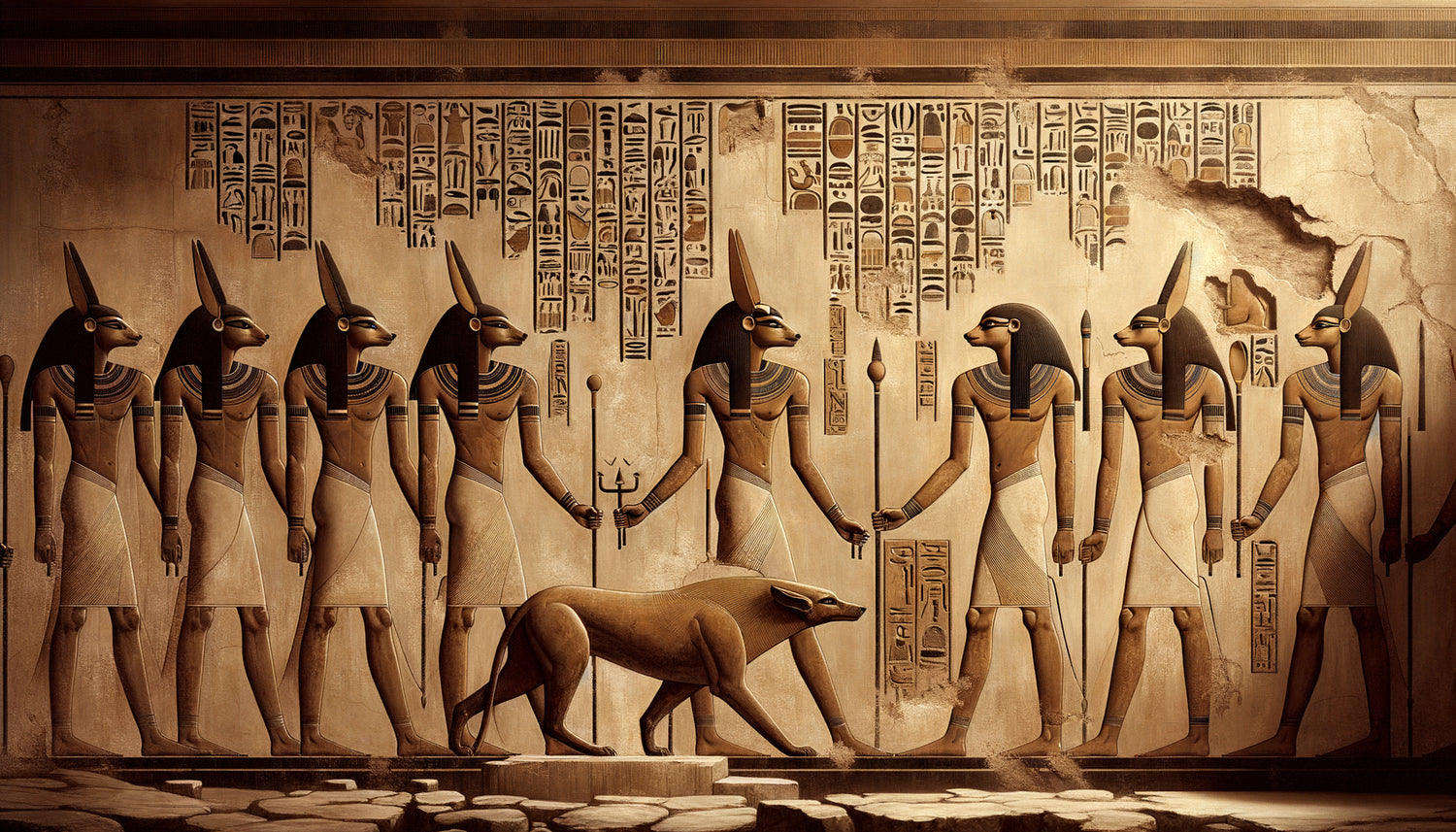
In the Osirian chapels, monochrome systematically dominated. Osiris, god of rebirth and judge of the dead, was associated with black and white tones symbolizing death and regeneration. Representations of him adopted this chromatic restriction out of ritual respect. I have documented more than forty tombs where representations of Osiris remain deliberately monochrome, even when neighboring deities shine with a thousand colors.
This chromatic sobriety intensified the solemnity of the judgment of the soul. Egyptian monochrome funerary paintings created an atmosphere of contemplation, contrasting with the exuberance of banquets and hunting scenes. Monochrome was not impoverishment but spiritual concentration.

Revealing Constraints: Technique and Symbolism
Some monochromes resulted from technical constraints transformed into aesthetic choices. Unpainted preliminary reliefs constituted an intermediate step in the creative process. But in several tombs of nobles from the 18th Dynasty, these monochrome reliefs were intentionally left as they were, their linear elegance being deemed sufficient.
The white Tourah limestone, a noble material for walls, offered a luminous surface ideal for bas-reliefs. Artists realized that the absence of color magnified the sculptural quality of their work. Monochrome Egyptian funerary paintings in relief created a play of light and shadows varying with the lighting of torches, a subtle animation impossible with opaque pigments.
Incompletion as a completed work
In the tomb of Horemheb, last pharaoh of the 18th dynasty, an entire room presents scenes in black on white. Egyptologists have long considered these frescoes unfinished. My research on adjacent hieroglyphic inscriptions reveals a ritual formulation indicating that these representations were considered complete. The pure line, without color, possessed its own perfection.
Monochrome Egyptian funerary paintings embodied the essence of forms, stripped of all chromatic distraction. This avant-garde minimalist aesthetic testifies to a remarkable conceptual sophistication. Monochrome became a universal language, understandable by gods and souls.
The hierarchical codes of funerary color
Social hierarchy was reflected in the use of monochrome. The tombs of artisans and scribes often featured monochrome scenes out of economic necessity, as pigments were reserved for the elite. But paradoxically, some wealthy nobles voluntarily adopted this chromatic sobriety for spiritual refinement.
In the Saqqarah necropolis, I studied two contemporary tombs from the 5th dynasty: one belonging to a vizier, the other to a priest of middle rank. The tomb of the vizier presents monochrome sections deliberately placed in the most sacred locations, while that of the priest uses all available colors in each scene. This inversion proves that monochrome could signal spiritual elitism rather than poverty.

The aesthetic legacy: from the Nile to our contemporary interiors
The Egyptian use of monochrome strangely resonates with current decorative trends. This ability to create emotional depth with a restricted palette inspires architects and decorators today. Monochrome Egyptian funerary paintings teach us that a voluntary chromatic restriction amplifies the visual impact rather than weakening it.
The frescoes of the Valley of the Kings demonstrate that black and white is not an absence of color but a concentrated presence of meaning. This visual philosophy crosses millennia. When you contemplate a monochrome contemporary composition, you unconsciously inherit this Nilotic wisdom: fewer colors, more depth.
Capture the essence of timeless monochrome in your space
Discover our exclusive collection of black and white paintings that capture this millennial visual power, where each shade tells a story without the need for color.
Towards a renewed understanding of funerary art
Egyptian monochrome funeral paintings were therefore neither accidents nor constraints, but deliberate choices carrying multiple meanings. Spiritual symbolism related to passage into the afterlife, narrative tool creating contrasts between visible and invisible worlds, aesthetic refinement valuing the purity of the line – each monochrome served a precise purpose.
This revelation transforms our view of Egyptian art. Far from being artisans mechanically applying conventions, the tomb painters were sophisticated creators mastering the psychology of color. They intuitively understood what contemporary designers are rediscovering: monochrome has an emotional force that polychromy cannot equal in certain sacred contexts.
The next time you admire a photograph of a monochrome Egyptian fresco, remember that it was probably designed exactly as it is. These millennial artists still teach us today that sophistication sometimes lies in restraint, and that true luxury is that of meaning rather than abundance. Their chromatic wisdom crosses the centuries, as relevant in our contemporary interiors as it was in the eternity chambers of the pharaohs.
Frequently asked questions about Egyptian monochrome funeral paintings
Did all Egyptian tombs contain monochrome scenes?
No, not all tombs featured deliberate monochrome scenes. The presence of monochrome sections varied depending on the era, the status of the deceased, and the deities depicted. Royal tombs of the New Empire generally combined vibrant polychrome scenes with strategically placed monochrome passages. Modest tombs used monochrome due to economic constraints, while certain spiritual elites adopted it as a philosophical choice. Chapels dedicated to Osiris consistently favored black and white hues for their symbolism of death and rebirth. Egyptian funerary monochrome therefore obeyed multiple logics, ritualistic and social, rather than a universal rule.
How do archaeologists distinguish a voluntary monochrome from an unfinished fresco?
Egyptologists use several clues to identify intentional monochrome. First, the quality of execution: a sure line, meticulous details and careful finishes indicate a completed work. Then, the architectural context: a monochrome placed in a strategically sacred area suggests a deliberate choice. Hieroglyphic inscriptions may contain ritual formulas declaring the work complete. The presence of sealed pigment jars near monochrome frescoes proves that colors were available but unused. Finally, coherent narrative sequences alternating colored and monochrome sections reveal a clear artistic intention. These sets of clues allow researchers to differentiate minimalist sophistication from simple incompletion, revealing the complexity of Egyptian aesthetic choices.
Can the effect of Egyptian monochrome funerary paintings be reproduced in modern decor?
Absolutely, and it is particularly relevant for contemporary interiors seeking depth and serenity. To capture the spirit of Egyptian monochrome frescoes, favor sharp contrasts between deep black and bright white, like those of Osiris representations. Incorporate linear elements reminiscent of hieroglyphs – geometric friezes, stylized motifs – which create visual rhythm without color. Wall reliefs and textures, such as stucco or worked plaster, reproduce the play of shadows of unpainted bas-reliefs. Combine these elements with indirect lighting evoking the flickering light of torches in tombs. The Egyptian teaching of sacred monochrome wonderfully translates into our current spaces, bringing that timeless and meditative dimension sought by the ancients for their eternal journeys.