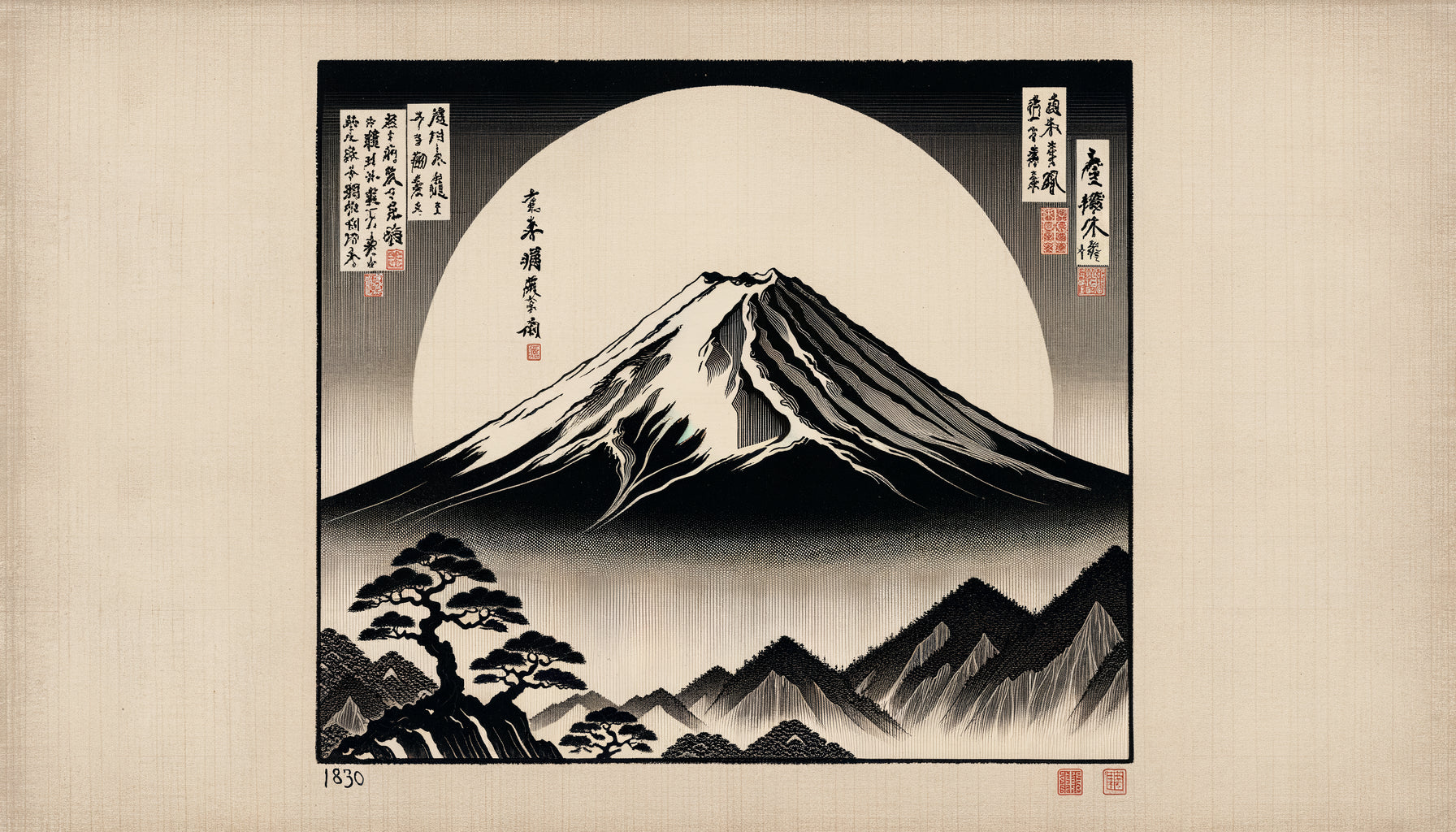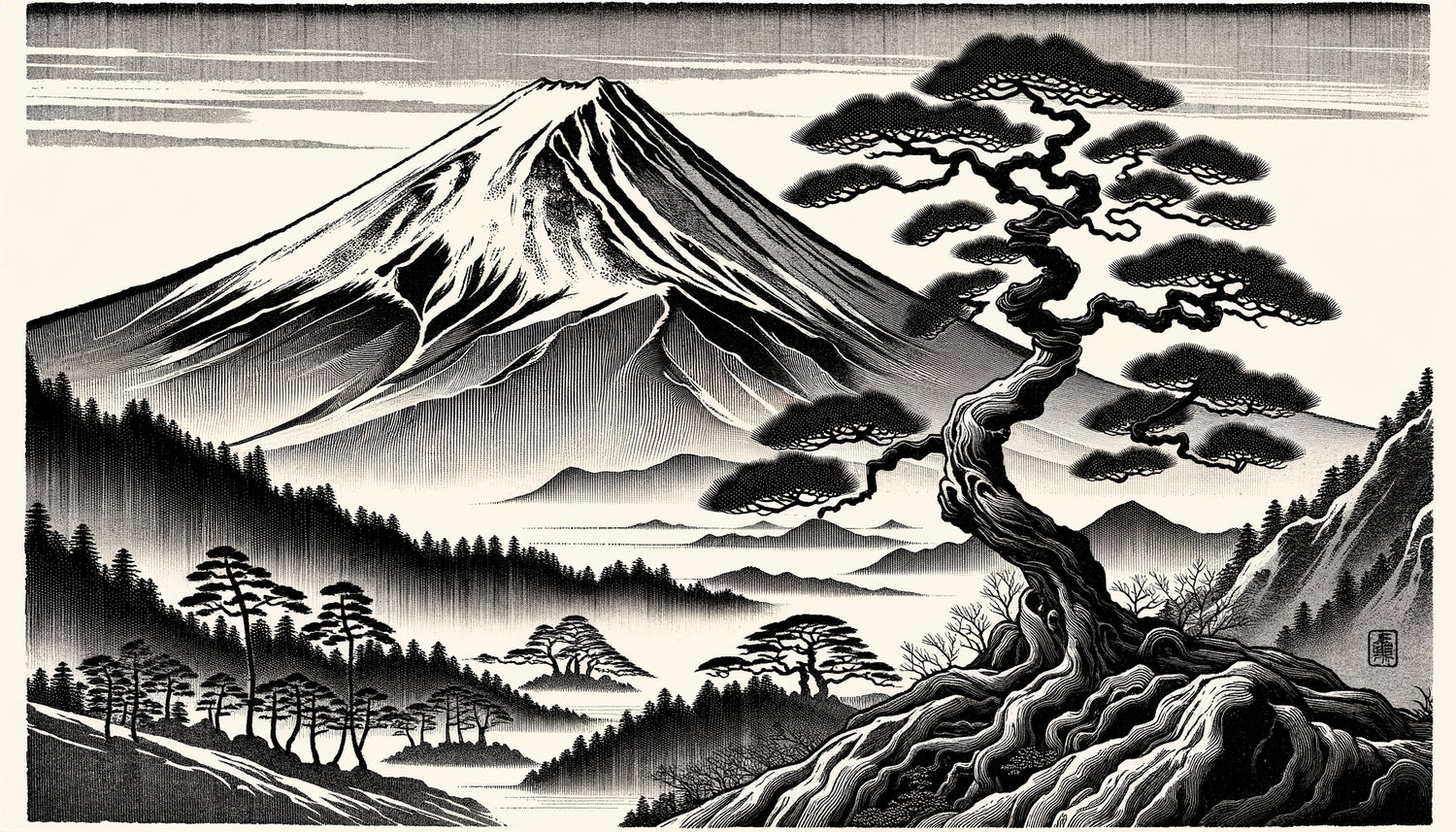
Imagine a monumental wave, frozen in black ink, its spray suspended like threatening claws above fragile boats. You know this image. It's The Great Wave off Kanagawa by Hokusai, one of the most reproduced works in the world. But have you ever noticed that its emotional power first rests on a radical balance between deep black and brilliant white? Here's what Japanese woodblock printing brought to art history: proof that two colors are enough to capture the essence of the world, a democratic technique that revolutionized artistic diffusion, and a minimalist aesthetic that still inspires our contemporary interiors. You might wonder how a popular art form from the 17th century could transform our gaze on monochrome to the point of making it a code of timeless sophistication? The answer lies in a technical constraint transformed into a visual manifesto, in the genius of anonymous artisans, and in a philosophy that makes emptiness a space for contemplation. Let me tell you about this silent revolution that still resonates in our galleries and living rooms.
When Constraint Becomes Signature: The Story of a Monochrome Revolution
Japanese woodblock printing, or ukiyo-e (images of the floating world), was born during the Edo period in a context of strict artistic restrictions. Shogunate authorities limit the use of expensive colors, reserved for the upper classes. Artisans then turn to an ancestral technique: carving wood to deposit ink and then pressing paper. The first prints are exclusively in black and white, using sumi ink made from pine soot.
This forced monochrome quickly becomes an aesthetic signature. Master engravers like Moronobu in the 17th century discover that by playing only on the intensity of black, they can create infinite nuances. The line becomes everything: thick for decisive outlines, thin for delicate details, absent to let the white of the paper breathe. This economy of means is not a limitation; it's a concentration of expression.
Unlike Western painting which seeks to faithfully reproduce chromatic reality, Japanese printmaking suggests rather than describes. White is not simply the absence of color: it is snow, light, the void inhabited by the ma, this Japanese concept of space between things. Black is not darkness but pure presence, essential form.
The Line That Tells a Thousand Stories
In a black and white print, each line carries considerable narrative weight. Engravers develop a graphic vocabulary of rare sophistication: the hair of courtesans unfolds in fluid arabesques, waves transform into hypnotic geometric patterns, kimonos are adorned with microscopic motifs.
Consider the works of Sharaku, a specialist in kabuki actor portraits from the 18th century. His compositions in black and white capture the dramatic intensity of expressions with astonishing economy of means. No color is needed to understand emotion: the furrowing of an eyebrow, the curve of a mouth, everything is said by the density of the black line on the light background.
The technique that democratizes art
Woodblock printing allows for unprecedented series reproduction. A single matrix can generate hundreds of impressions, making art accessible to merchants, artisans and ordinary city dwellers. This democratization transforms the status of the image: the print is no longer a precious object reserved for the elite, but a shared cultural asset.
Workshops in Edo produce thousands of prints illustrating urban daily life, landscapes, legends. Black and white becomes the visual language of the people, an accessible code that requires neither advanced artistic training nor fortune to be appreciated. This accessibility does not diminish the quality: on the contrary, it forces artists to strive for excellence in simplicity.

The influence that crosses the oceans
When Japanese ports open to Western trade in the 1850s, these black and white prints arrive in Europe, often as simple wrapping paper for porcelain. Parisian artists discover with astonishment this radically different aesthetic. The movement of Japonism explodes: Monet collects ukiyo-e, Van Gogh copies them, Toulouse-Lautrec draws inspiration from their bold compositions.
What fascinates the Impressionists is precisely this ability to express the essence without chromatic artifice. The engravings of Hokusai and Hiroshige prove that it is possible to capture light, movement, atmosphere with black on white. This revelation profoundly influences Western modern art, from Cubism to abstraction.
Japanese black and white also introduces a new conception of composition: flattened perspectives, bold framing inspired by plunging viewpoints, deliberate asymmetry. These principles will be found in art photography, graphic design, and even modern architecture.
The philosophy of inhabited emptiness
Behind the technique lies a worldview. Japanese woodblock printing in black and white is not minimalist by accident but by conviction. It embodies the zen principles of wabi-sabi (beauty of imperfection), ma (significant interval), and yohaku-no-bi (beauty of emptiness).
In a print, the unprinted white areas are not neglected spaces: they are visual breaths, silences that give meaning to the black line. This approach contrasts sharply with the horror of vacancy horror vacui which long characterized Western art. White does not need to be filled to exist fully.
From Edo prints to our contemporary walls
Today, when you choose a black and white artwork for your interior, you inherit this long tradition. The monochrome aesthetic carried by Japanese engraving has shaped our modern conception of refined elegance. A black and white print is not a default choice or a passing fad: it is the culmination of an aesthetic revolution centuries old.
Contemporary interior designers know this well: a black and white composition brings timelessness that color cannot offer. It creates a focal point without assaulting the eye, dialogues with all furniture styles, and brings this contemplative quality inherited from Japanese prints. Emptiness becomes presence, contrast becomes harmony.
Discerning collectors are now seeking these antique prints for their unique ability to transform a space. A Hiroshige engraving depicting snow falling on an Edo bridge instantly brings a meditative depth to a modern living room. Black and white acts as a temporal filter, a window to another era that remains perfectly current.
How to integrate this aesthetic into your home
The spirit of Japanese engraving is not limited to reproductions of ukiyo-e. It inspires a whole approach to decor: prioritize clean lines, accept empty space as an element of composition, create sharp contrasts rather than soft transitions. A contemporary black and white photograph shares with Hokusai's print the same search for essence rather than appearance.
Vertical formats, typical of Japanese prints, create an upward dynamic particularly suitable for narrow walls or transitional spaces such as hallways. Asymmetrical compositions break the monotony of overly symmetrical arrangements. And above all, black and white allows you to create coherent wall galleries even with varied subjects: landscapes, portraits, abstractions coexist harmoniously in this restricted palette.
Ready to welcome this timeless elegance into your interior?
Discover our exclusive collection of black and white artworks that capture the spirit of this millennial artistic tradition while perfectly complementing modern interiors.

The heritage that continues to inspire us
Japanese woodblock printing has accomplished something rare in the history of art: it transformed a technical and economic constraint into a universal aesthetic language. By proving that black and white was not a limitation but an expressive concentration, it paved the way for all subsequent monochrome explorations.
From Ansel Adams' photography to contemporary minimalist illustrations, from Chinese ink calligraphy to the radical contrasts of modern graphic design, the influence of ukiyo-e can be found everywhere. It taught us to see differently: to seek the essential rather than the exhaustive, to value emptiness as much as fullness, to understand that two colors are enough when they are used with intention.
Today, when you contemplate a black and white artwork, you participate in this artistic conversation that crosses centuries and continents. You welcome into your home a fragment of this silent revolution launched by Edo artisans who discovered that with a carved piece of wood, black ink and white paper, one can capture infinity. This lesson in expressive economy remains our best antidote to the visual overload of the contemporary world. Black and white are not the absence of color: they are the color of the essential.
Frequently asked questions about Japanese prints and black and white
Why were the first Japanese prints only in black and white?
The first Japanese prints were monochrome for both technical and economic reasons. Black and white woodblock printing was less expensive to produce and faster to execute than colored versions, which required several different matrices, one for each color. Furthermore, the Shogunate authorities imposed restrictions on the use of costly colored pigments. But this constraint quickly turned into a deliberate aesthetic choice: master engravers discovered that they could express an extraordinary range of emotional and visual with only black ink and the white of the paper. This approach perfectly matched the zen principles of simplicity and essence, valuing what is suggested rather than explicitly shown. Today, these black and white works are considered just as valuable, if not more so, than their polychrome counterparts.
How to recognize a genuine antique Japanese print from a reproduction?
Authenticating an antique Japanese print requires a trained eye, but a few clues will help you. Original prints generally show subtle irregularities in the printing: slight variations in inkage, visible texture of washi paper (traditional Japanese long-fiber paper), and wear consistent with age. The relief of the carved wood often leaves a perceptible tactile imprint on the back. Modern reproductions have too uniform a rendering, too white or too smooth paper. Also check for the presence of seals and signatures: artists, publishers and censors affixed their marks, whose typology evolves according to periods. Finally, be wary of prices that are too low: an authentic Hokusai or Hiroshige print is worth at least several thousand euros. For your interior decoration, know that beautiful contemporary reproductions perfectly capture the spirit of these works and offer an accessible alternative to enjoy this timeless aesthetic.
Can black and white Japanese works be mixed with a modern interior?
Absolutely, and it's even one of the most successful combinations in contemporary interior design! Black and white Japanese engraving has a timeless quality that dialogues beautifully with modern and minimalist aesthetics. The simplicity of the lines, the asymmetrical compositions and the clever use of space perfectly match the principles of current design. These prints fit just as well in an industrial loft as in a Scandinavian apartment or a refined contemporary interior. The secret lies in the framing: prioritize simple frames with clean lines, in black, white or light natural wood, without a too elaborate mat. You can create a wall gallery by combining traditional prints and modern black and white photographs, all linked by this common monochrome palette. This approach brings cultural depth and sophistication to your space while maintaining visual contemporary consistency.