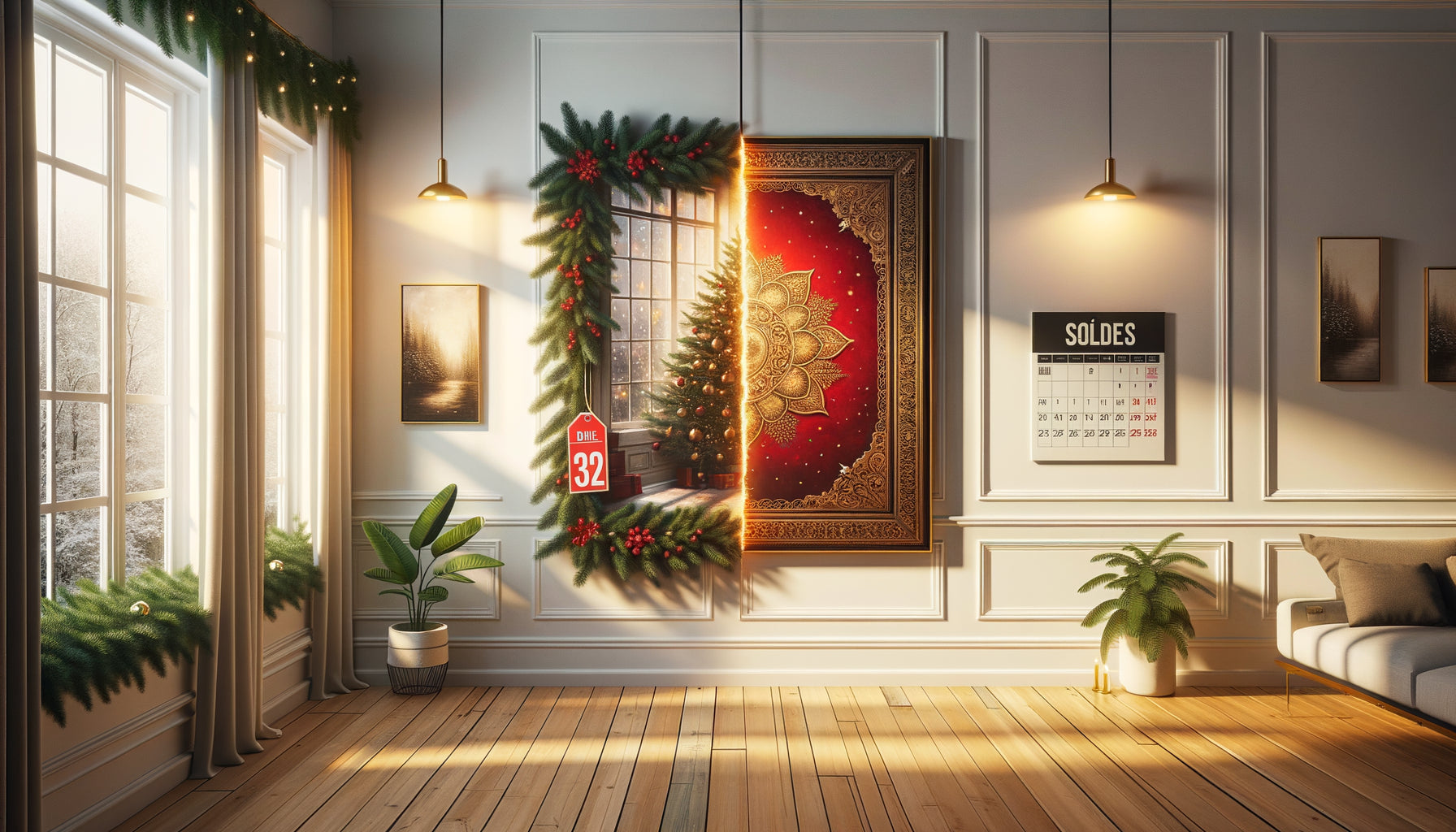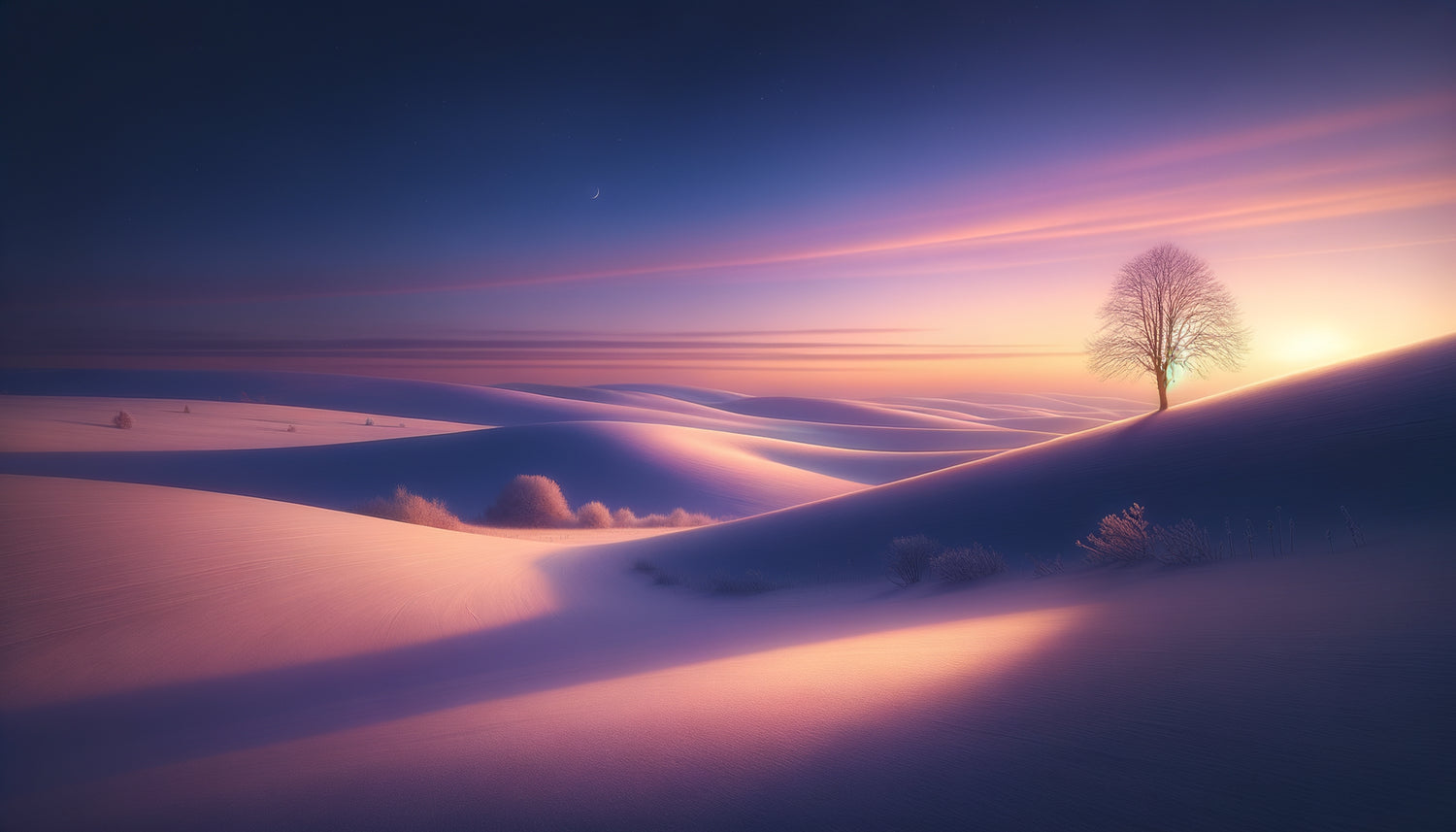
This morning, while passing in front of a Parisian gallery window, I stopped dead. A painting showed a snowy landscape bathed in golden light, and I immediately thought of those Christmases of yesteryear when time seemed to stand still. This winter scene exuded a gentle melancholy, almost palpable. It is exactly this magic that my clients seek when they want to transform their interior for the holidays.
Here's what Christmas paintings with snowy landscapes bring to your interior: a contemplative atmosphere that soothes, a visual poetry that tells silent stories, and that unique ability to create a timeless cocoon in the heart of winter.
However, faced with the prolific offer of winter decorations, it is difficult to discern the true gems. Between overly busy commercial illustrations and soulless cold representations, how to identify those works that truly touch the heart? How to choose a Christmas painting that transcends simple seasonal decoration to become a permanent element of your world?
Good news: after years of accompanying collectors and individuals in their artistic choices, I have developed a particular sensitivity to these snowy landscapes that carry within them a true poetic dimension. Let me guide you towards the most inspiring compositions.
The twilight light: when a snowy landscape becomes a living painting
The most poetic Christmas paintings often capture this magical hour when day declines. I have noticed that snowy landscapes bathed in the glow of dusk possess an incomparable evocative power. This golden-rosy light that caresses the fresh snow creates subtle contrasts, blue shadows that stretch across the immaculate white.
Look for these compositions where the light dialogues with the snow. A village whose windows gradually illuminate at dusk, fir trees projecting their silhouettes onto a white carpet, a church whose bell tower stands out against a watercolor sky. These scenes tell of the passage of time, the anticipation of reunions, the promise of human warmth.
In my gallery, I am currently exhibiting a painting that perfectly illustrates this approach: a snowy forest path where each branch bears its coat of frost, illuminated by the last horizontal rays of the winter sun. Visitors consistently stop in front of this work. Why? Because it doesn't just show a landscape; it captures a suspended moment, that precious second when nature holds its breath.
The narrative elements that stir the soul
A snowy landscape truly becomes poetic when it suggests a story. The most touching Christmas paintings integrate details that stimulate the imagination: a solitary silhouette in the white immensity, footprints winding towards an illuminated house, a sleigh abandoned near an old mill.
Architecture as an emotional anchor
Isolated chalets, village churches, stone bridges under the snow... These architectural elements transform a simple snowy landscape into a painting full of nostalgia. They evoke protection, shelter, community. A Christmas picture showing an old farm with its chimney gently smoking in the cold air immediately speaks to our universal need for security and comfort.
I recently accompanied a couple in choosing a large format for their living room. They eventually opted for a composition depicting a sleeping alpine village under the snow, with its narrow streets and roofs laden. What convinced them? The presence of a small church whose stained-glass windows projected an amber light onto the surrounding snow. That detail changed everything: the landscape was no longer just beautiful, it became inhabited, alive, full of humanity.

The color palette of winter poetry
Contrary to popular belief, Christmas paintings with snowy landscapes are not only white and blue. Snow reflects all the surrounding tones: deep purples of shadows, warm ochres of visible lands, dark greens of conifers, delicate pinks of winter skies.
Observe the works that exploit this subtle chromatic richness. A snowy landscape where the artist has managed to capture almost imperceptible nuances – that lavender blue in the hollows, that touch of orange reflected on a tree trunk, that pearl gray of the sky laden with snow to come. These tonal variations give emotional depth that overly simplistic representations never possess.
In my practice, I have found that the most sensitive clients consistently choose paintings where the snow is not a uniform white, but presents layers of light and shadow. This visual complexity creates a hypnotic effect: you can contemplate the painting for hours and constantly discover new details.
Minimalist composition: the power of emptiness
Paradoxically, some of the most poetic snowy landscapes for Christmas are also the most minimalist. An almost abstract expanse of white, punctuated by a single bare tree. A horizon line that separates the white of the ground from the gray of the sky. A landscape reduced to its essence.
These minimalist Christmas paintings possess a rare contemplative strength. They do not seek to entertain or impress, but to invite inner silence. In our often cluttered interiors, especially during the holiday season, these compositions breathe and create visual rest spaces.
I recently installed a large artwork depicting a simple snow-covered forest in the fog for an architect, where the trees gradually merged into white. No anecdotal details, no decorative overload. Just the poetry of the dissolution of forms in winter light. She told me that this work transformed the energy of the entire room, creating a point of absolute calm in her hectic daily life.

Intimate scenes: nature observed up close
Beyond the grand panoramas, some Christmas paintings with snowy landscapes capture intimate details that hold a unique poetry. A holly branch covered in frost, bright red berries against fresh snow, a stream partially frozen where water continues to murmur under the ice.
These close-up compositions transform the snowy landscape into a sensory universe. You can almost imagine the crunch of snow underfoot, the muffled silence of the winter forest, the biting cold on your cheeks. This intimate approach is particularly suitable for small spaces or series compositions: several medium-sized artworks, each exploring a fragment of the winter landscape.
Wild life in winter
Integrating animals into snowy landscapes adds a powerful narrative dimension. A majestic deer in a clearing, a robin perched on an icy branch, tracks in the snow suggesting a recent passage... These animal presences make the Christmas painting alive and mysterious.
One of my clients exclusively collects representations of snowy landscapes with winter birds. She sees them as messengers of resilience and hope, these creatures that persist despite the cold and adversity. Each artwork tells a story of perseverance in beauty.
Artistic techniques that enhance snow
The poetry of a snowy landscape also depends on the technique used. Watercolors have a transparency and lightness that perfectly evokes the fragility of snowflakes. Oil, on the other hand, allows for impasto that gives the snow a almost tactile texture.
Contemporary works sometimes play with mixed techniques: collages, silver leaf for light reflections, textures created by scratching or projection. These innovative approaches renew the traditional representation of the winter landscape without losing the essential poetic dimension.
In my gallery, I prioritize artists who understand that snow is not a static element to be mechanically reproduced, but a living, changing substance, carrying light. Some work with successive glazes to create the luminous depth characteristic of snowy days. Others use palette knives to create reliefs that physically capture the light.
Transform your interior into a poetic refuge this winter
Discover our exclusive collection of Christmas paintings that will capture the silent magic of snowy landscapes in your home.
Compose your atmosphere: integrating the snowy landscape into your decor
A Christmas painting with a snowy landscape does not float isolated on a wall. To fully reveal its poetry, it must dialogue with its environment. I often accompany my clients in this reflection of harmonious integration.
A large format representing a snow-covered forest at dusk will create a striking focal point above a sofa in neutral tones. Textiles – wool cushions, mohair blankets, shag rugs – will respond to the visual softness of the painted snow. Lighting plays a crucial role: a lamp whose warm light gently licks the painting in the evening intensifies the contemplative dimension.
For smaller spaces, a series of three medium-sized paintings, each capturing a different aspect of the winter landscape, creates an elegant visual narrative. You can play on variations: a close-up of frosted branches, a mid-distance landscape with a chalet, and a panoramic view of snow-capped mountains.
Remember that these Christmas paintings with snowy landscapes are not destined to disappear after the holidays. The most poetic transcend seasonality and deserve a permanent place in your interior. Their timeless beauty will continue to offer you moments of contemplative breathing throughout the year.
The invitation to travel immobility
Imagine yourself in a few days, comfortably settled in your favorite armchair, a steaming cup of tea in hand. Your gaze rests on this snowy landscape that now adorns your wall. The Christmas tree lights gently reflect on the protective glass. In the painting, this silent forest under the snow, this sleeping village, or this clearing bathed in twilight becomes your visual refuge.
You don't need to go to the mountains to feel this winter peace. The painting has captured it for you, preserved in this carefully elaborated composition. Whenever everyday life gets too hectic, you can lose yourself for a few moments in these white expanses, in this silent poetry that asks nothing other than your presence.
Choosing a Christmas painting with a snowy landscape is inviting contemplation into your daily life. It's deciding that your interior deserves this window on the white infinity, this constant reminder that beauty exists, peaceful and generous, even in the heart of the harshest winter.
Frequently Asked Questions
Will a Christmas painting with a snowy landscape work in a modern interior?
Absolutely, and it's even a particularly successful combination! Snowy landscapes, with their natural simplicity and often minimalist palette, dialogue wonderfully with contemporary interiors. The contrast between the pure lines of modern furniture and the organic nature of a winter landscape creates a fascinating visual tension. Favor compositions with plenty of negative space, bold framing or almost abstract approaches. A large format depicting a snowy forest in fog, for example, will bring softness and depth to a space with strict lines. Framing also plays a crucial role: opt for a thin black matte metal frame or light wood without molding, which instantly modernizes even a work of classic facture. Some of my clients even choose a presentation without a frame, mounted on chassis, for a perfectly contemporary integration.
How do I know if a snowy landscape is truly poetic or simply decorative?
This question touches on the heart of my practice as a gallery owner. A truly poetic painting provokes an immediate and personal emotional reaction. When you look at it, you feel something: nostalgia, gentle melancholy, wonder, inner peace... A snowy landscape that is merely decorative remains pleasing to the eye but does not create this deep connection. Test this: observe the painting for a full minute. Does your mind begin to wander in the landscape? Do you imagine stories, sensations? Do you want to keep looking at it? Poetry often lies in subtle details rather than obviousness: a particular light, an asymmetrical composition that creates mystery, an unexpected color palette. Beware of scenes that are too perfect, too symmetrical, too explicit. Poetry is born from suggestion, the unspoken, the space left for your imagination. Finally, trust your intuition: if a painting continues to haunt you after seeing it, then it possesses this rare poetic dimension.
What size should I choose for a snowy landscape painting in my living room?
The ideal size depends on several factors, but a general rule works well: the artwork should occupy about two thirds to three quarters of the width of the furniture above which it is hung. For a 200 cm sofa, aim for a format between 130 and 150 cm wide. This proportion creates a harmonious visual balance. However, snowy landscapes, by their nature often contemplative and refined, particularly support large formats. A panoramic landscape of 150 x 100 cm will literally transform your wall into a window open onto a winter universe. If your budget or space are limited, prioritize quality over quantity: it is better to have one medium-sized (80 x 60 cm) truly exceptional artwork than an accumulation of small ordinary pieces. For hallways or narrow spaces, vertical formats (60 x 90 cm) depicting forests in snowy perspective create a sense of elegant height. Do not forget the hanging height: the center of the artwork should be approximately 145-150 cm from the floor, at eye level. This position allows for natural and comfortable contemplation of your snowy landscape.