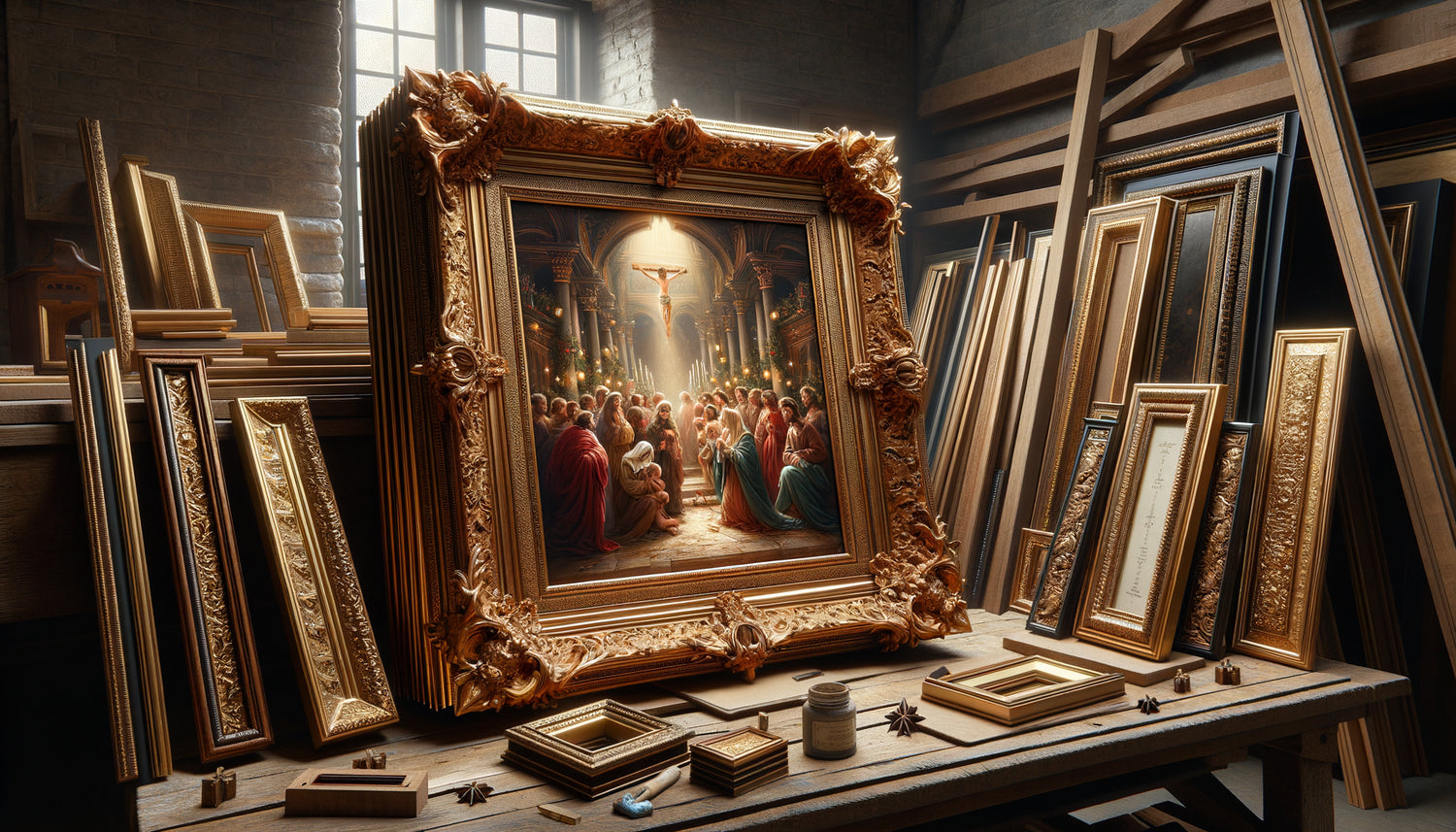
In my workshop, where I have been restoring antique frames for twenty-three years, December always brings its share of special requests. Clients arrive, carrying a Christmas painting under their arm, seeking the perfect frame to enhance these snowy scenes, golden nativity scenes, or rosy Santas. And each time, I notice the same hesitation: what frame should you choose not to betray the soul of a classic Christmas painting?
Here's what a well-chosen frame brings to your classic Christmas painting: it enhances the warm tones of your artwork, protects your emotional investment for decades to come, and transforms a simple seasonal decoration into a heritage piece that you will pass down.
The drama I too often see? Magnificent paintings stifled in overly minimalist modern frames, or conversely, intimate scenes drowned under disproportionate Baroque moldings. Framing a classic Christmas painting is not an insignificant decision: it's a dialogue between tradition and visual harmony.
Rest assured: after framing more than eight hundred Christmas paintings, I can tell you that there are simple rules to make the right choice. Rules that I will share with you, explaining not only which frame to choose, but above all why some pairings work wonderfully while others completely miss the mark.
Ready to discover how to transform your Christmas painting into a true family treasure? Follow me through the secrets of successful framing.
The golden rule: respect the era of your Christmas painting
Each classic Christmas painting bears the imprint of an era. Victorian scenes with families gathered around the fireplace do not speak the same visual language as Renaissance nativity scenes or 19th-century snowy landscapes. The first criterion for choosing a frame is therefore to identify the historical style of your artwork.
For a Christmas painting inspired by the Victorian era (1837-1901), favor dark wood frames – mahogany, walnut, or stained oak – with medium to wide moldings. These eras favored controlled opulence: neither too simple nor excessively ornate. Slightly worked corners, with discreet floral motifs, perfectly capture the spirit of these warm family scenes.
Christmas paintings inspired by Dutch or Flemish painting (think Brueghel's winter scenes) require more architectural frames. I guide my clients towards frames with an inverted profile, with a wider inner part that creates a soft transition between the wall and the artwork. The wood can be left natural or slightly patinated, never too shiny.
For classic Italian-inspired nativity scenes, dare to use gold leaf. But beware: not just any gold. Aged gilt, with subtle cracks that bear witness to the passage of time. These frames bring a quasi-sacred dimension that honors the subject depicted.
Dominant colors dictate frame choice
In my workshop, I always start by observing the tones of a Christmas painting for a long time before suggesting a frame. The dominant colors of your artwork are infallible guides to selecting the right frame.
A Christmas painting with cool tones – those beautiful scenes of villages covered in snow under a gray-blue winter sky – wonderfully suits light wood or silver frames. Bleached ash, natural beech, or even a pearl gray painted frame create a visual continuity that amplifies this frozen and poetic atmosphere.
When red and gold dominate
For Christmas paintings rich in deep reds, warm golds, and raw Sienna tones – scenes of festive interiors illuminated by candles – the frame must respond with warmth. Dark woods like walnut or cherry are your allies. They absorb and reflect this chromatic heat without creating visual competition.
I recently framed a painting depicting Santa Claus in his workshop, bathed in reds and golds. The client was hesitating between a gold frame and a modern black frame. We opted for a dark rosewood frame with a fine inner golden baguette – a compromise that made all the colors of the painting sing without crushing them.

The frame's width: a question of proportions and impact
Here is a mistake I constantly see: choosing a frame that is too narrow for a classic Christmas painting. These works, often rich in details and emotions, deserve framing that gives them presence. The frame's width should never be a secondary consideration.
For a small Christmas painting (size less than 40 x 30 cm), a frame 4 to 6 cm wide is sufficient. Beyond that, you risk creating an imbalance where the frame devours the artwork. But don't fall into the opposite extreme: a frame that is too thin will give your painting the appearance of a simple reproduction without value.
Medium formats (50 x 40 cm to 80 x 60 cm) – the most common for Christmas paintings intended to adorn a living room or dining room – require frames 6 to 10 cm wide. This width creates what I call visual breathing: a transition space between the wall and the universe of the painting that allows the eye to gradually immerse itself in the scene.
For large formats, don't be afraid of imposing frames. A Christmas painting measuring 120 x 90 cm can perfectly support a frame 12 to 15 cm wide, especially if it features worked moldings. The whole gains prestige and museum legitimacy.
The Marie-Louise: This Secret of Professional Framers
Allow me to reveal one of the most transformative techniques for a classic Christmas painting: adding a mat, or Marie-Louise in framer's language. This band of cardboard that creates a margin between the frame and the artwork possesses unsuspected powers.
For a Christmas painting with intense colors, a cream or off-white Marie-Louise provides a visual resting area. It prevents the rich colors of the frame and those of the painting from clashing. The eye benefits from a gentle transition that paradoxically amplifies the depth of the scene depicted.
Over the years, I have developed a preference for double Marie-Louise on classic Christmas paintings: a wide outer band (7-8 cm) in a neutral tone, and a thin inner band (1 cm) that picks up a color present in the painting. For example, for a nativity scene with blues and golds, a cream Marie-Louise with a midnight blue inner trim creates remarkable sophistication.
However, be careful: the Marie-Louise is not suitable for all Christmas paintings. Works on stretched canvas, in particular, often benefit from being framed without a border, where the frame comes directly against the edges of the canvas, creating a more contemporary continuity while respecting the classic character of the work.

Protecting Without Altering: The Question of Glass and Glazing
An often overlooked aspect when choosing a frame for a classic Christmas painting concerns protection. Is glazing necessary? And if so, which one to choose?
For prints, watercolors or reproductions on paper, glass is essential. It protects against humidity, dust and ultraviolet rays that fade colors over the years. I systematically guide my clients towards anti-reflective glass or, even better, museum glass. The latter filters 99% of UV rays and drastically reduces reflections, allowing you to admire your Christmas painting from all angles without seeing the reflection of the window or lighting fixtures.
For oil or acrylic paintings on canvas, the question is different. Traditionally, these works are presented without glass, allowing you to appreciate the texture of the brushstrokes and the relief of the pictorial matter. However, if your Christmas painting is exposed in a room subject to temperature or humidity variations, glazing can preserve it.
In this case, opt for a frame with an American box: a frame that creates space between the glass and the surface of the painting, avoiding any direct contact. This technique preserves the physical integrity of the paint while protecting it from external aggressions.
Harmonizing the frame with your interior decor
A classic Christmas painting doesn't float in a vacuum: it fits into an existing decorative environment. The harmony between the chosen frame and your interior will determine whether your artwork becomes a successful focal point or a visual dissonance.
In a traditional interior with exposed woodwork, antique furniture, and warm tones, your classic Christmas painting naturally finds its place with a solid wood frame, patinated, with pronounced moldings. Don't hesitate to create echoes: if your furniture is made of walnut, a frame in the same essence will create a reassuring coherence.
For more eclectic interiors, mixing old and modern, I recommend frames with cleaner lines but in noble materials. A natural oak frame with simple moldings allows a classic Christmas painting to dialogue with contemporary elements without betraying its traditional essence.
And for resolutely modern interiors? That's where the exercise becomes exciting. A classic Christmas painting can create a striking contrast in a minimalist space, provided you choose a frame that serves as a bridge between the two universes. Matte black frames with geometric lines, or brushed metal frames, make this bold coexistence possible. The artwork retains its timeless character while fitting into a current aesthetic.
The location influences the choice of frame
Where will you hang your Christmas painting? This question should influence your choice of frame. A work intended for an entrance, seen fleetingly, benefits from a more imposing frame that immediately captures attention. A Christmas painting in a bedroom, contemplated in intimacy, can allow itself a more discreet framing, with refined finishes that are discovered up close.
Your Christmas painting deserves the frame that will reveal all its magic
Discover our exclusive collection of Christmas paintings that will transform your interior into a true festive cocoon imbued with timeless elegance.
Investing wisely: the quality-durability ratio
Let's talk frankly about budget. Choosing a frame for a classic Christmas painting represents an investment, and like any investment, it must be considered in terms of quality-durability.
Low-end industrial frames, often imitation wood polystyrene, may seem economical. But in my workshop, I see these same clients returning three years later, their frame warped, the corners peeling off, the finish flaking. Ultimately, they spend more on successive replacements than they would have initially invested in a quality frame.
A solid wood frame, correctly assembled with reinforced mitred joints, will last for decades. Noble woods such as oak, walnut or beech age gracefully, developing a patina that adds character. This is particularly relevant for a Christmas painting intended to become a family tradition, brought out each year with emotion.
For tighter budgets, an intermediate solution exists: paulownia wood or solid pine frames, properly treated and finished. Less expensive than noble woods, they nevertheless offer honest durability and satisfactory aesthetics for modest-sized Christmas paintings.
Never forget this rule of thumb that I share with my clients: the frame should represent approximately 15 to 25% of the value of the painting. Not for a question of status, but because this balance generally guarantees framing of quality proportional to the importance of the work.
Conclusion: The alchemy between tradition and personalization
After these years spent handling mouldings and woods, I remain convinced of a simple truth: the ideal frame for your classic Christmas painting is one that disappears while being present. Paradoxical? Not really. The right frame is not noticed at first glance – you see the work first, magnified, sublimated. But remove it, and something is sorely lacking.
Remember the essential: respect the era and style of your painting, harmonize the colors, do not economize on the width, consider the Marie-Louise to create depth, intelligently protect with the right glazing, and think of your frame as a bridge between the work and your interior.
Tonight, when you contemplate your correctly framed Christmas painting, you will understand. In the dance of the lights of your tree that brush the carefully chosen mouldings, in the visual harmony that soothes and warms, you will know that you have done more than buy a frame: you have created a legacy.
Frequently asked questions about choosing a frame for a Christmas painting
Can I frame my Christmas painting myself or should I call a professional?
Personal framing is quite feasible for smaller formats and simple compositions, especially if you have a minimum of tools (mitre saw, staple gun). Many retailers now offer pre-cut moldings to assemble at home. This option is perfect for prints or reproductions of Christmas paintings without great sentimental or financial value. However, for an original work, a family portrait, or a format exceeding 60 x 80 cm, I strongly recommend a professional framer. The risk of cutting errors, poorly adjusted joints, or inadequate protection can irreparably damage your Christmas painting. A professional will also be able to advise you on the technical subtleties – the correct hanging system, the appropriate UV protection, the choice of a rigid backing to prevent deformation. Consider professional framing as an investment to preserve your artwork in the long term.
My Christmas painting is in a classic style but my interior is modern, what frame should I choose?
This situation, far from being problematic, offers an exciting creative opportunity. The secret lies in choosing a frame that respects the classic essence of your painting while dialoguing with your contemporary decor. Opt for clean lines in noble materials: a natural oak frame with minimalist moldings, a matte black frame with generous proportions, or even a metal frame in bronze or brushed brass tones. These choices create an elegant bridge between the two aesthetic universes. Avoid at all costs ornate gilded frames or dark sculpted woods that would create too marked a dissonance. The trick is to consider your classic Christmas painting as a character piece – an assumed contrast element that brings warmth and history to a modern interior. The frame should facilitate this dialogue, not prevent it. A pure white Marie-Louise can also serve as an effective buffer zone, creating a soothing visual transition between the style of the painting and the contemporary aesthetic of your space.
How do I maintain and clean the frame of my Christmas painting?
Regular maintenance of a frame guarantees its longevity and preserves the brilliance of your Christmas artwork. For natural or varnished wood frames, weekly dusting with a dry microfiber cloth is sufficient during the display period. Absolutely avoid harsh cleaning products or multi-purpose sprays that can alter finishes, especially on gilding or patinas. Once or twice a year, you can nourish the wood with a specific product – natural beeswax for waxed woods, or a suitable polish for varnished woods. Apply sparingly in the direction of the wood grain. For gold leaf frames, caution is advised: limit yourself to gentle dusting with a soft-bristled brush, never rubbing. Humidity is the main enemy: install your Christmas artwork away from direct heat sources and areas of excessive humidity. If you store your artwork for part of the year, wrap it in acid-free tissue paper, never in plastic which promotes condensation. A well-maintained frame will last through generations, faithfully accompanying your family's Christmas tradition.