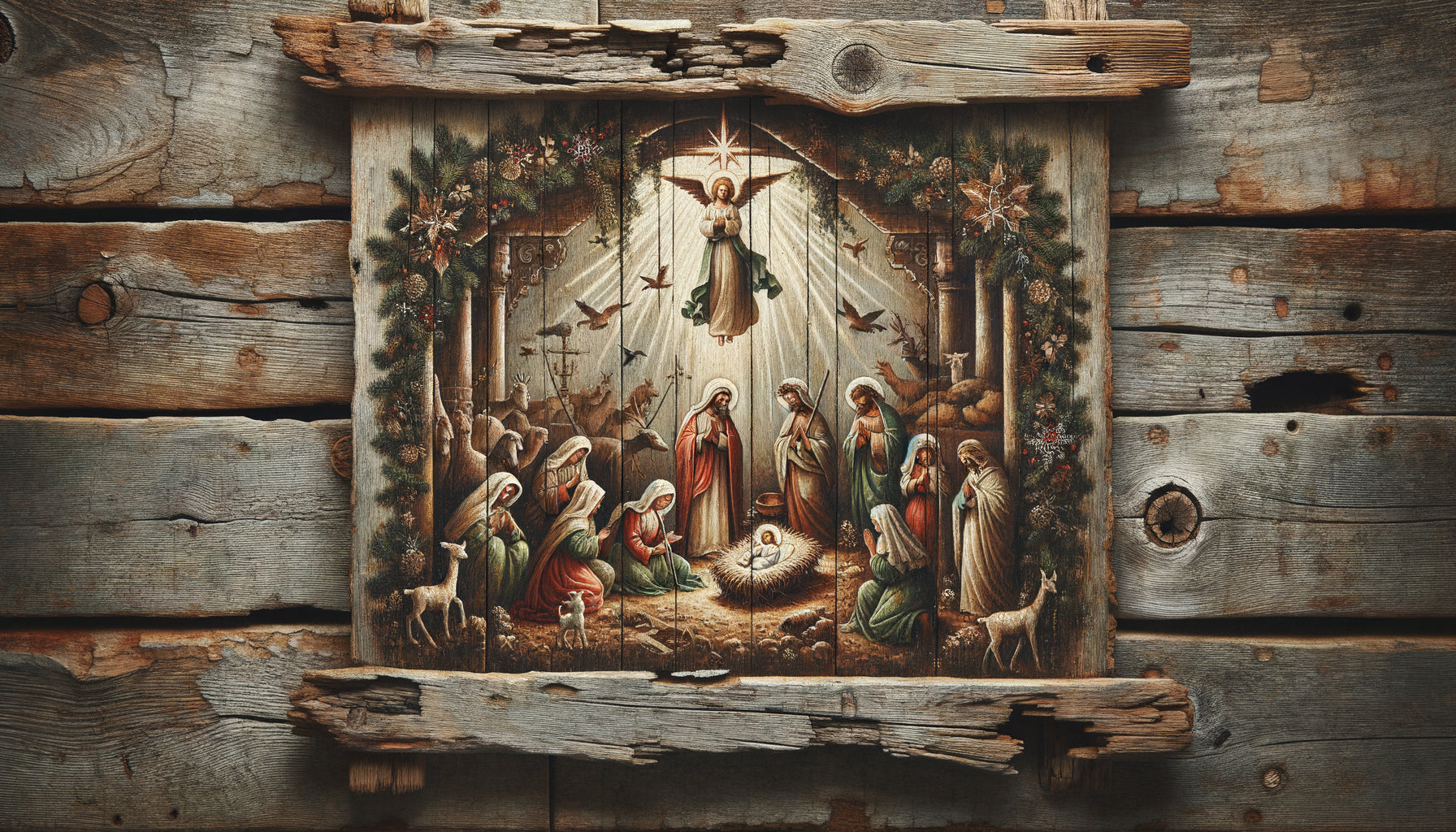
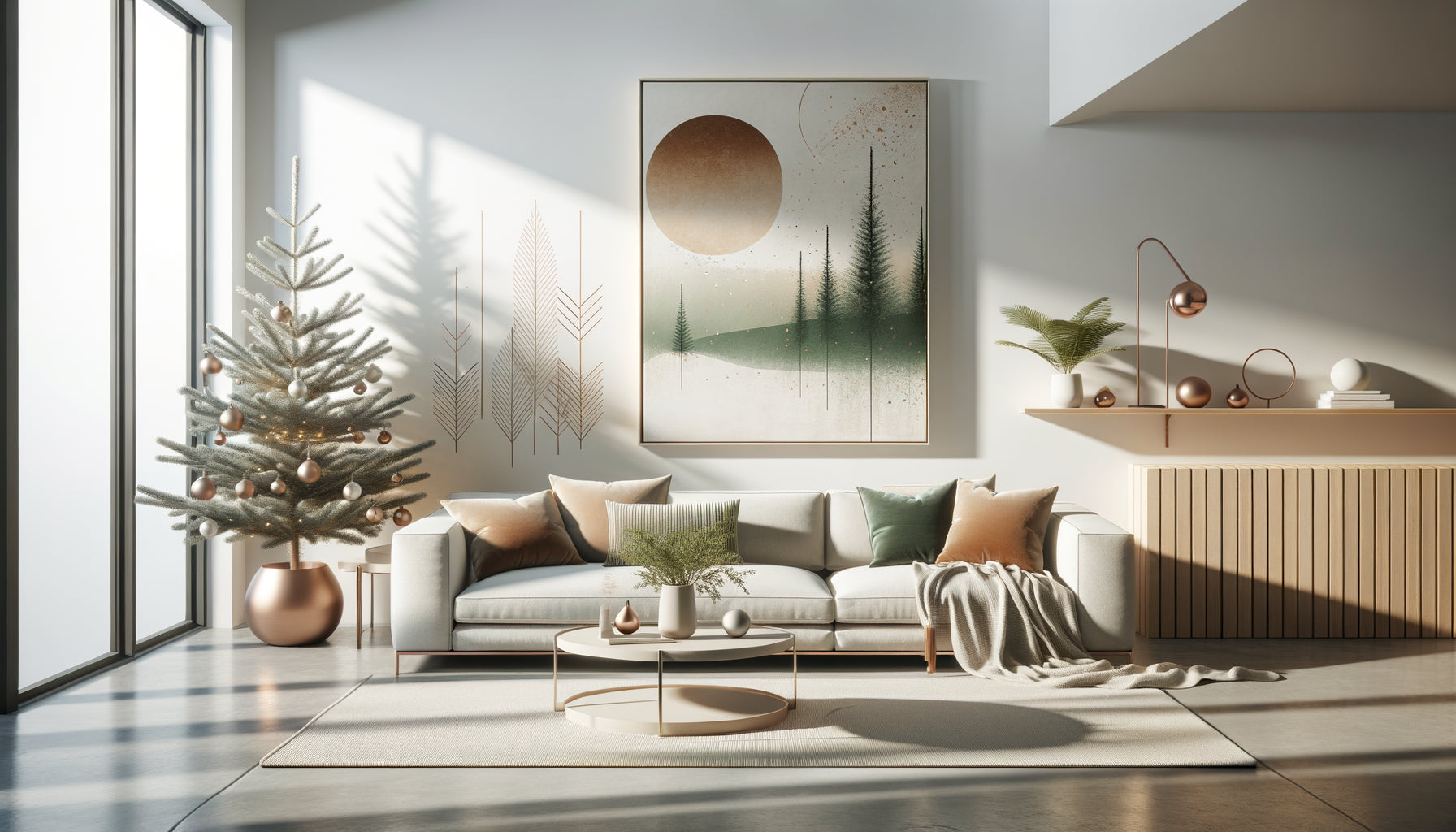
When I started assisting my clients with their seasonal decorating projects eight years ago, one question consistently resurfaced mid-November: how much should you invest to truly transform your interior with Christmas paintings? Between the fear of breaking the bank and getting a disappointing result, many hesitate to take the plunge. Yet, creating a consistent festive atmosphere throughout the house thanks to paintings doesn't require a pharaonic budget.
Here's what a controlled budget for your Christmas paintings brings you: a warm ambiance that evolves room by room, the ability to create instant decorative focal points, and above all a lasting investment that you will reuse year after year. Unlike ephemeral garlands or cut trees, Christmas paintings constitute a decorative heritage that lasts through the years without losing their luster.
The main frustration? Not knowing where to start or how much to allocate to each space. Many end up overloading the living room while neglecting the bedrooms, or worse, abandon the idea due to a lack of clear budgetary guidelines. I reassure you immediately: with intelligent planning and an understanding of priorities by room, decorating the whole house with Christmas paintings becomes accessible, whatever your initial budget.
In this article, I reveal to you the realistic budgets room by room, the optimization strategies that I use with my clients, and how to create maximum impact without compromising your wallet. You will discover that there is an approach for every budget, from minimalist to passionate collector.
Budgetary fundamentals: how much to generally plan?
To decorate a whole house with Christmas paintings, I generally recommend three budgetary tiers that correspond to distinct approaches. The minimalist budget, between €150 and €300, allows you to dress the key spaces with 4 to 6 Christmas paintings well chosen. This option is perfect for apartments of 50 to 80m² or those who prefer a clean decoration.
The intermediate budget, located between €300 and €600, offers real creative freedom. With 7 to 12 Christmas paintings, you can create narrative compositions, play on formats and install visual consistency throughout the living rooms. This is the budget I most often recommend: it allows you to express a true decorative identity without excess.
Finally, the passionate budget, over €600, is for lovers of the festive season who want to transform every corner into an invitation to travel. With 15 paintings or more, potentially including XXL formats or custom-framed pieces, you create a real domestic staging. I have accompanied clients up to €1200 for 150m² houses where every hallway, every child's bedroom told a different facet of Christmas.
Strategic allocation: what budget per room?
The living room and dining room naturally deserve the lion's share: 40% of your total budget. This is where family moments, festive meals, and guests' gazes are concentrated. For a global budget of €400, invest around €160 in these central spaces. This represents 2 to 3 Christmas paintings of generous sizes (60x80cm or triptychs), positioned above the sofa, near the dining table or facing the entrance.
The entrance, often neglected, should capture 15% of the budget. It's the first impression, the one that sets the tone. A welcoming Christmas painting near the door, a vertical composition in a narrow hallway: these €60 on a €400 budget create a disproportionate impact compared to the investment. I prefer warm scenes here, welcome messages or snowy landscapes that immediately invite you to cozy up.
Bedrooms represent 25% of the global budget. Master bedroom, children's bedrooms: each deserves its specific atmosphere. On our €400 budget, this means around €100 to be distributed. A large soothing Christmas painting for parents (forest scene, starry night), playful illustrations for children (mischievous Santa Claus, winter forest animals). These intimate spaces particularly benefit from this festive touch that prolongs the magic until bedtime.
Bonus spaces that make the difference
The remaining 20% is strategically dispersed: kitchen, office, bathroom. A small Christmas painting of 30x40cm in the kitchen (€30) transforms December mornings. An inspirational quote near the home office (€25) maintains the festive spirit even during teleworking days. These micro-investments create a narrative continuity: the entire house breathes Christmas, not just the main rooms.
I have noticed that stairways and landings, often forgotten, offer exceptional decorative opportunities. A vertical composition of 3 small Christmas paintings (20x30cm) creates a captivating ascending rhythm for only €60 to €90. These transition spaces become miniature galleries that multiply visual points of interest.

Optimizing your budget: the strategies of savvy decorators
The first golden rule for decorating the whole house with Christmas paintings without breaking the bank: prioritize quality over quantity in strategic spaces. A magnificent Christmas painting XXL in the living room (€120) will have infinitely more impact than four small formats scattered randomly. The human eye naturally seeks focal points: give it that satisfaction in high-traffic rooms.
Conversely, in secondary areas, adopt a strategy of controlled volume. Formats of 30x40cm or 40x50cm, often offered between €25 and €45, allow you to multiply presences without exploding the budget. I encourage my clients to create gallery walls in hallways with 4 to 5 Christmas paintings of varying sizes but thematically consistent: the visual effect is sumptuous for a moderate investment (€120-€150 total).
Thematic combination is another powerful trick. Instead of buying radically different Christmas paintings, build a common color palette (red-gold, white-silver, green-natural) that circulates from room to room. This visual consistency allows you to buy varied formats at different prices while maintaining harmony that gives the impression of a carefully assembled expensive collection.
The progressive approach: building your collection year after year
Few of my clients decorate the entire house from the first year. The progressive approach turns investment into renewed pleasure. Year 1: living room and entrance (€200). Year 2: bedrooms (€150). Year 3: bonus spaces (€100). In three seasons, you have built a complete collection of Christmas paintings for €450, or less than €13 per month spread over that period.
This method offers a considerable psychological advantage: each new season brings its share of decorative discoveries. You refine your tastes, test new locations, and avoid impulsive purchases you would regret. Plus, collections evolve: Christmas painting trends are partially renewed each year, allowing you to integrate the novelties that truly seduce you.
The budget pitfalls to absolutely avoid
The first pitfall: buying too small out of economy. A Christmas painting of 20x30cm lost on a 4-meter wall will not decorate anything at all. It is better to invest €70 in a 60x80cm format that visually structures the space than to scatter this sum into four mini-formats that will go unnoticed. The proportion between the painting and its welcoming wall determines 80% of the decorative impact.
A common second mistake is neglecting additional costs. A Christmas painting for €40 sometimes requires a suitable hanging system (€5-€15), or even custom framing for unframed prints (€30-€60 extra). Anticipate these costs in your overall budget to avoid unpleasant surprises. Conversely, ready-to-hang Christmas paintings, although slightly more expensive to purchase (€10-€15 more), eliminate these hidden fees.
The third pitfall is sacrificing coherence for variety. Buying a rustic Christmas painting, another ultra-modern one, and a third childlike one without an overall vision creates a visual chaos that devalues each piece. Even with a comfortable budget, a stylistic guideline (vintage Nordic, contemporary minimalist, warm traditional) multiplies the perceived impact. A coherent collection of 6 Christmas paintings at €30 visually surpasses 10 disparate pieces at €50.

Tight budget? Creative solutions that work
With only €100 to €150, you can absolutely decorate the whole house with Christmas paintings by adopting a mixed strategy. Invest €50 in a centerpiece for the living room, then deploy 4 to 5 formats of 20x30cm (€15-€20 each) in secondary spaces. This prioritization creates a strong visual anchor complemented by a festive but perceptible presence throughout the house.
DIY compositions significantly increase your decorative purchasing power. Three small format Christmas paintings arranged in a dynamic triangle on a wall produce the visual effect of a single large piece, for one-third of the price. I particularly encourage this approach in children's bedrooms where playful asymmetry reinforces the joyful atmosphere. Three 20x30cm illustrations at €18 each (€54) create more impact than a single 60x80cm painting at the same price.
Finally, don’t forget the rotation rule. If your budget is really limited, focus on 3 to 4 quality Christmas paintings that you will strategically move around. Week 1 and 2 of December: living room and entrance hall. Weeks 3 and 4: bedrooms and kitchen. After Christmas, first week of January: office and dining room to gently prolong the transition. This circulation creates a dynamic of renewal that maintains visual freshness without multiplying purchases.
Ready to transform your interior into a visual celebration of Christmas?
Discover our exclusive collection of Christmas paintings that suit all budgets and all styles, from minimalist Nordic to traditional opulence.
The true value of a durable festive investment
Beyond the immediate figures, consider the annualized cost of your Christmas paintings. An investment of €400 in a collection that you will use for at least 10 years represents €40 per season, or less than three restaurant meals. These Christmas paintings do not fade, do not require annual replacement like fragile decorations, and can even be passed on or resold if your style evolves.
I have clients who have built up collections of Christmas paintings that have become true family heirlooms. Each piece tells a year, a journey, an artistic discovery. What started as a €300 decoration budget has turned into an annual enrichment ritual, where adding one or two new Christmas paintings marks the beginning of the festive season as surely as the first snow.
The emotional dimension largely justifies the financial investment. Unlike electric garlands that are mechanically installed, hanging your Christmas paintings becomes a moment of conscious transition, a gesture that anchors the festive period in everyday life. Every morning in December, these visual presences remind you to slow down, savor, and celebrate. This intangible value far exceeds the few hundred euros invested.
The investment that improves with time
Unlike cut Christmas trees that end up on the sidewalk in early January, your Christmas paintings improve over the years. Associations of memories are enriched: this painting hung the year your daughter was born, the one discovered during your Nordic trip, another that survived the move. They become temporal markers loaded with personal stories, far beyond their initial decorative function.
Some formats and styles even increase in value. Illustrations by independent artists, limited editions, ephemeral collaborations: these Christmas paintings can be resold or exchanged at prices higher than their original purchase price. Without turning your decoration into an investment strategy, this dimension adds an interesting layer of reflection during your selections.
Imagine December next year: you step through your door after a long day, and immediately, the Christmas artwork illuminated in your entrance hall welcomes you into a warm atmosphere. In the living room, the large composition above the sofa catches the reflections of candles. In the children's bedroom, playful illustrations gently prepare them for the magical night before Christmas. The whole house breathes celebration, consistent and soothing at the same time.
It's not about a pharaonic budget, but about a clear intention and sensible planning. Whether you invest 150€ or 800€, the key lies in the consistency of your vision and the quality of your choices. Start by identifying your three priority spaces, define your stylistic palette, then gradually build your collection of Christmas artworks. In three years, you will have created, without even thinking about it, a decorative heritage that will transform each December into a visual celebration, year after year.
Frequently Asked Questions
Is it really necessary to put Christmas artworks in all rooms?
Absolutely not, and I even advise against the systematic approach which can create visual saturation. The goal is not to cover every wall, but to create a circulation of festive atmosphere through the spaces you live in daily. If you rarely go into your laundry room or pantry, there's no need to install a Christmas artwork. On the other hand, if your home office occupies your days, it definitely deserves its festive touch. Focus on the rooms where you actually spend time: living room, kitchen, bedrooms, entrance hall. A well-thought-out presence in 4 to 5 key spaces creates a consistent atmosphere without overload. The magic of Christmas lies in suggestion, not omnipresence. Three Christmas artworks perfectly positioned surpass ten scattered pieces without intention.
What is the minimum size for a Christmas artwork to have a real decorative impact?
The rule of thumb I apply: your Christmas artwork should occupy at least one third of the width of the furniture or area it surmounts, and ideally half. For an 180cm sofa, aim for a painting or composition at least 60cm wide, ideally 90cm. On a bare wall without furniture reference, consider the viewing distance: a painting viewed from 3 meters (living room) should measure minimum 50x70cm to create an impact. Conversely, in a narrow hallway where you pass 1 meter from the wall, a 30x40cm format works perfectly. Small formats (20x30cm) work wonderfully in compositions of 3 to 5 pieces, but isolated they get lost on large surfaces. Don't be afraid to invest in one or two large formats: an Christmas artwork of 80x120cm to 100€ structures a space infinitely better than four small ones at 25€ which will seem to float without visual anchoring.
Can we mix different styles of Christmas paintings or should we have absolute consistency?
Perfect consistency is neither necessary nor even desirable, but there's a subtle nuance between mastered eclecticism and decorative chaos. You can absolutely mix styles if you maintain a common thread: either chromatic (all your Christmas paintings share a red-gold palette, for example), or thematic (winter nature declined in different styles), or formal (all framed in black, whatever the contents). I even encourage this approach which tells a richer story than strict uniformity. However, avoid brutal stylistic jumps within the same space: an ultra-modern geometric Christmas painting next to a very figurative traditional scene will create dissonance. The solution? Create stylistic zones per room: the living room can have a clean contemporary atmosphere while the children's bedroom plays the playful traditional card. Transition spaces like hallways then become bridges that make these universes dialogue. The essential thing is that each room has its own internal consistency, even if the house as a whole presents stylistic diversity.