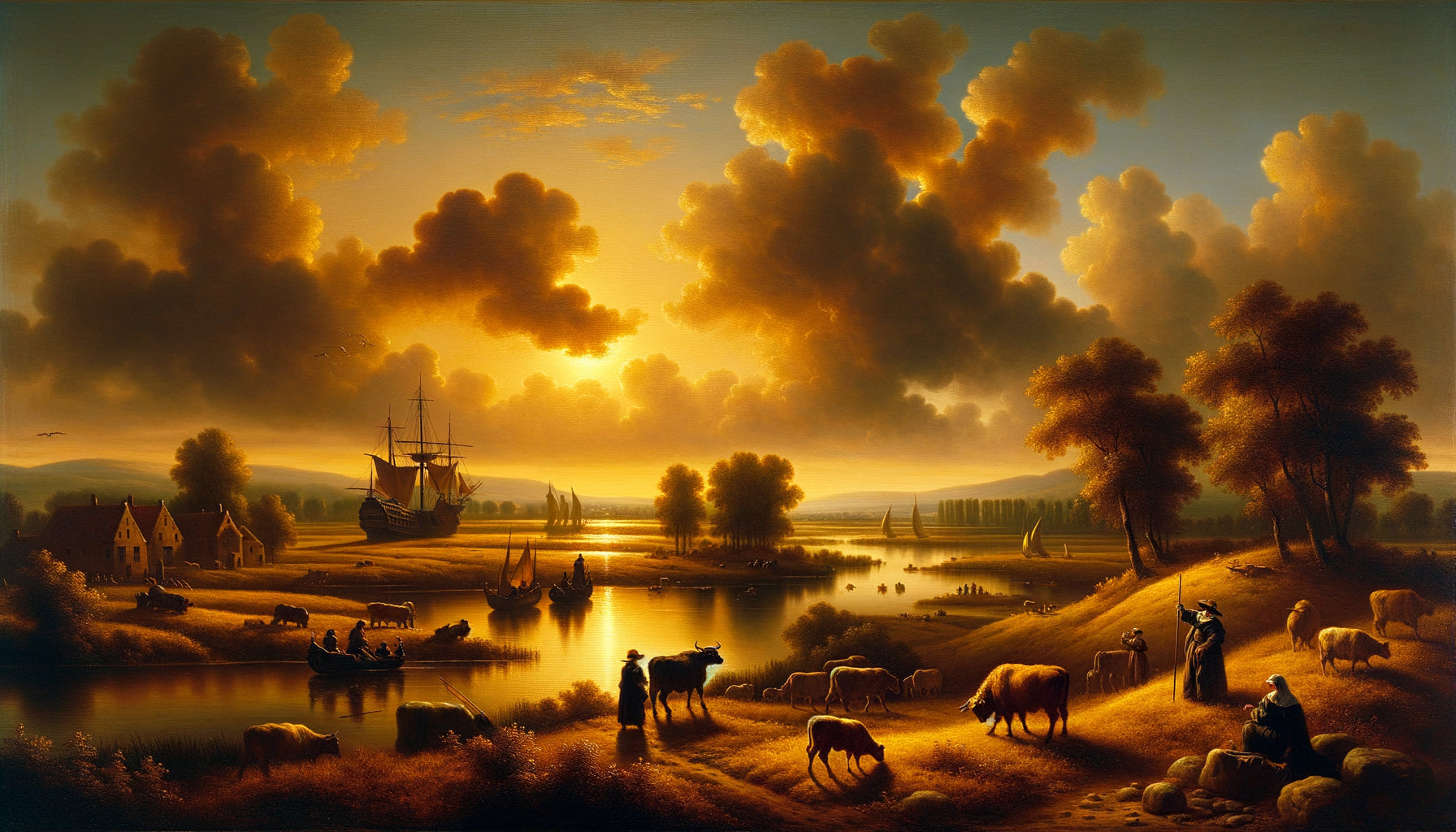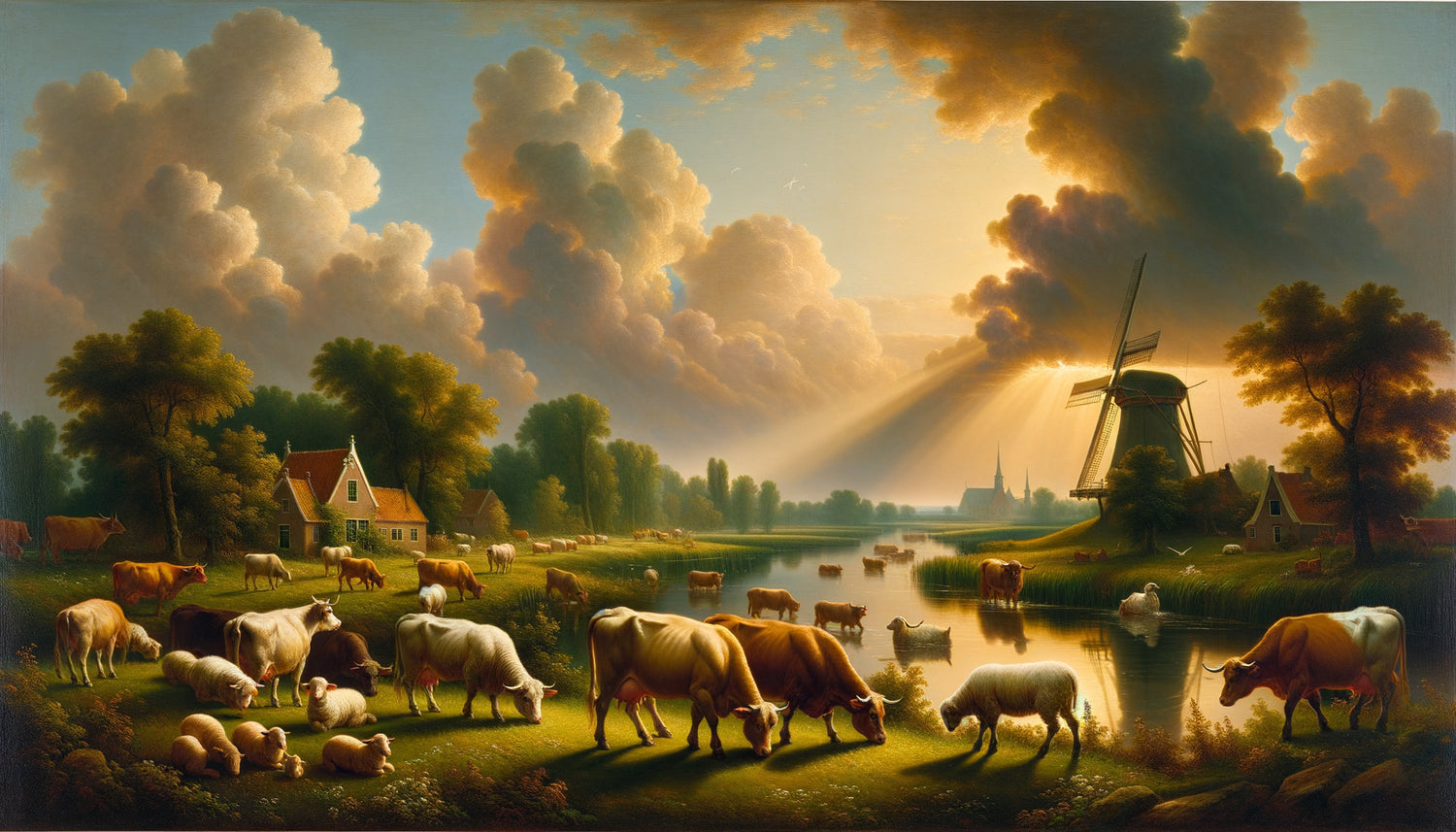
In the cozy living rooms of Amsterdam in the 17th century, a scene repeated endlessly: wealthy merchants flocked to canvases depicting peaceful cows grazing, sheep in the morning mist, shepherds watching over their flocks. These pastoral paintings adorned the walls of the most beautiful homes of the Dutch Golden Age, rivaling still lifes and family portraits. But why this fascination with rural scenes among merchants who had never held a pitchfork in their lives?
Here's what cattle landscapes brought to the Dutch merchant bourgeoisie: an affirmation of their economic prosperity, a contemplative refuge from urban bustle, and a prestigious artistic investment. These works were not mere decorations but veritable visual manifestos.
Today, when we admire these paintings in museums, it is difficult to understand their power of attraction. Cows? Really? We seek drama, heroism, grandeur... and we see only animals grazing peacefully. That's the whole misunderstanding.
Yet, by delving into this fascination, one discovers an entire chapter of Dutch art and social history. These paintings tell a silent revolution: that of a social class that invented a new form of prestige, far from traditional aristocratic codes. And this story strangely resonates with our own contemporary quest for authenticity and reconnection to nature.
This article plunges you into the fascinating world of these 17th-century collectors, to understand why a simple herd of cows was worth its weight in gold.
Livestock as a metaphor for national wealth
In the United Provinces of the 17th century, herds were not only an agricultural reality: they embodied the very prosperity of the country. The Netherlands possessed Europe's most fertile pastures, these polders reclaimed from the sea that produced exceptional fodder. Dutch cows provided the milk that became the famous Edam cheese, exported as far as Asia. Sheep produced wool prized throughout Europe.
For an Amsterdam merchant enriched by spice trade or finance, hanging a cattle landscape in his living room was akin to displaying a certificate of economic patriotism. These paintings celebrated the Dutch exception: a small territory that had managed to transform its marshes into green gold. Each cow painted by Paulus Potter or Albert Cuyp was a symbol of national ingenuity.
The painters understood this well. They represented these animals with almost scientific precision, detailing the texture of their coat, the power of their musculature, the serenity of their gaze. A prosperous herd on canvas meant a prosperous country. It was a shared pride, a collective identity that the Dutch merchant bourgeoisie wanted to celebrate and appropriate.
The cow as aristocrat of the meadows
Carefully observe these paintings from the Golden Age: cows are often depicted in majestic poses, bathed in golden light, with a backdrop of dramatic skies. They become almost heroic creatures. This nobility bestowed upon livestock was not insignificant. By elevating the animal to the rank of worthy pictorial subject, painters also elevated the status of those who owned these lands and herds.
An alternative democratic approach to aristocratic codes
Unlike European courts where mythological scenes and royal portraits were collected, the Dutch merchant bourgeoisie invented a new visual language of prestige. The United Provinces had no king, no lavish court, no traditional aristocracy. It was therefore necessary to create other codes.
Landscapes with herds offered this perfect alternative. They affirmed: Our wealth comes from the land, from work, from trade, not from hereditary privileges. This was a cultural revolution. A merchant could own a magnificent painting depicting sheep without imitating dukes and princes. He displayed his belonging to a new elite, that of the self-made men of the time.
This democratization of the pictorial subject was profoundly subversive. French or Italian art academies would have considered these rural scenes as minor, unworthy of the great masters. But in Holland, Paulus Potter could dedicate a monumental canvas to a simple bull and be celebrated for it. His famous Young Bull (1647) measured almost 3 meters! Imagine the audacity: giving a farm animal the dimensions reserved elsewhere for biblical scenes.
The choice of everyday life as a manifesto
By choosing landscapes with herds, the Dutch merchant bourgeoisie made a political and aesthetic choice. These paintings said: Beauty is found in reality, in our daily lives, not in ancient fables. This was an affirmation of a radical modernity, rooted in the tangible reality of their world.

A bucolic refuge in the face of rampant urbanization
The Dutch 17th century experienced unprecedented urbanization. Amsterdam grew from 50,000 to 200,000 inhabitants in a few decades. Port cities were teeming with activity: warehouses, shipyards, stock exchanges. In this mercantile turmoil, landscapes with herds offered a contemplative escape.
These canvases functioned as windows open onto an idealized countryside. They brought into urban bourgeois interiors the pure air of meadows, the calm of infinite horizons, the slow rhythm of pastoral life. It was a form of psychological compensation: the more intense urban life became, the stronger the nostalgia for rural life felt.
The painters masterfully captured this soothing atmosphere. The skies often occupied two-thirds of the composition, with those characteristic clouds of Dutch light. The herds evolved in suspended, eternal time. Contemplating these scenes allowed one to mentally escape from the stress of business, to reconnect with a natural world that already seemed distant.
This contemplative function of landscapes with herds was not explicitly formulated at the time, but it was very real. Inventories after death reveal that these paintings often adorned private rooms, bedrooms, personal studies - spaces of intimacy and rest.
Art investment as proof of refinement
Owning high-quality landscapes with herds demonstrated a trained eye, the ability to distinguish a good painter from a dabbler. For if the subject seemed simple, its execution required exceptional virtuosity. Rendering the texture of fleece, light on a damp flank, the atmospheric depth of a misty landscape: this separated masters from apprentices.
The Dutch merchant bourgeoisie developed a true connoisseur expertise. These merchants visited workshops, compared styles, followed the careers of promising painters. Albert Cuyp, with his golden lights inspired by Italy applied to Dutch scenes, was particularly prized. Aelbert Jacobsz. Cuyp created unique atmospheres where herds bathed in an almost divine aura.
Owning a Cuyp or a Potter was as distinctive as owning today a work by a listed artist. These paintings circulated in an already sophisticated art market, with auctions, intermediaries, price variations according to the painter's reputation. Landscapes with herds were therefore not only decorative objects, but also financial and cultural assets.
The signature of a social status
Receiving guests at home was also exhibiting one's collection. Cultured visitors knew how to identify hands, recognize manners. A beautiful landscape with herds well placed in a living room signaled belonging to a restricted circle of enlightened enthusiasts. It was a coded social language, where rural art paradoxically became an urban marker of elegance.

The Hidden Spiritual Dimension of Pastoral Scenes
There is a less obvious but fascinating dimension to landscapes with herds: their spiritual resonance. In the dominant Calvinist Protestant tradition in the Netherlands, contemplation of nature was a gateway to the divine. Unlike Baroque Catholicism with its saints and miracles, Protestantism favored a sober spirituality centered on divine creation.
Peaceful herds in their meadows could be read as an illustration of the harmonious order desired by the Creator. Pastoral scenes also evoked biblical parables, Christ as the Good Shepherd, the faithful as the flock. This allegorical reading, never explicit but always possible, added an extra layer of depth to these works.
For the Dutch merchant bourgeoisie, often deeply pious despite their material enrichment, these paintings allowed them to reconcile worldly success and spiritual concerns. Contemplating a well-guarded flock was meditating on divine providence, on the responsibility of the rich towards his community (like the shepherd towards his animals), on the humility necessary in the face of nature.
Want to rediscover this timeless serenity in your home?
Discover our exclusive collection of nature paintings that bring the soothing atmosphere of bucolic landscapes into your contemporary interior.
The Contemporary Legacy of a 17th Century Passion
This Dutch fascination with landscapes with herds has profoundly influenced the history of art. It legitimized landscape as a major genre, paving the way for French Impressionists who, two centuries later, would in turn paint rural scenes with cows and sheep - think of Pissarro, Monet.
More deeply, it established a revolutionary idea: that everyday life deserves to be celebrated, that beauty is found in the ordinary observed with attention. This philosophy resonates powerfully today, at a time when we are seeking to slow down, to rediscover authentic connections with nature, to value simplicity over artificial sophistication.
When we hang a landscape photograph today, a canvas depicting animals in nature, or when we collect works celebrating the rural world, we unknowingly extend this tradition initiated by the Dutch merchant class. We seek, as these Amsterdam merchants did four centuries ago, visual refuge, an affirmation of values, a beauty that grounds us.
Dutch Golden Age landscapes with herds teach us that a work of art is never neutral. It carries the aspirations, anxieties, and dreams of those who choose it. These cows and sheep immortalized by Dutch masters were not only about agriculture: they told how a society saw itself, what it valued, how it imagined its place in the world.
Today, when you contemplate a soothing landscape in your living room, ask yourself: What does it say about me? What aspiration does it express? What inner world does it reveal? For like these 17th-century Dutch bourgeois, we choose our images to inhabit not only our walls but also our imaginations.
Frequently Asked Questions
Why cows and not horses or hunting dogs?
Excellent question! Horses and hunting dogs were indeed present in art, but they were associated with aristocratic nobility and court life. The Dutch merchant class preferred cows and sheep precisely because they represented productive and commercial wealth, not the leisure of the aristocracy. A herd of cows recalled the dairy and cheese industry that enriched the country, while a hunting horse evoked the noble privileges from which the United Provinces had just freed themselves. It was therefore a choice as ideological as it was aesthetic, a way to affirm democratic and entrepreneurial values.
Were these paintings really expensive at the time?
Prices varied considerably depending on the painter's reputation. A landscape with herds by a recognized master like Albert Cuyp or Paulus Potter could cost as much as a year's salary for a skilled craftsman, sometimes even more. Inventories of the period show that some canvases reached considerable sums, comparable to the amounts invested in precious furniture or silverware. However, there was also a more accessible market with less famous painters who allowed middle-class bourgeois to own their own pastoral scenes. The 17th-century Dutch art market was already segmented, with works for all budgets, but masterpieces represented significant investments.
How to recognize an authentic 17th century Dutch Golden Age landscape with herds?
If you visit a museum or consider an acquisition, several elements will guide you. First, observe the sky: it generally occupies a large part of the composition, with characteristic clouds and a particular light, often golden or silvery. Then, examine the treatment of the animals: Dutch masters represented them with remarkable anatomical precision, every hair, every shadow being meticulously rendered. Atmospheric perspective is also typical: planes gradually fade into a luminous haze. Finally, look at the details of daily life: shepherds with their simple clothes, agricultural accessories, villages in the distance. Authenticity is also recognized by the painter's signature and the documented provenance of the work, elements that museums and serious dealers can always provide.