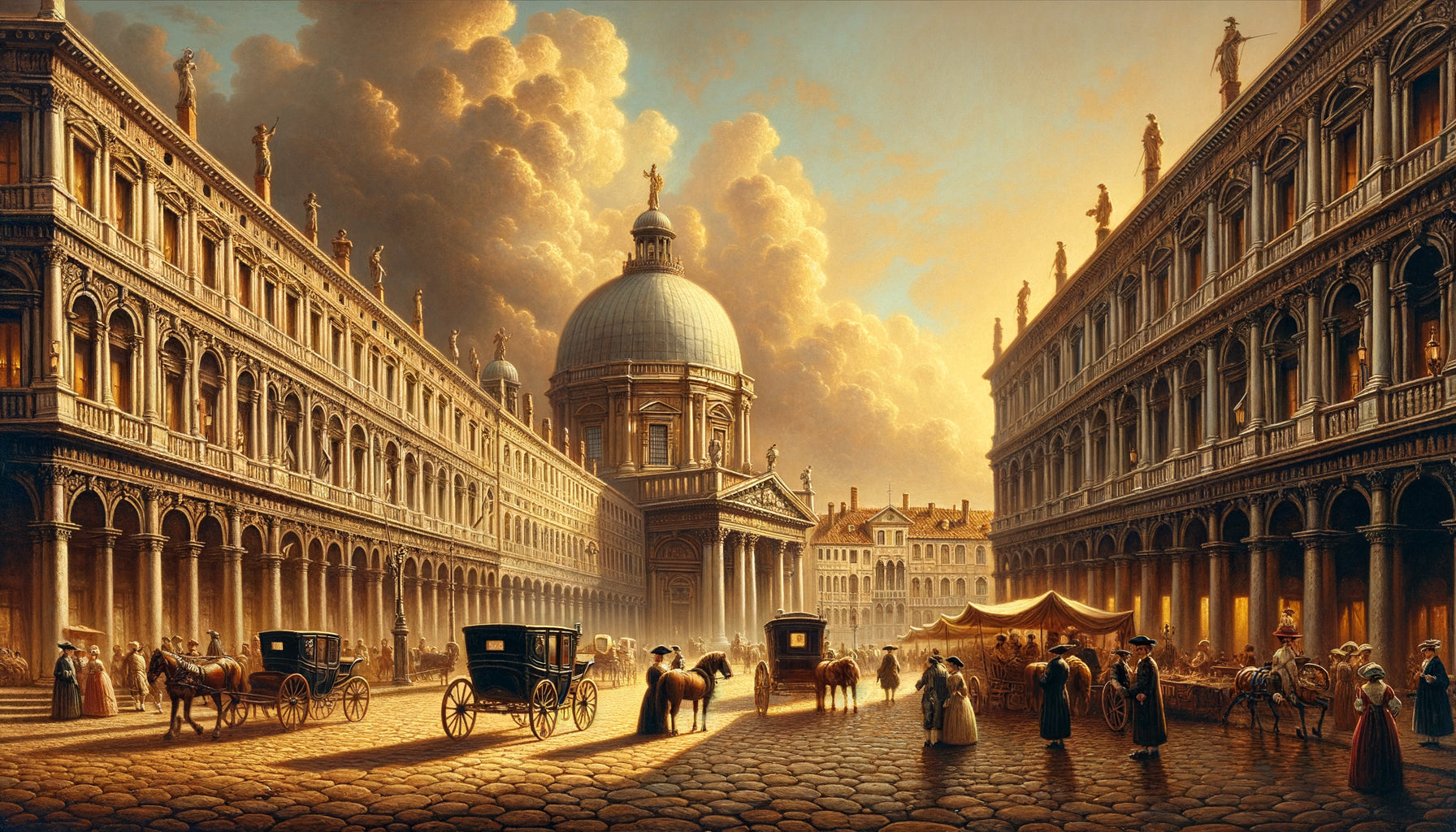
Imagine a room with walls adorned with majestic landscapes: castles perched on verdant hills, winding rivers traversing fertile valleys, picturesque villages nestled in deep forests. This is not just decoration. It's an empire captured on canvas, an entire territory suspended in time. Between the 17th and 19th centuries, German princes did not simply govern their lands; they had them immortalized by the greatest artists of their time. These series of views were not mere aesthetic whims, but genuine tools of power and prestige.
Here's what these princely commissions reveal: the assertion of a visible territorial power, the construction of a lasting dynastic identity, and the celebration of an ideal of enlightened governance. In a world where cartography was still rudimentary and photography did not exist, these painted panoramas were the best way to visually possess one's domain.
You may be admiring reproductions of landscapes in your interior without suspecting the fascinating history hidden behind this tradition. Why did these sovereigns invest fortunes in these monumental artistic projects? What was the true function of these galleries of views that adorned their palaces?
No worries: you will discover how landscape art became a refined political instrument, and why this ancestral tradition still influences our way of designing wall decor today.
This article plunges you into the fascinating universe of these collector princes who transformed their territories into works of art, and shows you how to reinvent this heritage in your own space.
The territory as a portrait: when geography becomes identity
For an 18th-century German prince, commissioning a series of views of his territories was equivalent to having an official portrait made. But instead of capturing a face, these paintings immortalized the very essence of his power: his lands, his castles, his cities, his forests. In the Holy Roman Empire, fragmented into hundreds of principalities, duchies and counties, a sovereign's identity literally merged with his geography.
These series of views functioned as exhaustive visual inventories. The Prince of Saxe-Gotha could thus contemplate in his gallery the twenty or thirty emblematic sites of his territory: the ancestral castle dominating the valley, the fortified city with its medieval ramparts, the Cistercian monastery nestled in the hills, the silver mines that made the region rich. Each canvas constituted a piece of a larger territorial puzzle.
This practice responded to a pragmatic necessity in a pre-photographic world. How could a sovereign visually grasp the extent of his possessions without constantly traveling difficult roads for weeks? These painted panoramas offered an elegant solution: they brought together in one place all the strategic points of the domain. The prince could thus, from his study, embrace with a glance the entirety of his heritage.
Art in the service of dynasty: transmitting more than just territory
The series of views commissioned by German princes transcended simple geographical representation to become true dynastic documents. They told the story of a family, a lineage, a power passed down from generation to generation. Each castle depicted evoked an ancestor who had built it, each city recalled a privilege granted by the emperor, each landscape testified to successful territorial management.
The princes invested considerable sums in these artistic projects that sometimes spanned several years. They hired renowned painters, often trained in Italy or the Netherlands, capable of mastering atmospheric perspective and faithfully reproducing local architecture. Some commissions involved dozens of large-format canvases, intended to adorn entire galleries specially designed in princely residences.
These view galleries became privileged spaces for family transmission. The prince would take his heir there to teach him the geography of his future domain, tell him the history of each place, and pass on the responsibilities associated with each territory. The paintings served as a living educational tool, far more evocative than any abstract map or administrative document.

When landscape becomes enlightened propaganda
In the Age of Enlightenment, the series of views commissioned by German princes acquired an additional dimension: they became manifestos of good governance. The paintings no longer simply show territories, but well-administered, prosperous, harmonious territories. Cities are depicted with their new rational districts, the countryside with its ordered fields, and roads with their newly built bridges.
This evolution reflects the ideal of enlightened despotism that characterizes many German princes of the 18th century. They no longer want to simply possess lands, but prove that they govern them wisely. Each view becomes visual proof of a successful policy: improvement of infrastructure, economic development, urban beautification, protection of architectural heritage.
Artists receive precise instructions: to show prosperity, highlight recent achievements, and value natural resources. A castle in ruins will be restored on canvas even before the actual construction begins. A newly established factory will be depicted in full operation, with its smoking chimneys symbolizing industrial progress. Peasants are shown happily working in fertile fields, embodying a happy population under a benevolent prince.
The geographical cabinet of curiosities: collecting one's own kingdom
German princes’ passion for these series of views is part of a broader aristocratic culture: that of Wunderkammer, those cabinets of curiosities where rare objects, natural specimens, scientific instruments and works of art were collected. But here, it is the territory itself that becomes an object of collection.
This approach radically transforms the sovereign's relationship with his domain. The prince no longer merely legally possesses his lands: he visually, aesthetically, emotionally owns them. Each view functions as a trophy, testimony to a conquest, a preserved heritage, an enriched legacy. Some princes organized their galleries like private museums, with labels detailing the history of each site depicted.
This practice also reveals a new sensitivity to landscape as a value in itself. Before Romanticism, European elites rarely considered nature worthy of artistic attention. The series of views commissioned by German princes participate in this revolution of perspective: the local landscape becomes a legitimate pictorial subject, worthy of being immortalized and contemplated. Hunting forests, fish-rich rivers, majestic mountains cease to be mere exploitable resources to become elements of territorial identity and dynastic pride.

Diplomacy through image: impressing visitors and ambassadors
Territorial view galleries also served as subtle but effective diplomatic instruments. When a foreign ambassador, a neighboring prince or an imperial dignitary visited a princely residence, he was systematically taken to the gallery of views. This visit was far from trivial: it constituted a demonstration of power disguised in cultural trappings.
The host prince personally commented on the paintings, emphasizing the extent of his possessions, the richness of his resources, the solidity of his fortifications, and the prosperity of his cities. Each canvas became an argument in an implicit negotiation: "See the scope of my territory, the quality of my administration, the strength of my position." These series of views functioned as visual curriculum vitae, establishing the credibility and prestige of the sponsor.
This diplomatic dimension explains why princes attached so much importance to the artistic quality of these commissions. They were not mere topographic documents, but works that had to rival the finest achievements of neighboring courts. Some princes did not hesitate to bring in renowned Italian or Dutch artists, ensuring that their galleries of views matched the splendor of the most powerful sovereigns.
The contemporary legacy: how to reinvent this tradition in your interior
This princely fascination with territorial views strangely resonates with our contemporary decorative practices. How many of us hang photographs of significant places, create walls of travel memories, or choose works depicting landscapes that are dear to us? We perpetuate, often without knowing it, this tradition of visually possessing the places that shape our identity.
The main difference lies in scale and intention. Princes collected views to assert their territorial power; we collect images to tell our personal story, our explorations, our attachments. But the principle remains identical: transforming lived space into contemplated space, creating an intimate geography visible on our walls.
This tradition now finds particularly interesting echoes in interiors that favor thematic series. Rather than a single work, create a coherent collection of landscapes sharing the same atmosphere, a similar palette, or a narrative continuity. This serial approach, directly inherited from princely galleries, brings depth and sophistication that a unique piece cannot offer.
Create your own gallery of views inspired by collector princes
Discover our exclusive collection of nature paintings that transforms your interior into a contemporary cabinet of wonders, where each landscape tells a story.
Cultivate your own inner geography
German princes intuitively understood it: we inhabit places as much by what we contemplate as by where we physically live. Their galleries of views created a double territory, both real and represented, geographical and imaginary. This duality enriched their daily experience, allowing them to travel mentally without leaving their palace.
Today, you can reinvent this tradition by composing your own gallery of views. Not to assert territorial power, but to cultivate an inner geography that resembles you. Whether it's landscapes from your region of origin, views of places that inspire you, or panoramas that embody your aspirations, each choice builds your domestic visual identity.
Start modestly: three or four paintings of similar sizes, sharing a chromatic or thematic consistency. Observe how they dialogue with each other, create a narrative, transform your wall into a window open onto another world. You will discover that this centuries-old practice of princely collectors has lost nothing of its relevance: it still responds to the fundamental need to anchor our identity in the places that define us.
Frequently Asked Questions
How many paintings typically comprised these series of princely views?
The series varied considerably depending on the prince's wealth and the extent of his territories. Some contained a dozen canvases representing only the major sites, while others counted several dozens of exhaustive views. The Elector Prince of Saxony possessed a gallery of over forty views of his various residences and cities. For your contemporary interior, a series of three to six paintings already offers a beautiful narrative coherence without overwhelming the space. It's not about quantity but about the ability of these works to dialogue together and create a unified atmosphere.
Were these views faithful to reality or idealized?
The answer lies between the two. Artists strove to faithfully represent the architecture and general topography, as these paintings also served as reference documents. However, they took artistic liberties to enhance places: improving the weather, adding picturesque characters, emphasizing the majesty of a castle, beautifying the prosperity of a city. One could say that they captured the ideal truth of the place rather than its daily reality. This approach remains relevant today: choose works that do not necessarily represent real places, but the essence of what those landscapes evoke for you emotionally.
How to adapt this aristocratic tradition to a modern interior without falling into pastiche?
The key lies in the contemporary appropriation of the concept rather than the imitation of forms. Forget rococo gilt frames and baroque castle views. Focus on the fundamental principle: creating a consistent series of landscapes that tell your story. Use contemporary formats, minimalist framing, and prioritize works whose style matches your current aesthetic. A series of black and white landscape photographs, sleek botanical prints, or abstract watercolor mountainscapes can perfectly embody this spirit of territorial collection while remaining resolutely modern. Princely heritage lives in the intention and composition, not in stylistic imitation.