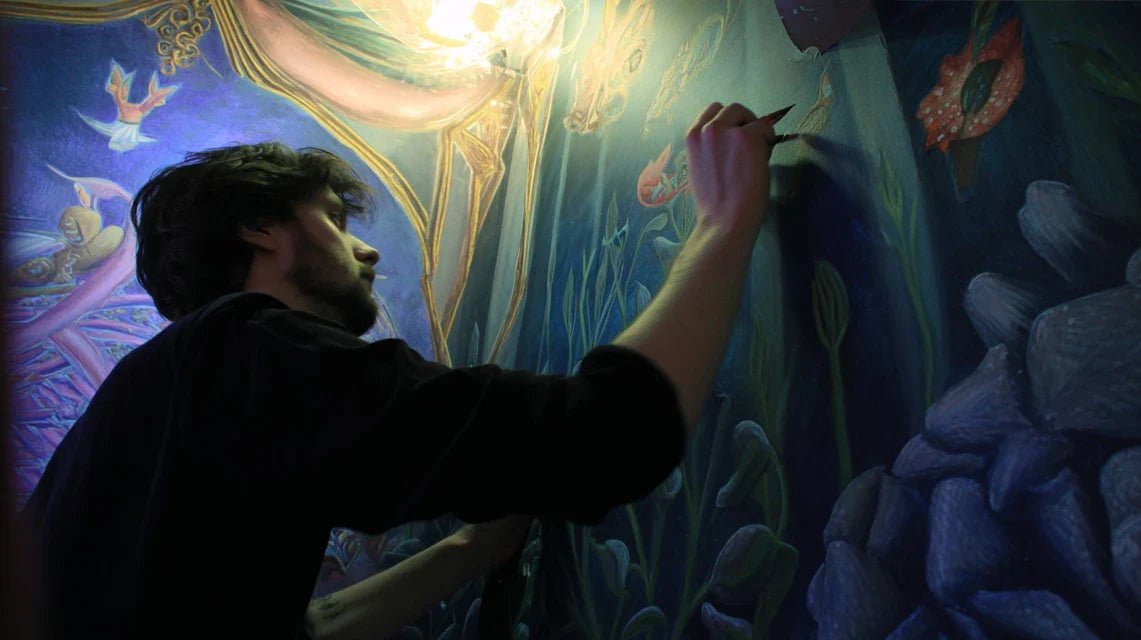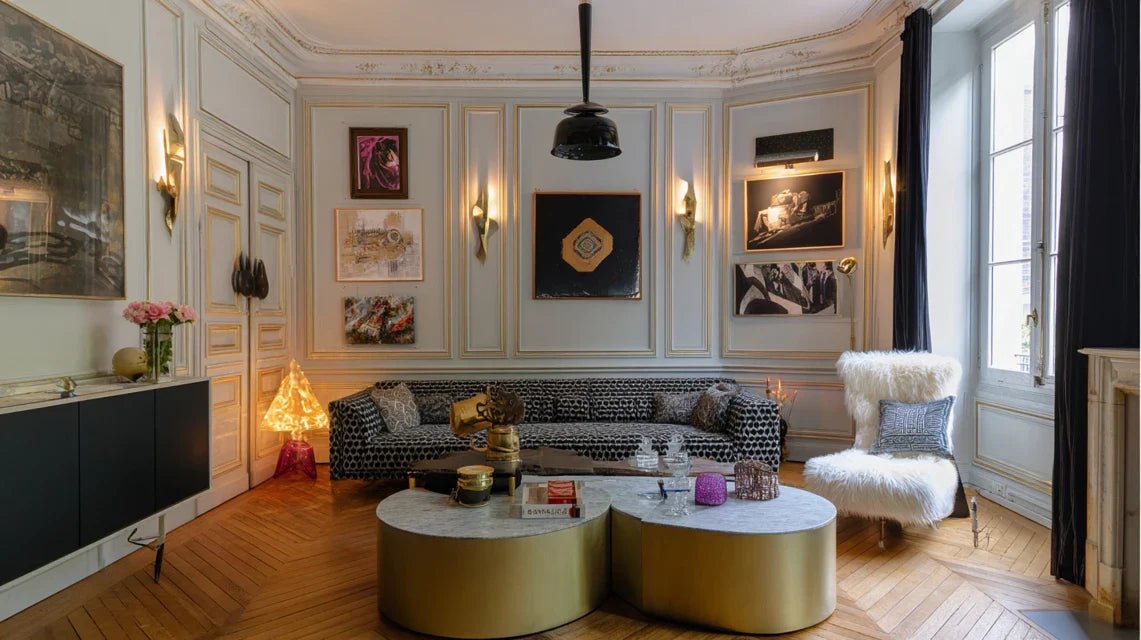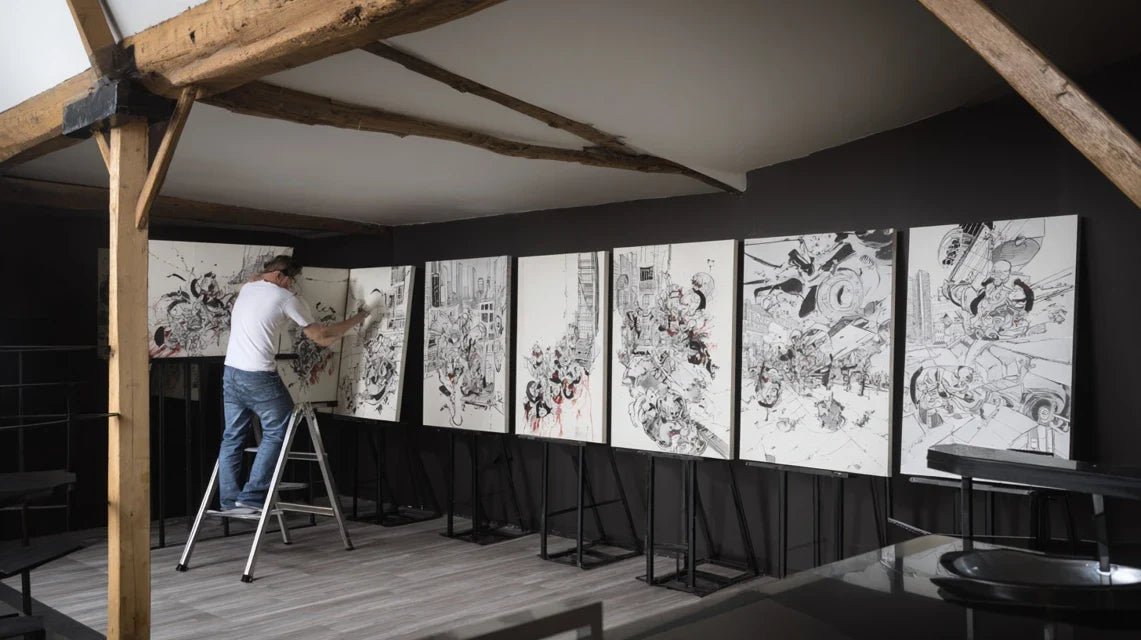
You're looking at your bare walls and feeling that sense of emptiness, that frustration of not being able to create the narrative atmosphere you imagine for your interior.
You’ve already tried hanging a few isolated paintings, but the result lacks coherence. Your living room looks more like an improvised gallery than a space where a true visual story unfolds.
You may have even attempted to create a mural composition, but without that sequential logic that makes the whole thing vibrate, your works seem disconnected from each other.
It's normal: creating a coherent decorative storytelling requires understanding the narrative codes mastered by cartoonists and storyboard artists.
By the end of this article, you will know how to transform your walls in a true visual narrative thanks to the techniques of sequential wall art, and your interior will finally tell the story you carry within yourself.
Why sequential wall art is revolutionizing narrative decor?
Sequential wall art responds to a deep need for narrative coherence in our living spaces. Unlike traditional decorative approaches that juxtapose isolated works, this technique borrows from the codes of comics to create a continuous visual flow that guides the eye and tells a story step by step.
🎨 Customer testimonial: "I transformed my hallway into a true narrative gallery. Each panel tells a stage of my trip to Japan, from arrival in Tokyo to the temples of Kyoto. My guests naturally follow the visual journey, as if they were reading a giant comic book on my walls."
💬 Conversation with a decor expert
The golden rule of sequential wall art: Each element must contribute to an overall story while maintaining its visual autonomy. The result? A wall that reads like an open book, capturing attention for hours.
Understanding what's really blocking your narrative decor
If you feel this frustration with your bare walls, c'est probablement que vous vivez l'une de ces situations : your paintings seem lost in space, your decor lacks personality, or you can't create that visual narrative thread that you imagine.
What’s really happening is that you’re applying classic decoration rules to a modern need: to create a narrative experience in your interior. The problem isn't your taste or budget, but the lack of sequential method.
Imagine trying to tell a story by showing only page 47 of a book. That’s exactly what happens with an isolated painting: it can be beautiful, but it only tells a fragment of a story.
The first hidden cause: the absence of narrative rhythm
Contrary to what many think, the problem isn't a lack of space or budget. It’s the absence of narrative rhythm in your composition. In comics, each panel has its function: introduction, development, climax, resolution.
Think about your favorite Netflix series: each episode contributes to the overall story while having its own dramatic intensity. Your walls work exactly the same way.
Without this rhythm, your decor resembles a playlist where all the tracks would be played simultaneously. With sequential art, you create a visual symphony where each note finds its place in the whole.
🔍 Quick test: Look at your living room and follow your gaze naturally. If it jumps from one element to another without logic, your decor lacks narrative continuity.
Many people choose their artworks as if they were doing groceries: a painting here, a sculpture there, without thinking about the visual conversation between elements.
It’s like building a sentence by picking words from different dictionaries. Each word may be beautiful, but the whole doesn't make sense.
As a result: you end up with an interior that looks like an exhibition room rather than a narrative living space. Your guests admire your taste, but don’t feel the deep emotion that a well-told story provides.
Ignorance of the power of visual transitions
What almost no one notices is the importance of transition spaces between artworks. In comics, this is called "ellipse": the thing that happens between two panels.
In your decor, these transitions can be light games, color reminders, or even empty spaces that allow the eye to "breathe" between two moments of the story.
Without these transitions, your wall becomes a visual cacophony where each element shouts to attract attention, instead of participating in an overall melody.
3 signs that your decor lacks sequentiality:
- Your guests look at your artworks one by one: Instead of being carried away by a narrative flow, they "visit" your decor like a museum
- You often change the placement of your artworks: This instability reveals a lack of compositional logic that would make each element indispensable to its place
- Some walls seem "empty" despite being decorated: This is a sign of a lack of narrative density that would give meaning to every square centimeter
The trigger factor: the fear of narrative commitment
What really makes the difference is daring to commit to a personal story rather than staying in generic decoration. Like a domino that triggers an avalanche, this decision completely transforms the energy of your interior. You will recognize it when you start seeing your walls as chapters of your story instead of supports to be decorated.
The rule of decorative storytelling: Each element must answer the question "What does this add to my story?" If the answer is "it's pretty", it's not enough. If it’s “this reveals who I am”, you are on the right track.
| ❌ Traditional decoration | ✅ Sequential wall art | 💡 Key difference | 🎯 Perceived benefit |
|---|---|---|---|
| Isolated and autonomous artworks | Panels that dialogue with each other | Creation of a continuous narrative flow | Feeling of immersion rather than observation |
| Aesthetic choice only | Logic of temporal progression | Each element has its narrative function | Your walls tell your personal story |
| Unexploited empty spaces | Mastered visual transitions | Conscious use of silences | Overall harmony without a feeling of emptiness |
| Hanging according to formal rules | Composition by narrative tempo | Rhythm that follows the architecture | Naturalness and fluidity in the visual journey |
Step-by-step method for creating your sequential wall art
Creating a sequential wall art is like building a cathedral: each stone has its place in the whole. The method follows a logic of narrative progression in three steps: define your story, structure your sequence, and master visual transitions. The final result will transform your walls into a true immersive experience that you will never tire of contemplating.
🎬 Overview of the method: Like a director who edits their film into sequences, you will first identify your personal narrative thread, then structure your panels according to a dramatic rhythm, and finally create the visual links that transform a series of images into a true wall story.
Step 1: Identify your personal narrative thread
Before choosing your artworks, you must define the story you want to tell. Like the foundations of a house, this step determines the solidity of your entire project. Once your narrative thread is identified, you will feel that deep satisfaction of seeing your personality revealed on your walls.
The narrative elements to gather
- Your central theme: It could be a significant journey, a passion, a personal evolution or a period of your life. Avoid themes that are too broad like "nature"; instead prefer "my urban gardening learning" which offers a natural progression and identifiable moments.
- Your key moments: Identify 3 to 5 crucial steps in your story. Like the chapters of a book, they must have a chronological or emotional logic. Each moment should be able to be translated visually by specific colors, shapes, or symbols.
- Your guiding emotion: What emotion do you want to convey? nostalgia, discovery, accomplishment, serenity? This emotion will guide your aesthetic choices and create the emotional coherence of your wall ensemble.
Now, let's move on to concrete design:
Build your decorative storyboard
Draw your narrative line: On a sheet of paper, draw a horizontal line representing your wall. Divide it into 3 to 5 equal sections, each corresponding to a key moment. This visualization prevents you from overloading your composition and ensures a natural narrative balance.
⏱️ Time: 20 minutes | ✅ Successful when: Your line tells a fluid story from beginning to end | ⚠️ Attention: Avoid trying to tell everything - simplicity creates more impact
Define your dramatic intensities: Like in cinema, your story needs rhythm. Identify which moment will be your visual "climax" (the most intense, colorful, or grand) and place it slightly off-center to create a dynamic tension.
⏱️ Time: 15 minutes | ✅ Successful when: You clearly visualize the emotional progression | ⚠️ Attention: Do not place the climax in the center - this creates a static symmetry
Choose your narrative formats: Vary sizes according to narrative importance. Your key moment deserves a larger format, transitions can be smaller. This variation creates a visual rhythm that naturally guides the eye.
⏱️ Time: 10 minutes | ✅ Successful when: Your formats reflect the narrative importance of each moment | ⚠️ Attention: Avoid overly similar formats that break the rhythm
✅ Step 1 Verification: Your storyboard should tell a coherent story even without the artworks. If someone can understand your narrative progression just by seeing your formats and their placement, you are ready for the next step.
RECOMMENDED PRODUCTS
Step 2: Structuring Your Sequential Composition
Now that your story is defined, you are going to translate it into a wall composition. This step transforms your concept into a visual reality. You will start seeing your wall as a true narrative playground where each element finds its natural place.
Principles of Sequential Composition
- The narrative rule of thirds: Divide your wall into three zones: introduction, development, resolution. As in a classic story, this structure intuitively guides the gaze of your guests. The introduction grabs attention, the development maintains interest, and the resolution brings narrative satisfaction.
- Breathing spaces: Between each panel, leave spaces equivalent to 1/3 of the width of the smallest panel. These "visual silences" allow the eye to digest each moment before moving on, creating a comfortable reading tempo.
- The narrative horizon line: Align your panels along an imaginary horizontal line that respects the height of your furniture and openings. This continuity creates a visual fluidity that unifies your composition.
Organizing Your Visual Flow
Position Your Narrative Anchors: Start by placing your key moment (the most important) slightly to the right of center, then organize the other elements around it. This asymmetry creates a natural dynamic that avoids the monotony of perfect symmetry.
⏱️ Time: 25 minutes | ✅ Success when: Your gaze naturally follows the narrative progression | ⚠️ Attention: Avoid starting with details - place the main elements first
Create Your Visual Transitions: Use color, shape, or texture reminders to create "visual bridges" between your panels. A blue detail in panel 1 can reappear in panel 3, creating a chromatic coherence that unites the whole.
⏱️ Time: 30 minutes | ✅ Success when: You identify at least 3 linking elements between your panels | ⚠️ Attention: Subtlety: transitions should be perceptible without being obvious
Step 3: Mastering Narrative Hanging
The final hanging determines the success of your project. At this stage, you have all the keys to create a immersive experience that will permanently transform the perception of your space. Your guests will never see your walls the same way again.
The tools of professional hanging
- Wall rail system: Instead of multiple nails, invest in a rail system that allows you to easily readjust your panels. This flexibility is crucial for fine-tuning your narrative rhythm to achieve perfect fluidity.
- Digital level: Millimeter precision is essential to maintain the narrative horizon line. A few centimeters' deviation can break the entire visual flow you have carefully constructed.
- Sequential lighting: Each panel should have its own lighting, creating "narrative spotlights" that guide the eye and reinforce the visual dramatization of your story.
Finalizing your narrative installation
Test your visual journey: Before the final hanging, simulate the path of your guests. Enter the room and let your eye naturally follow the progression. Adjust the height and spacing to achieve a perfect fluidity.
⏱️ Time: 45 minutes | ✅ Successful when: The visual journey is effortless | ⚠️ Attention: Test from multiple angles of the room
Calibrate your narrative lighting: Each panel should receive a luminous intensity proportional to its narrative importance. Your key moment can be more illuminated, creating a light hierarchy that reinforces your storytelling.
⏱️ Time: 35 minutes | ✅ Successful when: The lighting naturally reveals the narrative progression | ⚠️ Attention: Avoid harsh contrasts that break harmony
🎯 Final check: Invite someone to discover your creation. If this person can guess your story without explanation, your sequential wall art is perfectly successful. You have created a autonomous narrative experience.
The rule of narrative progression: You can move on to the next step when your composition tells a fluid story even from the most distant angle. Patience in adjustment makes the difference between a successful decoration and a memorable narrative work.
Congratulations! You now master the fundamentals of sequential wall art. Here are some expert subtleties that will make the difference and impress even the most demanding connoisseurs.
🎨 Master Technique: Create "visual echoes" by subtly repeating a graphic element at irregular intervals. This technique, borrowed from TV series, creates a narrative signature that unifies your set in an almost subliminal way.
❓ Frequently Asked Question from Our Readers
"I'm afraid my personal story isn't interesting enough to make a wall mural..."
This hesitation reveals a common confusion between spectacular and meaningful. Your story doesn't need to be epic to be captivating. Often, the most touching stories are the most intimate: the evolution of your garden over four seasons, your learning of an instrument, or even your morning routine can become fascinating wall narrations. Authentic emotion transforms any subject into a work of art.
💡 Validation Test: Tell your story to a loved one: if they listen attentively, it's worth telling visually. The engagement of your listener predicts the impact of your wall art.
The mistakes that can ruin your narrative project
Even with the best method, some mistakes can compromise your sequential wall art. These pitfalls are tempting but avoidable if you know them. Here are the most common to protect yourself.
- ⚠️ Trying to tell everything at once: The temptation to multiply panels to not forget anything creates a narrative cacophony. Like a book with too many characters, your story becomes unreadable. Prioritize 3 to 5 key moments rather than 10 anecdotes. ⚠️ Neglecting narrative proportions: Giving the same visual importance to all your panels creates a monochromatic composition without dramatic relief. Your key moment must visually dominate, creating a narrative hierarchy natural. ⚠️ Ignoring existing architecture: Imposing your narrative logic without taking into account ar architectural constraints (windows, doors, radiators) results in a forced composition. Integrate these elements into your storytelling instead of suffering them. ⚠️ Underestimating the importance of lighting: a uniform lighting kills the narrative dynamics. Each panel should have its own light intensity to create the visual rhythm that makes your story vibrate. ⚠️ Changing your mind along the way: Modifying your narrative thread after you've started hanging creates visual inconsistencies. Stick to your initial storyboard, amendments should remain nuances, not revolutions.
🔍 Anti-error control points: Regularly check that your gaze naturally follows the narrative progression, that each panel brings something unique to the story, that the whole remains readable from different angles, and that your guiding emotion shines through in every choice.
🎁 Special offer for readers
Because you took the time to learn, enjoy 10% off your first order:
⏰ Valid 72 hours after reading • Applicable on all our products
Frequently asked questions about sequential wall art
Allow 2 to 3 weeks for a finished project: a week to define your story and choose your artworks, a week to adapt them if necessary, and a few days for the final installation. Speed up by preparing your storyboard in advance and having your measurements precise. A client transformed their living room in 10 days by preparing their concept during their vacation.
For a 3-meter wall with 4 quality panels, allow between €800 and €1500 depending on the finishes chosen. Optimize by mixing formats (a large central panel, three smaller ones) rather than standardizing sizes. The visual impact depends more on narrative consistency than on the individual price of each element.
Adapt your approach according to the space: in a living room, prioritize soothing stories, in an office, motivating narratives, in a bedroom, introspective storytelling. The hallway is ideal for linear narratives (travel, temporal evolution), while open spaces allow more complex compositions with multiple storylines.
Start by identifying the elements of your current decor that can serve as narrative bridges. A plant can become the link between two nature panels, a vintage piece of furniture can anchor a personal story. Integrate rather than revolutionize: your sequential art should dialogue with what exists, not dominate it.
That's the beauty of sequential art: it can evolve! Plan from the start a flexible mounting system that allows you to add "chapters" or modify some panels. Your wall then becomes a living narrative growing with you. One client adds a new panel each year to celebrate her family's milestones.
Your transformation towards a narrative interior
In a few weeks, you will discover your interior under a completely new light. Your walls will no longer be simple decorative surfaces, but true open books telling your story with every glance. Your guests will not visit your living room, they will live an immersive narrative experience that reveals the richness of your personality.
This transformation goes far beyond decoration: You are developing a narrative eye that transforms your perception of space. This new skill will influence your future decorative choices, your spatial organization, and even the way you present your professional ideas. Sequential art becomes a language you master.
The most difficult thing - understanding narrative logic - is now behind you. Start today by drawing your storyboard, then let your creativity express itself. Your story deserves to be told, and your walls are waiting for your vision to become extraordinary.
🌟 Your moment has come: Every great story begins with a first stroke. Your sequential wall art will not only transform your interior, but will reveal the visual storyteller within you. The adventure begins now.