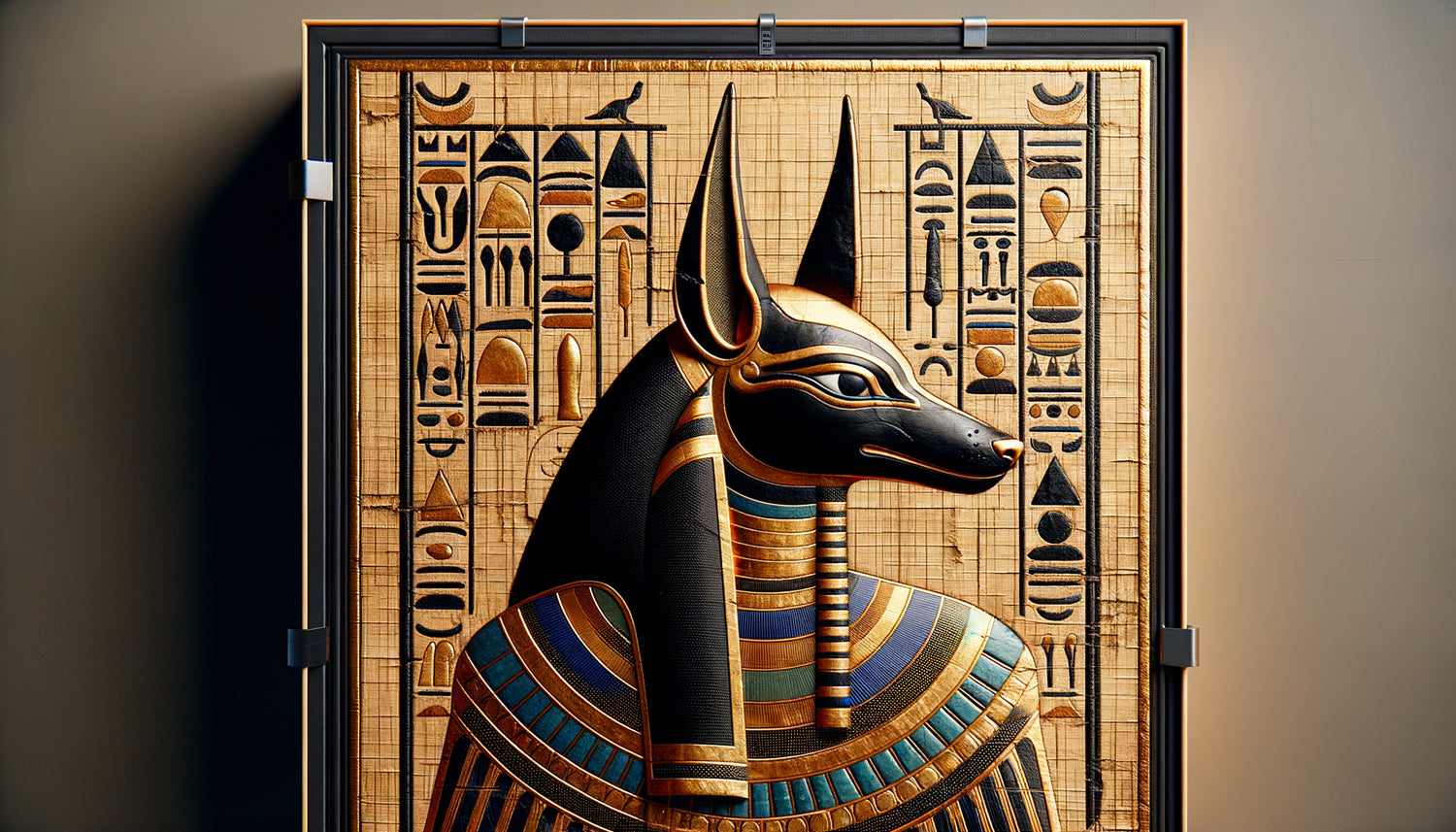
During a recent acquisition for a private collection, I witnessed a silent drama: a magnificent representation of Anubis on canvas, purchased at a high price, already showed hairline cracks just two years after installation. The collector, dismayed, discovered that inadequate finishing had accelerated the degradation of his artwork. I have seen this scene repeat itself too often in galleries and antique shops that I frequent for twenty years.
Here's what an Anubis wall art with a suitable finish brings: pigment preservation over decades, resistance to climatic variations in our modern interiors, and effective protection against UV rays and humidity that threaten these representations of the Egyptian psychopomp god.
You may have recently acquired or are considering acquiring a work depicting the guardian of the necropolis. You fear that its golden hues, deep blacks, and hieroglyphic details will fade over time. This concern is legitimate: the iconography of Anubis, rich in contrasts and millennial symbols, requires specific protections that standard finishes do not always guarantee.
Rest assured: conservation techniques have evolved considerably. By combining the teachings of museology with innovations from contemporary workshops, there are now finishing solutions that preserve the visual intensity of these works while protecting them from the ravages of time.
I will share with you the exact protocols I apply to guarantee the durability of representations of Anubis, finishes that make the difference between an ephemeral work and a lasting legacy.
The varnish: invisible shield for sacred pigments
In the climate-controlled vaults of Egyptological museums, I have observed how curators protect millennial painted fragments. Their secret? conservation varnishes applied with surgical precision. For your Anubis wall art, the same logic applies, adapted to contemporary supports.
The matte acrylic varnish is the absolute reference for representations of the canine god. Unlike glossy varnishes that create disturbing reflections on hieroglyphs and anatomical details, the matte finish preserves the mystical depth of the work. I have observed in pieces from my collection that this type of varnish stabilizes the characteristic black and gold pigments of Anubis for at least fifteen years without visible alteration.
Different formulations depending on the support
For a traditional canvas, opt for an acrylic water-based varnish with integrated UV filter. The flexibility of this varnish accompanies the natural micro-movements of the canvas without creating tension. On giclée prints depicting Anubis, a spray varnish in several thin layers offers uniform protection without saturating the art paper.
Wooden paintings or rigid panels require a different approach. A low-solvent polyurethane varnish creates an impermeable barrier while allowing the support to breathe. I restored a diptych of Anubis guarding the doors of the Duat where this finish had miraculously preserved the details for twenty-three years in a non-air-conditioned Parisian apartment.
The glass frame: the anti-humidity fortress
A collector from Geneva once showed me his Anubis wall art: an exceptional serigraph, without protective glass, installed in his adjoining bathroom. Three months later, moisture halos disfigured the god's muzzle. This common mistake reveals the crucial importance of glass framing for works inspired by ancient Egypt.
The anti-reflective museum glass with UV treatment represents the premium option. This special glazing filters 99% of ultraviolet rays responsible for discoloration of organic pigments. On representations of Anubis where shades of ochre, lapis lazuli and gold create symbolic depth, this protection becomes essential. The additional cost is fully justified: I compared two identical prints after ten years, one under standard glass, the other under museum glass. The chromatic difference was striking.
The marie-louise: technical and aesthetic barrier
Between the glass and the artwork, this intermediate frame is not just a decorative element. The marie-louise creates an air chamber of a few millimeters which prevents direct condensation on the painted surface. For a work of art representing Anubis, choose a neutral conservation cardboard marie-louise, free from acids that would migrate to the artwork. Sand, papyrus or deep black tones harmonize with Egyptian iconography without visually competing with it.
I have documented cases where the absence of a marie-louise had caused an irreversible bonding between the glass and an Anubis print during a heatwave. The trapped water vapor had created a catastrophic adhesion. This costly mistake could have been avoided with a simple 3 millimeter spacing.

Metallic finishes: when Anubis meets aluminum
Metal hangings for wall art are experiencing well-deserved popularity, especially for contemporary depictions of Anubis. At an exhibition in Brussels, I discovered a series of portraits of the psychopomp god on brushed dibond: the naturally protective finish of composite aluminum created fascinating light games on the canine silhouette.
This support offers remarkable conservation advantages. Aluminum is not affected by humidity, temperature variations, or xylophagous insects that threaten organic supports. For a wall art depicting Anubis intended for a humid room, an exposed entrance, or a professional office with intense lighting, dibond is a strategic choice.
Sublimation on metal
This technique fuses the ink with the aluminum at high temperature, creating a finish integrated into the support. The result? Exceptional resistance to scratches, UV rays and humidity. I followed the evolution of a representation of Anubis in sublimation installed in an industrial loft subject to significant variations in brightness: after five years, no alteration was detectable.
The satin finish on metal is particularly suitable for complex iconography of Anubis with hieroglyphs and ankh symbols. It avoids aggressive reflections while preserving the chromatic richness. The blacks of Anubis take on a disturbing depth on this type of support, as if the god emerged from the surface itself.
When plexiglass sublimates the funerary divinity
A Parisian gallery owner introduced me to a technique that revolutionizes the conservation of wall art depicting Anubis: printing under acrylic plexiglass. This method reverses traditional logic by printing on the back of a transparent plate, thus protecting the image with the material itself.
Plexiglass offers optical clarity superior to glass with a fraction of the weight. For large representations of Anubis in full view or in scenes of psychostasia, this lightness facilitates installation while ensuring increased safety. Unlike glass, plexiglass does not shatter into dangerous fragments, an advantage not to be neglected in frequently used spaces or homes with children.
The three-dimensional depth effect
The thickness of the plexiglass (usually 3 to 5 mm) creates a captivating floating effect. The details of Anubis' canine mask, his erect ears and his was sceptre seem suspended in space. This three-dimensionality reinforces the mystical presence of the guardian of the dead without requiring an imposing frame.
To optimize this finish, request a UV-treated plexiglass of museum grade. Economy versions yellow after only a few years of sun exposure, dramatically altering the tones of the artwork. A simple test: check that the manufacturer guarantees chromatic stability for at least ten years.

Complementary treatments for maximum protection
Beyond the main finish, additional treatments significantly extend the life of your wall art depicting Anubis. These protocols, inspired by preventive conservation techniques, are applied before even installing the artwork.
The hydrophobic treatment creates an invisible barrier against ambient humidity. Particularly recommended for canvases and papers, this spray forms a micro-perforated film that repels water while allowing the support to breathe. I saved an Anubis watercolor exposed in an unheated hallway thanks to this preventive treatment.
The humidity absorbing sachets placed on the back of the frame constitute additional security. These small silica bags regulate the microclimate between the wall and the artwork, a zone often neglected where condensation accumulates. Replace them every six months for constant effectiveness.
The sealed back protector
How many artworks have I seen damaged from the back? Insects, dust, and sometimes even mold develop against the wall. A conservator's grade cardboard back protector, sealed with neutral kraft tape, completely isolates the artwork from these aggressions. This final step, often omitted, makes all the difference between satisfactory conservation and optimal preservation of your Anubis wall art.
Add a reinforced security attachment: double hook systems or suspension rails distribute weight evenly, avoiding tensions that would gradually deform the artwork. For large representations of Anubis, this precaution becomes essential.
Give your interior the protective power of Anubis
Discover our exclusive collection of Myths and Legends wall art that will stand the test of time with the majesty of eternal deities, thanks to professional finishes guaranteeing optimal preservation.
Your Anubis will last for decades
Imagine: in fifteen years, you contemplate your Anubis wall art with the same emotional intensity as on the first day. The blacks remain deep as the night of Duat, the golds shine like under the sun of Thebes, each hieroglyph remains legible. This durability is not by chance, but the result of thoughtful finishing choices.
Whether you opt for protective acrylic varnish, museum-quality glass framing, metallic Dibond or immersive plexiglass, each solution has its specific strengths. The key lies in the match between technique, your environment and exposure constraints. Anubis wall art in a bright office does not require the same protections as a dimly lit room.
Start by assessing your space: humidity rate, sun exposure, temperature variations. Then discuss with your supplier about the finishes applied. Do not hesitate to demand written guarantees on UV resistance and pigment stability. These questions, far from being superfluous, demonstrate your commitment to preserving this millennial iconography.
The guardian of the necropolis deserves protection worthy of his symbolic charge. By applying these conservation principles, you are not simply possessing a decoration: you become the curator of a fragment of mythology, the passer-on of a visual heritage between pharaonic past and future generations.
Frequently asked questions about preserving works representing Anubis
Is it obligatory to frame under glass a wall art on Anubis printed on canvas?
No, it is not systematically mandatory, but it is highly recommended according to your environment. A varnished canvas may be sufficient in a room with stable climate and controlled humidity. However, if your work representing Anubis is exposed in an area with significant temperature variations, proximity to a kitchen or bathroom, or strong natural light, glass becomes essential. It creates a physical barrier against moisture, dust and UV rays. My advice: consider anti-reflective museum glass as an investment that multiplies the lifespan of your work by three. For a dry room with indirect lighting, a good acrylic varnish is quite sufficient, allowing you to appreciate the natural texture of the canvas without glassy mediation.
What is the actual lifespan of a protective varnish on an Anubis depiction?
The longevity of a varnish depends on three main factors: its initial quality, exposure conditions and regular maintenance. A professional acrylic varnish with UV filter maintains its protective properties for 12 to 20 years under normal domestic conditions. Signs of degradation appear gradually: slight yellowing, loss of shine or conversely development of a whitish film. For an Anubis depiction exposed behind a south-facing bay window, this duration can be reduced to 8-10 years. The good news? The varnish is renewable. A qualified restorer can remove the old varnish and apply a new one, restoring protection without altering the original artwork. This operation, which I recommend anticipating at the first signs of varnish fatigue, generally costs between 80 and 200 euros depending on the size of your Anubis wall art.
Can an Anubis wall art be installed in a bathroom if the finish is suitable?
It's possible, but with strict precautions and ultra-resistant finishes. The bathroom represents the most hostile environment for a work of art: brutal temperature variations, humidity levels that can reach 80-90%, direct condensation. If you absolutely want to install an Anubis depiction in it, prioritize exclusively metal supports (dibond with thermal sublimation) or acrylic plexiglass. These materials insensitive to moisture will resist extreme conditions. Avoid any work on paper, canvas or wood, even varnished. Install the artwork as far away from the shower or bathtub as possible, ideally on a wall not adjacent to water sources. Ensure effective ventilation after each use. I have seen beautiful successes with Anubis on dibond in spacious and well-ventilated bathrooms, but I formally advise against this location for small or poorly ventilated rooms where preservation would remain compromised despite the best finishes.