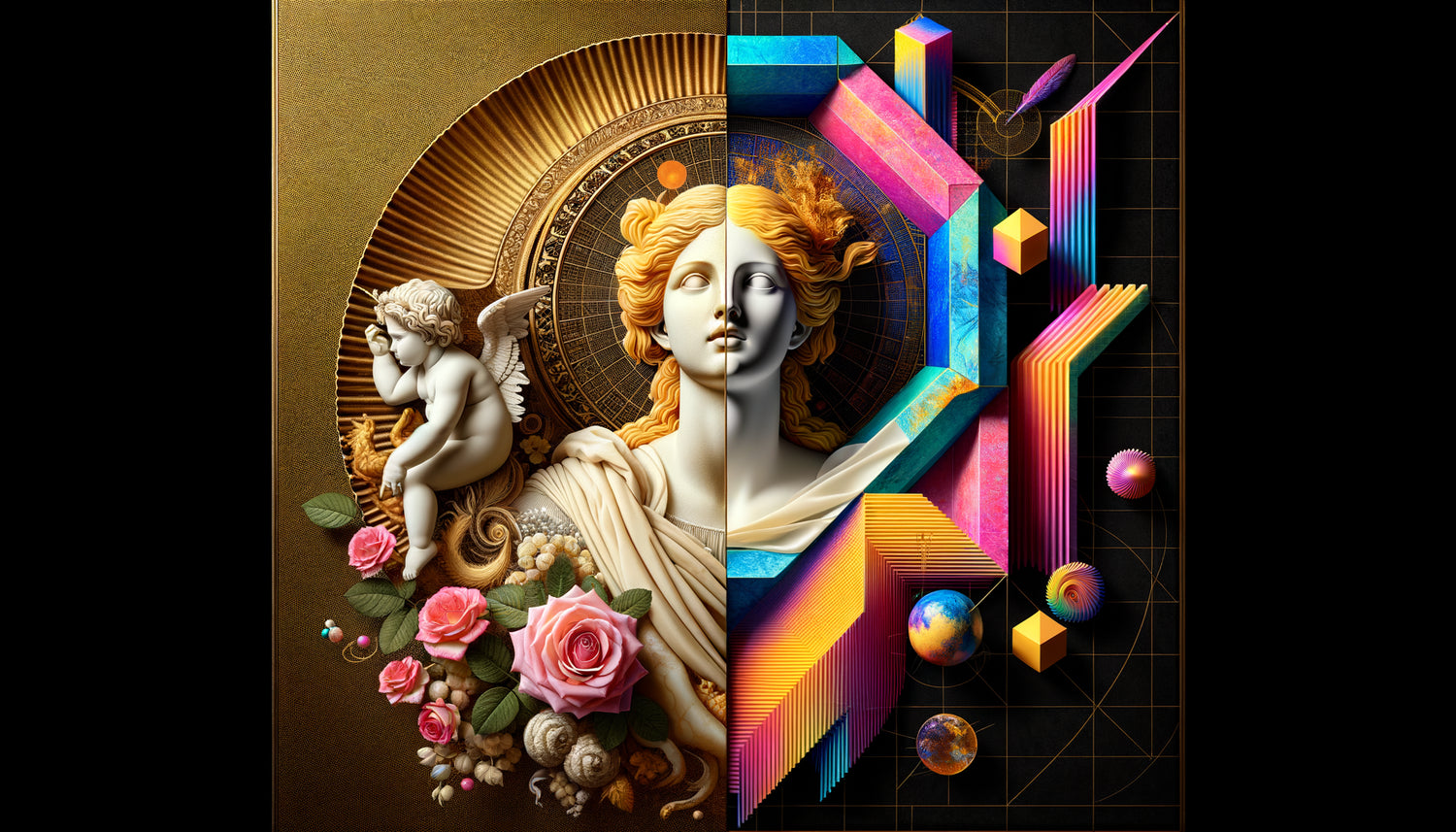
The morning light gently caressed the canvas. I was there, in the studio of a Parisian collector, facing two radically different visions of Aphrodite. On one side, a neoclassical reproduction with vaporous draperies, on the other, an abstract work with sensual curves and electric colors. "How do you choose?" she asked me. I hear this question regularly for fifteen years that I advise art lovers in their quest for the perfect painting.
Here's what an Aphrodite wall art brings to your interior: a timeless mythological dimension that instantly elevates a room, a powerful feminine energy that transforms the atmosphere, and a permanent conversation between history and modernity that fascinates your guests.
You may be facing this frustrating dilemma: you adore the goddess of love and beauty, but you hesitate between respecting traditional iconography or daring to imagine a modern vision. You fear that a classic interpretation will make it look like a dusty museum piece, or that a contemporary version will betray the essence of the myth. This creative tension paralyzes your decision.
Rest assured: there is no wrong choice, only the one that resonates with your universe. The art of Aphrodite transcends centuries precisely because she reinvents herself in each era. I will guide you to discover which version really corresponds to your vision, your space and your sensitivity.
The soul of the classic: when Aphrodite emerges from the foam of centuries
A classic interpretation of Aphrodite draws on a millennial iconographic tradition. Imagine these representations inherited from Botticelli, Cabanel or Bouguereau: the goddess emerges from the waves, wrapped in translucent draperies, accompanied by doves or roses. The colors are soft, often in shades of ivory, rose ochre, sky blue.
What I observe in my clients who choose this path? A search for cultural anchoring. A classic Aphrodite wall art does not just decorate: it connects your living room to a history that crosses the Renaissance, ancient Greece, up to the founding myths of our civilization. It is a deeply reassuring, almost meditative choice.
The major advantage? Decorative versatility. A classic Aphrodite naturally harmonizes with Haussmannian interiors, moldings, precious wood furniture. But I have also seen classic versions sublimated in industrial lofts, creating a striking contrast between mythological softness and the harshness of concrete. This clash of eras generates a fascinating aesthetic tension.
The visual codes to recognize
An authentic classic representation respects certain attributes: the seashell (symbol of her marine birth), modest nudity or veils suggesting more than they hide, the contrapposto posture inherited from Greek statuary, idealized proportions. These elements are not decorative at random: they convey centuries of symbolism.
When you observe a classic Aphrodite wall art, look for the light. Ancient masters used sfumato, this technique of imperceptible transition between shadow and light, which gives the skin an almost living quality. It is this technical mastery that differentiates a quality reproduction from a simple printed image.
Contemporary boldness: reinventing the goddess for our time
Then there's another path. The one I’ve seen emerge in recent years with astonishing creative force. The contemporary Aphrodite wall art deconstructs, reinvents, provokes. I have discovered Aphrodites in digital collage, minimalist lines, explosions of neon colors, even street art versions.
What fascinates me about these modern interpretations? They do not deny the myth, they question it. A contemporary Aphrodite can be an abstract female silhouette with geometric curves, a palette of liquid roses and golds without recognizable figures, or conversely a hyperrealistic portrait of a modern woman embodying today's beauty.
I accompanied a young couple in Le Marais who chose an Aphrodite in pop art style: bright colors, a bold graphic treatment, almost advertising. The painting transformed their minimalist Scandinavian space into a statement of intent. Their apartment was no longer just pretty: it had personality.
New visual writings
The contemporary Aphrodite painting embraces all techniques: textured canvas printing, brushed metal, three-dimensional acrylic, even augmented reality for the most avant-garde. Contemporary artists are not afraid to mix photography, digital illustration and traditional painting.
This formal freedom allows you a personalization impossible with the classic. You want an Aphrodite in gray and silver tones for a monochrome interior? Feasible. A golden version to dialogue with your brass lighting fixtures? It exists. A textile interpretation with relief textures? I saw it at a Lyon-based decorator, stunning result.

Diagnosing your space: what style does your interior call for?
This is the question I always ask in consultations: “Does your space want to breathe or vibrate?” This simple distinction immediately reveals the direction.
An interior that breathes favors harmony, soft transitions, a certain timelessness. The volumes are generous, the colors neutral or pastel, the furniture classic or neoclassical. In this setting, a classical Aphrodite wall art acts as a cultural anchor. It doesn't shout: it whispers a centuries-old story. Place it above a marble console, between two gilded sconces, and you create a true domestic altar to beauty.
An interior that vibrates plays on contrasts, stylistic breaks, the unexpected. Polished concrete, design furniture, architectural lighting. Here, a contemporary Aphrodite becomes an electric focal point. It immediately captures the eye, provokes discussion, and affirms your decorative boldness.
The rule of three perspectives
I use this method with my clients: observe your room at three different times of the day. Morning light, afternoon, evening. Note how the light circulates, where your eye naturally rests, which areas need visual energy.
A classical Aphrodite wall art wonderfully supports indirect and subdued lighting. Its subtle nuances are revealed gradually. A contemporary version, especially with saturated colors or metallic finishes, literally explodes under targeted lighting. These are two radically different aesthetic experiences.
What if you dared to hybridize? The little-known third way
Here's a secret that few decorators share: you don't have to choose a camp. The most exciting trend I'm currently observing? Hybrid Aphrodite wall art.
Imagine a classical composition – the pose, the mythological attributes – but treated with a contemporary technique: desaturated colors almost monochrome, grunge texture, digital layering effects. Or conversely: an abstract and modern Aphrodite that, upon closer inspection, reveals traditional iconographic details hidden in the patterns.
I recently discovered a series where the classical goddess is fragmented in a cubist puzzle style, each piece retaining its academic facture but the whole creating a resolutely contemporary dynamic. This is the intelligence of these hybrid works: they simultaneously satisfy your desire for culture and your need for modernity.
Creating a dialogue between eras
This approach works particularly well in transition spaces: entrances, hallways, landings. A hybrid Aphrodite wall art plays the role of a bridge between different living areas with distinct characters. It unifies without standardizing.
A collector showed me her trick: she owns three versions of Aphrodite in different styles, which she rotates according to the seasons or her mood. Spring: a delicate Botticelli version. Summer: a colorful contemporary explosion. Autumn: a mysterious sepia-toned hybrid. Her apartment breathes differently throughout the year.

The technical criteria that change everything
Beyond aesthetics, practical considerations determine your choice. A classic painting generally requires a vertical or square format, respecting the proportions of the human figure. What are the ideal dimensions? Between 70×100 cm and 120×180 cm to create a presence without dominating.
Contemporary interpretations break free from these rules. I've seen panoramic Aphrodites 3 meters wide, round formats, even modular triptychs. This dimensional flexibility adapts better to modern architectures and problematic walls.
Regarding the support: a quality classic reproduction requires a fine cotton canvas with high-definition giclée printing to restore chromatic subtleties. Contemporary versions make greater use of alternative supports: aluminum dibond for brilliance, plexiglass for depth, even wood for an organic texture.
The framing: a crucial detail often overlooked
A classic Aphrodite wall painting generally calls for an ornamental frame: gilded, patinated, with moldings. This frame is an integral part of the work; it creates a window to another time.
A contemporary version often rejects all framing, preferring a canvas stretched on chassis with painted edges, or conversely an ultra-minimalist brushed aluminum frame that almost disappears. The artwork stands on its own, without decorative mediation.
Ready to welcome the goddess of beauty into your home?
Discover our exclusive collection of Myths and Legends paintings that will transform your space into a sanctuary of timeless elegance or contemporary boldness.
Your decision: a question of personal authenticity
After hundreds of consultations, I realized a simple truth: the right Aphrodite wall art isn't the one that impresses your guests, it’s the one you stop in front of every morning with the same pleasure.
Ask yourself these ultimate questions: Which version makes you feel something in your stomach? Which one do you see yourself living with for the next ten years? Which reflects not the person you want to be, but the person you truly are?
If you're looking for serenity, a connection to tradition, if you love telling the story behind symbols, if your library contains more classics than contemporary bestsellers: the classic interpretation awaits you.
If you vibrate with innovation, creative disruption, if you regularly redecorate, if your playlist mixes all genres without complex: the contemporary version is your ally.
And if you are complex, contradictory, eager for dialogues between eras? Hybrid creations exist precisely for you.
Imagine yourself in six months. Your Aphrodite wall art stands proudly in your living room. The evening light caresses its surface. You're preparing a dinner, a guest stops in front of the artwork: “Tell me about this painting.” At that moment, you will know that you have made the right choice. Not because it is objectively beautiful, but because it tells your story, in your way, with your words.
The goddess of beauty belongs to no era. She crosses time reinventing herself. Your role isn't to freeze her in one style or another, but to choose the version that will make your heart beat every day. That is, ultimately, true decorative luxury: living surrounded by works that truly resemble you.
Frequently Asked Questions
Won't a classic Aphrodite wall art look dated in a modern interior?
Absolutely not, and it’s quite the opposite! I have found that the most successful interiors play precisely on these temporal contrasts. A classic Aphrodite painting in a minimalist loft creates a fascinating aesthetic tension, almost a sophisticated surprise effect. The trick is balance: if your furniture is resolutely contemporary, the classic painting becomes that cultural anchor that avoids coldness. Think about the framing – opt for a simple and clean version rather than a baroque gilded frame – and placement: a classic work on an immaculate white wall, illuminated by a modern architectural spotlight, acquires a very current museum presence. I’ve seen Haussmann apartments completely renovated in Scandinavian style where a neoclassical Aphrodite brings exactly the missing historical warmth. The secret? Don't multiply ancient references: one strong classic element is enough to create that dialogue between eras that characterizes truly personalized interiors.
How to tell if a contemporary version of Aphrodite will remain relevant in a few years?
This question reveals a legitimate concern: no one wants to invest in a work that will seem dated in five years. My answer may surprise you: prioritize creations with formal purity rather than those that follow very marked trends. For example, a minimalist Aphrodite in clean lines or blocks of primary colors stands the test of time better than a hyper-stylized neon version from the 2010s. Observe contemporary art galleries: works that last are those that possess a certain timelessness in their boldness. Another reassuring criterion: if the contemporary interpretation retains recognizable iconographic elements – posture, some mythological attributes – it remains rooted in a tradition that transcends fleeting fashions. Finally, question your visceral reaction: if the painting moves you deeply today for reasons you cannot explain, there is a good chance it will continue to do so tomorrow. Art that ages badly is generally the art we choose to impress rather than by a true connection.
Can you mix different styles of Aphrodite in the same space?
Here's a question from an insider! Yes, it is possible, but it requires a certain decorative mastery. I have seen this approach succeed in two specific configurations. First option: create a thematic gallery where different interpretations of Aphrodite – classic, modern, hybrid – converse on the same wall, like a revisited cabinet of curiosities. This works particularly well in cultural spaces such as a library or an office. The effect sought? To show the evolution of a myth through styles, to create a visual conversation between eras. Second option: scatter different versions in separate rooms, each space having its own identity. Your bedroom welcomes a soothing classic Aphrodite, your living room an energetic contemporary version. This approach respects the differentiated atmospheres of your home. What generally doesn't work: two large Aphrodite works with radically opposed styles in the same direct line of sight. They compete rather than converse. My advice? If you are really hesitating, start with a single work, live with it for a few months. Your space will then tell you whether it needs a companion or if she is enough to reign alone.