

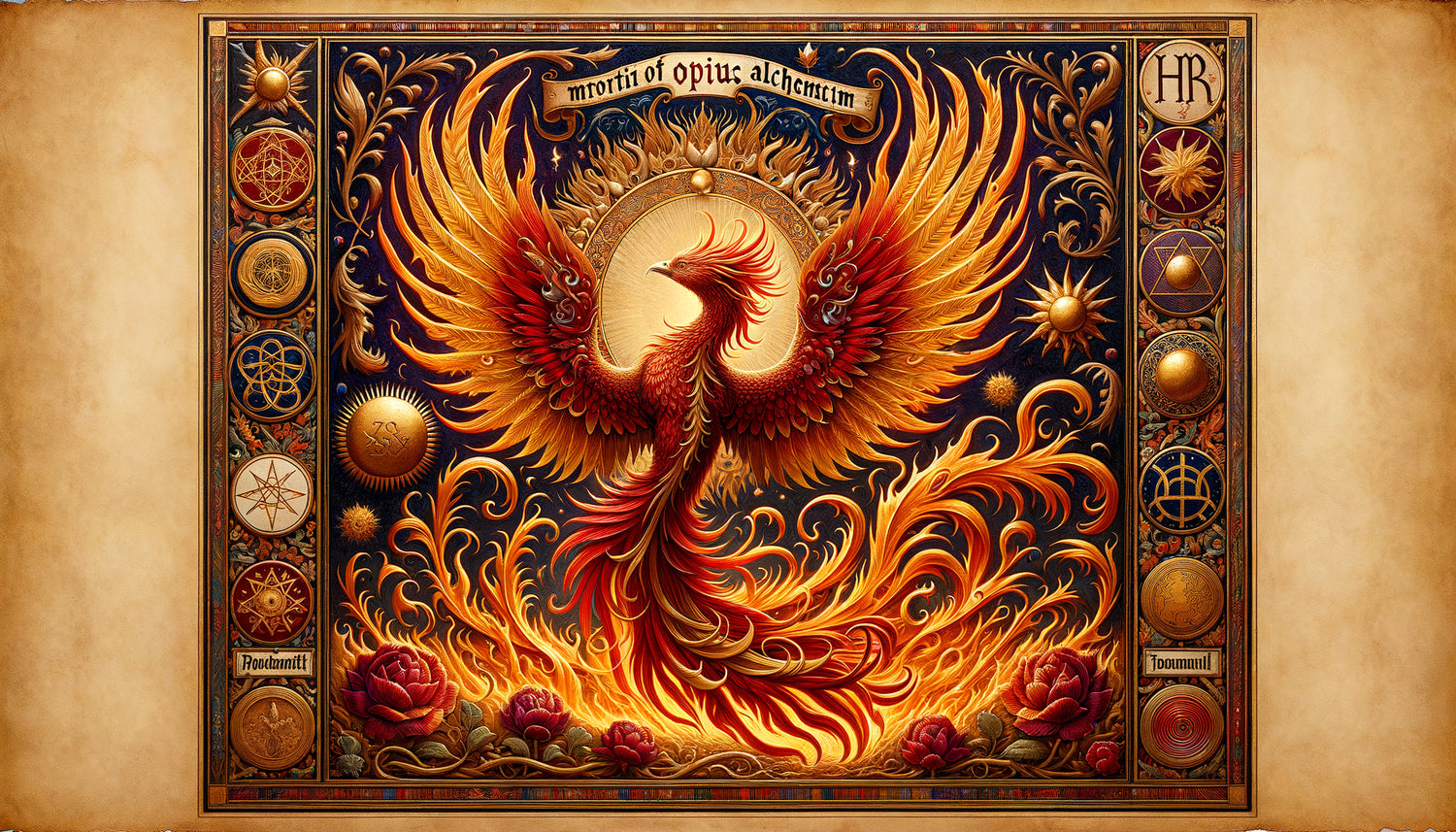
In the illuminated manuscripts of the 13th century, a fascinating creature traverses flames without ever disappearing. The phoenix rising, this mythical bird that consumes itself to be reborn from its ashes, obsessed medieval alchemists to the point of becoming their supreme emblem. But why did this legendary animal become the central symbol of alchemical transformation?
Here's what the phoenix rising represented for medieval alchemists: the promise of a total transformation of matter, living proof that death is only a step towards perfection, and the very embodiment of the transmutation process from lead to gold. This mythical creature concentrated all the hopes of an era seeking to unlock the mysteries of nature.
For today's curious minds, understanding why the phoenix rising captivated medieval alchemists seems like entering an inaccessible world, locked within encrypted grimoires and esoteric symbols. How can these obscure references be decoded without years of study?
Yet, the symbolism of the alchemical phoenix speaks a universal language: that of rebirth, purification through ordeal, and unwavering hope. I invite you to travel to the heart of this fascinating symbolism, where mythology meets nascent science, and where each flame carries within it the promise of renewal.
When ancient myth meets medieval science
The phoenix rising was not an invention of the Middle Ages. The Egyptians already venerated the Bénou, this sacred bird linked to the solar cycle and resurrection. The ancient Greeks, with Herodotus at the head, told that a unique phoenix lived five hundred years before building a nest of aromatics, consuming itself in it, then being reborn from its own ashes.
But it was in the Middle Ages that this myth found its alchemical consecration. Medieval scholars discovered translated Arabic texts, bearers of hermetic knowledge from Alexandria. The phoenix rising became much more than a legend: it embodied an observable and reproducible process.
In the laboratories of alchemists, matter underwent spectacular transformations. Metals melted, blackened, purified in the crucible. This cycle of death and rebirth strangely resembled the fate of the phoenix. How not to see a sign, a confirmation that nature itself followed the principles of regeneration?
The medieval alchemical bestiary
The phoenix rising thus joined a symbolic menagerie where each creature represented a stage of the Great Work. The green lion devoured the sun, the eagle and the dragon clashed, but the phoenix held a special place: it symbolized the final accomplishment, the ultimate success of the alchemical process. In this cosmology, the firebird was not just another symbol; it was living proof that transmutation was possible.
The colors of the phoenix: decoding alchemical language
Medieval alchemists did not work at random. They followed precise steps, marked by color changes in their materia prima. And the rising phoenix perfectly embodied this chromatic progression.
The black work, or nigredo, represented putrefaction, the symbolic death necessary. The phoenix had to first die, completely consume itself. This phase corresponded to the darkening of matter in the crucible, a terrifying moment when all seemed lost.
Then came the white work, or albedo, purification. From the ashes of the rising phoenix emerged a new substance, purer, free from its slag. Alchemists observed the same whitening in their preparations, a sign that regeneration was underway.
Finally, the red work, or rubedo, marked completion. The phoenix resurfaced in its golden and scarlet glory, a perfect image of the Philosopher's Stone obtained. This reddish-gold color symbolized the perfection achieved, the culmination of alchemical work.
A perpetual cycle of transformation
But the rising phoenix offered alchemists an additional lesson: the process had no end. The bird was reborn to live another five hundred years, then begin again. This circularity fascinated medieval scholars, who saw in it the deep nature of matter: an eternal cycle of dissolution and coagulation, death and rebirth.

The purifying fire: key element of symbolism
At the heart of the myth of the rising phoenix burns an essential element: fire. Not just any fire, but one that transforms without destroying, which purifies without annihilating. For medieval alchemists, this philosophical fire was the main agent of all transmutation.
Alchemical treatises distinguished between vulgar fire, destructive, and secret fire, that operated true transformations. The phoenix embodied this regenerative fire. It did not perish in the flames: it transformed within them. This nuance was crucial to understanding the alchemical process.
In the athanor, the alchemical furnace, the matter had to be heated at a constant temperature for weeks, sometimes months. This slow cooking imitated the process of the rising phoenix, which patiently built its pyre of aromatics before setting it on fire. The mastery of fire separated the accomplished alchemist from the simple blower.
When spirituality and science were one
The Middle Ages did not separate the material from the spiritual as we do today. For alchemists, transforming lead into gold was not just a chemical operation: it was an initiatory journey. And the phoenix rising symbolized this double quest.
The mythical bird represented the resurrection of the soul as much as that of matter. Medieval alchemical texts multiplied Christian references: the phoenix became a figure of the resurrected Christ, the Philosopher's Stone assimilated to the Grail. This fusion between alchemy and mysticism gave the phoenix an additional depth.
Illuminated manuscripts often showed the phoenix rising at the center of complex mandalas, surrounded by planetary symbols and geometric figures. These compositions were not decorative: they constituted true initiatory maps, guides for those who undertook the Great Work.
Inner alchemy according to medieval masters
Great alchemists like Nicolas Flamel or Basil Valentine insisted: the true phoenix rising was the alchemist himself. Each step of the process corresponded to a personal transformation. The calcination of matter symbolized the abandonment of the ego, dissolution represented questioning, final coagulation embodied spiritual rebirth. The phoenix became a mirror in which the adept contemplated his own journey.

The medieval legacy of the phoenix in our imagination
Even today, the phoenix rising continues to fascinate. But why does this medieval alchemical symbol resonate so strongly in our modern era? Because it carries a universal message: the possibility of starting over, transforming, being reborn from failures.
Contemporary creators constantly reinterpret this figure. In decoration, the phoenix appears as a symbol of resilience and transformation. Integrating this iconography into your interior is to surround yourself with a daily reminder that every end holds a new beginning.
Medieval alchemical manuscripts, with their depictions of the phoenix rising, have become sources of inspiration for artists and designers. These centuries-old images retain an intact visual force, blending mystery and beauty, science and poetry.
Let the power of the phoenix transform your space
Discover our exclusive collection of Myth and Legends wall art that captures the timeless magic of alchemical symbols and gives your walls a unique spiritual depth.
Reborn from its ashes: a symbol for our time
Medieval alchemists made the phoenix rising much more than just a symbol: they made it a philosophy of life. In their smoky laboratories, they were not only looking for material gold but also that ability to transform the base into the precious, the ordinary into the extraordinary.
Whenever you go through a trial and emerge transformed, you are living the process of the phoenix. Whenever you let go of what no longer serves you to embrace a renewed version of yourself, you accomplish the Great Work that alchemists pursued.
The rising phoenix became a major alchemical symbol in the Middle Ages because it embodied the craziest hope of that era: that nothing is definitive, that everything can be purified, that transformation is always possible. This legacy continues to inspire us, reminding us that in the ashes of our failures already burns the fire of our rebirth.
Frequently asked questions about the phoenix and medieval alchemy
Was the phoenix the only symbolic animal in alchemy?
No, the medieval alchemical bestiary was rich and varied. The dragon represented the unpurified raw material, the eagle symbolized volatilization, the lion embodied solar strength, and the Ouroboros serpent that bites its tail depicted the eternal cycle. But the rising phoenix held a special place because it summarized the entire alchemical process: death, purification, and rebirth. It was the only animal symbol to show complete transformation rather than just one step. Its unique character in mythology (there is only one phoenix at a time) also reinforced its association with the Philosopher's Stone, which was also unique and precious.
Did alchemists really think the phoenix existed?
The question of literal belief is complex for the Middle Ages. Alchemists worked in a mental universe where the boundary between physical reality and symbolic truth was porous. Some probably considered the phoenix as a real creature living in distant lands – remember that the era did not clearly distinguish mythology from zoology. Others understood the rising phoenix as a powerful metaphor for a very real process they observed in their crucibles. The essential thing for them was not so much the physical existence of the bird as the truth of the principle it embodied: the ability of matter to regenerate through fire. The symbol carried knowledge that transcended the question of its factual existence.
How to recognize an alchemical phoenix in medieval art ?
The rising alchemical phoenix has specific visual attributes in medieval iconography. It is often depicted in flames or on a pyre of aromatics, unlike purely decorative representations. Colors are significant: red and gold dominate, recalling the red work and the Philosopher's Stone. In alchemical manuscripts, the phoenix frequently appears at the center of circles or mandalas, surrounded by planetary symbols (especially the sun) and cryptic Latin inscriptions. Sometimes, the bird bears a crown or nimbus, emphasizing its royal and sacred character. A revealing detail: the presence of three heads or phases of the phoenix on the same image, illustrating the three works (black, white, red). If you see a phoenix associated with a crucible, an athanor or chemical symbols, you are certainly facing an alchemical representation.


