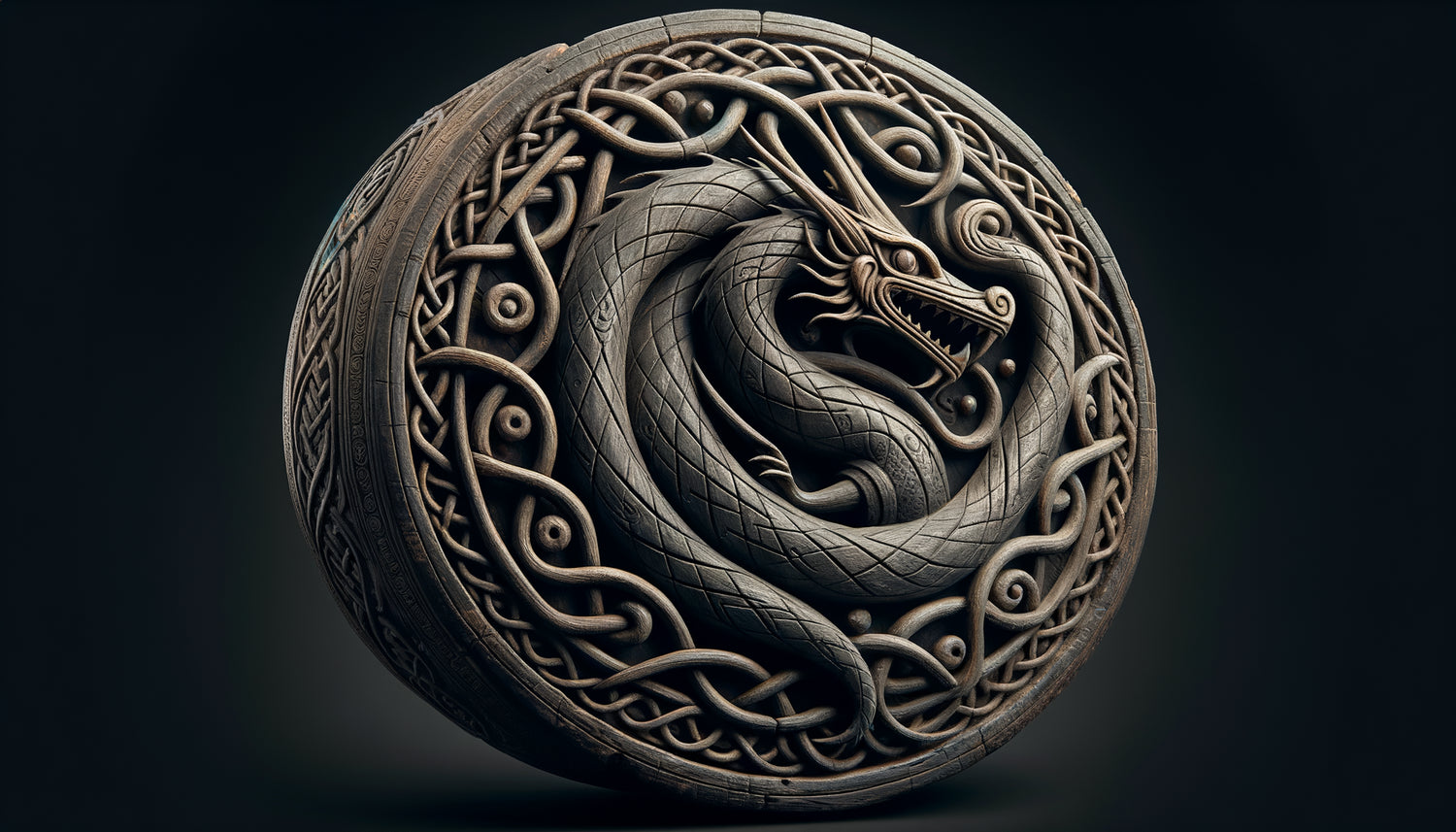
The first time I held a ninth-century Scandinavian fibula in my hands, my fingers instinctively followed the meanders of a dragon with impossible shapes. Its body coiled into infinite loops, biting its tail, knotting itself into a hypnotic dance. This creature was not simply represented — it was woven into the metal, as if the Viking artisan had captured the very movement of life.
Here's what intertwined Nordic dragons reveal: a worldview where everything is connected, prodigious technical mastery, and spiritual symbolism that transcends centuries. These knots are not mere decorative ornaments—they tell the story of a people who saw the universe as an immense cosmic weaving.
You may admire these Viking motifs on modern reproductions, fascinated by their labyrinthine complexity, but you wonder why these Nordic dragons always seem trapped within their own curves. Why this obsession with interlacing? What meaning lies behind these knots that defy spatial logic?
After fifteen years spent restoring and authenticating medieval Scandinavian artifacts, I have learned to read these dragons as a forgotten language. Each loop tells a story, each intersection carries a meaning. Let me guide you into the fascinating universe of Viking art, where mythological creatures become bearers of millennial wisdom.
The cosmic weaving: when the universe becomes an interlacing
In Nordic cosmology, the universe is not a fixed structure—it's a living weaving in perpetual transformation. The Vikings conceived of the cosmos as a giant tapestry where each thread represented a destiny, a life, a natural force. The three Nornes, goddesses of fate, tirelessly wove at the foot of Yggdrasil, the world-tree that connects the nine realms.
The intertwined Nordic dragons embody this worldview. Their serpentine body visually reproduces the concept of wyrd, this invisible network of connections that unites all beings and all events. Unlike medieval Western dragons, massive and planted on their paws, Viking dragons are fluid, almost liquid, their limbs blending into their tails in a seamless continuity.
I have examined dozens of runestones in Jelling, Gotland, and Uppland. On each, the dragons intertwine with the runic inscriptions themselves, suggesting that the creature and the message are one. The dragon does not illustrate the text—it is its living support, the cosmic bearer of meaning. This fusion of form and content reveals a remarkable conceptual sophistication.
The perpetual metamorphosis: creatures that escape definition
A disturbing peculiarity of Nordic dragons: their morphological ambiguity. Examine these interweaves closely, and you will see that the head can be that of a serpent, a wolf, or even a bird. The legs transform into plant tendrils, the tail becomes a new head. This visual metamorphosis is not the result of incompetence — it's a deliberate strategy.
The Vikings were not trying to represent a dragon fixed, but the very principle of transformation. In their mythology, the boundaries between species are porous: Loki turns into a salmon, Odin takes the form of an eagle, Fafnir becomes a dragon out of greed. The interwoven knots visually express this ontological fluidity — the dragon is always in the process of becoming something else.
On the famous portal of the Urnes church in Norway, the dragon entwines with a deer in an eternal struggle. But where does one begin and where does the other end? The bodies merge into a hypnotic tangle of curves and counter-curves. This deliberate ambiguity forces the gaze to circulate endlessly, unable to grasp a stable form. It is precisely the effect sought: to represent the perpetual movement of life and death, of creation and destruction.

The horror of the void: a nature that knows no rest
Viking artisans practiced what specialists call the 'horror vacui' — the horror of emptiness. Every square millimeter of a surface must be filled, every space exploited. This ornamental density is not merely a decorative aesthetic—it translates a worldview where nature leaves no space unoccupied.
The interwoven dragons fill the available space with an irresistible organic logic. Like the roots of Yggdrasil that penetrate all realms, like branches that touch all heavens, the dragon's body colonizes the surface according to the laws of natural growth. I have often noticed that Viking interweaves respect a subtle bilateral symmetry, like a living organism.
This profusion of ornamentation also creates an apotropaic—protective against malevolent forces—effect. The complex knots were thought to trap hostile spirits in their labyrinth. A dragon intertwined on the prow of a drakkar did not merely intimidate human enemies — it served as a magical barrier against supernatural creatures. The knot itself possessed a power of ligature, of chaining forces.
Animal styles: a fascinating evolution over four centuries
Viking art experienced a remarkable stylistic evolution between the 8th and 11th centuries, and interwoven dragons bear witness to this magnificently. As a restorer, I have learned to date an object simply by the morphology of its dragons.
The Oseberg style (early 9th century) features naturalistic creatures with well-defined clawed paws, but already caught in semi-vegetal interlacings. The Borre style introduces the famous chain rings and triangular masks. Then comes the Jelling style, where the dragon really becomes a ribbon, its body flattening into an ornamental band that winds with elegance.
But it is with the Mammen, Ringerike and Urnes styles that the art of interlacing reaches its peak. The dragon becomes purely linear, almost calligraphic. Its limbs end in vegetable spirals, its body traces elegant S shapes. In the Urnes style — the latest and most refined — the creatures thin into graceful threads that cross according to precise geometric rules: always over-under, as in a true weaving.
This evolution is not simply a change of fashion. It reflects the progressive Christianization of Scandinavia and the influence of Celtic and Anglo-Saxon island motifs. Viking dragons begin to coexist with crosses, integrating new symbols into their eternal dance. Interlacing then becomes a visual language capable of uniting two cosmologies.

The technical prowess: creating the impossible
Creating a convincing interwoven dragon requires exceptional technical mastery. I myself have tried to reproduce some motifs on wood, and I can testify to the difficulty. You have to visualize mentally how a continuous ribbon will cross itself, go over then under, create an illusion of depth on a flat surface.
Viking artisans often worked without preparatory drawings, tracing these labyrinthine compositions freehand. On some runestones, one can guess corrections made along the way — a loop that does not close properly, an imperfect crossing. These imperfections make these works all the more touching: they reveal the creative process, the human behind the apparent perfection.
The symmetry of Viking interlaces obeys intuitive mathematical rules. Many follow principles of rotation or reflection, creating patterns that can be divided into repetitive sections. This underlying structure allowed artisans to create large-scale coherent compositions—some runestones measure several meters in height, entirely covered with interlaced dragons.
Beyond aesthetics: the magical power of knots
In Norse thought, a knot is never simply decorative—it possesses an intrinsic power. Sagas mention ligature spells (herfjöturr) that paralyzed enemy warriors. Runes themselves were sometimes linked together to create magical sigils. Interlaced dragons are part of this operative magic.
The serpent-dragon Jörmungandr, which encircles Midgard by biting its tail, embodies the ultimate cosmic knot—the Norse ouroboros. Its presence maintains the order of the world; when it releases its tail during Ragnarök, the universe unravels. The interlaced dragons on everyday objects recall this power of maintenance, cohesion. Wearing jewelry adorned with these motifs was wearing a fragment of the cosmic order.
I have examined amulets where the interlaced dragon literally forms a knot impossible to undo without breaking the object. This physical permanence translated into magical permanence—a definitive protection, an inviolable oath. Medieval Scandinavian wedding rings often borrowed these motifs, symbolizing the indissoluble union of spouses, linked like the loops of an eternal dragon.
Let Nordic dragons weave their magic in your home
Discover our exclusive collection of Myths and Legends paintings that captures the timeless power of Viking interlaces and transforms your interior into a mystical contemplation space.
When Viking dragons meet your everyday life
Even today, interlaced dragons exert their fascination. I regularly see customers seeking to incorporate these motifs into their home decor, attracted by their graphic sophistication and symbolic depth. Unlike Asian or medieval dragon representations, Nordic dragons possess an abstraction that makes them surprisingly contemporary.
Their labyrinthine character invites visual meditation. Hanging a reproduction of a runestone or a painting inspired by Viking art creates a focal point that holds the gaze, drawing it into the meanders of the interlaces. This contemplative quality makes them perfect works for spaces where concentration and serenity are sought—office, library, reading corner.
The color palette of Viking art — deep blacks, warm golds, blood reds, bone whites — blends remarkably well with modern Nordic interiors. These motifs naturally dialogue with raw wood, unbleached linen, organic textures. They bring a visual and narrative density that contrasts beautifully with contemporary Scandinavian minimalism.
Nordic dragons remind us of forgotten wisdom: all is connected, all is transformation, nothing exists in isolation. In a world that values separation and reductive simplicity, these intertwined creatures offer an alternative vision — complex, organic, woven. They invite you to see invisible connections, to accept ambiguity, to embrace perpetual metamorphosis.
The next time you encounter a Viking dragon winding in impossible knots, take the time to follow its path with your eyes. Let your gaze travel along its ribbon-like body, cross intersections, get lost in the labyrinth. You are then doing exactly what Vikings did a thousand years ago: connecting to the cosmic weaving, participating in the eternal dance of creation. And perhaps, as I did during this first encounter, you will feel with your fingertips the pulse of a world where mythological creatures still breathe.
Frequently Asked Questions about Intertwined Nordic Dragons
Are Viking dragons always depicted with knots?
Not systematically, but the vast majority of depictions of Nordic dragons in Viking art incorporate interlacing. It is such a dominant characteristic that it practically defines medieval Scandinavian style. The few exceptions — more naturalistic dragons from the beginning of the Viking era — confirm that interlacing has gradually become the aesthetic and symbolic norm. This evolution reflects the growing importance of the concept of cosmic connection in Nordic thought. If you see a Viking dragon without knots, it is probably a very early work (before the 8th century) or a modern interpretation that does not respect historical codes. The knots are not just an ornament — they are constitutive of the very identity of the Scandinavian dragon.
What is the difference between a Viking dragon and a Celtic dragon?
Excellent question that reveals fascinating cross influences! Celtic and Norse dragons indeed share a love of interlaces, resulting from intense contact between Vikings and the Celtic populations of the British Isles. However, Celtic dragons tend towards more vegetal forms, with characteristic triple spiral terminations. Viking dragons, especially in later styles like Urnes, adopt more slender and angular bodies, with distinctive triangular heads and limbs ending in stylized claws. Celtic interlaces often follow strict geometric patterns (braids, spirals), while Norse interlaces retain organic asymmetry, a sense of spontaneous movement. Finally, symbolically, the Celtic dragon fits into a different cosmology, more linked to seasonal cycles and telluric forces, whereas the Norse dragon embodies woven fate and perpetual transformation.
Can we integrate Norse dragon motifs into a modern decoration?
Absolutely, and it's even a growing trend in contemporary interior design! Interlaced dragons possess a timeless graphic quality that transcends their medieval origin. Their partial abstraction makes them compatible with minimalist or industrial aesthetics. I recommend using them as dramatic focal points — a large painting above a sleek sofa, embroidered cushions on a white bed, or even wall tiles in a zen bathroom. Viking motifs work particularly well in black and white for contemporary interiors, or in metallic tones (bronze, copper, gold) to add warmth. The trick is not to overload: one or two elements are enough to create a strong visual impact. These dragons bring narrative depth and cultural sophistication without falling into medieval-fantasy kitsch, provided that quality reproductions based on authentic sources are chosen.