Imagine a woman with a petrifying gaze, encircled by hissing serpents, whose face embodied absolute horror for centuries. Then, almost overnight, this very creature transforms into a melancholic victim with delicate features, a figure of seduction and tragedy. This spectacular metamorphosis of Medusa in the artistic imagination of the 19th century reveals much more than a simple aesthetic change: it translates a profound revolution in our relationship to femininity, beauty, and violence.
Here's what this artistic transformation brings us: a renewed understanding of female psychology that still fascinates our contemporary interiors, a redefinition of beauty as an ambivalent force capable of adorning our living spaces, and a reflection on victimization that strangely resonates with our modern sensibilities. Collectors seeking to infuse mystery and depth into their decor often grapple with this question: how to integrate mythology without falling into cliché? The answer lies precisely in this reinvention of Medusa, where beauty and tragedy merge to create an aesthetic as disturbing as it is elegant. Let yourself be guided through this fascinating artistic odyssey that explains why the Gorgon now reigns, serene and magnetic, on so many contemporary walls.
The romantic shift: when the monster becomes a mirror
At the turn of the 19th century, the Romantic movement radically overturned representation codes. Where Neoclassical art privileged the heroism of Perseus brandishing Medusa's severed head as a trophy – think of Cellini's famous bronze –, the Romantics operate a shift in gaze. They are no longer interested in the victor, but in the vanquished. This inversion translates a new obsession with the tormented soul, complex psychology, melancholic beauty.
Théodore Géricault, with his studies of heads of condemned men, opens the way to this aesthetic of sublimated suffering. Medusa ceases to be a simple mythological monster to become a symbol of the human condition, a creature trapped in a destiny she did not choose. Romantic artists, fascinated by marginal and cursed figures, discover in her an unsuspected narrative potential: what if Medusa was not the monster, but the victim?
The rediscovered influence of Ovid
Ovid's Metamorphoses, reread with a new sensitivity, become the key to this transformation. The Latin poet already told how Medusa was originally a magnificent young woman, raped by Poseidon in Athena's temple, and then punished by the jealous goddess who transformed her hair into snakes. This version of the myth, long neglected in favor of Perseus' heroic narrative, resonates powerfully with Romantic sensibilities. Medusa then becomes the archetype of the woman punished for a crime she did not commit, figure of divine injustice and sullied beauty.
The sleeping Medusa: birth of an aesthetic icon
It's probably the Medusa’s Head by Bernin, sculpted in the 17th century but rediscovered in the 19th, that inaugurates this new paradigm. Unlike previous terrifying representations, this Medusa displays harmonious features, almost peaceful in death. The snakes of her hair undulate with a grace reminiscent of vegetation, evoking more a natural crown than a curse.
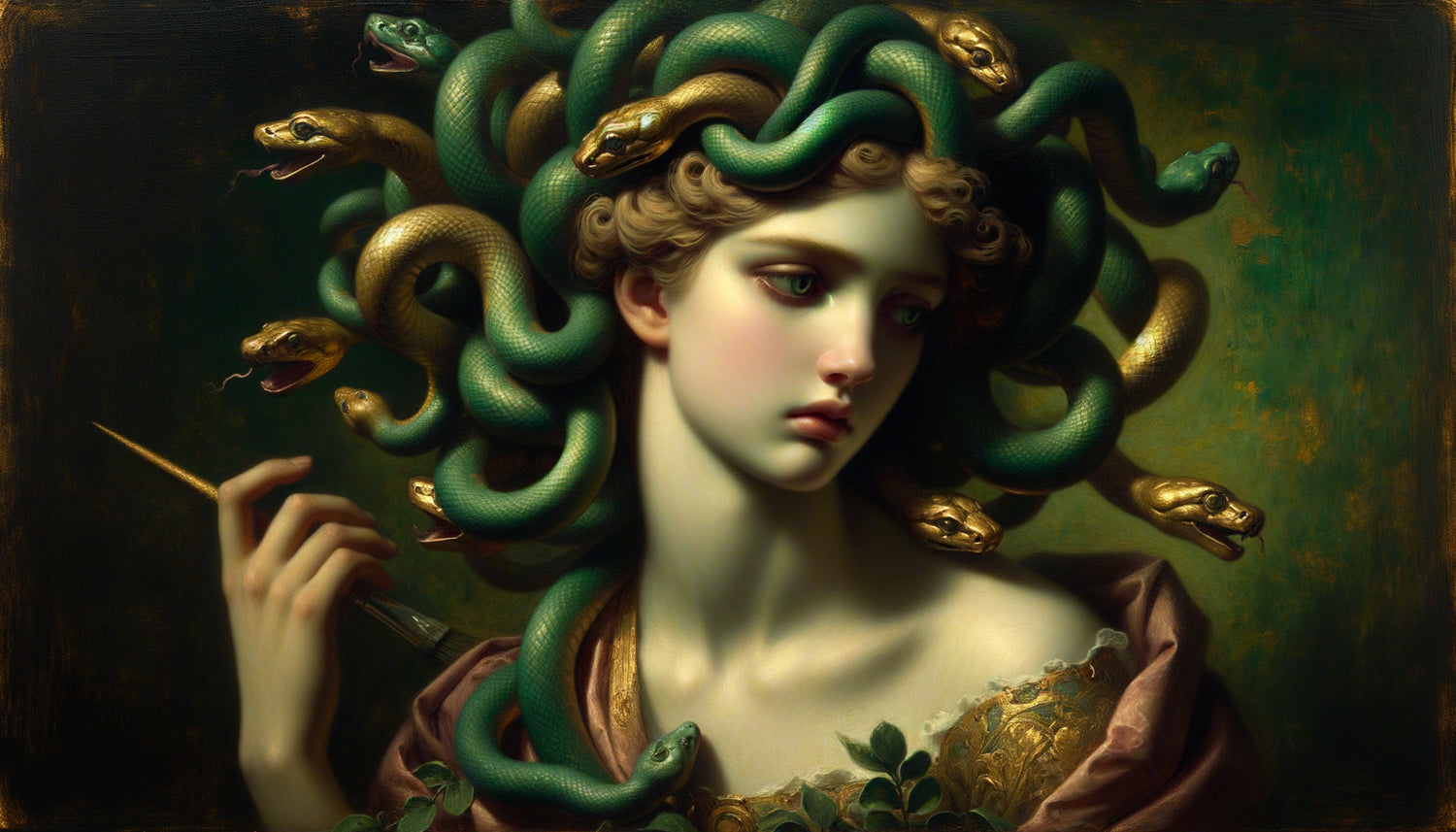
This vision inspires an entire generation of artists. In 1819, Antoine-Denis Chaudet created his own version, further accentuating the serene beauty of the Gorgon. The oval face, parted lips, and closed eyes suggest less violent death than an eternal sleep imbued with melancholy. The snakes become decorative elements, almost ornamental, losing their monstrous charge to gain a fascinating aesthetic dimension.
The Pre-Raphaelite Obsession with Tragic Femininity
British Pre-Raphaelites take this aesthetic to its paroxysm. Dante Gabriel Rossetti, Edward Burne-Jones and their colleagues cultivate a fascination for cursed beauties and tragic heroines. Their Medusa is no longer a monster: she is a young woman with extraordinary hair, whose gaze certainly possesses a dangerous power, but above all embodies vulnerability and suffering. This vision fuels a rich iconography where the Gorgon joins Ophelia, The Lady of Shalott and other female figures trapped in cruel destinies.

The Freudian Symbol Before Its Time: Eroticism and Danger
Long before Freud theorized Medusa’s head as a symbol of castration and sexual anxiety, 19th-century artists instinctively explore this dimension. The transformation of Medusa into tragic beauty allows for the expression of an ambivalent fascination with female sexuality perceived as both attractive and dangerous.
The Symbolist painter Fernand Khnopff creates disturbing Medusas, where sensuality and threat coexist in a precarious balance. The snakes wind around the neck like living jewels, the sensual mouth contrasts with the petrifying gaze, the pale skin evokes both virgin purity and death. This femme fatale aesthetic – which will culminate with Salomé, Judith and other fin-de-siècle icons – finds in Medusa its perfect mythological archetype.
The power of the gaze: reversal of power dynamics
Paradoxically, by humanizing Medusa, artists amplify her power. When she was hideous, her gaze petrified through horror. Having become beautiful, it petrifies through fascination. This subtle inversion reflects a masculine anxiety about female erotic power. The seductive Medusa of the 19th century thus becomes even more disturbing: one cannot look away, even knowing the danger. This tension between desire and destruction explains why these representations still exert a magnetic attraction in our interiors.
The impact of emerging photography on representation
The emergence of photography in the 1840s-1850s profoundly changes the way artists perceive the human face and its expressiveness. The first photographic portraits, with their long exposure times, capture fixed expressions, almost petrified, inadvertently creating an aesthetic link with the myth of Medusa. Photographers experiment with theatrical staging which directly influences painting.
Julia Margaret Cameron, a British pioneer, photographs her female models in poses evoking mythological heroines, creating a new imagery of tragic beauty. This photographic aesthetics, where artistic blur and dramatic lighting soften the features while preserving emotional intensity, inspires Symbolist painters in their representation of Medusa. The monster becomes portrait, psychology embodied in matter.

Medusa in our interiors: a magnetic presence
This reinvention of Medusa in the 19th century explains her current popularity in contemporary decoration. Far from the ancient terrifying imagery, the modern Gorgon embodies a mysterious sophistication that perfectly dialogues with eclectic and cultured interiors. Reproduction of Symbolist paintings, neo-classical sculptures, or contemporary graphic reinterpretations: Medusa crosses styles with remarkable ease.
Her harmonious face, often depicted in grayscale reminiscent of ancient marble, blends seamlessly into both a neo-bourgeois living room and a minimalist loft. The stylized serpents bring a natural and flowing dimension, creating a captivating focal point without visual aggression. It is this duality – accessible beauty and symbolic depth – that makes Medusa such a sought-after decorative element. She tells a complex story of transformation, resilience, and ambiguity, resonating with current sensibilities seeking objects imbued with meaning and narrative.
Placement choices : creating a dialogue
A representation of Medusa is not placed at random. In an office, she evokes protection and the power of gaze, a modern guardian against negative energies. In a bedroom, she displays her more intimate dimension of melancholic beauty and assumed vulnerability. Passage areas – entrances, hallways – particularly benefit from her presence, creating an unexpected moment of contemplation, a narrative pause in the daily flow. The essential thing is to give her the space and lighting necessary for her ambivalent gaze to exert its fascination.
Invite the power of myths into your daily life
Discover our exclusive collection of Myth and Legends paintings that transform your walls into portals to timeless tales, where each artwork tells a story of transformation and tragic beauty.
Medusa today : a mirror of our contradictions
The transformation of Medusa in the 19th century was not merely an aesthetic exercise, but a profound cultural revolution in our relationship with femininity, victimization, and power. By humanizing the monster, artists created a symbol infinitely more complex and troubling, which continues to question us. This reinvented Medusa – beautiful, tragic, dangerous, and vulnerable – perfectly embodies the contradictions we are still exploring today.
In our contemporary interiors, her image serves as a subtle reminder that authentic beauty always contains a shadow, that vulnerability can coexist with power, and that the richest narratives are those that escape simple categories. Choosing to welcome Medusa into your home is an affirmation of a taste for narrative complexity and intellectual elegance, far beyond mere decoration. It is inviting mythology to dialogue with our present, recognizing that these millennial stories still speak to our modern sensibilities, illuminating our spaces with their timeless mystery.
Frequently asked questions about the representation of Medusa
Why Did Medusa Become a Positive Symbol in Modern Decor?
The reappropriation of Medusa as a positive symbol stems directly from her transformation in the 19th century. By transitioning from monster to magnified victim, she became a figure of resilience and assumed female power. Today, many see it as a symbol of protection – her petrifying gaze wards off negative energies – but also of empowerment, since she represents a woman who, despite the injustice suffered, retains an impressive power. In decoration, choosing Medusa signals a cultivated sensitivity and an affinity for ambivalent symbols, rejecting simplistic interpretations. It is a sophisticated aesthetic choice that immediately creates a conversation starter, inviting exploration of the multiple layers of meaning behind this familiar but profoundly rich image.
How to Incorporate a Representation of Medusa Without Creating an Oppressive Atmosphere?
The key lies in the choice of representation and its visual context. Favor neoclassical or symbolist versions from the 19th century, where Medusa displays serene features rather than grimacing ones. Soft tones – grayscales, sepia, pale blues – blend harmoniously without assaulting the eye. The framing also plays a crucial role: an elegant and simple frame elevates the work to the rank of artwork rather than macabre curiosity. Surround her with natural or soothing elements – green plants, soft textiles, natural light – to create a contrast that softens her intensity. Also consider the scale: a small reproduction creates a moment of contemplative intimacy, while a large piece requires generous space to breathe. The goal is to create productive aesthetic tension, where the strength of the symbol dialogues with the gentleness of its environment.
Which 19th Century Artists Best Captured This New Vision of Medusa?
Several artists stand out in this reinvention. Antoine-Denis Chaudet offers a Medusa of unsettling serenity, where death resembles a peaceful sleep. Fernand Khnopff, leader of Belgian symbolism, creates hypnotic versions where sensuality and danger merge into a refined decadent aesthetic. Arnold Böcklin, Swiss symbolist painter, explores the psychological dimension with expressive Medusas that seem to bear the weight of their curse. Dante Gabriel Rossetti and the Pre-Raphaelites, although not always directly depicting Medusa, establish the aesthetics of tragic beauty with extraordinary hair which influences all subsequent representations. For accessible contemporary reproductions, look for interpretations inspired by these masters, which capture their sensibility while adapting to current tastes. These works transform an ancient myth into a modern aesthetic statement, proving that great stories cross centuries constantly reinventing themselves.