For twenty years, I have been visiting galleries, and one enigma has fascinated me: why did the mythological creatures that once adorned Roman mosaics suddenly disappear from Byzantine walls? The centaurs, these powerful figures—half-man, half-horse—that proudly galloped in the ancient imagination, vanished as if by magic from the workshops of Constantinople. This absence is not accidental; it is the silent testimony of an unprecedented artistic and spiritual revolution.
Here's what this disappearance reveals: the radical transformation of symbolic codes, the emergence of a new Christian visual language, and the creative tensions between pagan heritage and Orthodox faith. Understanding why the centaurs left Byzantine wall art means discovering how a civilization completely reinvents its visual identity.
You may be intrigued by these artistic metamorphoses, those moments when the history of art shifts. You observe Byzantine mosaics in books or museums, and you wonder: where have all the fabulous creatures that populated Roman frescoes gone? This question deserves a nuanced answer, as it touches on the very foundations of Byzantine aesthetics.
Rest assured, this transition was neither brutal nor arbitrary. Byzantine artists did not simply erase their heritage. They carried out a careful selection, a cultural sorting guided by profound theological concerns. By exploring this enigma, you will discover how art becomes a mirror of the spiritual upheavals of an era.
I invite you to dive into the workshops of Constantinople, to understand the dilemmas of Christian mosaicists facing ancient heritage, and to decode the theological, symbolic, and aesthetic reasons that condemned centaurs to artistic exile.
The clash of symbols: when Christianity meets mythology
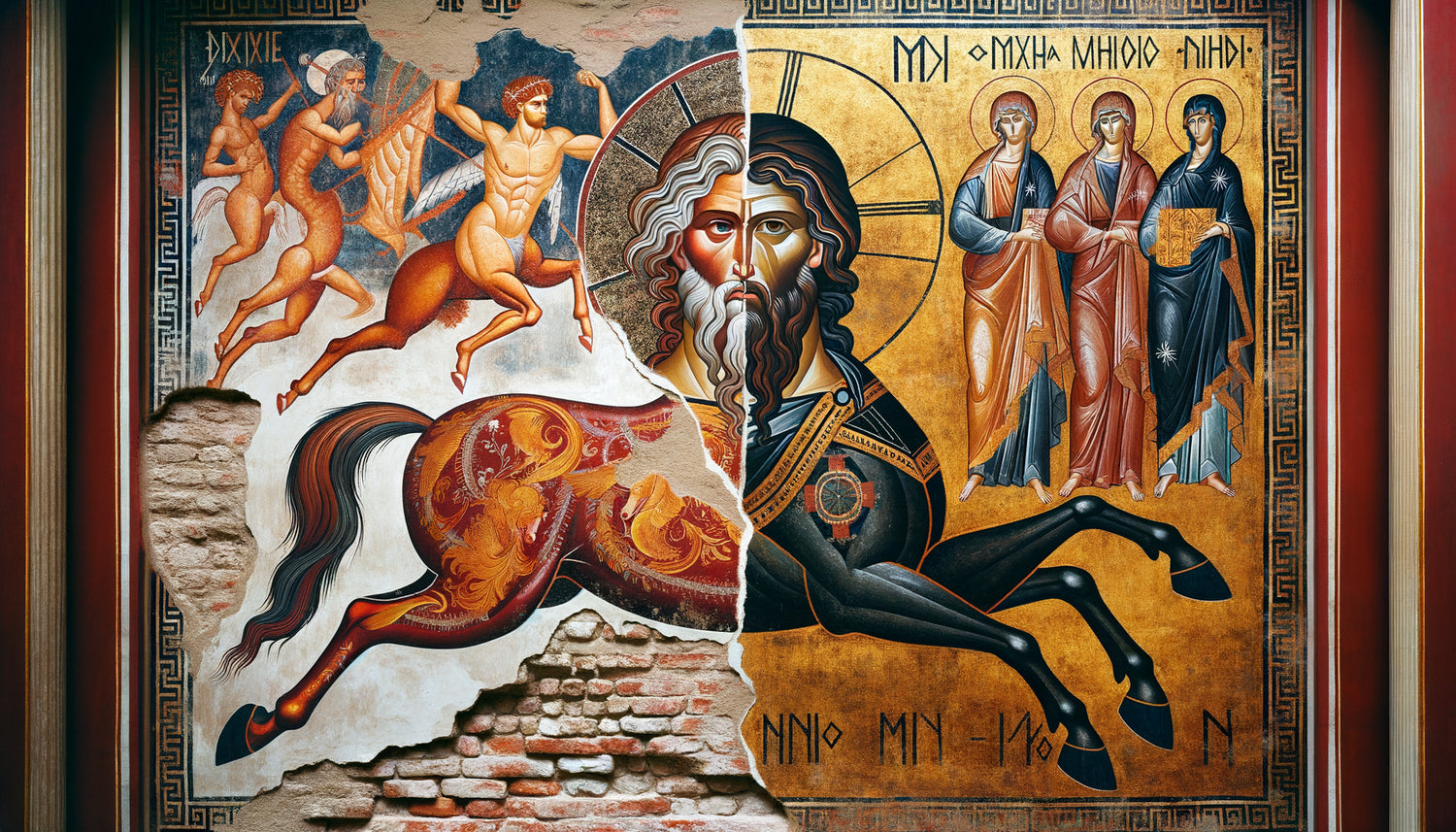
Byzantine art was born in a context of radical change. From the 4th century onwards, Constantinople became the heart of an officially Christian empire. Workshops that once produced mosaics celebrating Dionysus, Apollo, and centaurs suddenly had to convert to a new iconography. Centaurs, symbols of duality and wild nature, embodied in the Greek and Roman imagination the tension between civilization and barbarism, reason and instinct.
But for Byzantine theologians, these hybrid creatures posed a fundamental problem. They represented moral ambiguity, the uncertainty between good and evil. However, Byzantine wall art sought precisely the opposite: doctrinal clarity, ordered celestial hierarchy, a clear separation between the sacred and the profane. Centaurs no longer had their place in this binary system of thought.
In the basilicas of Ravenna or Constantinople, each image had to serve a specific pedagogical purpose. Walls became visual bibles for a largely illiterate population. How can we justify the presence of pagan creatures in this Christian educational program? Bishops and ecclesiastical patrons preferred angels with golden wings, saintly martyrs, and Christ Pantocrator. Centaurs now belonged to a bygone era, or even suspicious.
The progressive demonization of hybrid creatures
Church Fathers did not simply ignore centaurs; they actively rejected them. In patristic writings, hybrid creatures gradually become symbols of paganism to be fought. Saint Augustine, Clement of Alexandria, and other theologians associate the half-human, half-beast figures with moral corruption, spiritual confusion, or even demons.
This demonization radically transforms the status of centaurs in the collective imagination. What was once celebrated as a harmonious synthesis between man and nature becomes suspect, dangerous. Byzantine mosaicists, working under the close supervision of the clergy, receive clear instructions: eliminate ambiguous mythological references. The iconographic programs of churches are carefully controlled.
Some Byzantine manuscripts bear witness to this transition. We sometimes see centaurs relegated to the margins, in secular illuminations or bestiaries, but never in sacred spaces. Mural art, particularly visible and symbolically charged, becomes an exclusively Christian territory. The few exceptions confirm the rule: when a hybrid creature appears, it is usually to illustrate a vice or represent the forces of evil defeated by the saints.
The exception of secular manuscripts
Paradoxically, centaurs survive in some non-religious contexts. Byzantine scientific manuscripts, notably copies of astronomical or medical works inherited from antiquity, sometimes preserve these figures. But these documents circulate within learned circles, far from the eyes of the people. Public and monumental mural art obeys much stricter rules.

The new geometry of the sacred
Byzantine art develops a completely new visual language, based on hierarchy and transcendence. The mosaics of Hagia Sophia or Saint-Vital do not seek to represent the terrestrial world with its ambiguities, but to open a window onto the celestial kingdom. This ambition requires radically different visual codes than those of ancient art.
Centaurs, creatures rooted in forests and mountains, oppose this vertical aspiration. Byzantine iconography favors hieratic, frontal, dematerialized figures. Gold backgrounds abolish spatial depth to suggest eternity. In this abstract and symbolic universe, the hybrid creatures of ancient mythology seem anachronistic, too carnal, too narrative.
Byzantine artisans perfectly master the art of tessellation and monumental composition. Their rejection of centaurs is therefore not technical, but ideological. They could have beautifully represented these creatures, as their Roman predecessors did. But the Byzantine artistic project pursues another ideal: visual deification, transforming architectural space into a gateway to paradise.
When the emperor controls images
In Byzantium, art is never politically neutral. The emperor considers himself the representative of Christ on earth, and imperial iconography must reflect this divine legitimacy. The decorative programs of palaces and churches are subject to constant imperial supervision. Centaurs, associated with earlier paganism, risk blurring this message of Christian continuity.
The iconoclastic controversies of the 8th and 9th centuries further intensify this control. For over a century, Byzantium is torn apart by the question of religious images. In this climate of suspicion, any ambiguous figure becomes potentially dangerous. Centaurs, already marginalized, disappear definitively from monumental projects. Only strictly orthodox images survive this theological purge.
Imperial workshops establish strict canons: which figures can be represented, in what postures, with what attributes. These iconographer's manuals, such as the famous Hermeneia, never mention mythological creatures. Byzantine art becomes an art of controlled repetition, where iconographic innovation is suspect. Centaurs have no place in this codified system.

The selective memory of the ancient heritage
Byzantium nevertheless did not reject everything from Antiquity. Byzantine artists admire Roman techniques, study classical compositions, and even reuse certain decorative motifs. But they operate a meticulous selection. Vegetal scrolls, geometric patterns, and some real animals cross the centuries. Centaurs, however, remain on the platform.
This selection reveals the sophistication of the Byzantine cultural project. It is not a barbaric destruction of heritage, but a critical appropriation. Artisans retain what can be Christianized or symbolically neutralized. The lion becomes the attribute of Saint Mark, the eagle that of Saint John. But how to Christianize a centaur? The creature remains irreducibly linked to its pagan mythological context.
In the rare cases where fantastic creatures appear in Byzantine art, they are generally beings drawn from the Bible or Revelation: the six-winged seraphim, the tetramorphs, the creatures of Ezekiel's vision. These biblical hybrids legitimize the presence of the fantastical while maintaining orthodoxy. Greek centaurs cannot compete with these sacred monsters.
The timid return to the Palaeologian Renaissance
In the 14th century, during the Palaeologian Renaissance, Byzantium experienced a cultural revival and renewed interest in classical Antiquity. A few aristocratic manuscripts discreetly reintroduce some mythological motifs. But even in this context of openness, centaurs remain absent from the mural art of churches. The Christian iconographic tradition remains too powerful to allow their return to sacred spaces.
Passionate about these metamorphoses of artistic imagination?
Discover our exclusive collection of Myths and Legends paintings that celebrate the symbolic richness of ancient creatures in inspiring contemporary compositions.
The creative exile to medieval Occident
Irony of history: while Byzantium bans centaurs from its walls, medieval Occident rediscovers them with fascination. Roman sculptors integrate these creatures into the capitals of churches, medieval bestiaries reinterpret them morally. The centaur even becomes a Christological ambiguous figure, representing the double nature of Christ.
This divergence illustrates the different paths taken by Byzantine and Western art. Byzantium, a rigorous guardian of theological orthodoxy, maintains strict iconographic discipline. The West, further from Greek sources and more open to local syncretisms, integrates pagan survivals more freely. Centaurs find refuge in the margins of medieval Europe, far from Constantinople.
Today, this absence fascinates art historians. It is a testament to the power of images in pre-modern societies, their ability to structure collective imaginations. The centaurs banished from Byzantium remind us that art is never innocent, that it always bears the traces of ideological battles of its time.
Conclusion : The eloquence of silence
The absence of centaurs in Byzantine mural art is not a neglect, but a deliberate choice laden with meaning. It reveals how a civilization reconstructs its visual identity according to its new spiritual values. The mosaicists of Constantinople preferred doctrinal clarity to mythological ambiguity, a coherent theological program to the seductive but problematic pagan heritage.
This artistic metamorphosis still questions us today about our own aesthetic choices. What images do we prioritize? What symbols do we reject? The history of Byzantine centaurs invites us to reflect on how art reflects, constructs and transforms our belief systems. The next time you admire a Byzantine mosaic, think of the absent figures, the creatures that could have galloped on these golden walls but remained silent, eloquent victims of a monumental spiritual revolution.
FAQ : Your questions about centaurs and Byzantine art
Do we sometimes find centaurs in Byzantine art?
Yes, but only in very specific and non-religious contexts. A few Byzantine scientific manuscripts, notably copies of Greek astronomical works, preserve representations of centaurs as the constellation Sagittarius. These creatures can also be found in some secular objects such as ivories or textiles intended for the lay aristocracy. But in the mural art of churches and sacred spaces, their absence is almost total. This distinction shows that Byzantine artists had not lost the technical ability to represent centaurs, but that an ideological prohibition prevented them from appearing in religious contexts. The few exceptions confirm this strict rule.
Why are other mythological creatures accepted in Christian art?
The fundamental difference lies in the source of legitimacy. The creatures depicted in Byzantine art generally originate from the Bible or Christian traditions: seraphim, cherubim, the four beasts of the Apocalypse, the serpent of Genesis. These fantastical beings possess a scriptural endorsement that makes them acceptable. Centaurs, on the other hand, belong exclusively to Greek and Roman pagan mythology. They are associated with narratives involving pagan gods such as Dionysus. Furthermore, some ancient creatures have been morally reinterpreted: the phoenix becomes a symbol of Christ's resurrection, the pelican represents Christ’s sacrifice. But centaurs, with their hybrid nature and bacchanalian associations, resist any satisfactory Christianization.
Does this disappearance concern only centaurs?
No, centaurs are part of a much broader elimination of ancient mythological imagery. Satyrs, nymphs, the gods of Olympus, heroes such as Hercules (though sometimes Christianized in the West) also disappear from Byzantine wall art. The entire Greco-Roman pantheon is progressively banned from sacred spaces. This systematic iconographic purge begins in the 4th century and intensifies after the iconoclastic controversies. Byzantine art develops a completely Christianized visual repertoire, centered on Christ, the Virgin, saints, and biblical scenes. Centaurs are therefore representative of a broader phenomenon: the construction of a Christian visual identity that deliberately breaks with the pagan heritage while preserving some ancient artistic techniques.