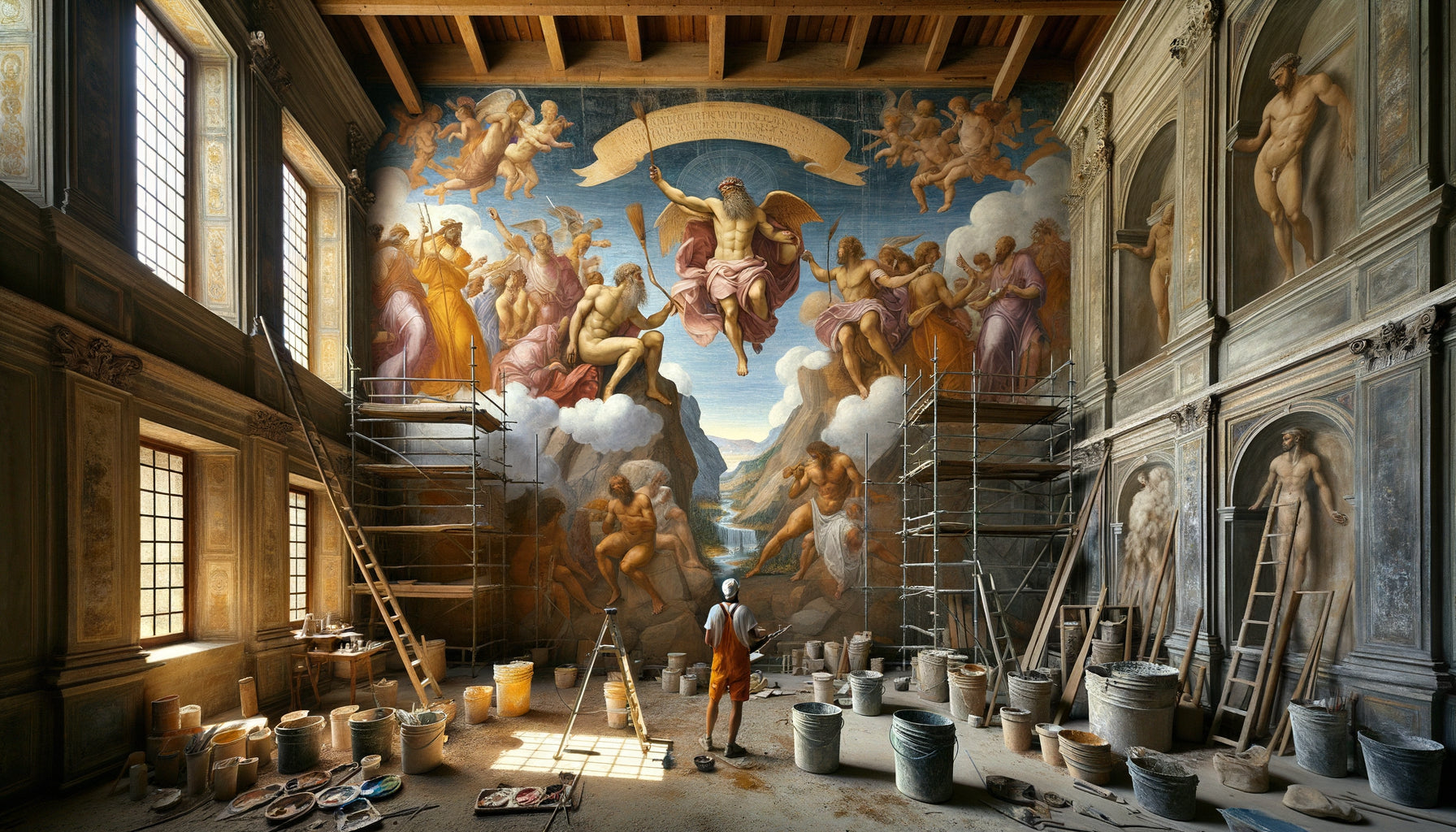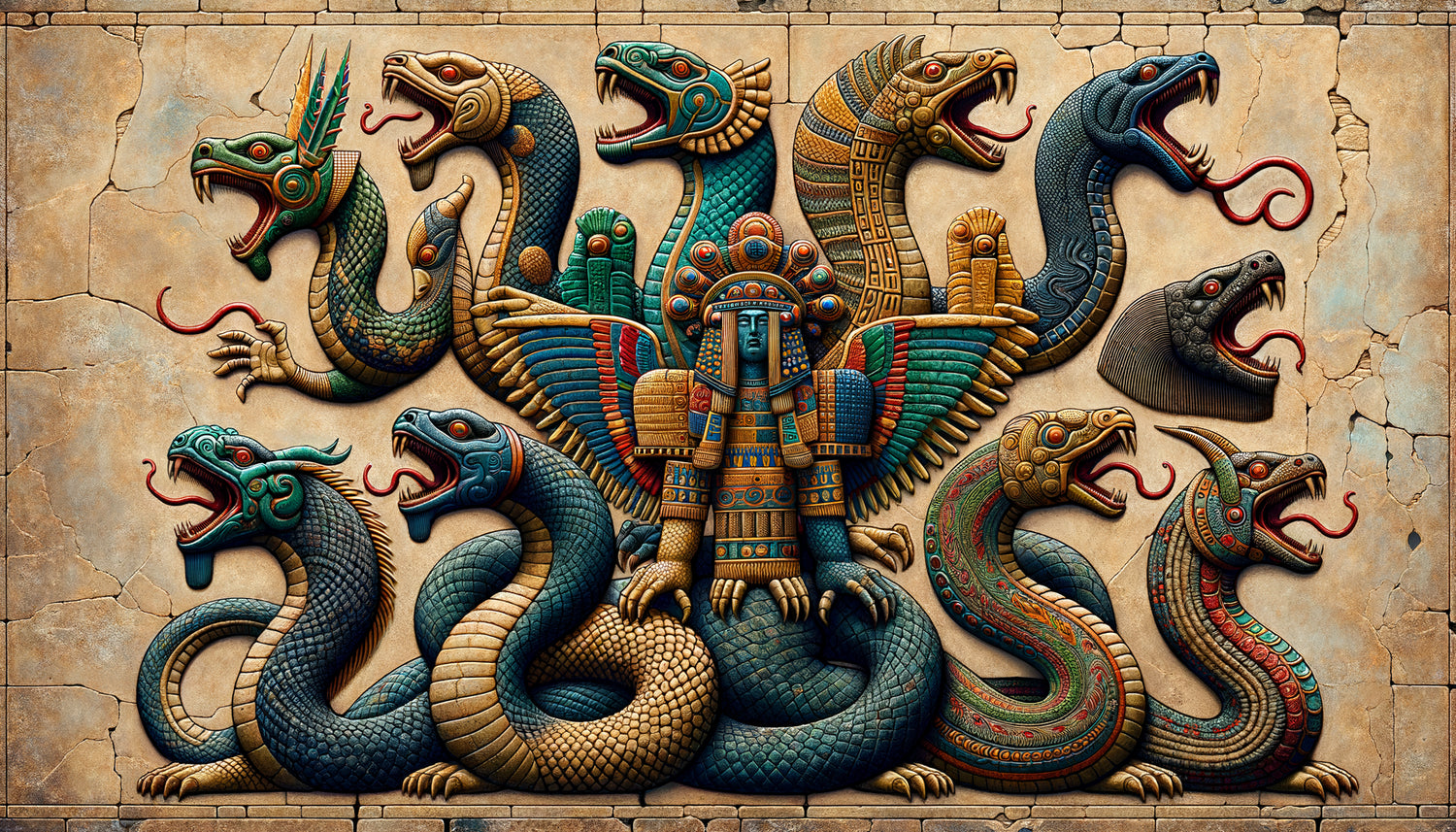
When I began my research into mythological iconography to create a collection of narrative paintings, I discovered a fascinating phenomenon: the seven-headed hydra was not limited to the story of Hercules. This polycephalous creature appears in countless traditions, from Babylon to the Book of Revelation, revealing universal meanings about our fears and inner struggles. Each culture has imagined its own version of this multi-headed monster, transforming a symbol of chaos into a true cross-cultural archetype. Seven-headed hydras actually exist in many world mythologies, far beyond the Greek narrative we all know. Everywhere they embody the same idea: an evil that regenerates, a trial seemingly impossible to overcome, a challenge that forces the hero to transcend himself. You might think these creatures belong only to ancient Mediterranean legends? Think again. By exploring Mesopotamian, biblical, Hindu, or even Native American traditions, I discovered that humanity has always been fascinated by these multi-headed entities. Let me guide you on this extraordinary mythological journey that reveals how different civilizations have expressed the same existential anxieties through surprisingly similar symbols.
The Lernaean Hydra: The Greek Model That Conquered Western Imagination
Let's start with the foundational myth we know best. The Lernaean Hydra faced by Hercules in his twelve labors represents the very archetype of the polycephalous creature in Western consciousness. According to versions, it possessed between seven and nine heads, sometimes even up to a hundred according to some ancient authors. What made this monster terrifying was not simply its number of heads, but its ability to regenerate: each head cut off made two new ones grow.
This regenerative characteristic transforms the Greek hydra into a powerful symbol of problems that seem to amplify when we try to solve them. Hercules had to call on his nephew Iolaus who cauterized the necks with red-hot iron to prevent regrowth. This collaboration highlights a profound truth: some battles cannot be fought alone. The Greek mythological hydra inhabited the swamps of Lerna, an aquatic and murky environment that symbolically reinforces the idea of insidious danger, a threat emerging from the depths.
Ancient depictions of this creature have permanently influenced Western art, from Greek vases to Renaissance paintings. Gustave Moreau, in particular, immortalized this battle in his symbolist canvases, showing how this myth continues to inspire contemporary artists. This Greek hydra constitutes our cultural reference, but it is only the tip of a global mythological iceberg.
Tiamat and Babylonian Dragons: The Mesopotamian Ancestors
Tracing back further in time, to ancient Mesopotamia, we discover creatures even older than the Greek hydra. Tiamat, the primordial goddess of chaos in the Babylonian epic Enuma Elish, is often depicted as a dragon or serpent with multiple heads. Although the text does not always specify the exact number of heads, visual representations frequently show her with seven heads, a highly symbolic number in Mesopotamia.
Tiamat embodies the primordial salty waters, the original chaos that precedes creation. Her dismembered body by the god Marduk will serve to create the sky and the earth, transforming chaos into an ordered cosmos. This cosmogonic dimension distinguishes Mesopotamian hydras from their Greek counterpart: they are not simply monsters to be defeated, but ambivalent creative forces, necessary for the formation of the world.
Babylonian cylinder seals regularly show serpentine polycephalous creatures, testifying to the importance of these symbols in the Mesopotamian imagination. The number seven had a particular significance: seven gates of hell, seven sages, seven visible planets. This sacred numerology deeply permeates representations of mythological creatures, making the seven-headed monster a manifestation of perverted cosmic completeness, a totality become threatening.

The Beast of the Apocalypse: when paganism meets the Bible
One of the most famous manifestations of the seven-headed hydra outside the Greek context is found in the New Testament. In the Book of Revelation (chapters 12 and 13), a scarlet dragon with seven heads appears, bearing ten horns and seven diadems. This creature represents Satan or the Antichrist according to interpretations, symbolizing the power of evil in its malevolent fullness.
What is fascinating about this biblical representation is its clear lineage with earlier pagan mythologies. The first Christians integrated symbols familiar to Mediterranean and Near Eastern cultures to express their own eschatological visions. The number seven, far from being anecdotal, represents here corrupted perfection: if seven symbolizes divine completeness (seven days of creation), the seven heads of the apocalyptic dragon embody a diabolical counterfeit of this perfection.
This beast emerges from the sea, a detail that recalls both the Lernaean Hydra and Tiamat, reinforcing the idea of symbolic continuity across cultures. Medieval Christian iconography has abundantly represented this creature, from Carolingian illuminations to the tapestries of the Apocalypse of Angers. These representations have profoundly marked the Western imagination, creating a lasting association between absolute evil and the figure of the multi-headed monster.
The seven heads as a symbol of the seven deadly sins
Medieval theologians developed fascinating allegorical interpretations of these seven mythological heads. Each head would represent a deadly sin: pride, avarice, lust, envy, gluttony, anger and sloth. This reading transforms the monster into a moral map, a visual representation of the temptations that assail the human soul. Defeating the hydra then becomes a metaphor for the spiritual struggle against our own weaknesses.
Hindu nagas and multi-headed serpents in Asia
Traveling to the East, we discover that Hindu and Buddhist traditions also possess multi-headed creatures. The nagas, semi-divine serpentine deities, are regularly represented with seven heads or more. Unlike Western hydras systematically evil, nagas embody a spiritual ambivalence: they can be protective or dangerous depending on the circumstances.
The most famous is undoubtedly Shesha (or Ananta), the cosmic serpent with a thousand heads upon which Vishnu rests between cycles of creation. Although he theoretically has a thousand heads, he is often depicted with seven caps unfurled, a number considered sacred in Hinduism as well. This representation with seven heads facilitates visualization while retaining the symbolism of multiplicity and divine power.
The temples of Angkor in Cambodia show balustrades adorned with seven-headed nagas, protective guardians of sacred spaces. This protective function contrasts radically with the Greek hydra destroyer, revealing how a single iconic motif can carry opposite meanings depending on cultural contexts. Asian mythological creatures with multiple heads are not monsters to be eradicated but forces to be venerated and appeased.

The feathered serpent of Mesoamerica and shamanic visions
Pre-Columbian mythologies also offer their version of polycephalous creatures, although less systematically structured around the number seven. Quetzalcoatl, the Aztec feathered serpent, is sometimes depicted with multiple heads in certain codexes, symbolizing his multiple divine attributes. Mayan traditions also feature reptilian deities with multiple aspects.
More broadly, Native American shamanic visions frequently refer to giant multi-headed serpents guarding passages between worlds. These creatures are not necessarily hostile but represent thresholds, initiatory trials that the shaman must traverse to access spiritual knowledge. This initiatory dimension links Native American traditions to medieval European allegorical interpretations: the hydra as a transformative trial.
Petroglyphs and rock art from various Native American cultures show branched serpentine creatures, possessing multiple heads or extensions. These representations suggest a transcultural fascination with forms of life that defy biological normality, embodying supernatural powers by their very impossible anatomy.
Transform your interior into a mythological sanctuary
Discover our exclusive collection of Myths and Legends paintings that captures the timeless power of these fascinating creatures and gives a narrative soul to your living spaces.
Why does the seven-headed hydra cross all cultures?
This ubiquity of polycephalous creatures in world mythologies raises a fascinating question: why has humanity independently imagined these multi-headed monsters? Carl Jung would see this as a universal archetype, a primordial image rooted in the collective unconscious. The number of heads, particularly seven, resonates with our psychological need for structure and numerical symbolism.
From an anthropological point of view, the mythological hydra perfectly represents the type of threat that terrifies humanity: a danger that multiplies when one tries to fight it. This characteristic reflects universal human experiences: rumors that amplify, conflicts that escalate, problems that branch out. The hydra externalizes our anxieties about the uncontrollable and the protean.
The recurrent choice of the number seven is explained by its symbolic charge in almost every tradition: seven days, seven classical planets, seven openings of the human face, seven notes of music. This natural recurrence makes seven a number of completeness, totality. A creature with seven heads therefore embodies a complete power, achieved in its monstrous perfection. The universal symbolismThe Hydra as a Metaphor for Our Contemporary Challenges Even today, we use the expression "fighting the hydra" to describe complex and recurring problems. Climate change, fake news, global health crises: so many modern hydras where each head lopped off seems to generate new ones. This metaphorical persistence proves the vitality of this millennial symbol, its ability to evolve with our concerns while retaining its original evocative power. Imagine your living room adorned with a contemporary artistic representation of these mythical creatures, a visual dialogue between Babylonian, Greek and Asian traditions. These transcultural hydras tell the story of our shared humanity, our common fears and our universal quest for meaning in the face of chaos. Each head represents a different civilization that has expressed the same fundamental truth: some battles require more than brute force, they require intelligence, collaboration and inner transformation. In decoration, integrating these powerful symbols creates a narrative depth that transforms an ordinary space into a place of contemplation. A painting depicting the hydra in its various cultural incarnations becomes a fascinating conversation starter, a window onto the collective wisdom of humanity. Myths and legends are not just stories from the past: they are timeless mirrors that reflect our eternal struggles and our possible victories. Did the Lernaean Hydra really have seven heads or more? Why do we find similar creatures in cultures that have never had contact? How to integrate these mythological symbols into modern decor?Frequently Asked Questions about Mythological Hydras
Ancient sources vary considerably on this point. Hesiod mentions nine heads, other authors speak of seven, and some later texts refer to up to a hundred heads. This variation reveals that the precise number mattered less than the principle of monstrous multiplicity. In iconography, seven heads became the standard representation because that number has a strong symbolic charge in Mediterranean cultures. It represents completeness (seven days of creation, seven visible planets) while remaining visually representable in art. Keep in mind that the version with seven heads became canonical primarily for symbolic and aesthetic reasons rather than fidelity to a single text.
This fascinating phenomenon can be explained by several factors. Firstly, cultural diffusion was more important than we think: ancient trade routes connected the Mediterranean, Mesopotamia and Asia long before our era. Secondly, Carl Jung would speak of universal archetypes: certain images spontaneously emerge from the collective unconscious human mind. Finally, the anthropological explanation suggests that all human societies face the same existential challenges (chaos, fear of the unknown, multiplying problems) and naturally create similar symbols to express them. The serpent, a real and fascinating animal, constitutes a universal basis that each culture has amplified into a fantastic multi-headed creature according to its own symbolic codes.
Contemporary mythological art offers extraordinary possibilities for creating interiors that are both elegant and narrative. Favor stylized representations rather than literal ones: an abstraction evoking serpentine curves and the multiplicity of heads will work better than a too-literal illustration which could seem disturbing. Colors play a crucial role: emerald and turquoise tones evoke primordial waters, while reds and golds recall the apocalyptic dragon. Place these works in contemplative spaces (office, library, living room) rather than in bedrooms. The goal is to create focal points that invite reflection on universal myths, transforming your decor into a true cultural and spiritual journey through civilizations.