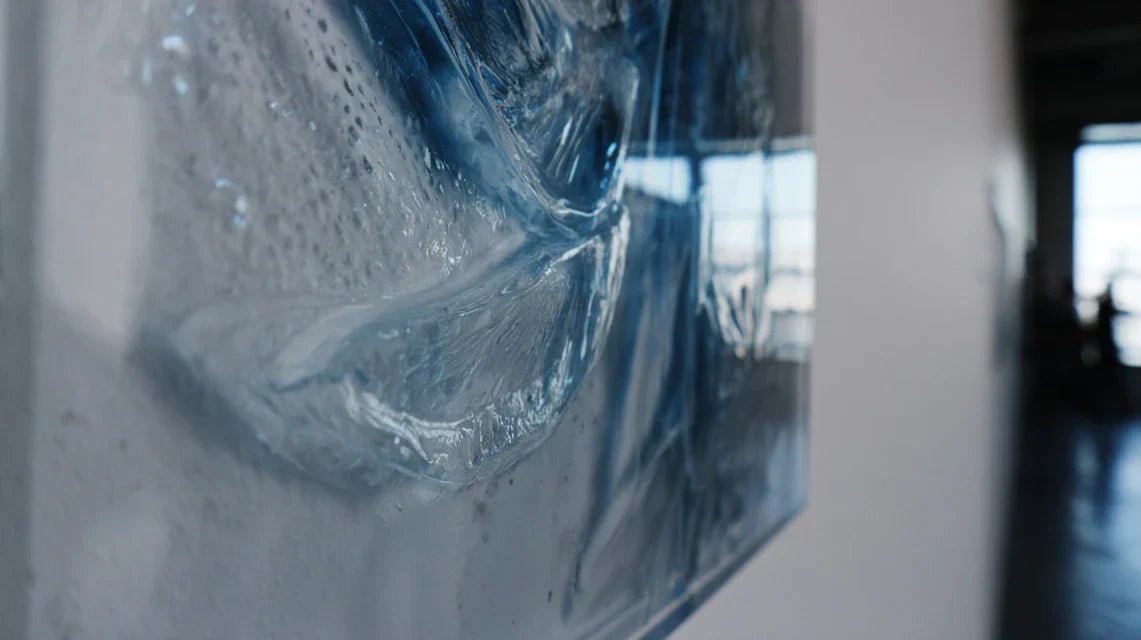
By the end of this article, you will understand why acrylic glass literally transforms the visual impact of a work and how to choose an artwork that truly enhances your living space.
Why does the choice of support determine the soul of your decoration?
Imagine two photographers capturing the same sunset. One uses a disposable camera, the other professional equipment. Same scene, radically different results. This is exactly what happens with your artwork: the work can be beautiful, but if the support does not do it justice, you miss the emotion it should convey.
🎨 Customer testimonial: "I had ordered the same visual as a laminated poster to test, then in acrylic glass. When I received the acrylic version, I thought they had made a mistake so much was the difference striking. The colors seemed literally alive, as if the light came from within the artwork."
💬 Conversation with a decor expert
The golden rule of premium decoration: A quality support reveals the nuances that the eye did not suspect, transforming a simple image into a true emotional window. In 48h, your guests will notice this difference without even understanding why.
What Really Happens When Your Artwork Disappoints You
Do you feel that dull frustration when you look at your wall? Do you find yourself avoiding that corner of the living room? Does your gaze slide over the artwork without stopping, as if it had become invisible? These symptoms are more common than you think.
The problem doesn't come from your artistic taste or your ability to decorate. It comes from a trap into which 80% of buyers fall: confusing the image and its support. It’s like judging the beauty of a diamond by looking at it through a dirty window.
Think about the difference between watching a movie on your smartphone or on a cinema screen. Same content, totally different experience. Your artwork undergoes the same transformation depending on the chosen support.
The First Hidden Cause: The "Invisible Barrier" Effect
Contrary to what many believe, an inexpensive support does not “protect” the image: it literally separates it from you. It's like looking at a landscape through a fogged-up window versus a perfectly transparent bay window.
Imagine watching your favorite series through a permanent filter that taints colors and creates parasitic reflections. After a few minutes, you would lower the volume out of unconscious frustration.
This is exactly what happens with your artwork: your brain “lowers the emotional volume” to this work which fails to create the expected visual connection. Result? You end up completely ignoring it.
🔍 Immediate test: Look at your current artwork under different lighting conditions. If you see more reflections than artistic details, or if the colors seem “flat”, it’s a sign of a support that creates a barrier rather than reveals.
You were told that a frame with glass better protected your investment. In reality, this “protection” often creates more problems than it solves. Between condensation, reflections and the distance created, your work loses its impact.
It’s like keeping a vintage car under a permanent tarp to protect it: technically preserved, but deprived of its primary function which is to be admired.
Acrylic glass revolutionizes this approach by merging protection and revelation. No distance, no parasitic reflections, just the pure emotion of the artwork reaching you directly.
The Third Hidden Cause: Ignoring "Optical Depth"
Here’s what nobody tells you: some supports add a dimension of depth that the eye perceives unconsciously. Others, on the contrary, “flatten” the image like a photocopy.
Carefully observe your current artwork: can you distinguish nuances in the dark areas? Do the whites have multiple tones or do they seem uniform? These details reveal the quality of your support.
When this depth is missing, your brain receives a "flat image" signal and automatically adjusts its level of attention. That's why some artworks captivate the eye for minutes while others become transparent in days.
🎯 3 signals that don’t lie:
- Continuous discovery test: Do you still notice new details after several weeks? A good support gradually reveals its secrets
- Magnetic attraction test: Do your guests naturally approach the artwork? Visual quality creates an unconscious force of attraction
- Constant emotion test: Do you still feel something when looking at it? A premium support maintains the emotional connection intact
The trigger element that changes everything: image-support fusion
What truly distinguishes a high-end acrylic artwork, is this unique ability to make you forget that there's a support. The image seems to float, exists by itself. It's the "magic window" effect: you’re no longer looking at a decorative object, you dive into a universe.
The "forgetfulness test" rule: If you regularly forget that your artwork is “just” a decorative object because it transports you, then the support is doing its job of revealing emotion perfectly.
| ❌ Traditional Support | ✅ Premium Acrylic Glass | 💡 Why this difference | 🎯 Concrete Benefit |
|---|---|---|---|
| Colors seem veiled | Vibrant and deep colors | Crystal clear transparency without filtering | Immediate and lasting visual impact |
| Annoying reflections depending on the lighting | Perfect clarity from all angles | Integrated anti-reflective treatment | Constant visual pleasure, day and night |
| Feeling of distance from the artwork | Direct and immersive connection | Optical image-support fusion | Artistic emotion preserved |
| "Flat" rendering without relief | Natural depth and dimension | Amplification of subtle contrasts | Continuous discovery of details |
How to reveal the true potential of your wall decoration
Good news: transforming the impact of your space doesn’t require revolutionizing all your decor. It's like adjusting the focus of a camera: a small adjustment can reveal an unsuspected sharpness. The progression is simple: understand, choose, install, then savor this new level of visual quality.
🎯 Overview of the transformation: Three natural steps lead you from diagnosing your current situation to a result that exceeds your expectations. Each step reveals a different aspect of what a high-end acrylic glass wall art can bring to your daily life.
Step 1: Identify the potential of your space
Before choosing, you need to understand how your wall "dialogues" with light. This is the foundation of everything: even the most beautiful painting on an unsuitable support will be spoiled by poor placement. This step avoids disappointments and maximizes impact from installation.
🔍 What to observe in your space
- Natural lighting: Note how the light evolves in the room throughout the day. Acrylic glass reveals differently depending on the lighting, unlike ordinary supports which remain dull. Avoid locations with direct, harsh light that creates glare even on the best supports.
- Artificial light sources: Identify spotlights, lamps and sconces that illuminate the area. A good acrylic support transforms even average lighting into a revealer of nuances, where a cheap support would create annoying reflections. The ideal: indirect lighting that caresses the surface.
- Color environment: Observe the dominant colors of your walls, furniture and textiles. Acrylic glass amplifies color harmonies and creates subtle dialogues between the artwork and its environment that you wouldn't suspect.
Now, let's move on to a concrete assessment of your situation
🎨 How to evaluate your candidate wall
Evolving lighting test: Observe your target wall at three times: morning, afternoon, evening. Note where parasitic reflections appear and where the light best reveals details. Acrylic glass excels in areas with changing lighting as it adapts without creating visual discomfort.
⏱️ Time: 15 minutes spread over a day | ✅ Successful when: You clearly identify the optimal zone without reflections | ⚠️ Attention: Do not confuse a single reflection with a globally problematic area
Viewing angle test: Stand in different places in the room and imagine your future painting. Acrylic glass offers perfect clarity from all angles, unlike supports with glass which create blind spots. Check that from your sofa, dining table and entrance to the room, the view remains clear.
⏱️ Time: 10 minutes | ✅ Successful when: No viewing angle presents a major obstruction | ⚠️ Attention: Very low angles create reflections even on the best supports
Color harmony test: Take a photo of your wall with your smartphone and observe the dominant colors. Acrylic glass reveals subtle color correspondences that are not always immediately perceived by the naked eye. Note whether your space tends towards warm, cool, or neutral tones.
⏱️ Time: 5 minutes | ✅ Success when: You clearly identify the dominant palette | ⚠️ Attention: Artificial lighting can distort color perception
✅ Step 1 validation: Your ideal location combines soft lighting, clear viewing angles and harmony with existing elements. If you are hesitating between two walls, choose the one you naturally look at most in your daily life. The next step will reveal how to choose a work that sublimates this space.
OUR RECOMMENDED PRODUCTS
Step 2: Choosing your artwork with the eye of an expert
Now that you master your space, let's move to the next level: selecting a work that will truly reveal its magic on acrylic glass. Not all images benefit equally from this premium support. Some reveal hidden treasures, others remain simply pretty.
🎨 The visual criteria that make the difference
- Richness of fine details: Favor works with textures, subtle nuances or play of shadows. Acrylic glass reveals every micro-detail that the artist has integrated, transforming a beautiful image into a permanent visual exploration. Avoid overly minimalist visuals that do not exploit this potential for revelation. Depth of contrasts: Look for works that mix bright and dark areas. The acrylic support naturally amplifies these contrasts without hardening them, creating that impression of relief that the eye loves. This is where the magic really happens. Evolving color palette: Choose artworks with colors that seem to change depending on the lighting. Acrylic glass becomes a revealer of nuances that you will discover over the seasons and hours.
🔍 How to recognize an "acrylic compatible" artwork
"Mental magnifying glass" test: Observe the work and imagine zooming in on different areas. Are there enough details to justify a support that reveals everything? Acrylic glass turns every detail into a point of interest, so the richer the artwork, the more striking the effect.
⏱️ Time: 3 minutes per work | ✅ Success when: You identify at least 5 areas of interesting details | ⚠️ Attention: Do not confuse complexity and visual confusion
Test of enduring emotion: Look at the artwork for 30 seconds, then look away. What do you remember? A perfect piece for acrylic glass leaves a strong emotional impression which will be amplified by the quality of the support.
⏱️ Time: 1 minute | ✅ Success when: The image "pursues" you mentally | ⚠️ Attention: Distinguish authentic infatuation from simple visual seduction