Why Visit an Independent Gallery? Authentic Places to Discover Local Art
By Alexandre MARY
⏱️ Reading time: 8 minutes
You wander the streets of your neighborhood, desperately searching for a unique artwork that truly reflects your personality, but you always come across the same reproductions sold in all major stores.
This frustration, we all know it: browsing dozens of stores only to end up leaving empty-handed, with the bitter feeling of having wasted your time.
You already imagine that perfect corner wall in your living room, but impossible to find the artwork that moves you.
You may have tried online decoration sites, scoured Sunday flea markets, or even tried your luck in specialty department stores.
Result? The same formatted styles, without soul, without history.
This disappointment is not your fault. The problem comes from the fact that 95% of the works offered in traditional circuits pass through the same distribution channels, creating a standardization of tastes and styles.
Yet there is a parallel artistic world, vibrant and accessible.
By the end of this article, you will know exactly where to find these rare gems that are independent galleries, how to navigate them with confidence, and why they represent your passport to authentic art that will truly transform your interior.
Why do independent galleries revolutionize your relationship with art?
In a world where decorative uniformity reigns supreme, ignoring independent galleries is like missing out on a constantly evolving artistic treasure.
It's like having a magic key and choosing to stay in front of the door: you miss the unique opportunity to discover artists before they become inaccessible.
🎨 Testimonial of a discovery: Sarah, an interior architect, tells how she found in a small Belleville gallery a series of engravings by a local artist still unknown. Three years later, his works are selling out at international fairs, and her living room has become the conversation starter for all her guests.
💬 Conversation with a decor expert
"Independent galleries are for connoisseurs... I wouldn't even know what to look at, I'm afraid of looking like someone who doesn't know anything."
Think again! Independent galleries are like neighborhood bookstores: more intimate than department stores, they allow you to learn and discover at your own pace. Passionate gallerists love to share their favorites with curious visitors, without judgment.
"I've always been told that you have to invest astronomical sums to have quality art in your home."
That era is over! Independent galleries offer original artworks starting from €80-€200, often cheaper than high-end reproductions sold in home decor stores. It's the artistic equivalent of short supply chain food purchasing: direct from producer, fair price.
Fundamental principle: the independent gallery acts as a natural quality filter: unlike online platforms where everything is mixed together, it preselects coherent artworks according to a precise artistic vision. Guaranteed result: you leave with a piece that perfectly integrates into your world, usually within 2-3 visits.
What really happens when you cross the threshold?
Familiar situation: you hesitate in front of the window display, unsure whether you can "just look" without buying.
You wonder if prices are displayed, if they will judge you based on your budget, if you will understand the exhibited artworks.
The reality: these apprehensions simply reveal that you haven't yet discovered the welcoming operation of these places. The problem is not your legitimacy, but the lack of explicit codes.
Once these mechanisms are understood, visiting becomes an authentic pleasure.
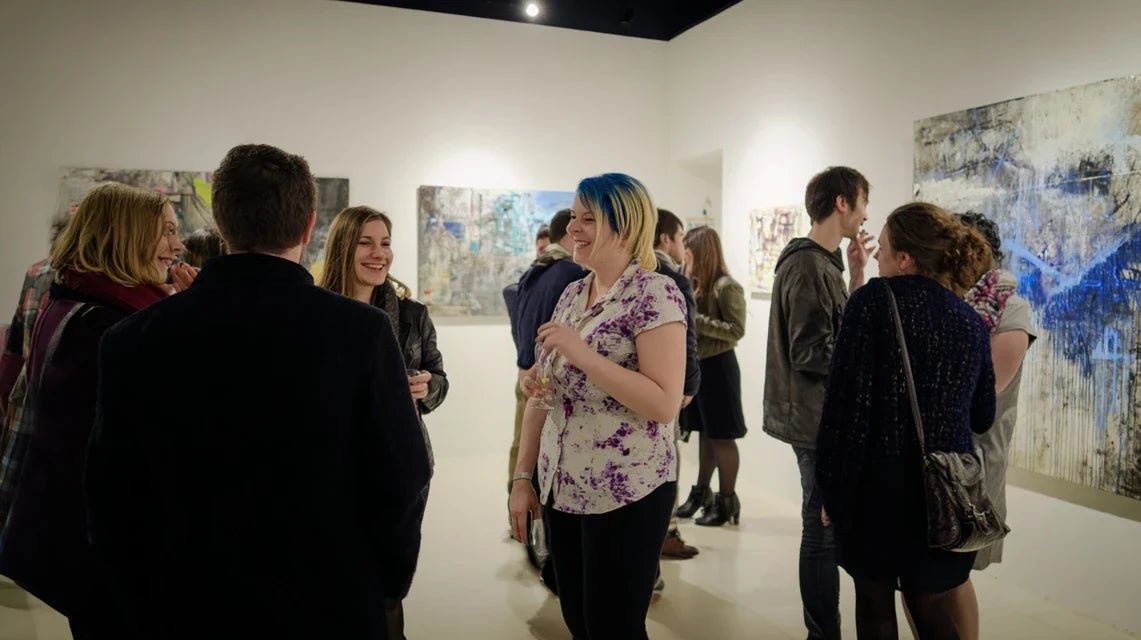
Imagine a gallery as a temporary private living room where each artwork has been chosen to create a dialogue with the others. You're not in a store, but in a space of discovery.
🔍 The real difference: personalized curation
Contrary to popular belief, the gallery owner doesn't try to sell you the most expensive piece, but the one that will resonate with your sensitivity.
Their reputation depends on the accuracy of their advice, not the volume of their sales.
It’s like the difference between a passionate sommelier who guides you towards the perfect wine for your palate, and a salesperson who pushes the most profitable bottle.
One creates a lasting relationship, the other a one-off transaction.
This approach completely transforms your confidence in your artistic choices: no more regretted impulse purchases, but thoughtful crushes that last through the years.
✨ Immediate test: on your next outing, walk into a gallery and simply ask this question: "Can you tell me about this artwork?" Observe the enthusiasm of the owner. You will instantly understand the difference in passion with a classic salesperson.
🎯 Art as a mirror of your personality
Popular belief: "Art is subjective, so you can't be wrong."
In reality, some artworks amplify your daily energy while others parasitize it. The independent gallery helps you identify this personal alchemy.
It's like the perfect match between a perfume and your skin: technically, all perfumes "smell good", but only one truly reveals your character.
The independent galleries master this art of matching artwork to personality.
As a result, you gradually develop a keen eye that allows you to instantly spot the pieces that suit you, even in other contexts.
💡 The invisible network of discoveries
Here's the secret almost no one notices: independent galleries form an interconnected ecosystem. A gallerist knows the specialties of his peers and doesn't hesitate to direct you to the perfect gallery for your searches.
Recognize this signal: when a gallerist spontaneously says "For this style, I know someone wonderful just two blocks from here", you know that you are in an authentic network of trust.
This professional generosity transforms your artistic exploration into a true guided treasure hunt, where each recommendation opens up new perspectives.
🔮 The 3 signals that never lie:
The gallerist asks you questions about your tastes before showing you artworks: he seeks to understand your universe rather than impose his own. This is a sign of a true professional.
Prices are clearly displayed or communicated without ambiguity: no mystery, no misunderstanding. Transparency reveals a healthy relationship with art.
You are offered to "live" with the artwork for a few days: some galleries accept that you take a piece on trial. They prioritize your long-term satisfaction.
⚡ The trigger: when art becomes obvious
The triggering element that transforms a gallery visit into a revelation is the moment you forget to look at the price and focus on your emotions.
It's the "artistic love-at-first-sight" effect: like a lever that tips, your relationship with art changes definitively.
Identify this moment by observing whether you naturally start imagining the artwork in your home, anticipating the reactions of your loved ones, visualizing the impact on your daily life.
Golden rule of the independent gallery: if a work interests you three times during the same visit, it has created a lasting emotional connection. Test by deliberately diverting your gaze: if your eyes naturally return to it, you have found your piece.
❌ Classic commercial gallery
✅ Authentic independent gallery
💡 Why this difference
🎯 Your concrete benefit
Rapid turnover of artworks according to trends
Carefully selected selection based on an artistic vision
Passion vs. immediate profitability
Guaranteed consistency and timelessness
Salesperson trained in sales techniques
Gallerist expert passionate about his artists
Authentic relationship vs. commercial
Personalized and lasting advice
Disguised mass reproduction
Original works in limited edition
Industrial vs. artisanal
Exclusivity and real added value
Standardized store atmosphere
Cultural and convivial living space
Transaction vs. experience
Enriching and memorable discovery
How to turn your first visit into a successful experience?
Rassurez-vous : no prior knowledge is required to fully enjoy an independent gallery.
It's a progressive process, like learning to savor good wine: start with curiosity, then naturally develop your palate.
Your innate sensitivity is your best guide, and each visit enriches your perspective without any particular effort.
🗺️ Your discovery journey in 3 steps: as when exploring a new neighborhood, you will begin by getting familiar with the atmosphere (step 1), then you will learn to decode the works that speak to you (step 2), finally you will develop your personal artistic network (step 3). Each step brings immediate satisfaction while preparing for the next.
🌱 Step 1: Getting comfortable with the space and creating contact
Starting with this step allows you to soften the approach to contemporary art.
Like laying the first stones of a solid foundation, this approach gives you confidence for what follows.
Once this step is mastered, you will feel that deep satisfaction of feeling legitimate in any gallery.
🎒 What you need to get started
Your natural curiosity: it's your main asset, more valuable than any technical knowledge. Trust your spontaneous emotions in front of the works, they reveal your authentic sensitivity. Avoid immediately seeking intellectual explanations that could parasitize your feeling.
A notebook or your smartphone: to discreetly note the names of artists who touch you and immortalize (with permission) the works that mark you. This visual memory will help you identify your recurring tastes. Prefer handwritten notes to photos whenever possible, as they anchor memories better.
A relaxed approach to time: unlike classic shopping, the gallery is savored slowly. Allow a minimum of 45 minutes to let the works create their effect, without haste or immediate purchase objective.
Now, let's move on to practice with confidence
🚪 How to cross the threshold with serenity
Choosing the right time for your first visit: prioritize late afternoons on weekdays or weekend mornings. The gallerist is more available, and the atmosphere is more relaxed. This technique allows you to benefit from a personalized welcome without the pressure of peak hours.
⏱️ Time: 10 minutes of silent observation | ✅ Success when: you feel comfortable looking at each work without rushing | ⚠️ Attention: don't try to understand everything in the first few minutes, let your impressions form naturally.
Establishing a natural initial contact: after a few minutes of observation, ask an open question like "Can you tell me about the exhibition?" or "What is the common thread of this selection?". This approach shows your sincere interest while giving you the keys to understanding.
⏱️ Time: 15-20 minutes of exchange | ✅ Success when: you understand the general artistic approach and feel the gallerist's passion | ⚠️ Attention: avoid asking about prices immediately, focus on the artistic dimension first.
Identifying your spontaneous favorites:let your gaze linger naturally on certain works. Don't try to analyze why, just mentally or discreetly note those that create an emotional resonance.
⏱️ Time: 20 minutes of free wandering | ✅ Success when: you have identified 2-3 works that particularly appeal to you | ⚠️ Attention: resist the temptation to immediately rationalize your preferences, emotion takes precedence over analysis.
🎯 Validation of your first experience: you know this step is successful when you leave with the desire to return, names of artists noted, and above all that feeling of having discovered an accessible universe. If you are still shy, remember that your presence values the gallerist's work: you are a welcome visitor, not an intruder.
OUR RECOMMENDED PRODUCTS
🎨 Step 2: Develop your eye and refine your tastes
You are now moving to the next level: decoding the works that attract you to understand your deep preferences.
This step is more rewarding because you begin to develop your own artistic vocabulary. The snowball effect kicks in: the more you understand your tastes, the better you can communicate them, and the more galleries can surprise you with targeted discoveries.
🔍 Your new analysis tools
Personal observation grid: systematically note whether you prefer warm or cool colors, intimate or imposing formats, figurative or abstract styles. This mapping of your tastes becomes your artistic compass to navigate effectively through all galleries.
Relevant questions to ask: prepare formulations such as "What characterizes the style of this artist?" or "How does this work fit into his/her journey?". These questions reveal your seriousness and curiosity while enriching your artistic culture.
Network of galleries to explore: create a list of 4-5 galleries with complementary specialties in your area. This diversity allows you to broaden your references and confirm your preferences by comparison.
🧠 Mastering the art of dialogue with artworks
Analyze your emotional reactions: in front of each work that interests you, question your feelings: is it serenity, energy, nostalgia, intrigue? This introspection reveals your deep aesthetic needs and guides your future choices.
⏱️ Time: 5 minutes per significant artwork | ✅ Success when: you can verbalize the emotion evoked by the work | ⚠️ Attention: do not confuse "I like it" and "it's beautiful", focus on the personal impact that the work has on you.
Decode techniques and materials:ask the gallery owner to explain the processes used (oil painting, acrylic, mixed media, supports...). This technical knowledge enriches your appreciation and helps you anticipate the rendering in your interior.
⏱️ Time: 10 minutes of technical explanation | ✅ Success when: you understand how the work was created and why certain technical choices serve artistic expression | ⚠️ Attention: do not get lost in the technical details, keep the link with your first emotion.
Visualize integration into your space:ask for the exact dimensions and imagine concretely the work in your interior. Some galleries even offer digital simulations. This projection avoids disappointments and confirms the relevance of your choice.
⏱️ Time: 15 minutes of mental projection | ✅ Success when: you visualize the artwork at home and anticipate its impact on the atmosphere of the room | ⚠️ Attention: a work that you like in a gallery may have a different rendering at home, hence the importance of this step.
🎨 Confirm your progress: this step is mastered when you start to spontaneously identify your preferences upon entering a new gallery, that you ask relevant questions and that you know why a work suits you. Your confidence naturally strengthens.
🌟 Step 3: Building Your Art Collection and Network
You are now reaching the level of the informed enthusiast: you not only know how to recognize your tastes, but also how to build consistency in your choices.
The difference with a simple buyer? You develop an overall vision and lasting relationships with the art ecosystem. As a result: your interior tells a personal story, and you become a reference for those around you when it comes to artistic discoveries.
🏛️ Mastering the Art of Consistent Collecting
Define the common thread of your collection: whether it's by theme, technique, period or emotion, identify what will unify your future acquisitions. This consistency transforms isolated purchases into a true personal collection that gains value and visual impact.
⏱️ Time: 1 hour of in-depth reflection | ✅ Success when: you can explain the logic of your collection in 2 sentences | ⚠️ Attention: avoid overly restrictive common threads that would limit your future discoveries.
Cultivate your relationships with gallerists:inform them of your specific research and your budget. A good gallerist becomes your personal scout, contacting you when a perfect piece arrives. This privileged relationship gives you access to the best opportunities.
⏱️ Time: 30 minutes per reference gallery | ✅ Success when: gallerists contact you spontaneously with targeted proposals | ⚠️ Attention: remain loyal to your trusted galleries, dispersion is detrimental to the quality of advice.
Participate in art events: vernissages, open studio days, art fairs... These events multiply your discoveries and integrate you into the local artistic community. You often meet the artists themselves.
⏱️ Time: 2-3 hours per event | ✅ Success when: you know several artists personally and anticipate their new creations | ⚠️ Attention: don't spread yourself too thin, choose events based on your collection axes.
Rule of progression for the informed collector: you can move on to acquisition when you have visited at least 3 different galleries to compare, that you know the artist's background, and that the work fits into your overall vision. Patience and vision take precedence over impulse, even positive ones.
Congratulations! You now master the subtleties of the world of independent galleries. Here are the expert tips that give you an edge over other art enthusiasts and transform each visit into a unique opportunity.
💎 Collector's secret: the best deals are found within the first 6 months after a new gallery opens. Gallery owners then offer attractive prices to build a clientele and test their market. Watch out for openings in your area!
💭 Frequent question from our readers
"I've spotted a work that I love immensely, but the price seems high for my budget. How can I negotiate without offending the gallery owner?"
Your hesitation is perfectly understandable and even reveals a healthy relationship with art: you buy with your heart but keep your head cool. Most gallery owners respect this responsible approach.
Rather than negotiating the price, explore other options: payment facilities, similar works by the artist in more accessible formats, or even attending a vernissage where prices are sometimes preferential.
The gallery owner often prefers a long-term sale with a passionate client than a one-off transaction.
🤝 Diplomatic strategy: simply say "This work touches me deeply, but it exceeds my current budget. Do you have other creations by this artist or could you keep me informed of his upcoming productions?" You will often get unexpected proposals.
⚠️ Pitfalls to avoid to preserve your enjoyment of discovery
Beware, some mistakes can spoil your experience and make you miss artistic wonders. These pitfalls are common among new visitors, but perfectly avoidable once identified.
🏃♀️ Wanting to see everything in one visit: it's tempting to want to "optimize" your time, but art requires slowness to reveal its richness. Consequence: you leave saturated without a memorable crush. Limit yourself to a maximum of 2-3 galleries per outing and allow yourself the luxury of strolling. This apparent "slowness" saves you valuable time in the quality of discoveries.
🧠 Trying to intellectualize everything immediately: it is natural to want to "understand" what you are looking at, but over-analyzing kills the first emotion. Result: you miss your authentic feeling. Allow yourself 5 minutes of pure observation before any reflection. Emotion guides better than reason in art.
💰 Focusing on prices before exploring: knowing prices is legitimate, but starting there orients your gaze and limits your discoveries to works "within your budget". Explore freely first, then discuss budget: you will often discover unexpected solutions (different formats, facilities...).
📱 Photographing frantically instead of observing: the desire to keep a record is understandable, but machine-gunning prevents contemplation. You come back with dozens of blurry photos and no memorable memories. Prioritize a few thoughtful photos after really looking at the work.
👥 Letting yourself be influenced by the opinions of companions: it's reassuring to seek approval, but art is deeply personal. Imposing or accepting the tastes of others prevents you from accessing your own sensitivity. Listen to opinions but maintain your independence of judgment: it's your interior, your choice.
🛡️ Your error prevention verification system: before leaving a gallery, ask yourself these questions: did I take the time to feel before analyzing? Did I let at least one work surprise me? Did I focus on my emotions rather than the gaze of others? These checkpoints guarantee an authentic and enriching experience.
Because you took the time to inform yourself, enjoy 10% discount on your first order:
ART10
⏰ Valid 72h after reading • Applicable to all our products
🤔 Practical questions to perfect your approach
⏰ How much time should you allow for a productive gallery visit and what is the average budget to consider?
Allow 45 minutes to 1h30 for an enriching visit, depending on the size of the exhibition. For the budget, independent galleries generally offer original works from 80€ to 2000€, with a concentration in the 200-800€ range. Optimize your time by visiting 2-3 galleries in the same neighborhood during the same outing. Concrete example: Sophie discovered her favorite artist on her third visit to a gallery in Le Marais, after investing only 3 hours in total.
🎭 How can you tell if a gallery is truly "independent" and not just a disguised commercial showroom?
Several clues are not misleading: the stability of the exhibitions (minimum 3-4 weeks), the presence of a passionate gallerist who personally knows his artists, regular vernissages with the creators present, and above all a consistent editorial line visible from one exhibition to another. Be wary of too frequent rotations and salespeople who cannot talk about the artists' backgrounds.
💡 Are there any "codes" to know in order to be taken seriously in a gallery?
No secret code! Genuine curiosity is your best passport. Just avoid a few faux pas: never touch the artworks without permission, turn off the flash on your camera, and don't hesitate to ask simple questions like "Can you tell me about this artist?" Galerists love sharing their passion with attentive visitors, regardless of their level of knowledge.
🔍 How to assess whether the price of a work is fair, especially for an artist you don't know?
Several objective criteria: the artist's training, their previous exhibitions, the technique used, and the format of the artwork. A recent Fine Arts graduate exhibiting for the first time will logically offer prices of €80-300, while an artist with several collective exhibitions behind them justifies €300-800. The gallerist should be able to explain this pricing transparently.
🚀 How to move from "occasional visitor" to "informed collector" without breaking the bank?
Start by defining an annual art budget (even modest: €300-500) and adhere to it scrupulously. Prioritize regularity over impulsive purchases: it's better to acquire 2-3 coherent pieces per year than one expensive artwork. Build a network of 3-4 trusted galleries and attend vernissages: you will often discover the best opportunities there before other visitors.
🌟 Your new life as an enlightened art enthusiast
In a few weeks, you'll walk into any independent gallery with the quiet confidence of someone who knows. Your sharp eye will immediately spot the artworks that match your sensitivity, you will naturally dialogue with gallerists, and above all, your interior will tell your story through unique pieces that never tire. Your guests will not fail to notice this discreet sophistication that transforms a simple decoration into a true personal expression.
This mastery of independent galleries goes far beyond acquiring artworks. You develop a trained eye, a visual culture and confidence in your aesthetic choices which resonates in all your other decorative areas. This newly acquired assurance makes you more daring in your color, furniture, layout choices, creating a remarkable overall coherence.
The hardest part was understanding that art is not reserved for an elite: you now just need to push the door of this first gallery by applying our advice. Start this weekend by spotting an independent gallery in your neighborhood. Your artistic adventure begins now, and it will transform your relationship with beauty for years.
✨ Your first step towards authentic art: True art awaits you just around the corner, in places where passion and talent meet. You now have all the keys to fully enjoy it and build a collection that truly resembles you.
📚 To deepen your artistic expertise
Discover our other guides on responsible art purchasing, trends in the contemporary painting market, and the secrets of seasoned collectors to further enrich your approach.