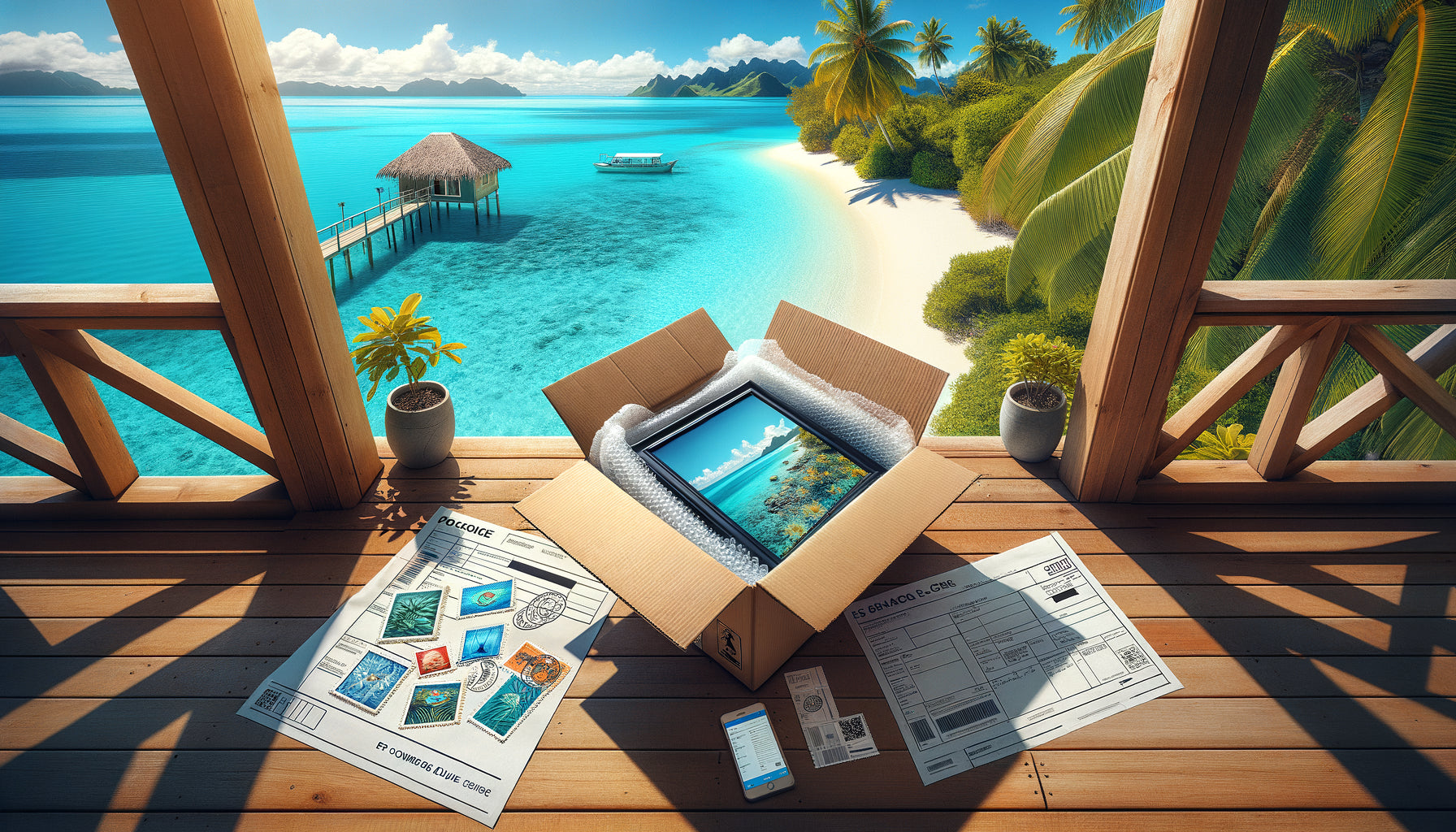
You’ve fallen in love with a painting perfect for your living room. The dimensions are ideal, the colors harmonize with your interior, the price is right. You add the artwork to your cart, enter your address in Martinique or Reunion Island... and then, the shock: “Sorry, we don't ship to your area.” How many times have you read this sentence? I know this frustration intimately after having helped dozens of overseas clients in their decorative quest. I remember this Guadeloupean architect who spent three weeks selecting artworks for a hotel project, before having to start all over again due to systematic rejections. This reality affects all decoration enthusiasts living abroad, creating a sense of unfair exclusion.
Here’s what understanding the logistical blockages of French overseas departments brings you: deciphering the real reasons behind these refusals to better circumvent them, discovering concrete alternative solutions to transform your walls, and accessing stores that consider overseas departments as a source of pride rather than a constraint.
This situation is not inevitable. Solutions exist, brands are committed, and your geographical location should never be an obstacle to the beauty of your interior. Together, let's explore the behind-the-scenes of this problem and, above all, the ways to overcome it.
We ship everywhere, including French overseas departments!
Metropolitan France, Guadeloupe, Martinique, Guiana, Reunion, Mayotte... Wherever you are, discover our exclusive collection of wall art shipped to French overseas departments delivered directly to your home.
Behind the refusal: why so many stores turn their backs on French overseas departments
Behind each shipping refusal lies a complex logistical reality. Shipping costs to French overseas departments represent the first obstacle. A parcel for Metropolitan France costs an average of 8 to 15 euros, while the same shipment to Guadeloupe or Reunion easily climbs between 40 and 80 euros. For a small online store working with tight margins, absorbing or passing on these costs becomes a financial headache.
The extended delivery times constitute the second brake. Where a Metropolitan France client receives their order in 3 to 5 days, residents of overseas departments must wait between 10 and 21 days. These delays create customer anxiety, multiply tracking requests, and increase the risk of claims. E-commerce platforms fear these complications which burden their after-sales service.
The administrative complexity adds an extra layer of difficulty. Even though overseas departments and territories (DOM-TOM) are an integral part of France, certain customs formalities remain, especially for products exceeding specific value thresholds. Small businesses often lack the expertise to navigate these specific procedures, preferring simple avoidance.
The psychological weight of distance
Beyond the figures, a psychological factor comes into play. For some brands, overseas departments represent the unknown, a distant territory associated with overestimated risks. This perception creates an involuntary geographical discrimination but very real one, where the ease of limiting their delivery area outweighs inclusivity. I have met shop managers who simply had never considered the logistical possibility, due to lack of information rather than bad will.
Alternative solutions: how to overcome blockages to decorate your interior
Faced with these obstacles, the ingenuity of residents in overseas territories has given rise to several alternative strategies that are effective. The first is to use reshipping services. These platforms assign you an address in mainland France where you have your purchases delivered, then they take care of transferring them to your home overseas. Players like ColisExpat or MesAchatsEnFrance offer this service for reasonable fees, turning any mainland store into a potential supplier.
The second approach favors inclusive marketplaces. Amazon, CDiscount or La Redoute often offer delivery to DOM-TOM, with conditions clearly displayed. Their large volumes allow them to negotiate advantageous transport rates. For your decorative wall art, favoring specialized brands that have strategically chosen territorial inclusivity guarantees a surprise-free experience.
The family and community network
A solution often underestimated relies on the personal network. Many residents in overseas territories have family or friends in mainland France. Coordinating deliveries during their travels avoids specific shipping costs altogether. This approach works particularly well for artworks of reasonable dimensions, turning a trip to mainland France into a decorative opportunity.

The retailers who said yes: identifying committed stores
Fortunately, more and more retailers consider delivery to overseas departments (DOM) as a civic and commercial commitment. These stores have realized that the 2.7 million residents of the French overseas territories represent a dynamic and loyal market, eager for quality products. Identifying these reliable partners radically transforms your online shopping experience.
The reliability indicators are easy to spot. A truly committed retailer clearly displays its DOM-TOM delivery policy on the homepage, with transparent rates. It offers a shipping cost calculator allowing you to know the exact cost before validating the cart. Customer testimonials and verified reviews explicitly mention successful overseas deliveries, creating reassuring social proof.
For wall art enthusiasts, some online galleries like Walensky have made complete coverage of French territory a differentiating argument. This approach reflects an inclusive vision where every customer, regardless of their location, deserves the same access to artistic creations. These retailers invest in specific logistics partnerships, negotiate group rates with carriers, and integrate overseas specifics into their business model from the outset.
Negotiate and communicate: the proactive strategy that changes everything
An often-neglected approach is to contact stores directly displaying an automatic refusal. Behind the technical parameters are human beings, often receptive to a well-formulated request. I have seen customers succeed by calmly explaining their situation, offering to cover additional costs, or accepting extended deadlines.
Your message must demonstrate your seriousness and understanding of constraints. Explain that you are aware of the logistical surcharges, that you accept the extended deadlines, and that you are simply seeking equitable access to products. Offer advance payment to reassure about your commitment. This approach transforms an automated transaction into a human relationship, where the exception becomes possible.
Collective purchasing groups
In overseas communities, group purchases are emerging as a clever solution. By coordinating multiple orders to the same destination, you dilute shipping costs and create negotiating power. Local Facebook groups regularly organize these initiatives, transforming logistical constraints into opportunities for social connection. This approach works particularly well for decorative items such as frames, canvases or design objects.

The local alternative: rediscovering creators and artisans from nearby
This logistical difficulty may hide an unsuspected opportunity: exploring the overseas creative ecosystem. Each overseas department is full of artists, craftsmen and creators whose work reflects the unique cultural identity of their territory. Favoring these local talents completely eliminates delivery constraints while injecting authenticity into your decor.
Local art markets, independent galleries and artist studios offer original artworks impossible to find online. This approach transforms your interior into a unique space, carrying a story and territorial anchoring. I have seen Martinican interiors enhanced by contemporary canvases with Caribbean colors, Réunion apartments illuminated by photographs of volcanic landscapes, creating a deeply personal decorative coherence.
This local approach does not necessarily replace access to online stores, but intelligently complements your decoration strategy. It creates a balance between global and local, between international trends accessible through inclusive brands and the authenticity of creations from nearby. Your interior then becomes a reflection of a double belonging, rooted in its territory while opening up to the world.
Towards an evolution: encouraging signals for the future
The situation is gradually evolving in the right direction. Major logistics platforms are investing in the optimization of overseas routes, progressively reducing costs and deadlines. The emergence of regional logistics hubs in Guadeloupe, Martinique and Reunion facilitates local distribution once products arrive on the territory.
New generations of e-commerce entrepreneurs are integrating the ultramarine dimension into their business models from the start. For them, offering complete national coverage is no longer an option but a standard, reflecting a modern vision of territorial equality. This shift in mindset will gradually transform the French e-commerce landscape towards greater inclusivity.
Imagine your living room transformed by a work you once thought inaccessible. Imagine the satisfaction of unpacking a long-awaited package, discovering that perfect artwork which dialogues with your tropical light, capturing the essence of your decorative vision. This reality is within reach, provided you know the right paths. Start today: identify committed brands, explore local creators, and refuse to let your address become an obstacle to the beauty of your interior. Your space deserves the best, regardless of its longitude.
Solutions exist. Committed players are multiplying. Your role is to identify them, support them with your purchases, and thus create a virtuous circle where territorial equality in access to decoration becomes the norm rather than the exception. Overseas departments and regions (DOM-TOM) are not distant destinations, but fully integrated French territories, deserving the same service, attention, and decorative possibilities as any metropolitan city.