When I decided to move to Reunion Island eight years ago, I discovered a fascinating paradox: living surrounded by stunning natural beauty while sometimes paying triple for that designer lamp seen on a French website. All residents of overseas territories know this reality intimately. Every click on "finalize order" is accompanied by a small apprehension: how much am I going to pay for shipping this time?
Here's why shipping costs to the French Overseas Departments and Territories (DOM-TOM) are higher: the considerable geographical distance, limited modes of transport requiring air or sea delivery, and specific customs formalities that complicate logistics. These three factors combine to create costs significantly higher than those in mainland France, even though we remain in France.
I know how frustrating this situation can be. You fall for a painting that would transform your living room, a wall sculpture that would bring that final touch to your decor, and then you discover that shipping costs sometimes represent 30 to 50% of the price of the item. I deeply understand this feeling of paying a "geographical tax" for perfectly legitimate decorative choices.
But understanding the mechanisms behind these fees allows us to better anticipate, compare, and above all identify brands that are making real efforts to make their creations accessible to people living in overseas territories. In this article, I reveal the backstage of DOM-TOM logistics and share my tips for decorating your interior without breaking the bank.
We ship everywhere, including the French Overseas Departments and Territories (DOM-TOM)!
Metropolitan France, Guadeloupe, Martinique, Guiana, Reunion, Mayotte... Wherever you are, discover our exclusive collection of wall art shipped to the French Overseas Departments and Territories delivered directly to your home.
Geography, this relentless reality
Let's start with an obvious fact that is sometimes forgotten in mainland France: the French Overseas Departments and Territories (DOM-TOM) are not simply distant departments. Reunion Island is 9,400 kilometers from Paris. Martinique is 6,800 kilometers away. New Caledonia is more than 16,000 kilometers. To put these distances into perspective, Paris-Moscow represents only 2,500 kilometers.
This colossal distance means that your package cannot simply travel along a land route with trucks. It must cross oceans. Delivery necessarily involves maritime or air transport, two modes that cost exponentially more than classic road transport used in mainland France.
When a painting leaves a Parisian warehouse for Lyon, it travels by truck for a few hours. When that same painting heads to Fort-de-France, it must first reach a logistics hub, be consolidated with other packages, take the plane (or boat depending on urgency), pass customs checks, and then be redistributed locally. Each step generates handling, storage, and transportation fees which quickly add up.
Weight and volume, enemies of the budget
When it comes to shipping costs to overseas territories (DOM-TOM), the weight and volume of your order become crucial. Carriers often calculate based on “dimensional weight,” a formula that takes into account the space your package occupies in the airplane or container. A painting measuring 120x80 cm, even relatively light, occupies a considerable volume which translates to high costs.
I learned firsthand that a decorative mirror weighing 5 kilos can generate fees higher than a compact sculpture weighing 15 kilos. Dimensional pricing particularly penalizes decorative objects, often designed to have a visual impact and therefore spatial presence.
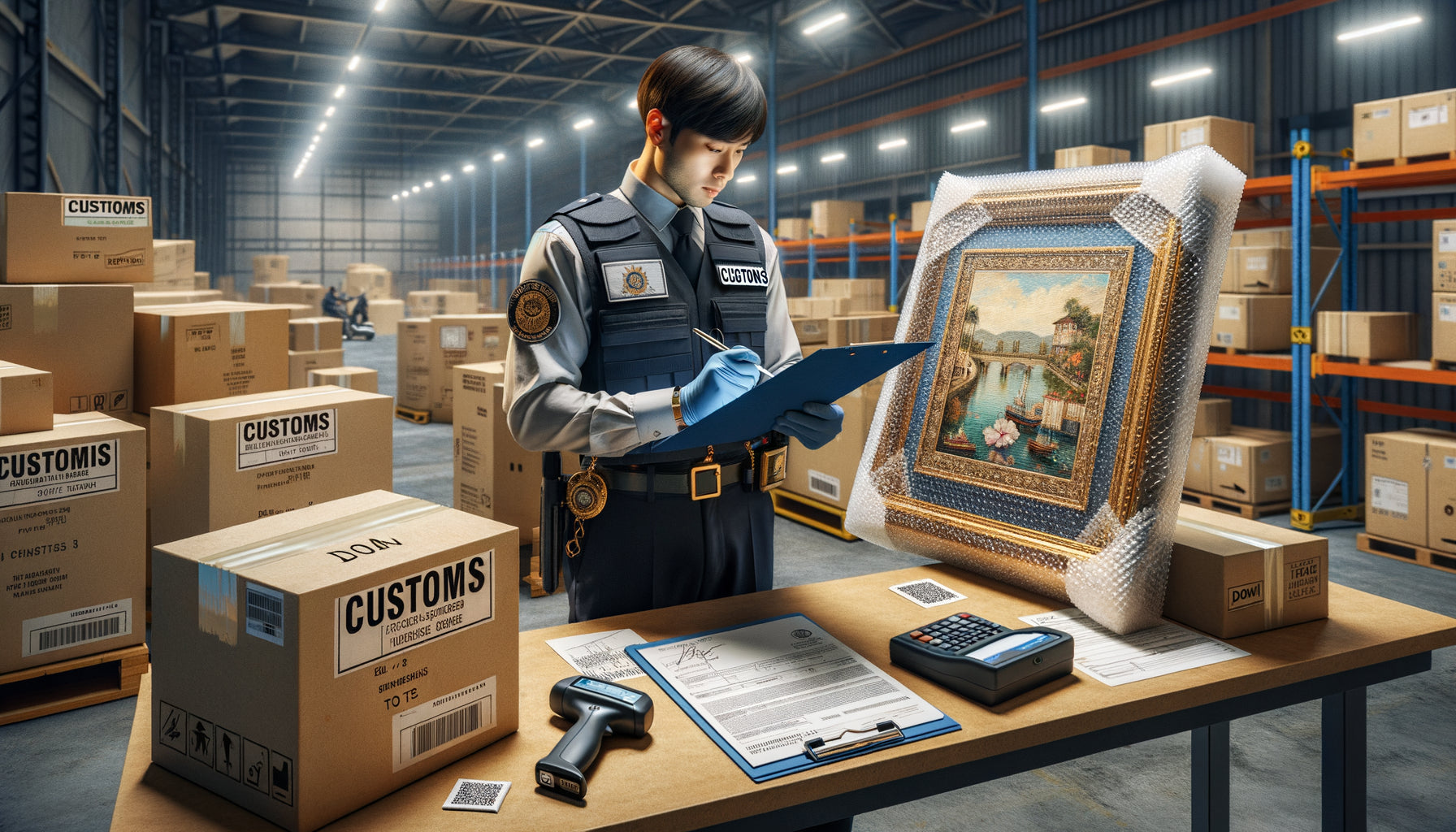
Customs formalities, this invisible but costly step
Here's an aspect that few people really understand: although DOM-TOM are French, they constitute specific customs territories. Legally, they are not part of the European Union’s customs territory (except Guadeloupe, Martinique, Reunion and Mayotte which are part of it but with specific features).
In concrete terms, this means that even a shipment from mainland France must follow customs clearance procedures. Each package must be declared, checked, and sometimes subject to specific taxes such as sea freight tax. These administrative steps require time and specialized personnel, which mechanically increases fees.
Carriers must maintain dedicated teams who master these complex formalities. They also need to anticipate processing times that can vary depending on the period. All of this is reflected in the final price you pay to receive your wall decoration or designer furniture.
Local taxes that are added
Sea freight tax, this local tax applied to goods imported into DOM, is an important financial specificity. Although it aims to protect the local economy, it represents an additional cost for the consumer. Rates vary depending on products and territories, but can reach several percentage points of the price.
Some sellers integrate these fees directly into their pricing, others bill them separately. This opacity can create unpleasant surprises at the time of delivery, when the carrier demands additional fees before handing over the package.

Shipping by sea versus air: balancing time and budget
Faced with these constraints, two main options exist for delivery to overseas departments. Air transport, fast but expensive, allows you to receive your order in a few days. Ideal for urgent purchases or fragile items requiring delicate handling, but its cost can easily triple standard shipping costs.
The maritime transport, a more economical solution, requires patience. Allow several weeks, even a month depending on the destinations and frequency of rotations. For non-urgent decorative elements such as paintings, sculptures or furniture, this option allows to significantly reduce the bill.
Most e-commerce companies offer these two options, with a price difference that can range from double to triple. Personally, for my decorative acquisitions, I systematically prefer maritime transport, anticipating my needs several weeks in advance. This planning transforms a prohibitive surcharge into reasonable costs.
Massification, key to affordable DOM-TOM delivery
Some brands manage to offer reduced shipping costs to overseas territories. Their secret? The massification of shipments. By grouping several orders to the same destination, they negotiate preferential rates with carriers and dilute fixed costs over a large volume.
These companies also maintain long-term partnerships with carriers specializing in DOM-TOM. This regularity allows them to optimize rotations, systematically fill containers, and smooth out costs. The end consumer then benefits from much more accessible rates than if they were to ship an isolated package.
As a decorator who has advised dozens of overseas clients, I always recommend prioritizing specialized stores that clearly display their DOM-TOM delivery policy. These players have made the commercial choice to invest in adapted logistics rather than charge exorbitant fees.
Compare, always compare
Before finalizing your order, take the time to compare shipping costs between several sites. For the same artwork, I have sometimes noticed differences of €50 to €100 depending on the retailer. Some even offer free delivery above a certain amount, which can justify grouping multiple purchases.
Always calculate the total cost (item price + shipping + any applicable taxes) before making a decision. An item slightly more expensive from one seller may ultimately be more economical if their shipping costs are reasonable.

Local infrastructure, the final link in the chain
One last factor explains high shipping costs: the local distribution infrastructure in overseas departments and regions. These territories, often islands and sometimes mountainous, present specific logistical challenges for last-mile delivery.
In Reunion, for example, some areas of the Highlands are difficult to access. In French Guiana, the vastness of the territory and the limited road network complicate routes. These geographical constraints require more time and resources to deliver your package from the local hub to your home.
Local carriers must maintain adapted fleets, train teams, manage depots in several areas. All these investments are reflected in the final delivery rates, even after your package has crossed the ocean.
My tips for decorating your overseas interior without breaking the bank
After eight years navigating this ecosystem, I have developed effective strategies. Anticipate your decorative purchases to systematically prioritize sea freight. Create a Pinterest board of your desires and order in batches every two or three months rather than one by one.
Favor transparent sellers who clearly display their overseas shipping costs on the product page. Be wary of sites that promise attractive prices but hide the real costs until the final payment stage.
Also explore local creators! Overseas territories are full of talented artists and artisans. By buying local, you completely eliminate shipping costs while supporting the creative economy of your island. I have discovered in Reunion photographers, painters and sculptors whose work is nothing to be ashamed of compared to creations from mainland France.
Finally, consider group orders with your neighbors. If several people in your building or neighborhood want to order from the same seller, group your purchases together. Some retailers accept multiple packages to the same address with reduced fees.
Living in French overseas departments and territories (DOM-TOM) does indeed involve dealing with higher shipping costs; it's an unavoidable geographical and logistical reality. But understanding these mechanisms allows you to make informed choices and optimize your decorating expenses. Your interior deserves as much attention and beauty as anywhere else, and with the right strategies, you can create a space that reflects you without sacrificing your budget.
FAQ: Your questions about shipping costs to DOM-TOM
Why are shipping costs to Martinique so high when it's France?
This question comes up constantly, and I completely understand it. Legally, Martinique is indeed a French department, but geographically, it is 6,800 kilometers from the mainland. This distance requires shipment by plane or boat, two modes of transport infinitely more expensive than the truck used for metropolitan deliveries. Furthermore, even though it's France, Martinique constitutes a specific customs territory requiring administrative formalities that add time and costs. Carriers must manage these specifics with trained teams and adapted procedures. Finally, the volume of packages to DOM-TOM remains lower than that of the mainland, which prevents the same economies of scale. However, some retailers are investing in optimized DOM-TOM logistics to offer reasonable rates. The trick is to favor these committed players rather than sites that consider overseas territories as an exotic and occasional destination.
Are there sellers who offer free shipping to DOM-TOM?
Yes, but let's be realistic: totally free delivery to overseas departments and regions (DOM-TOM) remains rare for obvious economic reasons. However, several strategies exist. Some sellers offer free shipping from a certain amount of purchase, generally higher than for mainland France (often 150 to 300 euros depending on the brands). Others directly integrate part of the transport costs into the price of their products, which makes delivery seemingly free but in reality included. My recommendation: always compare the total price (product + shipping) rather than focusing solely on the displayed free shipping. An item at 100 euros with 30 euros shipping may be more advantageous than a similar item at 140 euros with free shipping. Promotional periods are also excellent opportunities, some brands occasionally offering significant discounts on DOM-TOM shipping costs. Subscribe to your favorite retailers' newsletters so you don't miss these opportunities.
How long should you wait to receive a package in DOM-TOM?
Patience becomes a virtue when living overseas! Delivery times vary considerably depending on the chosen mode of transport. With express air freight, count on approximately 5 to 10 business days, depending on the exact destination and customs checks. This is the fastest option but also the most expensive. Standard air transport usually takes 10 to 15 days. As for sea transport, the economical option, anticipate 3 to 6 weeks depending on ship rotations and your island. These deadlines include the ocean voyage, customs clearance which can take several days, then local delivery. My advice after eight years in Reunion: for your decorating projects, adopt a planned approach. Create a wish list and order by sea as soon as you have validated your choices. While your paintings cross the ocean, you prepare your walls, choose the ideal location, and waiting becomes part of the pleasure of arranging your interior. This anticipation transforms logistical constraints into a process of maturing your decorative project.