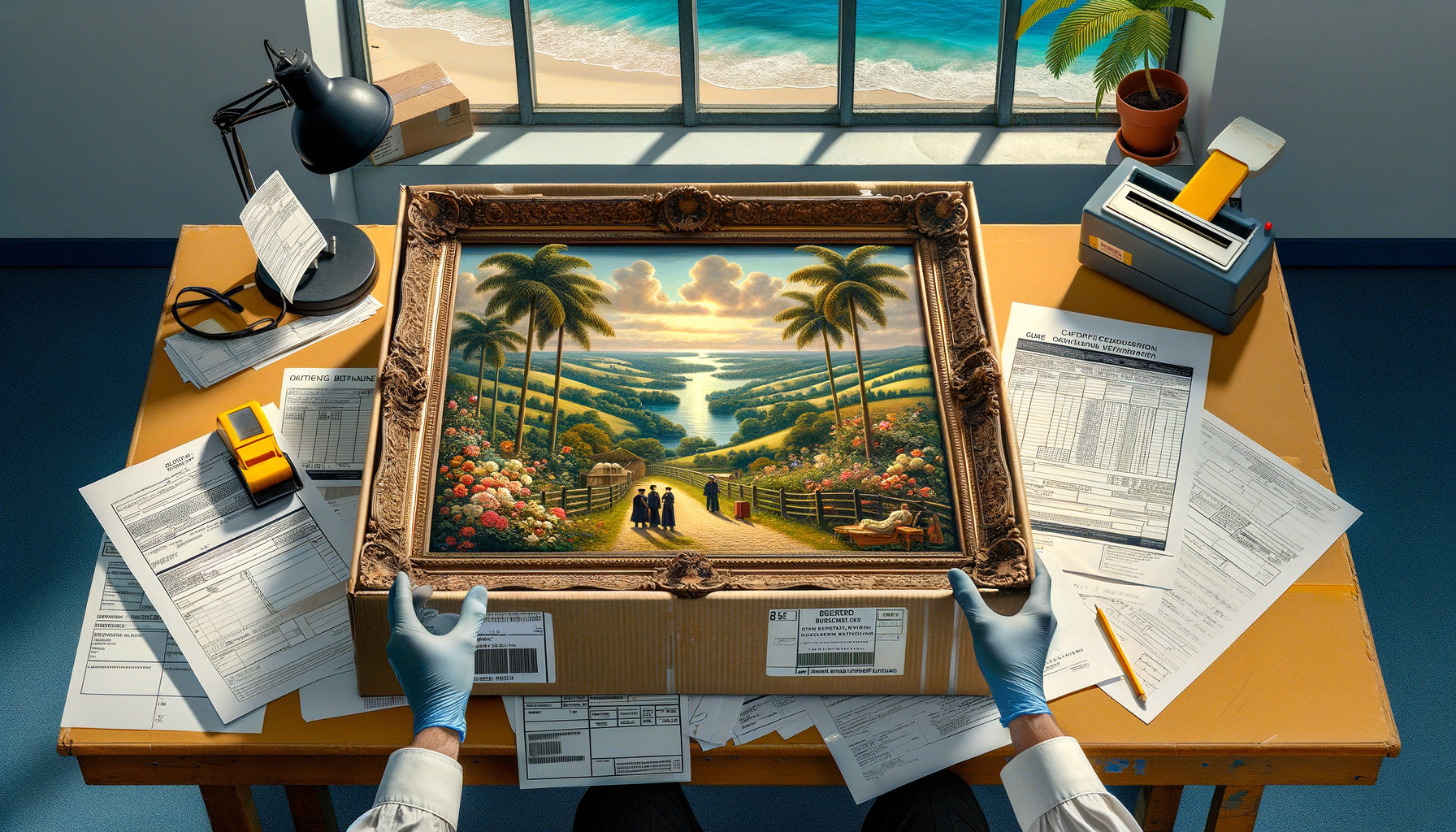
When I organized my first contemporary art exhibition in Reunion twelve years ago, shipping fifty paintings from Paris turned into an ecological nightmare. Oversized containers, a profusion of plastic packaging, diesel trucks to cross the island... This contradiction haunted me: how could we celebrate beauty while sacrificing the island ecosystems that we cherished so much? Today, after coordinating more than three hundred art deliveries to overseas territories, I see a silent revolution transforming our approach.
Here's what eco-responsible painting deliveries to islands concretely bring: a reduced carbon footprint of up to 70% thanks to optimized sea routes, biodegradable packaging adapted to tropical humidity, and direct support for local economies through the employment of island carriers. This transformation is no longer utopian but a vital necessity to preserve the splendor of the territories we inhabit.
You may hesitate to have a work of art delivered to your island for fear of environmental impact. This legitimate guilt often prevents art lovers from fulfilling their desire to beautify their interiors. Yet, refusing beauty is not the solution – demanding respectful practices is.
Rest assured: players in the art market understand the urgency. From galleries to online platforms, a new generation of operators are completely rethinking the logistics chain to harmonize artistic passion and ecological responsibility. Solutions exist, tested and proven under the tropics.
In this article, I reveal how to receive paintings in overseas territories without compromising your environmental values, while discovering the innovations that reinvent the transport of artworks to island territories.
We ship everywhere, including overseas territories!
Metropolitan France, Guadeloupe, Martinique, French Guiana, Reunion, Mayotte... Wherever you are, discover our exclusive collection of paintings deliverable to overseas territories delivered directly to your home.
Why islands require a different logistics approach
Island territories present unique logistical challenges that amplify the ecological footprint of classic deliveries. In Reunion, Guadeloupe or Martinique, each package travels at least 7000 kilometers from mainland France, multiplying intermediaries and modes of transport.
Geographic isolation imposes specific constraints: limited rotations between mainland France and overseas territories, the need for intermediate storage exposed to heat and humidity, sometimes aging port infrastructure. For a painting, this has traditionally meant massive over-packaging in polystyrene and plastic, intended to protect the artwork but generating considerable waste in territories with limited recycling capabilities.
I have observed transport crates containing more packaging materials than the weight of the painting itself. In French Polynesia, this waste ended up burned or buried due to a lack of adequate infrastructure. This absurdity has pushed several players to radically rethink their methods.
The impossible equation of disposable packaging
Traditional packaging for paintings – exotic wood crates, petrochemical foams, multi-layer plastic films – accumulates a considerable ecological debt. In islands, where space and resources are precious, these materials quickly become problematic.
The solution is gradually emerging: reusable packaging adapted to tropical conditions, designed to perform several dozens of rotations. Pioneering companies have developed rigid shells made from recycled materials, resistant to salt humidity, precisely sized to optimize space in shipping containers. The return of these packages to the mainland is part of a closed circuit that eliminates waste.
The innovations transforming eco-responsible deliveries
The revolution of eco-responsible painting deliveries to islands relies on three technological and organizational pillars that disrupt established practices.
First pillar: the optimization of maritime circuits. Unlike ultra-polluting air freight, well-organized sea transport divides the carbon footprint by fifteen. Logistics platforms now group shipments of artworks to the same island destination, pooling containers. This consolidation allows only full containers to be shipped, eliminating empty spaces synonymous with energy waste.
I accompanied a Marseille gallery that reduced its carbon footprint by 68% by switching from weekly individual shipments to bi-weekly grouped shipments to Martinique. The delivery time increases by a few days, but customers who are aware accept this compromise for a respectful delivery.
Bio-based materials adapted to the tropics
Tropical humidity is the worst enemy of paintings, justifying the traditional massive use of waterproof plastic barriers. New generation bio-sourced materials are changing the game: treated coconut fibers, recycled technical cardboard with hygroscopic properties, hemp textiles protecting without stifling.
These materials have the colossal advantage of being compostable locally once they reach their destination. In Reunion, several collection points now accept these packages which decompose into natural fertilizer. No more mountains of polystyrene cluttering island waste disposal sites.
The cost of these innovations remains 15 to 20% higher than conventional packaging, but this difference is rapidly decreasing with economies of scale. Above all, it represents a tiny investment compared to the preservation of island ecosystems.

How to choose a truly eco-responsible provider
Faced with the explosion of greenwashing, identifying actors genuinely committed to eco-friendly delivery of wall art to islands requires vigilance and knowledge of tangible criteria.
First verification: transparency on circuits used. A serious provider details precisely the route of your artwork – port of departure, shipping company partner, local distribution hub. This traceability allows you to verify the ecological consistency of logistical choices. Be wary of vague promises of 'green delivery' without operational details.
Second indicator: recognized environmental certifications. ISO 14001 labels for environmental management or the Carbon Neutral Shipping program attest to measurable and audited commitments. In overseas territories, prioritize partners collaborating with locally certified carriers, thus reducing last-mile emissions while supporting the island economy.
Essential questions to ask
Before ordering a work of art destined for French overseas departments and regions (DOM-TOM), systematically ask the seller five key questions: the nature of the packaging materials used, their fate after delivery, the preferred mode of transport, local logistics partners mobilized, and the existence of a verified carbon offset program.
Vague or evasive answers generally signal a superficial commitment. Conversely, a professional genuinely invested in eco-responsible deliveries will readily explain their choices, their environmental benefits, and any potential limitations. This transparency is the best guarantee of reliability.
Don't hesitate to ask for concrete evidence: photos of reusable packaging, documentation on carbon offsets performed, testimonials from island customers. Serious players have these elements and are happy to share them.
The Local Impact of Responsible Deliveries in Overseas Territories
Beyond simply reducing the carbon footprint, eco-friendly art deliveries generate tangible social and economic benefits on the islands, creating a virtuous circle that is often overlooked.
By prioritizing local final delivery partners rather than logistics multinationals, these short circuits retain added value within the island economy. I met a young entrepreneur in Pointe-à-Pitre who created his company specializing in the delicate delivery of artworks, now employing seven people trained in respectful handling techniques.
This local economy is accompanied by a gradual awareness among island populations about the environmental issues of e-commerce. Educational initiatives accompanying these deliveries – guides for sorting bio-sourced packaging, explanations of short circuits – contribute to collective awareness.
Preserving the Beauty That Inspires Artists
Exceptional island landscapes have always inspired creators. The beaches of Guadeloupe, the Pitons of Réunion, the Polynesian lagoons nourish the global artistic imagination. Preserving these fragile ecosystems through responsible logistics creates a profound coherence: the beauty transported does not destroy the beauty that inspires it.
This philosophy particularly resonates with artists from overseas territories themselves. Several Reunionese and Martinican creators now package their works in local materials – banana fibers, locally grown bamboo – transforming packaging into a poetic extension of the artwork itself.

Towards a Democratization of Virtuous Practices
Financial accessibility remains a major challenge for generalizing eco-friendly art deliveries on the islands. Initial surcharges can hinder the massive adoption of these virtuous practices.
However, trends encourage optimism. The progressive massification of responsible circuits mechanically reduces unit costs. A specialized platform confided in me that their eco-responsible rates to Réunion have fallen by 30% in three years, bringing their prices closer to those of conventional deliveries.
Public policies are also starting to support these initiatives. Some overseas territories are experimenting with subsidies for companies adopting bio-based packaging. Partial tax relief on green logistics investments in DOM-TOM could significantly accelerate the transition.
The evolution of mentalities is perhaps the most decisive factor. Island consumers, particularly exposed to the consequences of climate deregulation – rising waters, intensification of cyclones – demonstrate a growing environmental awareness. They massively favor brands demonstrating an authentic commitment, creating a virtuous competitive pressure.
Imagine your next artwork arriving in harmony with your island
Visualize this moment: your new artwork arrives at your door, carried by a local delivery person you may know. The packaging, understated and elegant, is made of materials that you can compost in your garden. No mountain of plastic to eliminate, no ecological guilt to manage. Just the pure joy of welcoming a work that will beautify your interior without darkening your conscience.
This vision no longer belongs to the distant future. It is being realized today for thousands of overseas households who refuse to choose between artistic passion and environmental respect. Eco-responsible artwork deliveries to islands prove that harmony and beauty can coexist at every stage.
Your next art acquisition can participate in this movement. Question, demand, choose partners aligned with your values. Each responsible order strengthens the virtuous ecosystem, encourages innovation, protects the natural wonders that create the magic of your island territory. Art and ecology do not oppose each other – they sublimate each other when we make the right choices.
FAQ
Are eco-responsible deliveries really possible to all French islands?
Absolutely, even if solutions vary depending on the destinations. The most populated territories such as Reunion, Martinique and Guadeloupe benefit from regular sea routes allowing efficient consolidations and optimized eco-responsible deliveries. For more isolated islands like Mayotte or Pacific territories, rotations are less frequent, extending deadlines, but the principles remain identical: grouping of shipments, bio-based packaging, partnerships with local carriers. The key is anticipation and acceptance of slightly longer lead times than polluting express deliveries. Ask your supplier about specific routes to your island – a serious player will explain you precisely the journey of your artwork and the ecological measures applied at each stage.
How to be sure that the eco-friendly packaging will properly protect my artwork during transport?
This legitimate concern often hinders the adoption of bio-based packaging, but current technologies offer equivalent or even superior protection to conventional materials. Technical natural fibers – coco, hemp, recycled corrugated cardboard – exhibit excellent shock absorption properties. Above all, unlike synthetic foams that compress with tropical humidity, these materials maintain their protective properties in island conditions. Reusable rigid packaging, specifically designed for maritime rotations, undergoes resistance tests far exceeding the actual constraints of transport. Serious professionals guarantee their eco-friendly packaging and offer insurance covering the full value of the artwork. Ask to see photos of the planned packaging and don't hesitate to request references from satisfied island customers – proof through experience remains the best indicator of reliability.
Is the additional cost of an eco-responsible delivery to overseas territories significant?
The price difference is considerably reduced and often becomes marginal or even non-existent for some players. Historically, eco-friendly deliveries did indeed cost 20 to 30% more than conventional circuits, but this equation is changing rapidly. First, optimized and shared routes generate economies of scale offsetting the cost of bio-based materials. Secondly, an increasing number of platforms directly integrate a responsible approach into their standard model, without additional charge. Finally, the calculation should include hidden costs: with a conventional delivery, you often have to manage bulky packaging disposal, which can sometimes be costly in certain islands. Eco-responsible compostable or recoverable packaging eliminates this constraint. My advice: compare overall offers including all parameters. You will see that the actual difference is often between 5 and 15%, a negligible investment to preserve your island environment and support a respectful local economy.