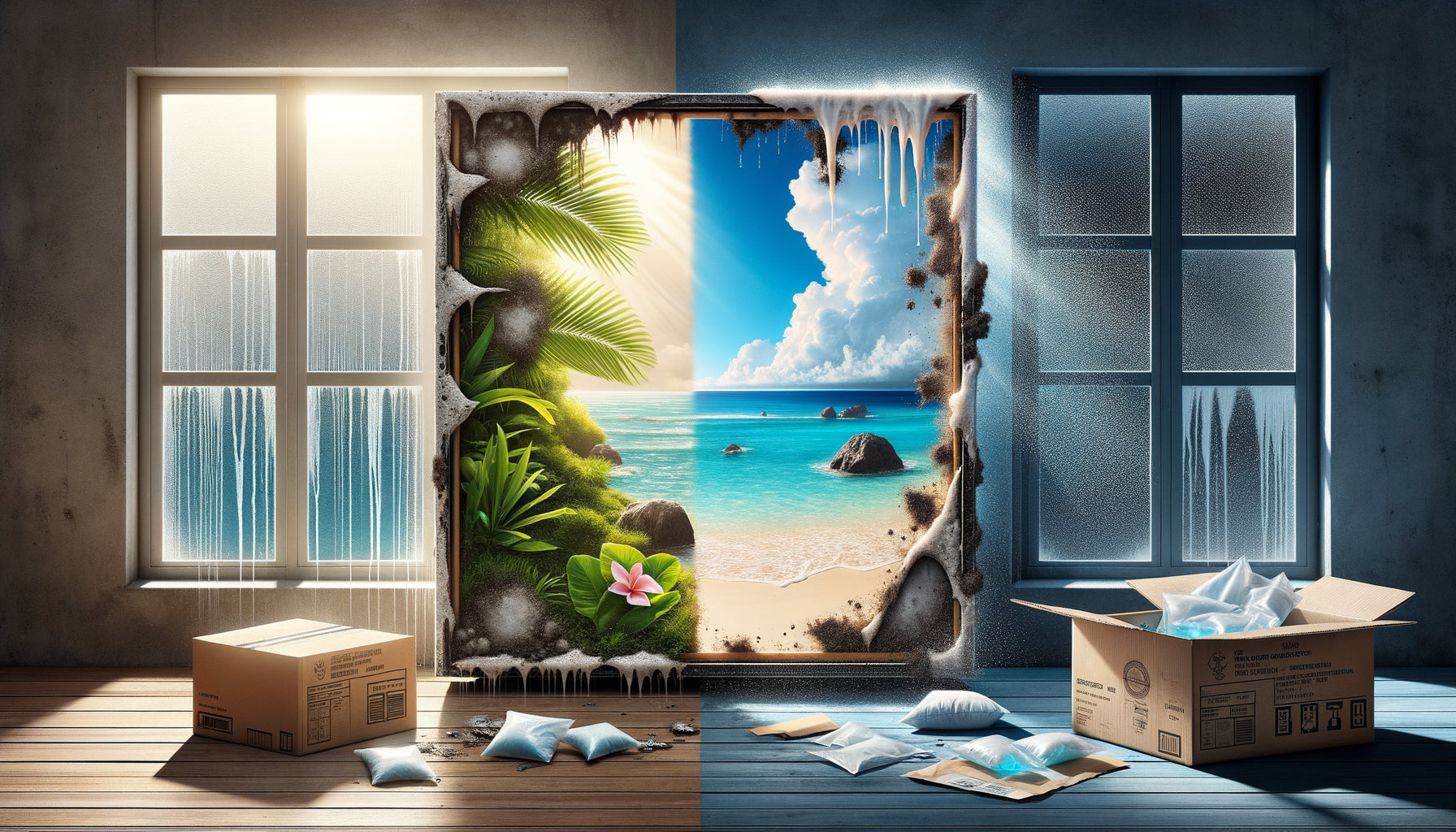
That morning, the container finally opens in the port warehouse. Among the crates marked 'fragile', the one containing your painting has been waiting for weeks. It crossed the Atlantic, endured the humidity of the holds, survived the ship's movements. Inside lies a work that will transform your living room – but between this moment and when it finds its place on the wall, every gesture counts. Because a painting that has traveled by sea requires particular attention: oceanic humidity has infiltrated the packaging, materials have worked, wood has breathed. Hasty unpacking, improvised hanging, and you risk seeing tension appear on the canvas, deformation of the frame, or even cracks in the pictorial layer.
Here's what a successful unpacking and hanging after sea transport brings: the complete preservation of your artistic investment, the assurance that colors and structure remain perfect for decades, and the pride of installing a piece that already tells a story of travel. Are you perhaps afraid of damaging your painting when opening the packaging? Of not knowing how to recognize signs of a potential problem related to transport? Of choosing the wrong fixing system and seeing your acquisition fall? These concerns are legitimate. After fifteen years spent coordinating the arrival of artworks in European ports, I have seen too many collectors sacrifice months of waiting for a few minutes of impatience. But rest assured: with the right method, unpacking and hanging a maritime painting becomes a rewarding ritual that extends the acquisition experience. I will guide you step by step, from opening the crate to the final step back in front of your transformed wall.
We deliver everywhere, including overseas territories!
Metropolitan France, Guadeloupe, Martinique, French Guiana, Reunion, Mayotte... Wherever you are, discover our exclusive collection of paintings deliverable to overseas territories delivered directly to your home.
The acclimatation ritual: why patience is your best ally
The first rule after a sea crossing seems counterintuitive for the impatient enthusiast: do not immediately touch the packaging. Your painting arrives from an environment where relative humidity ranged between 70 and 90%, where temperatures varied depending on the cargo zones. Placing it abruptly in your heated interior at 20°C with 40% humidity would create a thermal shock comparable to plunging into an ice-cold pool after a sauna.
Install the crate in the final destination room – ideally the one where the artwork will be hung – and let it acclimatize for a minimum of 48 to 72 hours. This period allows the canvas, wooden frame, and packaging materials to gradually reach equilibrium with your home environment. I have seen perfectly stretched canvases develop visible ripples simply because their owner had opened the package in a cold garage before mounting them in an overheated living room.
During this acclimatization, position the crate horizontally on a flat surface, never standing against a wall. Avoid proximity to radiators, air conditioning vents, or windows exposed to direct sunlight. If you receive your artwork in winter and the outer packaging shows signs of condensation, gently wipe away any superficial moisture with a dry cloth, but do not pierce the internal protective film before the end of the acclimatization period.
The art of methodical unboxing: protecting what the ocean has spared
The time has come. Prepare your unpacking space like a surgeon prepares his operating room: a clean and clear surface, covered with a soft blanket or flat cardboard boxes, large enough to accommodate the artwork and all the packaging materials you will gradually remove. Arm yourself with a retractable blade cutter, scissors, and above all white cotton gloves – fingerprints on fresh varnish or a matte finish are almost impossible to remove without professional intervention.
Start by photographing the packaging from all angles. These images will serve as proof in case of dispute with the carrier, but also as documentation for your own archive if you ever need to ship the artwork again. Then remove the straps and banding on the outside, then open the wooden or reinforced cardboard box by always cutting outwards, never towards the artwork. Nails and staples must be removed with pliers, not torn off.
The successive layers of protection
Inside, you will generally find several layers: bubble wrap, kraft paper, sometimes polyethylene foam or cardboard corner protectors. Remove these protections one by one, slowly, while inspecting each level. Look for signs of moisture, suspicious stains, deformations of the materials. If the kraft paper is soaked or has halos, take additional photos before continuing.
When you reach the plastic film in direct contact with the artwork, this is the critical moment. Slide your gloved fingers between the film and the edges of the frame, and gently lift the artwork by holding it always by the sides of the frame, never by the frame (which may simply be placed and not fixed) or by the painted surface. Place it face up on your prepared surface, and only then completely remove the protective film by peeling it from the center towards the edges to avoid any friction on the pictorial layer.

The post-travel inspection: discerning what the untrained eye might miss
Your painting now rests before you, freed from its cocoon. Before any wall installation, give it a thorough inspection from several lighting angles. First, face the artwork with indirect natural light, then move laterally to observe in raking light – this technique reveals subtle canvas distortions, impasto that may have been affected, micro-cracks in the varnish.
Check the tension of the canvas by observing its flatness. Slight undulations on the edges are normal after sea transport and will generally subside within a few days in a stable environment. On the other hand, pronounced waves in the center or marked creases require consultation with a restorer before any hanging. Also examine the corners of the frame: has the wood warped? Are the assemblies still solid?
For paintings with frames, inspect the junction between frame and canvas. Are the fixing nails or staples still in place? Does the frame show cracks, especially at the corners? If your acquisition comes from a specialized catalog for works intended for tropical areas, the finishes will normally have been adapted to hygrometric variations, but a verification is still necessary.
Choosing the right wall: location is never trivial
The final location conditions the longevity of your painting more than the quality of the hanging system. After sea crossing, the artwork remains particularly sensitive to environmental variations for the first three to six months. Absolutely avoid walls exposed to direct sunlight, even through a window with UV protection – photosensitive pigments can begin to fade in just a few weeks.
Also avoid locations above radiators, active fireplaces, or in rooms with high humidity such as bathrooms and kitchens without effective extraction. The rule of thumb: if you yourself feel marked variations in temperature or humidity in that location, your painting will experience them in an amplified way. Prefer interior walls, which benefit from better thermal insulation than exterior-facing walls.
The hanging height follows a simple museum rule: the optical center of the painting (usually located in the upper third of the work) should be at eye level, i.e., between 145 and 165 cm from the floor depending on your height and that of your family members. This position creates optimal visual engagement and avoids distorting perspectives that occur when hanging too high or too low.

Hanging systems for works on the move
The choice of hanging system depends on three factors: the weight of the painting, the type of wall, and the possibility that you may need to move the work. After sea transport, I systematically recommend double-point fixing systems rather than traditional central hanging. This configuration distributes constraints better and limits oscillations that could fatigue the frame still in the stabilization phase.
For lightweight to medium paintings (up to 10 kg)
X hooks or angled table hooks are perfectly suitable for solid walls. Plant them at a slight downward angle to create increased resistance to tearing. If your wall is made of plasterboard or gypsum board, you must use metallic toggle anchors (Molly type) sized to support twice the actual weight – a 5 kg painting requires a fixing designed for a minimum of 10 kg.
For large formats (over 10 kg)
Invest in a rail suspension system or professional table hooks fixed to wall studs. Use a stud finder to locate the supporting structures behind the plasterboard. If no stud corresponds to your ideal location, install a horizontal wooden crosspiece (a 4x2 cm batten) securely attached to several studs, then hang your painting on this base. This technique, used in galleries, guarantees absolute safety.
On the back of the painting, check the existing hanging system. D rings screwed into the frame are preferable to simple taut wire, which can shear the wood over time. If you need to add fixings, position them at the top third of the height of the frame, never flush with the upper edge, as this would create a forward tilting effect.
The final touch: hang with the confidence of a collector
You have prepared your wall fixings, the painting is inspected and ready. Before lifting the artwork, measure and mark your hanging points precisely with a light pencil. The kraft paper method is infallible: cut a template to the exact dimensions of the painting, mark the positions of the rear fixings, stick it temporarily to the wall with masking tape, and install your hooks through the paper. Then remove the template – your fixing points are perfectly positioned.
To lift the painting, ask a second person if the artwork is over 80 cm wide or weighs 5 kg. Always hold the frame by the sides, distributing the weight. Never lift a painting by its hanging wire – this practice deforms the frame and can tear off the fixings. Approach the wall, position the rear attachments on the wall hooks, then gently step back, letting the painting settle naturally.
Once hung, check that it is level with a spirit level placed delicately on the upper edge of the frame. Micro-adjustments are made by slightly lifting one side and repositioning it on the hook. Finally, perform the step-back test: step back three meters and observe the overall effect. Does the artwork dialogue harmoniously with its environment? Does its presence transform the space as you imagined during those weeks of sea transport?
Allow a few days to pass, then re-inspect the tension of the canvas and the stability of the hanging. After long sea transport, it is normal to have to make a slight adjustment to the level after about a week, allowing all materials to reach their final equilibrium state in your home.
When your wall becomes a window onto elsewhere
The painting that faces you now has crossed thousands of nautical miles to join your home. It carries within it the spray of the oceans, the rhythm of the waves that rocked the cargo ship, the waiting in transit ports. By taking the time to unwrap it carefully, inspect it attentively, and hang it methodically, you have extended its journey until its final mooring point. Each time your gaze rests upon it, you will know that it is there to last – protected, stable, perfectly integrated into your world. And if tomorrow you feel like acquiring a new piece from elsewhere, you will have the confidence of one who knows how to welcome a work as it deserves.
FAQ : Your questions about unboxing and hanging after sea transport
My painting has slight undulations after unpacking, is this serious?
No, slight undulations on the edges of the canvas are perfectly normal after prolonged sea transport. Oceanic humidity temporarily swells the canvas fibers. In a stable domestic environment (temperature between 18-22°C, relative humidity 40-60%), these ripples usually disappear on their own within 7 to 15 days. Hang your artwork as usual and monitor its evolution. If the ripples persist after three weeks or worsen, consult a restorer who can re-stretch the canvas on the frame. On the other hand, if you notice marked creases or deformations in the center of the work upon unboxing, photograph immediately and contact the seller before hanging – it may be transport damage requiring assistance.
How long should I really wait before opening the packaging?
The minimum acclimatization period is 48 hours for standard sea transport, but I systematically recommend 72 hours (three full days) for valuable works or journeys longer than two weeks at sea. This duration allows for gradual stabilization and significantly reduces the risk of thermal shock. If your artwork arrives in the middle of winter with a very cold packaging, or if you live in a very different tropical climate from the place of shipment, extend it to five days. Install the crate in the final destination room upon receipt – moving the painting from one room to another after unboxing would subject it to a second acclimatization. This patience may seem frustrating, but it represents less than a week over a period of ownership that is counted in years, or even decades. It's the most worthwhile time investment for preserving your acquisition.
Can I hang my artwork on an exterior wall or in a humid room?
Absolutely avoid exterior walls and rooms with high humidity for an artwork that has already undergone the constraints of sea transport. Walls facing outwards are subject to significant temperature variations depending on the seasons, creating expansion-contraction cycles that fatigue the frame and canvas. In bathrooms, kitchens or unairconditioned conservatories, relative humidity can regularly exceed 70%, causing mold development, peeling of the pictorial layer, or corrosion of metal fixings. Always prefer interior walls of main living rooms (living room, bedroom, office) where the environment remains stable. If you live in a tropical area and want to decorate a conservatory, specifically choose artworks designed for these conditions – some sellers offer artworks treated to resist the humid climates of overseas departments and regions, with reinforced varnishes and treated wood frames.