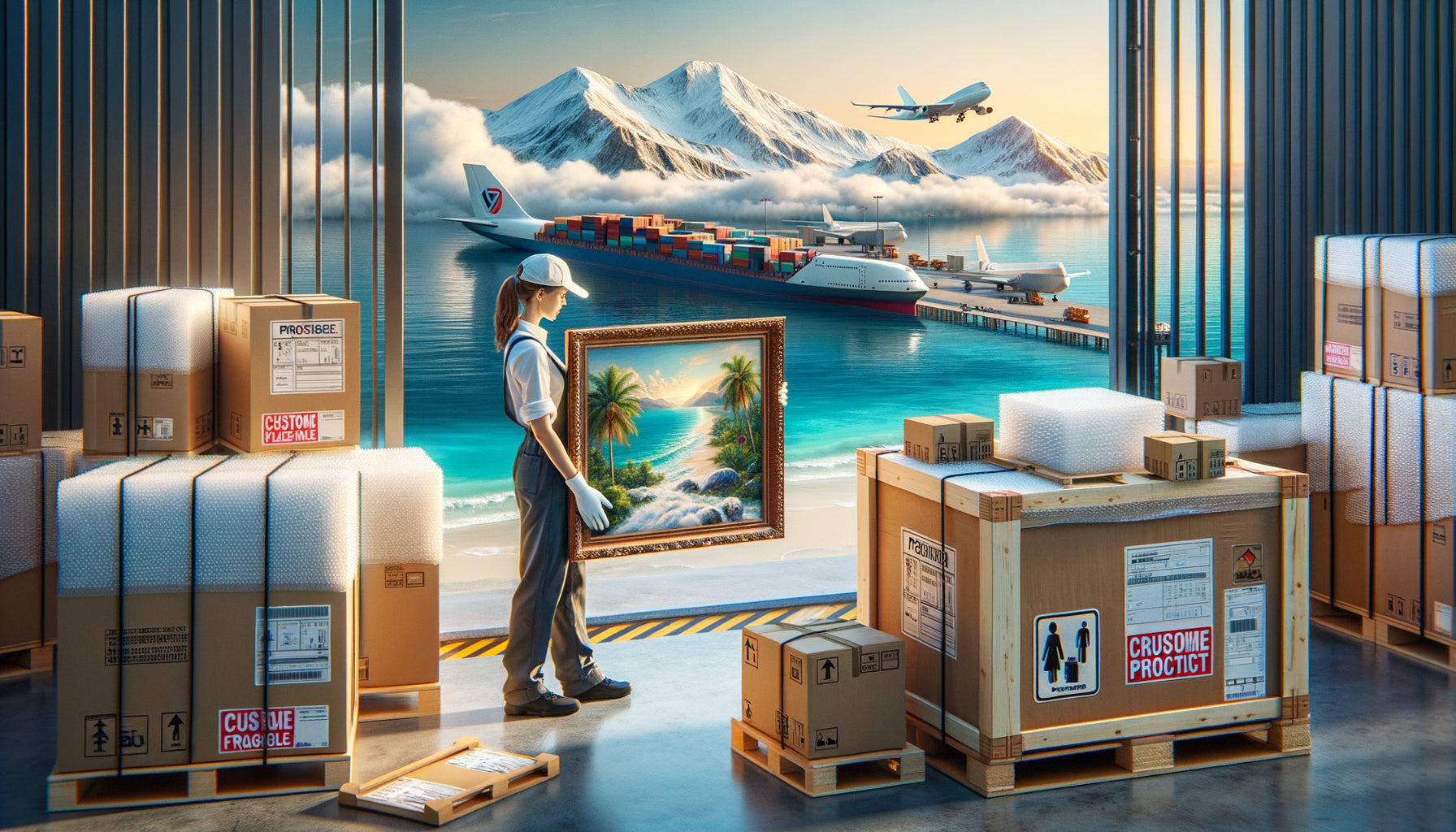
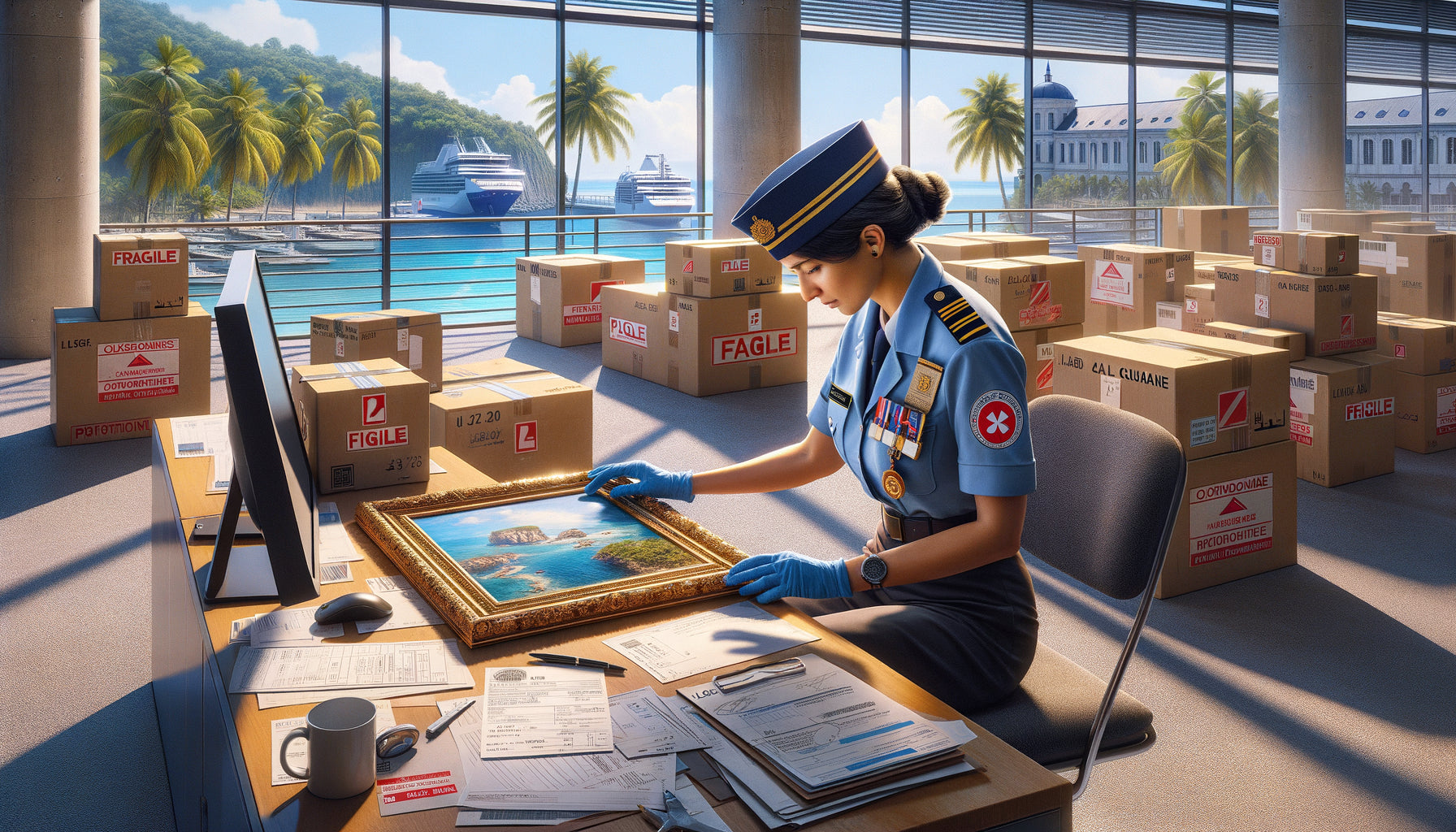
I still remember that day in May 2019, when I unpacked a canvas in Fort-de-France that I had shipped from Paris three weeks earlier. The artwork was magnificent at first: a contemporary oil painting with deep colors. But beneath the plastic film, mold spots had begun their destructive work. Local hygrometry had defeated packaging designed for the temperate European climate. For fifteen years that I have been organizing the transport of artworks between the metropolis and overseas territories, I have learned that the packaging of your paintings can never be the same in the tropics as it is in the mainland.
Here's what tropical humidity-adapted packaging really brings: a hermetic protection against excessive hygrometry (often above 80%), an effective barrier against brutal temperature variations during air or sea transit, and optimal security against fungi and insects attracted to organic materials. It would be wrong to think that a simple cardboard box and bubble wrap are enough to protect a work of art destined for Guadeloupe, Martinique, French Guiana or Reunion. These beautiful territories impose specific climatic constraints that too many collectors and galleries still ignore, at the cost of sometimes irreversible damage. But rest assured: with proper packaging techniques and a precise understanding of the climatic challenges, your paintings can travel serenely in all latitudes. I am going to share with you the strategies that I have developed over hundreds of successful shipments to overseas departments and regions.
We deliver everywhere, including overseas departments and regions!
Metropolis, Guadeloupe, Martinique, French Guiana, Reunion, Mayotte... Wherever you are, discover our exclusive collection of paintings deliverable to overseas departments and regions delivered directly to your home.
The invisible enemy: understanding tropical humidity and its effects on artworks
During my first mission in Cayenne, the climatic shock was immediate. Stepping off the plane, the hot, water-saturated air envelops you like a damp blanket. This physical sensation is known to everyone who has lived in the tropics. But what many do not know is that tropical humidity represents a permanent danger for paintings. In overseas departments and regions, the humidity rate generally oscillates between 75% and 95%, against 40% to 60% in the mainland. This colossal difference completely transforms the approach to packaging.
The wood of the frames absorbs this humidity like a sponge. The canvases relax, losing their tension. Acrylic paints, despite being known for their resistance, can develop a whitish veil. Oils, more stable, are not spared: the varnish becomes cloudy, the surface becomes sticky. Worse still, molds find in this humid environment the ideal conditions to proliferate. I have seen antique gilded frames literally eaten away by microscopic fungi in just a few months. Climate challenges therefore require a complete revision of usual packaging standards.
The three critical phases of the journey
Each expedition to overseas territories has three moments when the packaging of your paintings will be tested. The first: storage before departure, often in metropolitan dry hangars. The second: the transport itself, with extreme temperature variations between the air-conditioned aircraft hold and the scorching tarmac. The third, the most dangerous: arrival on the overseas territory where the painting abruptly goes from a controlled environment to the local saturated atmosphere. It is during this last phase that 70% of humidity-related damage occurs according to my observations.
The essential materials for high-performance tropical packaging
Forget simple cardboard and kraft paper. To adapt the packaging to tropical conditions, you need to create a true multi-layer airtight barrier. My method, proven over 500 shipments, relies on four strategic materials. First, aluminum moisture barrier film: this multi-layered membrane combines polyethylene and aluminum to completely block water vapor. I use it in double layer, with thermal sealing of the edges. This is your first line of defense.
Next come the silica gel desiccant sachets. But be careful: not just any ones. For overseas territories, I use oversized sachets, at a rate of 100 grams per square meter of painting surface area. I place them inside the aluminum film, directly against the artwork, to absorb any residual moisture. These sachets create a dry and stable microclimate, even if the outside of the packaging is exposed to tropical air. Third essential component: high-density alveolar foam. It advantageously replaces standard bubble wrap which, on the other hand, can retain moisture. This foam provides cushioning and shock absorption while allowing everything to breathe.
Finally, the crate itself must be made of marine grade plywood treated. Ordinary solid wood warps under the effects of humidity. Marine plywood, designed to withstand sea spray, offers perfect dimensional stability. I systematically treat it with a waterproof varnish on all faces, including the inside. This attention to detail makes all the difference between a painting that arrives intact and a disaster.

The seven-step packaging technique for tropical climates
Allow me to guide you through the protocol that I religiously apply. First step : preliminary conditioning of the painting. I leave it for 48 hours in an environment with 50% humidity to stabilize the materials. This acclimatization phase prevents hygrometric shocks. Second step : corner protection. I use reinforced cardboard corners, then wrap the painting in a non-woven protective veil that eliminates the risk of friction.
Third crucial step : installation of desiccant sachets. I fix them with repositionable adhesive tape at several points around the painting, ensuring they do not touch the painted surface directly. Fourth step : barrier film application. I unroll a first layer of aluminum foil, place the painting on it, then hermetically seal the edges with a heat sealer. I repeat the operation with a second layer, the welds offset to guarantee absolute tightness. This double protection is non-negotiable for the tropical humidity of overseas departments and regions.
The finishing touches that make the difference
Fifth step : securing in the crate. I create a mattress of 5 cm minimum alveolar foam on all sides. The wrapped painting must be suspended in the center of the crate, without ever touching the walls. Sixth step : signage. I clearly attach 'Fragile', 'Artwork', and especially 'Sensitive to humidity' labels. The latter mention alerts handlers to the particular nature of the contents. Seventh final step : crating film wrapping. I wrap the outside with opaque stretch film that protects against water splashes during port or airport handling.
Adapt your strategy according to the overseas destination
Not all overseas departments and regions present the same challenges. Martinique and Guadeloupe, with their cyclonic periods, require structural reinforcement of the crate. I increase the thickness of the plywood to 15 mm and add metal reinforcements to the corners. For French Guiana, where humidity regularly reaches 95%, I triple the amount of desiccant sachets and use humidity indicators inside the packaging. These small cards change color if the rate exceeds 60%, allowing the recipient to quickly check that your paintings' packaging has worked correctly.
Réunion presents a different challenge: altitude variations. A painting destined for the highlands of the island will experience greater pressure and temperature changes. I then adjust the timing to ensure it remains effective even if the materials expand or contract slightly. Mayotte, the newest territory, suffers from less developed logistical infrastructure. Intermediate storage times are longer, exposing artworks more. To adapt the packaging to this reality, I use desiccant sachets with an extended action duration, capable of remaining active for up to 60 days.

Mistakes to absolutely avoid
Over the years, I have identified recurring mistakes that cause damage. The first, the most frequent: using newspaper or kraft paper as cushioning. These organic materials love moisture and turn into a breeding ground for mold. Second mistake: packing a painting still fresh. An oil paint must dry for at least six months, an acrylic for three weeks, before any airtight packaging. Otherwise, residual solvents remain trapped and attack the surface.
Third trap: neglecting the back of the painting. The back of the canvas is often forgotten, while it represents the most vulnerable surface. I systematically fix a waterproof foam board to the back of the frame before packing. Fourth costly mistake: saving on materials. A low-quality barrier film or undersized desiccant sachets compromise all protection. The climatic challenges of overseas departments and regions do not forgive any compromises. Finally, last mistake: failing to document the initial condition. I always photograph the artwork before packing, from several angles. This precaution greatly facilitates procedures in case of disaster.
After arrival: strategic unboxing in the tropics
The protection work does not end with delivery. Unpacking in a tropical environment requires as many precautions as the initial packaging. My golden rule: let the painting, still packaged, acclimatize for 24 hours in its final destination before opening the crate. This period helps avoid thermal shock which could cause condensation to form inside the airtight packaging. I have seen collectors rushing to open their package immediately and discover droplets forming instantly on the varnish.
Proceed with unpacking in the driest available room, ideally air-conditioned. Remove the layers progressively: first the crate, then the foam, then the first layer of aluminum foil. Wait another hour before removing the second layer, which is in direct contact with the artwork. This gradual approach allows the materials of the work to gradually adapt to ambient tropical humidity. Recover the desiccant sachets: if they are still firm and granular, the packaging has worked perfectly. If they are soft and clumped together, they have absorbed a lot of moisture and saved your artwork.
Imagine this moment: you carefully remove the last layer of protection and discover your work exactly as it was originally, the colors intact, the surface perfectly dry, no trace of mold. This immense satisfaction, I have experienced hundreds of times, and it is exactly what you deserve after investing in a piece that moves you. Adapting the packaging of your paintings for tropical humidity is not an optional luxury, it is the guarantee that your collection will cross the oceans as serenely as it enriches your daily life. Take the time to do things right, invest in good materials, follow these proven protocols, and your works will travel to overseas territories with the protection they deserve. The beauty of art has no borders, but it deserves all the attention to cross climates safely.
Frequently Asked Questions about Painting Packaging for Overseas Territories
How much does it actually cost to have packaging adapted for tropical climates?
This question comes up repeatedly, and I understand the concern. Professional packaging adapted to the tropical humidity of overseas territories is indeed an investment greater than standard packaging. For a medium-sized painting (60x80 cm), expect between 80 and 150 euros for specific materials: quality aluminum barrier film, professional desiccant sachets, marine plywood, high density foam. Add to this the preparation time, about 2 to 3 hours to properly respect all the steps. But this cost must be put into perspective with the value of your work. I have seen paintings worth 3000 euros completely ruined by an economical packaging costing 30 euros. Adapted protection is not an expense, it is insurance against often irreversible damage. Furthermore, some specialized carriers offer packages including professional packaging, which optimizes the overall budget.
Can a tropical packaging be reused for a return to mainland France?
Excellent question that raises an important point. In theory, yes, materials can be reused, but with essential precautions. Desiccant sachets must absolutely be replaced: once saturated with moisture, they lose all effectiveness. You can check their condition by touching them - if they are soft or clumped together, they are unusable. The aluminum barrier film can be reused if it has not been perforated and the welds are intact, but I strongly recommend using a new film for maximum safety. The marine plywood crate, on the other hand, is perfectly reusable; that's even one of its advantages. The alveolar foam as well, as long as it is not deformed. In practice, to adjust the packaging during a return, I advise renewing 60% of the materials, especially all elements in direct contact with the artwork. As the metropolitan climate is less aggressive, some collectors are tempted to lighten the protection, but variations during transport remain identical in both directions.
My painting has developed mold despite the packaging, what should I do?
This situation is fortunately rare with correct packaging, but it happens, usually because the painting was already slightly contaminated before packaging or because a micro-perforation compromised the seal. The first absolute rule: never try to clean mold yourself on a painting. Spores can become deeply embedded in the pictorial material and an amateur cleaning may spread contamination or irreversibly damage the surface. Contact a specialized art restorer immediately. In overseas territories, there are professionals trained in specific tropical issues. While waiting for intervention, isolate the painting in an airtight bag with new desiccant sachets to stop the progression. Photograph the damage for your insurance if the artwork was covered. For the future, this unfortunate experience highlights the importance of calling on professionals who perfectly master climate challenges and appropriate packaging techniques. A thorough visual inspection before packaging and the use of humidity indicators inside the barrier film allow any problems during transport to be detected quickly.