I spent fifteen years shaping impossible forms in my workshop in Vincennes. Wall sculptures that follow the curves of a staircase, works that blend into the architecture as if they had been part of it forever. And every time a client discovers what a thermoformed wall art can bring to their space, I see the same spark in their eyes. Because unlike traditional flat frames that remain prisoners of their rigidity, curved formats literally transform the perception of a room. Here's what a thermoformed artwork brings: a perfect adaptation to architectural constraints, an exceptional resistance in passageways, and a sculptural presence that transcends simple wall decoration. You may have given up dressing that curved wall in your hall, abandoned the idea of adorning that circular space because no conventional work would integrate harmoniously into it. This frustration particularly affects contemporary architectures and renovated historic buildings, where straight lines are rare. The good news? Thermoforming is revolutionizing wall decoration by allowing creations that embrace the very soul of your architecture.
When material meets architecture: the magic of thermoforming
The thermoforming process resembles modern alchemy. In my workshop, I heat composite plates until they become malleable, then I mold them over three-dimensional shapes. This process, borrowed from the aerospace industry, makes it possible to create wall artworks with curves impossible to achieve with traditional techniques. Unlike wooden frames that warp with humidity or canvases that buckle, a thermoformed artwork retains its original shape for decades. I have installed pieces in spas, where humidity reaches 80%, and they remain impeccable after five years. The dimensional stability of these creations comes from their molecular structure reorganized during heating. Polymers align according to the new form, creating a quasi-permanent memory of shape. For curved spaces – columns, curved walls, rounded alcoves – this technology offers a solution that even the best framers cannot rival.
Impossible curves become possible
I recently worked on a project for a Parisian hotel where the designer wanted to adorn a helical staircase. With a thermoformed wall art piece, we created a work that followed the spiral three meters high. The curved format perfectly embraced the geometry of the space, creating a stunning visual continuity. Guests consistently stop to photograph this installation. It's this ability to adapt to architectural constraints that fundamentally differentiates thermoforming from other techniques. No rigid frame, however well made, can follow a tight radius without cracking.
The hidden strength: why curved formats last longer
Here's something I discovered by accident during a fire in a restaurant: a thermoformed wall art piece installed on a curved wall survived intact to a shock that would have shattered a traditional frame. The reason? The distribution of mechanical stresses on a curved surface is completely different from a flat surface. In engineering, this is called the principle of the vault – the same reason why Gothic cathedrals have stood for eight centuries. A wall art piece with a curved format distributes forces across its entire surface, whereas a flat frame concentrates tensions on its four corners. In passageways – hotel corridors, reception halls, commercial spaces – this resilience makes all the difference. I have installations in colleges for seven years, exposed daily to backpack impacts and lost balls. They show less wear than classic frames installed six months earlier in protected areas.
The thermal advantage in challenging spaces
Thermoformed wall art pieces excel in environments where temperature fluctuates. Their homogeneous coefficient of thermal expansion avoids internal stresses that crack mixed wood-glass assemblies. In a conservatory exposed to the south, where the thermometer oscillates between 5°C at night and 45°C in the afternoon, a curved wall art piece maintains perfect integrity. The materials used – typically acrylic composites or technical polymers – possess remarkable thermal inertia. They absorb and dissipate heat gradually, without creating stress points. For architects working on projects where climate control is not optimal, this technical characteristic represents a decisive advantage.

The Sculptural Effect: When a Painting Becomes Architecture
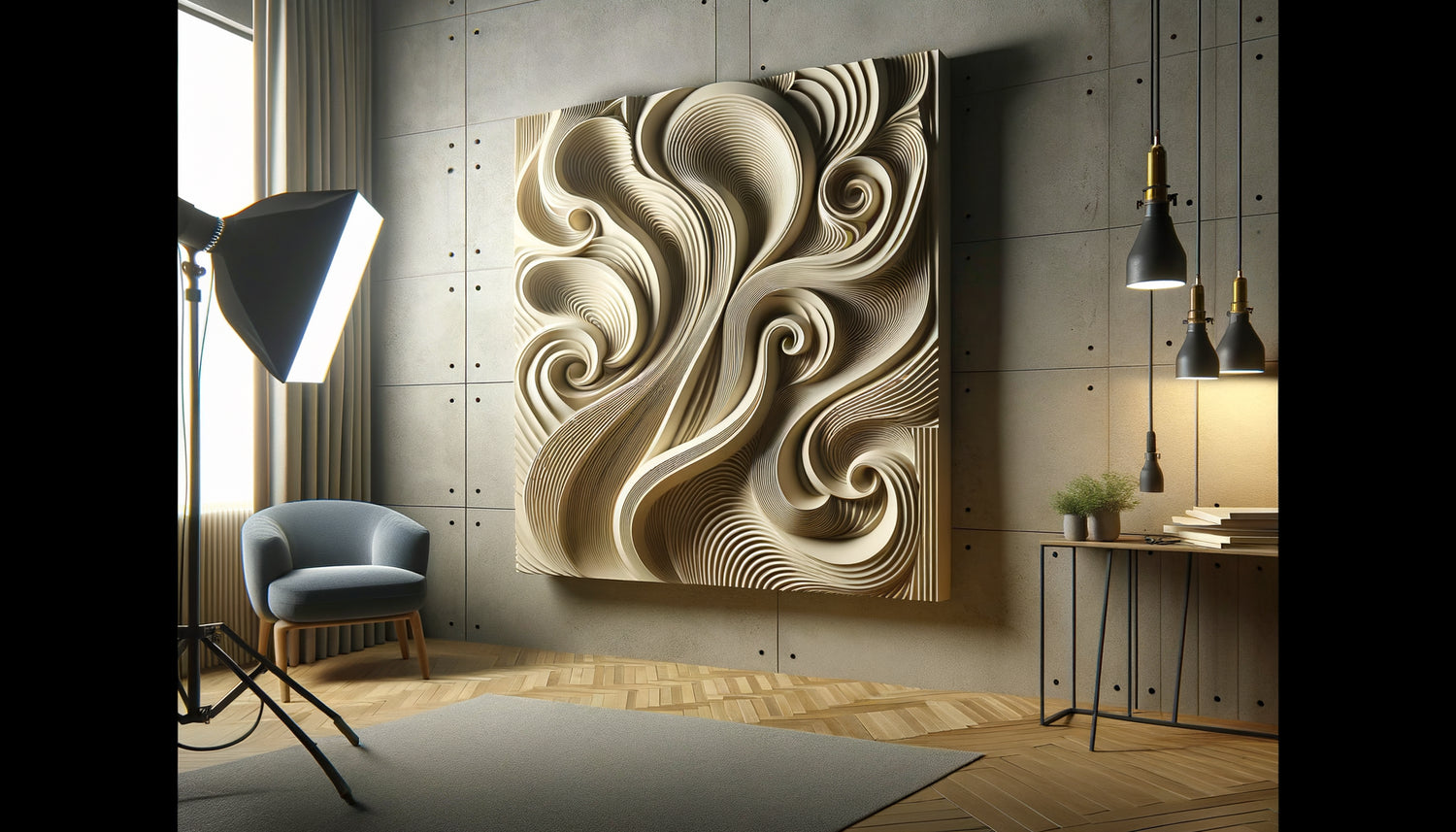
The first time a client sees a thermoformed wall painting in a curved format, they realize that the boundary between art and architecture has just blurred. These pieces don't simply decorate a wall – they redesign it spatially. A flat, boring wall suddenly gains depth, a three-dimensional presence that alters the perception of the entire space. I have created convex works that give the impression of enlarging a room, and concave shapes that create visual niches in monotonous open spaces. This sculptural dimension radically distinguishes the thermoformed painting from conventional solutions. Where a frame remains an object applied to a wall, the curved format dialogues with space, captures light differently depending on the viewing angle, creates shadows that evolve throughout the day. In high-end projects, this architectural quality alone justifies the investment.
Revolutionary Light Management
A flat wall painting reflects light in a predictable way – often with annoying reflections. A thermoformed curved format diffuses light at multiple angles, creating soft and changing lighting. In my workshop, I precisely calculate the radii of curvature to optimize this effect according to the ambient lighting of the installation location. For a hall bathed in natural light, a gentle convex curve will diffuse clarity without glare. In a space with directional artificial lighting, a more pronounced undulation will create fascinating games of shadow and light. This dynamic interaction with light makes a thermoformed painting seem alive, changing appearance depending on the time and season.
Simplified Installation: A Little-Known Technical Advantage
Do you think a complex curved work requires complicated installation? It's exactly the opposite. A thermoformed wall painting is often easier to install than a heavy traditional frame. The composite materials used offer an excellent strength-to-weight ratio – a two-meter piece can weigh less than five kilos. I have designed invisible fixing systems that integrate directly into the thermoformed structure during molding. Result: no visible frame, no visible hardware, just the work that seems to float against the wall. For curved formats intended to follow a pillar or column, I provide anchoring points every 40 centimeters, distributing the weight evenly and allowing perfect adherence to the geometry of the support. This ease of installation considerably reduces installation costs in professional projects.

Infinite Customization: Your Vision Takes Shape
In my workshop, each thermoformed artwork begins with a conversation. What curve embraces your space? What depth will create the desired visual impact? Thermoforming allows for almost unlimited personalization – from subtle undulations to complex organic shapes inspired by nature. I have created waves for a seafood restaurant, curves inspired by dunes for a spa, and bold geometric shapes for an architect's office. Each curved format can be adapted to the exact dimensions of your space, eliminating the frustrating compromise of ready-to-hang pieces that never fit perfectly. For series projects – hotel chains, commercial franchises – thermoformed wall art offers another advantage: exact reproducibility. Once the mold is created, I can produce strictly identical pieces, ensuring perfect visual consistency across all your locations.
Transform Your Curved Spaces into Exceptional Galleries
Discover our exclusive collection of luxury hotel art that combines technical innovation and aesthetic sophistication to enhance every curve of your architecture.
Your Space Deserves Better Than Flatness
Imagine yourself in six months, looking at the space that once frustrated you. That curved wall which seemed impossible to decorate now features a work of art that perfectly follows its contours. The morning light caresses its curves, creating moving shadows that bring your hall to life. Your guests stop, intrigued by this sculptural presence that transcends simple decoration. A thermoformed wall artwork doesn't just fill a space – it reveals its hidden potential, transforming an architectural constraint into a visual signature. Start by identifying that curved space you have abandoned: that central column, that rounded wall, that helical staircase. Measure its radius of curvature with a simple string. Visualize a work of art that would follow its shape, creating continuity between art and architecture. This is exactly what thermoforming allows you to achieve, with durability and elegance that traditional solutions cannot match.
Frequently Asked Questions about Curved Thermoformed Wall Art
Can a curved thermoformed artwork really withstand a high-traffic space?
Absolutely, and that's even one of its greatest strengths. I have installations in hotel lobbies welcoming thousands of passages daily for over five years, with no visible degradation. The thermoformed structure distributes mechanical stresses evenly, unlike traditional frames which concentrate tensions on their angles. The composite materials used – typically engineering polymers or high-density acrylics – possess an impact resistance superior to glass or wood. In commercial, collective or public spaces, this robustness represents a considerable economic advantage: fewer replacements, less maintenance, a flawless appearance that lasts. The curved format even adds extra protection: rounded edges resist impacts better than the sharp angles of rectangular frames.
How to maintain a curved thermoformed wall artwork?
Maintaining a thermoformed artwork is remarkably simple, much more so than a traditionally framed work. The monobloc surface – without joints or assemblies – does not retain dust and can be cleaned with a simple pass of a slightly damp microfiber cloth. Unlike wooden frames which require specific products or canvases that accumulate particles in their weave, the thermoformed artwork offers a smooth and non-porous surface. For installations in demanding environments – professional kitchens, spas, covered outdoor spaces – monthly cleaning with a mild detergent is more than sufficient. Thermoformed materials are resistant to UV rays, humidity and temperature variations without requiring any special treatment. This ease of maintenance represents a considerable time saving for space managers, and an appreciable comfort for individuals. No re-varnishing, no glass replacement, no restoration: your artwork retains its original appearance for decades with minimal maintenance.
Can any curve be created or are there technical limitations?
Thermoforming offers exceptional creative freedom, but like any technique, it has optimal parameters. Gentle, progressive curves – radius greater than 20 centimeters – are achieved without particular constraints and offer the best durability. For tighter curves or complex shapes combining multiple directions, everything depends on the material chosen and the thickness of the piece. In my workshop, I have created double-curved forms – like horse saddles – that followed particularly complex architectures. The key lies in thermoforming expertise: precise temperature, controlled cooling speed, choice of material adapted to the desired geometry. Before each project, I carry out a feasibility study based on the dimensions and curvature of your space. In 95% of cases, the architectural curve can be perfectly reproduced. For the remaining 5%, we find an approximate solution that preserves the spirit of the project while respecting the physical limits of the material. This bespoke approach guarantees a result that is both aesthetically perfect and technically durable.