

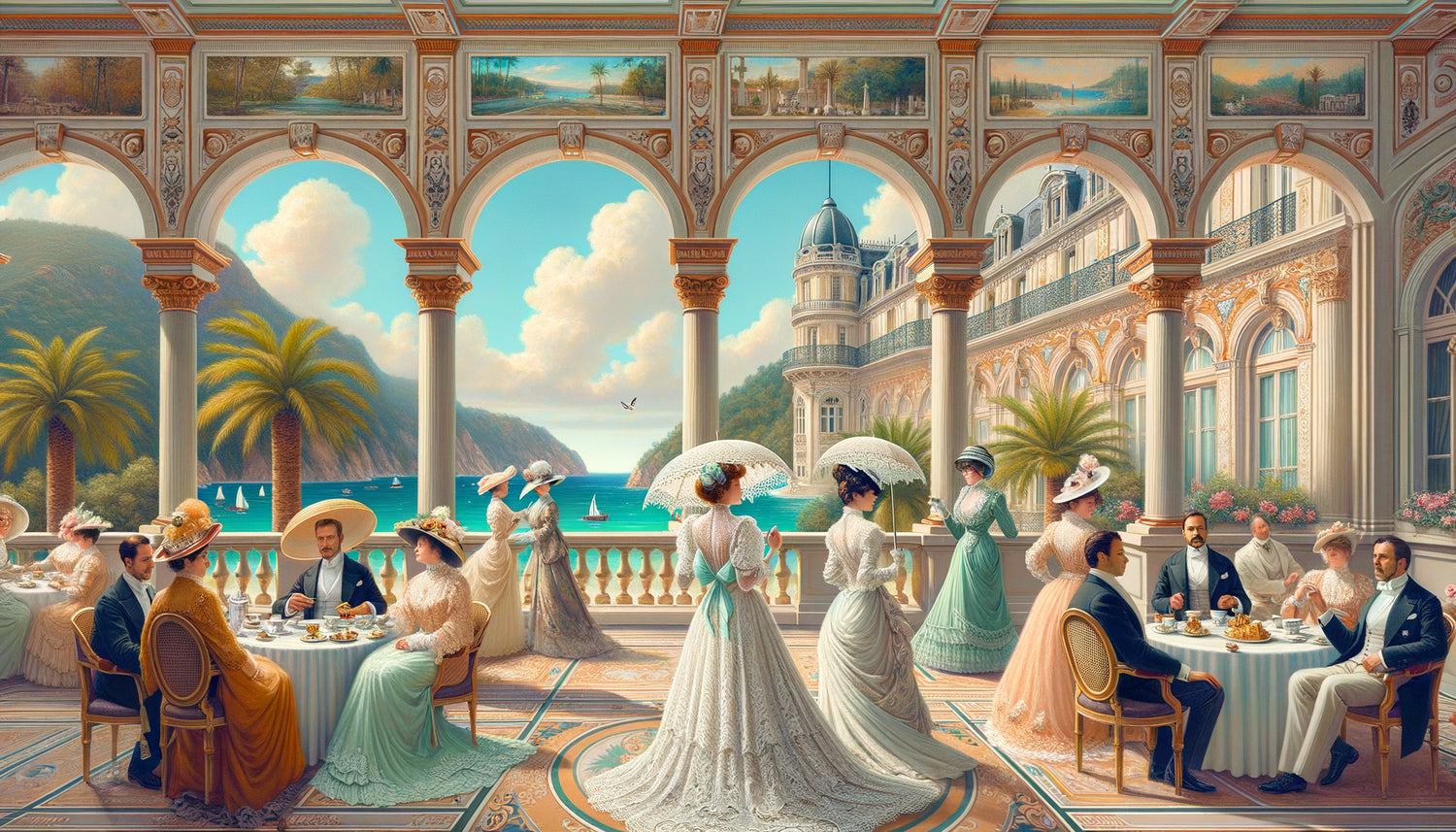
Imagine stepping through the threshold of a Nice palace in 1905. Your gaze rises to the walls of the grand hall, and there, under light filtered by crystal chandeliers, stretch monumental frescoes: aristocrats in flowing robes stroll through Mediterranean gardens, white umbrellas punctuate sun-drenched terraces, elegant silhouettes linger near sculpted fountains. These scenes of aristocratic leisure are not mere decorations. They constitute the visual language of a promise, that of belonging, for the duration of a stay, to a world of timeless elegance.
Here's what these wall decor brought to Belle Époque hotels: they transformed a simple place of accommodation into an aspirational social theater, reassured wealthy clients about their status by sending them back their idealized image, and created an aesthetic continuity between aristocratic art de vivre and modern hotel experience. In short, they sold tangible dreams.
Yet, this omnipresence of scenes of aristocratic leisure in the wall art of Belle Époque hotels is intriguing. Why this specific theme? Why not neutral landscapes, floral motifs, mythological scenes? The answer reveals a marketing strategy of surprising sophistication, combined with a fascinating sociological reflection on the aspirations of a pivotal era.
The palace as a flattering mirror of its time
The years 1880-1914 mark the apogee of a silent revolution: the relative democratization of luxury. For the first time in history, industrialists, bankers and wealthy merchants access spaces previously reserved for aristocrats by birth. Palaces become these places of controlled social mixing where a Lyon merchant can cross paths with an Austrian duke.
The scenes of aristocratic leisure painted on the walls then play a crucial role: they establish the visual codes of expected behavior. A panel showing aristocrats having tea on a Biarritz terrace discreetly teaches the nouveau riche how to behave, how to occupy space nonchalantly, how to perform distinguished idleness. Wall art becomes a silent manual of etiquette.
I studied the order books of the Guérin workshop in Paris, specializing in hotel decor. The instructions from establishment managers are revealing: 'Show leisure as natural, never ostentatious', 'Privilege daytime scenes suggesting cultivated leisure', 'Avoid any reference to work or effort'. These decorations meticulously construct the illusion of a life where time stretches out infinitely.
Leisure as a visual appeal product
Beyond the social function, scenes of aristocratic leisure function as integrated advertising. Belle Époque hotels develop in newly accessible seaside, spa or mountain resorts. Their challenge: convince a Parisian or London clientele to come and spend several weeks in previously isolated places.
Murals depicting aristocrats enjoying these very places accomplish a marketing feat. They show that vacationing in Nice, Deauville or Montreux is not an exile in the provinces, but the new center of worldly life. An industrialist contemplating a scene of aristocratic promenade on the Croisette immediately understands: this is where social theater is now being played.
The archives of the Hôtel Negresco reveal that decorative panels were often inspired by real photographs taken on site, but systematically 'aristocratized': clothing became more luxurious, postures more studied, servants more discreet. This augmented pictorial reality created a powerful aspirational effect: clients wanted to recreate these scenes, become characters in these living paintings.
The chromatic palette of aspiration
The colors used in these aristocratic resort scenes are no accident. Palaces systematically favor pastel and golden tones: powdered pinks, sky blues, almond greens, luminous ochres. This color scheme evokes both the aristocratic refinement of the 18th century (a reference to Fragonard and Watteau) and contemporary Mediterranean light.
This color strategy creates a visual continuum between aristocratic tradition and Belle Époque modernity. The client stays in a resolutely modern establishment (elevators, electricity, private bathrooms) while bathing in a visual atmosphere that connects them to five centuries of European aristocratic culture. The wall scenes are the temporal bridges of this alchemy.

Aristocracy as a certificate of cultural legitimacy
There is a deeper dimension to this omnipresence of aristocratic resort scenes: it responds to an anxiety of cultural legitimacy among new economic elites. The aristocracy, even politically declining after 1870-1880, retains a symbolic monopoly on good taste and the art of living.
By wallpapering their walls with aristocratic scenes, Belle Époque hotels offer their bourgeois clientele a form of cultural validation by proxy. The subliminal message is clear: 'By staying here, you adopt the millennial aesthetic codes of European aristocracy'. The frescoes function as certificates of visual authenticity.
Contemporary testimonials are eloquent. In her memoirs, the Countess of Pange notes with irony that nouveau riche 'seem reassured by these images which confirm they are doing things correctly'. This pedagogical and reassuring function of wall decorations explains their ubiquity: they transform social insecurity into cultural confidence.
When architecture dialogues with mural painting
The effectiveness of aristocratic resort scenes also lies in their sophisticated architectural integration. Belle Époque decorators master the art of creating spatial illusions: a fresco depicting a terrace open onto the sea visually extends a living room, mentally abolishing walls.
Trompe-l'œil techniques allow for the fusion of real space and represented space. A client having coffee in the reading room finds themselves virtually seated alongside the painted aristocrats, imaginarily participating in their silent conversation. This porosity between reality and representation amplifies the aspirational effect.
I analyzed the original plans of the Carlton de Cannes: decorative panels were positioned precisely to be visible from compulsory points of passage (reception, main staircase, restaurant entrance). This visual orchestration ensured that each client was immersed daily in the aristocratic universe, through repeated exposures, until complete internalization of codes.
The role of recurring elements
Certain motifs obsessively recur in aristocratic resort scenes: the parasol, the boater hat, the book carelessly placed, the pet dog, the deck chair. These totem objects function as instantly recognizable class markers.
The parasol, in particular, crystallizes a whole system of values: it signals pale skin (proof that one does not work outdoors), constant aesthetic concern, cultivated aristocratic fragility. Its recurrence in wall decorations makes it an ideogram of social status. Clients of palaces also massively bought parasols in the adjacent shops, creating this virtuous commercial loop where wall art stimulates the consumption of accessories.

The legacy of fêtes galantes revisited
The aristocratic resort scenes of Belle Époque hotels are a direct lineage with the fêtes galantes of the 18th century. Watteau, Fragonard and Boucher had already created this imagery of aristocracy at leisure in the countryside, in idealized gardens where social time seems suspended.
Belle Époque decorators simply update this visual vocabulary: the gardens of Versailles become terraces of Menton, hoop skirts transform into Edwardian dresses, but the narrative structure remains identical. It is still about showing the aristocracy in their supposed natural element: elegant idleness outdoors.
This aesthetic continuity reassures a cultivated clientele: they recognize familiar pictorial codes, learned in museums. Wall scenes thus become doubly legitimate, by their subject (the aristocracy) and by their style (the legacy of the masters). A German industrialist may know nothing about French social codes, but recognizing a composition 'after Watteau' gives him cultural references.
Transform your spaces into echoes of this timeless elegance
Discover our exclusive collection of luxury hotel wall art that captures the refined spirit of the Belle Époque and creates an atmosphere of aristocratic elegance in your establishments.
When decor becomes a total experience
Ultimately, the dominance of aristocratic resort scenes in the wall art of Belle Époque hotels reveals an early understanding of experiential marketing. These establishments were not simply selling rooms, but a temporary identity transformation.
Wall frescoes constituted the visual infrastructure of this metamorphosis. By immersing themselves daily in representations of aristocratic life, the client gradually internalized these codes, subtly modified their gestures, their way of occupying space, their relationship to time. Scenes of aristocratic resorts functioned as anticipatory mirrors: they did not show the customer who they were, but who they could become during a stay.
This alchemy explains why these decorations were so carefully maintained, regularly restored, considered as strategic investment rather than simple embellishment. Belle Époque hotel managers intuitively understood what modern marketing would formalize a century later: visual environments shape behaviors and aspirations.
Today, when we contemplate the vestiges of these wall decorations in historic palaces, we perceive their strategic sophistication. These aristocratic resort scenes were not decorative nostalgia but social aspiration technologies of formidable effectiveness. They have shaped the imaginary of luxury hospitality for over a century, establishing visual codes that the industry has never completely abandoned. The aristocracy painted on these walls continues, phantomly, to define our unconscious expectations of luxury.
FAQ : Understand everything about Belle Époque wall decorations
Why did Belle Époque hotels prefer aristocratic scenes to simple landscapes?
Neutral landscapes told no social story, while aristocratic resort scenes encoded behaviors and aspirations. A mountain landscape remains decorative; a scene showing aristocrats having tea in the mountains becomes a social instruction manual. Hotel managers sought to create an aspirational atmosphere, not simply a pretty one. Aristocratic scenes turned clients into actors in a social theater, whereas a landscape left them passive spectators. This difference justified the considerable investment in complex narrative decorations rather than generic picturesque views. The return on investment was measured in customer loyalty and establishment prestige.
Did these wall decorations really influence customer behavior?
Absolutely, and in a measurable way. Period memoirs are full of accounts of the psychological effect of hotel decor. Clients unconsciously adopted the postures and attitudes represented: straighter posture, more measured gestures, different occupation of common areas. Photographers of the time note that clients naturally posed 'as in frescoes'. Hoteliers also report a change in requests: more 'aristocratic' services (afternoon tea, organized walks) in establishments with elaborate narrative decorations. The visual environment created a gentle social pressure towards certain behaviors, exactly as intended by the designers. It was behavioral design ahead of its time, using art as a vector for temporary social transformation.
Can this decorative approach still be used today in luxury hospitality?
It's not only possible but strategically relevant, provided you adapt the codes. Explicit aristocracy no longer works as a universal aspirational marker, but the underlying principle remains valid: showcase the idealized clientele in the desired experience. The most sophisticated contemporary hotels use narrative décor showing cultured, cosmopolitan, and culturally engaged travelers. The aristocratic resort scene becomes a scene of initiatory travel, cultural exploration, and holistic well-being. The best decorators today draw directly from Belle Époque methodology: identify the deep aspirations of the target clientele, then create a visual environment that embodies and validates them. Wall art remains a powerful marketing tool, simply updated in its iconographic vocabulary to resonate with contemporary values of luxury.


