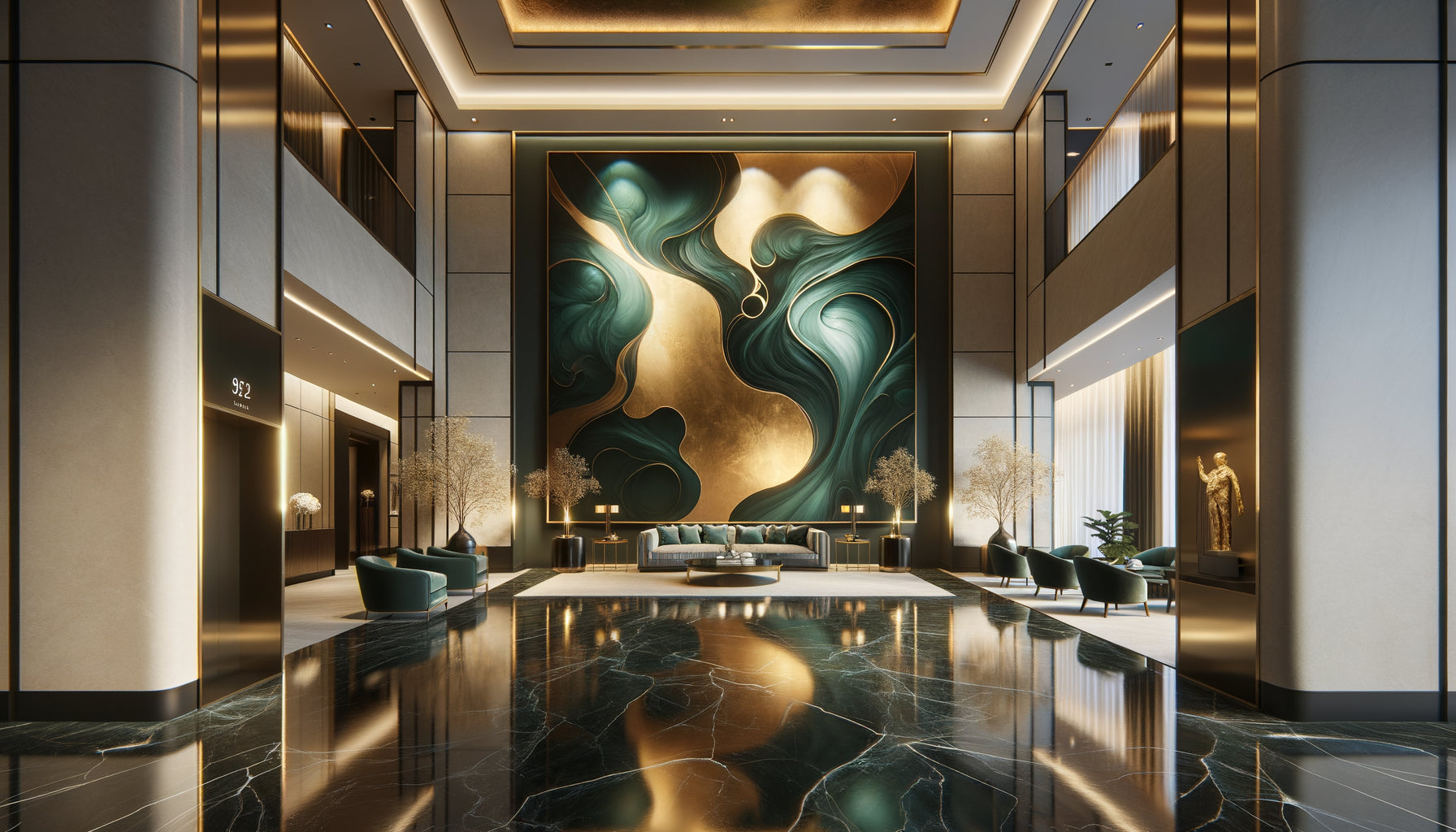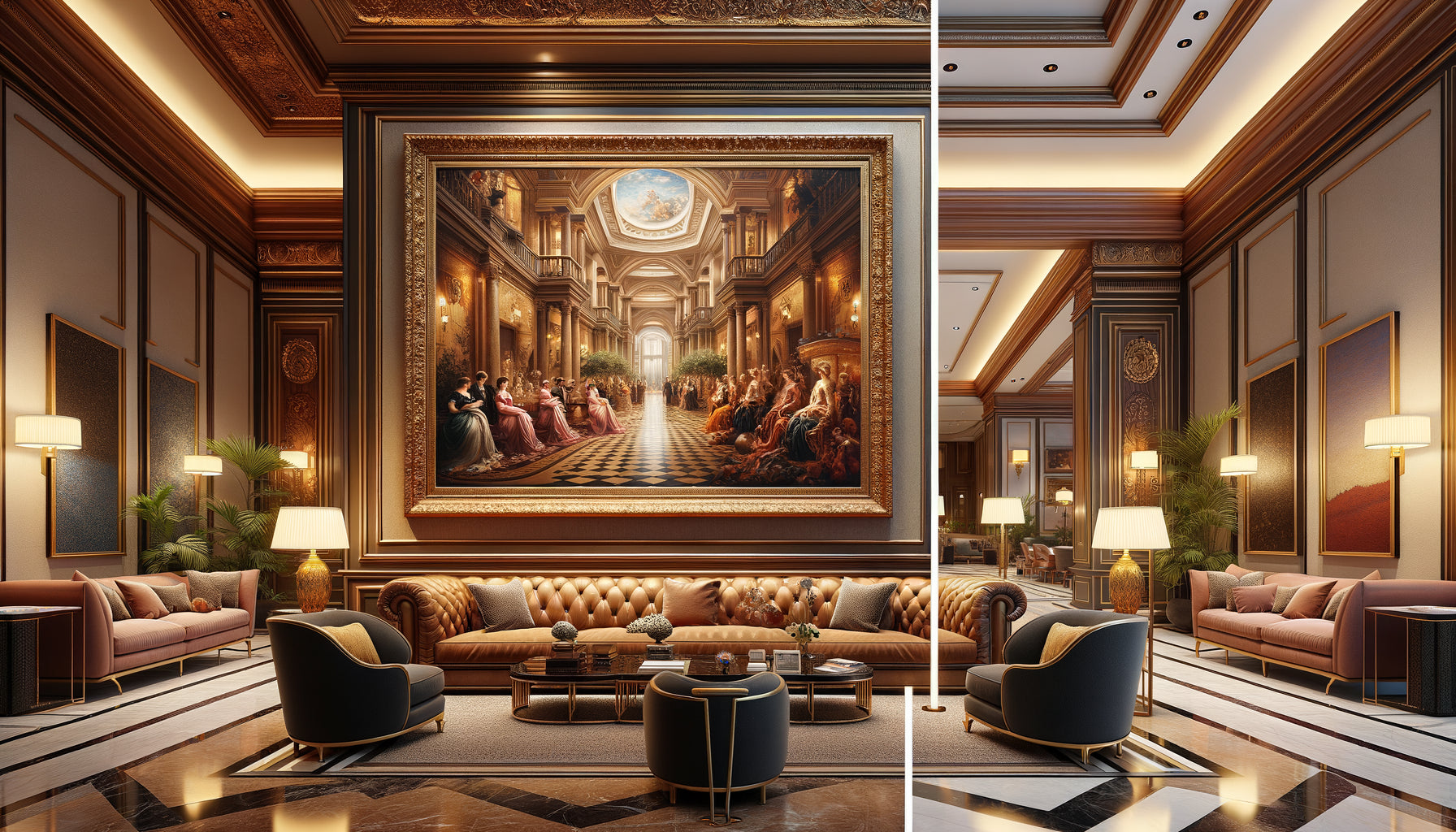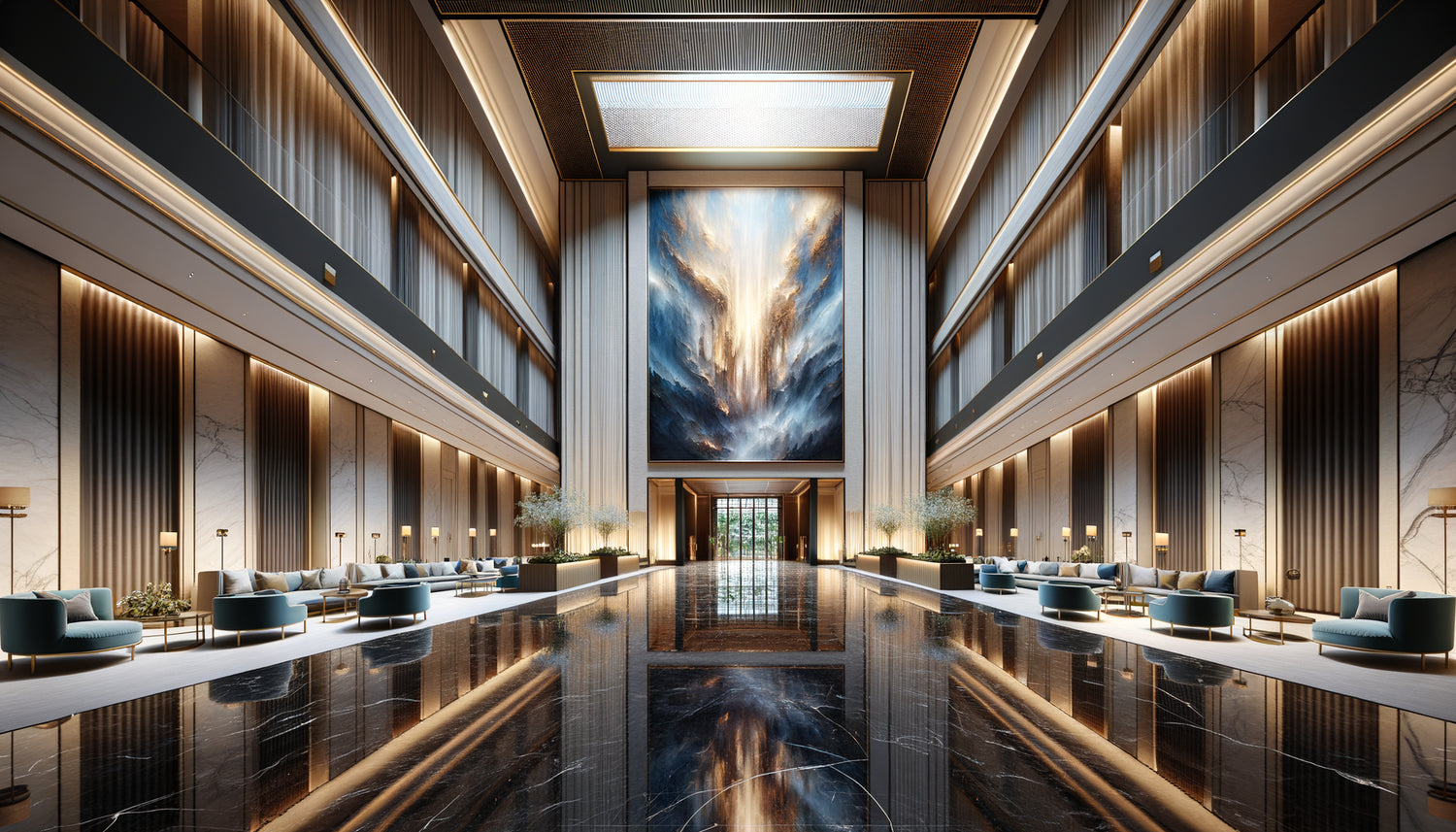
I spent fifteen years designing interiors for Parisian palaces, from Dubai to Shanghai. And every time a hotel manager calls me to rethink their lobby or presidential suites, the same request comes up: “We want something that immediately strikes, that marks the minds.” The answer often lies in a precise architectural gesture: installing a monumental work that instantly transforms the atmosphere.
Here's what large formats bring to exceptional hotel spaces: an immediate presence that visually structures the space, a feeling of luxury and exclusivity without decorative clutter, and a memorable signature that anchors the identity of the place. These three pillars explain why you will never see a palace displaying a multitude of small frames in its reception areas.
You may be the owner of a high-end establishment, or simply fascinated by these universes where every detail counts. You wonder how these places manage to create this impression of timeless elegance at first glance. Why do some hotel lobbies take your breath away while others remain anonymous despite their standing?
The answer lies neither in the budget nor in precious materials, but in a deep understanding of proportions and visual impact. Art directors of the largest hotel groups have understood this for a long time: one well-chosen monumental format is better than ten average works.
I am going to reveal the principles that I apply in every large-scale project, these silent codes that transform a simple wall into an architectural manifesto. Rules that you can adapt, whether you manage a boutique hotel or are simply looking to understand decorative excellence.
The law of proportions: when architecture dictates the format
In the lobby of the Shangri-La in Paris, facing five meters of ceiling height, I installed a canvas 2.80 meters high. Not by chance. Large formats respond to a mathematical logic that every interior architect knows: the ratio between the height of the wall and the height of the work should oscillate between 50% and 70% to create perfect visual balance.
Five-star hotels have generous volumes – often 3.50 meters to 6 meters under ceiling in reception areas. A 50x70 cm painting on such a wall looks like a lost postage stamp. It creates a void, a visual insufficiency that the brain instantly perceives as an imbalance. Conversely, a large-format wall decoration naturally asserts itself, dialogues with the architecture instead of getting lost in it.
I learned this lesson during a project in Geneva. The client had insisted on a gallery of twelve small formats in his private living room. Result: the eye darted around without ever settling, creating visual fatigue. We replaced the whole thing with three monumental paintings. The appeasement was immediate. High-end hotel spaces seek precisely this effect: visual serenity despite luxury.
Immediate emotional impact: create the « wow » effect
A client steps through the threshold of a palace. They have three seconds – sometimes less – to form their lasting impression. Luxury establishment directors know this: that initial emotion determines the entire experience. And within that infinitesimal timeframe, only a dominant visual element can capture attention and trigger wonder.
Large-scale wall art functions as emotional anchors. During the renovation of Florence’s Four Seasons, we installed a 4-meter wide contemporary abstraction in the hall. Gazes instantly converge on it, creating that famous “wow” effect sought by all exceptional hotel directors.
This strategy is based on a simple neurological principle: our brains prioritize large stimuli. A monumental painting enters our field of vision before we are even consciously aware of it. It creates a clear visual hierarchy, naturally guiding the gaze and structuring the spatial experience. Smaller formats, however remarkable they may be, require an active approach, an intention to look. Luxury hospitality cannot afford this requirement.
The memorable visual signature
I’ve noticed a fascinating phenomenon when consulting customer reviews of the establishments I have decorated: visitors spontaneously mention the monumental works they discovered. “That incredible painting in the hall,” “that impressive fresco near the elevator.” Large formats become memorable landmarks, distinctive elements that anchor the identity of the place in the minds of travelers.
This memorability has considerable commercial value. In an ultra-competitive hotel market, differentiation becomes vital. Luxury hotels have understood this: a well-chosen monumental format functions as a signature, an element of identification as powerful as a logo or an iconic facade.

Space management: structuring without partitioning
Interior architects facing vast hotel spaces face a constant challenge: how to define zones without fragmenting the space. Partitions weigh down, screens are dated, changes in flooring cost a fortune. Large-scale wall art offers an elegant solution to this age-old problem.
At the Nolinski Paris, we used three very large format artworks to define three distinct atmospheres in a 200-square-meter open lobby. A mineral abstraction near reception, a dreamlike landscape on the lounge side, an organic composition towards the restaurant. Each work creates an identifiable visual zone without ever interrupting the flow of circulation.
This technique relies on the notion of focal point. In interior design, a focal point attracts the eye and organizes the reading of space around it. A large format naturally fulfills this function. It becomes the visual center of gravity of a zone, allowing to create coherent sub-spaces in an open volume. High-end establishments favor this approach because it preserves spatial generosity while offering the sought-after intimacy.
Verticality as a space amplifier
Paradoxically, a monumental vertical artwork does not shrink a wall: it visually enlarges it. By attracting the gaze upwards, a large format work exploits all available height and accentuates the perception of volume. This is particularly crucial in suites where the feeling of space constitutes a fundamental criterion of luxury.
I systematically apply this rule in presidential suites: an imposing vertical format above or facing the bed transforms a beautiful room into an exceptional suite. 5-star hotels understand that luxury is measured in terms of spatial sensation, and large formats are a cost-effective spatial amplifier compared to structural work.
The balance between minimalism and opulence
Here is the paradox of contemporary luxury: wealthy clients now flee decorative overload. They seek out clean spaces where every element counts. But how to create visual luxury without accumulation? Large formats resolve this delicate equation.
A single monumental work advantageously replaces ten decorative elements. It asserts a strong aesthetic bias while maintaining visual sobriety. This is the philosophy I applied to Cheval Blanc Courchevel: very large format artworks in each key space, but never more than two per room. The result? An impression of discreet and refined luxury, far from ostentation.
Art directors of premium hotel groups have understood this: a well-chosen monumental format communicates more than a profusion of objects. It testifies to a vision, a demanding curation. In today's codes of luxury, this voluntary restraint paradoxically signals a higher level of excellence than ostentatious abundance.

The strategic role in brand identity
Each palace develops a distinctive visual identity. Hotel groups invest fortunes in brand strategy, olfactory signatures, and proprietary design. And within this identity arsenal, large format murals play a central role often underestimated.
During a project for an international group, we developed a concept of monumental artworks collection declined in their eighteen European establishments. Each hotel received three large-format paintings sharing a common visual language but adapted to the local context. This consistency created a recognizable signature while respecting the specificities of each destination.
The large-scale artworks function as emblems. They naturally appear in architecture photographs, on websites, and in customers' Instagram publications. They become, without particular marketing effort, the visual ambassadors of the establishment. This organic visibility explains why luxury hotel managers consider the choice of their large formats as a strategic decision, not simply decorative.
Art investment as positioning
A monumental artwork of quality represents a significant investment. And that is precisely what interests exceptional establishments. By choosing remarkable large format artworks, they signal their commitment to artistic excellence. This approach radically differentiates a true luxury hotel from a simply comfortable establishment.
I also observe a fascinating evolution: some palaces are now developing real art collections around their large formats, even offering guided tours to their clients. The monumental artwork then becomes a service, a cultural experience integrated into the stay. This positioning elevates the hotel to the rank of cultural institution, an enviable status in the ultra-premium segment.
The technical considerations that justify the choice
Beyond aesthetics, pragmatic reasons explain the preference of 5-star hotels for large formats. Maintenance, for example. A monumental artwork requires fewer maintenance interventions than a composition of multiple small formats. Fewer frames to adjust, fewer fixings to check, less glass surface to clean.
Decorative flexibility is another little-known advantage. Changing the ambiance of a space simply requires changing the main large format. This operation, although costly, remains more economical and less disruptive than a complete renovation. Hotel managers appreciate this ability to refresh their decor without major work.
Finally, the issue of timelessness. Quality monumental artworks, properly installed, last for decades without losing their impact. They are a lasting investment, consistent with the long-term vision of heritage establishments. Small formats, more sensitive to ephemeral trends, age faster and require frequent replacements.
Transform your spaces with the elegance of large formats
Discover our exclusive collection of luxury hotel wall art that brings this memorable visual signature to exceptional spaces.
Visualize your transformed space
Imagine your entrance hall tomorrow morning. A guest pushes the door. Their gaze is immediately captured by this monumental presence on the wall facing the entrance. No need to accumulate decorative details, no tiring profusion. Just this majestic artwork that structures the space and anchors the identity of the place.
The most beautiful 5-star hotels in the world have understood that contemporary luxury goes hand in hand with sobriety. An exceptional large format is worth all budgets scattered in small touches. It creates this impression of evidence, of natural perfection that characterizes exceptional places.
Whether you manage a hotel establishment or simply want to understand the codes of spatial luxury, remember this principle: the power of a space is measured by its ability to mark memories with elegance. And in this quest for excellence, monumental formats are your best ally.
Start by observing the proportions of your main space. Measure the height of your walls. Then imagine an artwork that occupies 60% of this height. This is the first step towards a visual transformation that will distinguish your place from all others. Large formats are not an aesthetic whim: they respond to spatial, emotional and strategic logics mastered by the world's leading establishments.
Frequently Asked Questions About Large Formats in Luxury Hotels
What is the minimum size for a piece to be considered large format in a hotel?
In professional hospitality settings, we generally consider large format starting from 120 cm in the smallest dimension. For lobbies and halls of 5-star hotels, dimensions often start at 150x150 cm and can reach 300x400 cm. The rule I consistently apply is: the artwork should occupy between 50% and 70% of the wall's height to create an optimal visual impact. A format that is too small on a large wall creates an uncomfortable imbalance, while a suitable format naturally structures the space. Remember that perception of size also depends on the volume of the room: an 180 cm artwork will appear imposing in a 30m² suite but modest in a 200m² lobby. Art directors of palaces always work with scale models before investing in a monumental work, a precaution I highly recommend.
Are large formats also suitable for small boutique establishments?
Absolutely, and it's even a particularly effective strategy for boutique hotels looking to position themselves in the premium segment. I have worked on several projects of small establishments with 8 to 15 rooms where a single large format in the lobby immediately created an impression of luxury and artistic curation. The key lies in adapting proportions: a boutique hotel with a hall of 40m² will greatly benefit from a 150x200 cm artwork, whereas a palace will install a work of 300 cm. What's important is not the absolute size but the harmonious relationship between the artwork and the space. Small establishments even have an advantage: they can afford bolder artistic choices, creating a strong identity with a controlled budget. A quality large format will position your establishment well above standard accommodations, even with reduced capacity.
How to choose between a monumental unique artwork or several large formats?
This decision depends on three factors: the configuration of your space, your desired visual identity, and the customer journey. For a lobby with an obvious focal point – the wall facing the main entrance – a single monumental work will create maximum impact. This is the solution I prefer for compact spaces where the gaze must converge on a single strong element. On the other hand, in large L-shaped halls or multifunctional spaces (reception-lounge-bar), several large formats allow you to define distinct zones while maintaining visual consistency. I recently furnished a Parisian hotel with three 180x200 cm paintings forming a thematic triptych on three perpendicular walls: the effect was spectacular while naturally guiding circulation. The golden rule: never more than three major focal points in the same space, otherwise you risk creating a tiring visual competition. Always prioritize quality over quantity: a single exceptional format will mark people's minds more than an accumulation of average works.