Last year, I assisted a Parisian boutique hotel manager in a dispute that could have been avoided. A contemporary artwork, displayed in their lobby for three years, turned out to be a forgery. Between the outraged artist, the disappeared gallery owner, and the disappointed clients, legal fees exceeded €45,000. This mishap confirmed an obvious point to me: legally protecting wall art displayed in hotel public spaces is not an option, it's an absolute necessity. Here's what legal protection for wall artworks brings to your establishment: it secures your artistic investments against litigation, preserves your reputation by guaranteeing the authenticity of your collections, and transforms your spaces into legally impeccable cultural showcases. Too many hoteliers think a simple purchase invoice is enough. They discover too late the grey areas of copyright law, missing clauses in their acquisition contracts, or legal obligations related to public display. Rest assured: with the right legal reflexes, you can create a wall collection that delights your guests while allowing you to sleep soundly. I'm going to share with you the essential protections I have put in place for dozens of hotels.
Here's what legal protection for wall artworks brings to your establishment: it secures your artistic investments against litigation, preserves your reputation by guaranteeing the authenticity of your collections, and transforms your spaces into legally impeccable cultural showcases. Too many hoteliers think a simple purchase invoice is enough. They discover too late the grey areas of copyright law, missing clauses in their acquisition contracts, or legal obligations related to public display. Rest assured: with the right legal reflexes, you can create a wall collection that delights your guests while allowing you to sleep soundly. I'm going to share with you the essential protections I have put in place for dozens of hotels.
The fundamentals of intellectual property in hospitality
The first confusion I systematically encounter? Buying a wall art does not mean acquiring its exploitation rights. You own the physical object, certainly, but the artist automatically retains their moral and patrimonial rights. This fundamental legal distinction changes everything for a hotel.
Specifically, when you display an artwork in your lobby, restaurant or hallways, you are carrying out a communication to the public within the meaning of the Intellectual Property Code. Even without an admission ticket, even if the work simply decorates the space, you must obtain authorization for reproduction and representation. I have seen establishments receive cease and desist letters for having simply photographed their decor including protected works, then disseminated these images on their website.
Protection begins at the time of acquisition. Systematically request a detailed certificate of authenticity mentioning the exact title, dimensions, technique, year of creation and above all the provenance of the work. This document proves your good faith in case of dispute and facilitates insurance procedures. For luxury hotel art, I always insist that this certificate be accompanied by an archived high-definition photograph.
The duration of copyright protection
A crucial, often overlooked point: copyright lasts for 70 years after the artist’s death. This long period means that most contemporary and modern works remain protected. Before displaying a wall art piece in your common areas, be sure to check whether the artist is still alive or if their heirs can claim rights. Works by artists who died before 1953 generally fall into the public domain, offering total freedom of display.
The acquisition contract: your legal shield
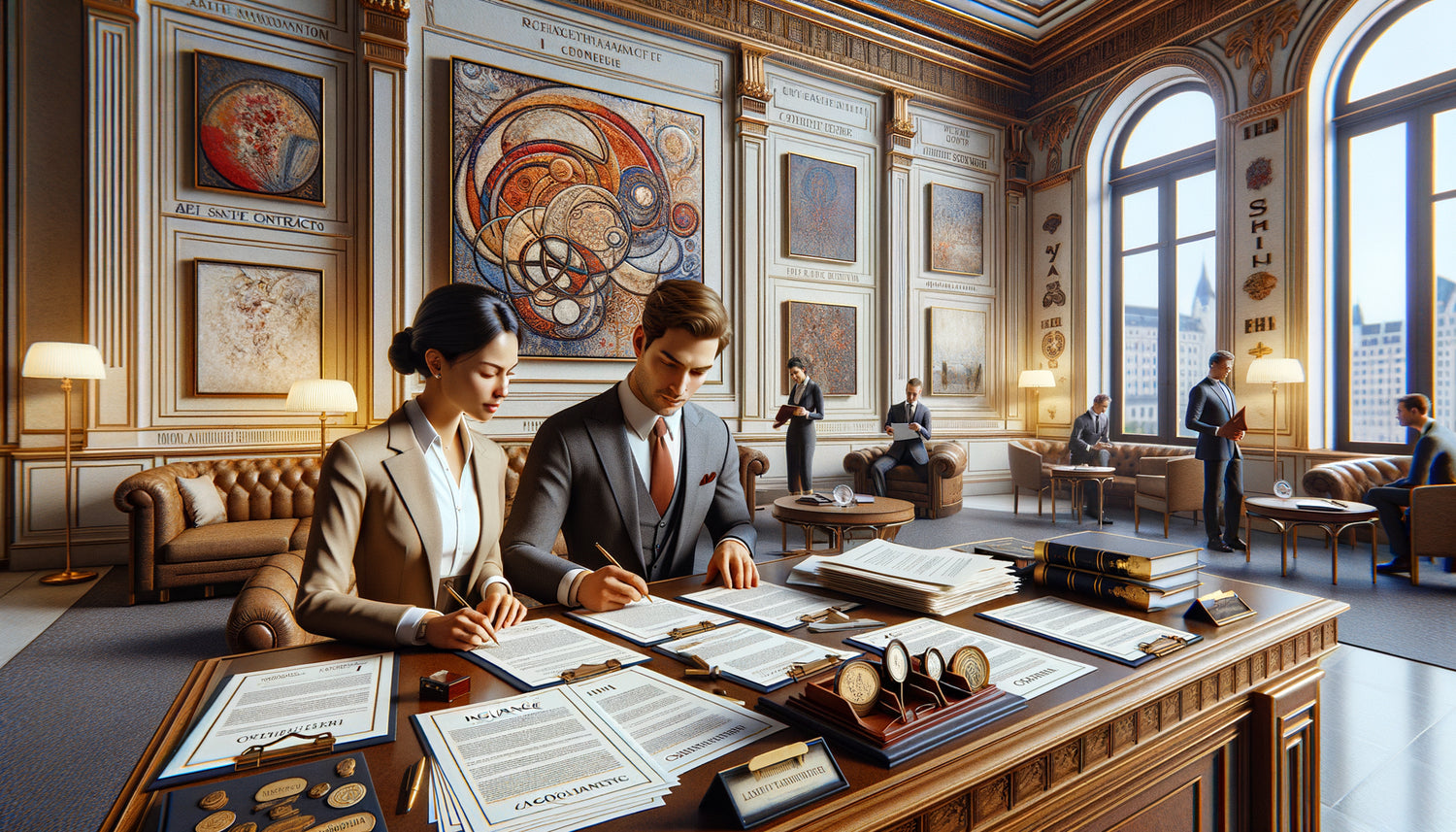
The contract that accompanies the purchase of your wall art pieces constitutes your first line of legal defense. I have developed a standard clause that I now systematically integrate: the guarantee of eviction. It obliges the seller to indemnify you if a third party claims ownership of the work or contests your right to display it.
In this contract, three clauses seem absolutely essential to legally protect your wall art pieces. Firstly, the cession of photographic reproduction rights: you must be able to take photos of your decorated spaces for your communication without having to ask permission each time. Secondly, the clause of destination which explicitly states that the work will be exhibited in a hotel space open to the public. Thirdly, the limitation of liability in case of accidental damage by a client.
For significant acquisitions, I add a reverse droit de suite clause. If the value of the work increases significantly, you agree to pay a percentage to the artist in the event of resale, creating a lasting and benevolent relationship. This ethical approach paradoxically strengthens your legal security: a satisfied artist will never seek to cause you trouble.
Deposit and loan contracts
Many hotels exhibit works on consignment or temporary loan. These configurations require even more precise contracts. The deposit contract must specify who assumes the insurance, who bears the risk of theft or degradation, and what are the conditions for restitution. I have negotiated agreements where the hotel takes out insurance in exchange for a reduced commission on sales, creating a win-win situation.

Insurance: anticipating the unpredictable
A wall art piece displayed in a hotel's public space faces risks that private collectors ignore. Suitcases bumping into frames, children touching them, humidity variations due to constantly open doors, not to mention theft attempts.
Your establishment's standard insurance policy generally does not adequately cover artworks. You must subscribe to an all-risk art insurance with several specific guarantees: theft, fire, water damage, accidental breakage, and especially extended professional liability insurance that covers you if a client is injured due to a poorly secured painting.
I always insist that my clients have a valuation appraisal carried out every three years. Art markets evolve rapidly, and a painting purchased for 5,000 euros can be worth 25,000 euros a decade later. Your insurance contract must reflect this updated value, otherwise you risk being seriously underinsured in the event of a claim.
Preventive photographic documentation
Photograph each wall art piece from multiple angles, in high resolution, immediately after installation. These images constitute irreplaceable evidence in the event of a dispute with your insurer regarding the initial condition of the artwork. I also archive maintenance and restoration invoices, which demonstrate your diligence in preserving artworks and strengthen your legal positions.
Legal obligations for public display
As soon as your wall art pieces are visible to your customers, you fall within the scope of public exhibition. This legal situation implies obligations often unknown to hoteliers.
If you exhibit works by living artists or deceased less than 70 years ago, you must obligatorily mention the artist's name near the artwork. This is respect for moral rights, inalienable and perpetual. A simple elegant label is sufficient, but its absence constitutes a copyright violation. I have seen hotels sentenced to pay damages for this simple oversight.
The issue of photographic reproductions deserves special attention. Your customers constantly take photos of your public spaces and share them on social networks. Legally, you cannot prevent them from doing so, but you can protect yourself by obtaining from the artist an exhibition authorization with a photographic tolerance clause. This clause specifies that the artist accepts that their work is photographed as part of the normal use of the hotel.
Protection against counterfeiting
Before acquiring wall art for your common areas, perform a thorough provenance check. For artists with established reputations, consult databases of stolen artworks such as Interpol Stolen Works of Art or the Art Loss Register. This due diligence protects you legally: if you later discover that your artwork is stolen, your documented good faith significantly limits your liability.

When art becomes communication: the pitfalls of hotel marketing
Here's the trap that 80% of establishments fall into: using images of their wall art in their marketing communications without explicit authorization. Your beautiful Instagram photo of the lobby with this spectacular contemporary artwork? It constitutes an illegal reproduction if you have not obtained the corresponding rights.
The solution I consistently recommend: negotiate a reproduction license for promotional purposes from the outset. Specify the authorized media (website, brochures, social networks) and the duration of this authorization. Some artists graciously accept this license in exchange for the visibility offered by your hotel. Others request compensation, generally modest if negotiated upfront.
I advised a four-star hotel that had made its wall art the central element of its visual identity. We structured a win-win partnership with a local gallery: the hotel exhibited rotating artworks every six months, obtained reproduction rights for its communication, and the gallery benefited from an exceptional showcase to a wealthy clientele. This model legally secures the hotel while constantly renewing its decor.
Creating a collection register: the legal memory of your hotel
The legal protection of your wall art largely depends on the quality of your documentation. I recommend creating a digital and physical collection register that centralizes all essential information.
For each artwork, this register should include: the certificate of authenticity, the complete acquisition contract, invoices, proof of payment, exhibition and reproduction authorizations, insurance policies, expert reports, and high-resolution photographs. This file constitutes your legal arsenal in case of dispute, tax audit, or insurance claim.
I always add a traceability section that documents the artwork’s history before acquisition. Where does it come from? Who previously owned it? This artistic genealogy enhances your collection and significantly strengthens your legal position. The more you can trace the journey of a wall art piece, the more protected you are against third-party claims.
Transform your spaces into secure galleries
Discover our exclusive collection of wall art for luxury hotels that combines artistic excellence and total legal security, with certificates of authenticity and clarified exhibition rights.
From compliance to a differentiating factor
Legally protecting your wall art does not represent a bureaucratic constraint, but a strategic opportunity. Establishments that master these legal aspects transform their artistic collection into a true distinctive signature.
Imagine presenting to your clients a documented artistic journey, with plaques telling the story of each work, QR codes revealing creation details, and the pride of exhibiting pieces whose provenance and rights you fully control. This professional approach instantly elevates your positioning.
Start by auditing your existing wall art. For each artwork displayed in your common areas, verify that you have the essential documents. Identify legal risk areas and gradually regularize them. This preventive approach will avoid costly disputes and transform your collection into a truly valued asset. Art and law, far from opposing each other, reinforce each other to create hotel spaces that are both inspiring and perfectly secure.
Frequently asked questions about the legal protection of wall art in hospitality
Do I need to pay copyright for exhibiting a painting that I bought in my hotel?
Excellent question that reveals a common misunderstanding. Purchasing a wall art transfers ownership of the physical object only, not exploitation rights. Technically, displaying this artwork in a publicly accessible space constitutes a representation requiring the artist's authorization. However, most artists and galleries consider that an exhibition within a hotel setting, without direct profit linked to the artwork itself, falls within normal use. My recommendation: systematically obtain written display authorization when purchasing, even if free. This simple precaution avoids any subsequent dispute and demonstrates your professionalism. For works by artists deceased for more than 70 years, you are completely free to exhibit without authorization, these creations having fallen into the public domain.
How can I verify that a painting is not a forgery before buying it for my hotel?
Authenticity verification constitutes your fundamental legal protection. Start by requiring a detailed certificate of authenticity from the seller, ideally issued by the artist themselves, their representative gallery or a recognized expert. This document should mention the precise technical characteristics of the work and its provenance. For established artists, consult their raisonné catalogue, this exhaustive directory of their authenticated creations. Also request a detailed invoice that engages the seller's responsibility. If the acquisition represents a significant investment, call in an independent expert for a counter-expertise before purchase. Finally, check that the artwork does not appear in international databases of stolen objects. This preliminary due diligence protects you legally: if you subsequently discover a forgery despite these precautions, your documented good faith limits your liability and allows you to seek recourse from the seller.
Can I photograph my common areas decorated with wall art for my website and social networks?
This question touches on the heart of modern hospitality communication. Photographing your spaces including protected artworks, and then distributing these images constitutes a legal reproduction requiring the artist's permission. In practice, tolerance is generally in place when the artwork is not the main subject of the photograph but an element of decor. Nevertheless, I strongly advise you to secure this situation by negotiating a clause on rights of reproduction for promotional purposes from the time of acquisition. Specify the media concerned: website, brochures, social networks, press. Most contemporary artists readily accept this authorization, considering the visibility offered as a mutual benefit. For major works that you wish to highlight in your communication, consider a formal reproduction license, possibly paid. This approach turns a legal risk into a beneficial partnership: the artist gains notoriety, you secure your communication, and your art collection becomes a genuine marketing argument perfectly legal.