I still remember the neo-gothic hotel lobby in Brussels where the owner dared to install a monumental abstract canvas with turquoise splashes. Guests stopped dead in their tracks at this striking contrast between the 19th-century stone vaults and this explosion of modernity. Some found it audacious, others sacrilegious. This anecdote perfectly summarizes the debate that animates the world of luxury hospitality: do abstract paintings really have a place in all architectural styles?
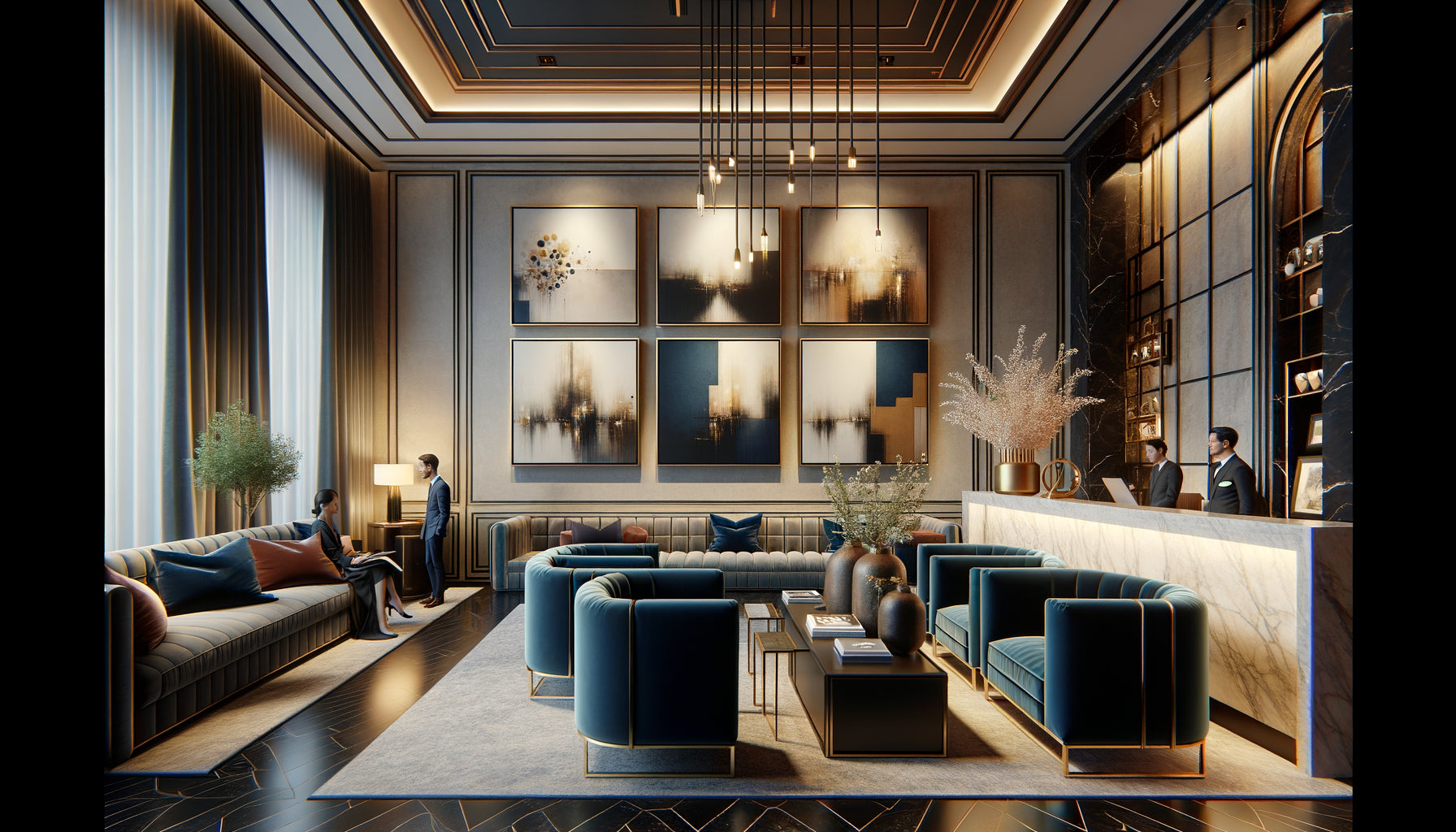
Here's what abstract art brings to hotel spaces: a unique ability to create bridges between tradition and modernity, an interpretative flexibility that suits a diverse international clientele, and a visual signature that transforms a simple accommodation into a memorable experience.
Too many establishments play it safe by reproducing predictable decorative codes. The result? Forgettable spaces struggling to differentiate themselves in an ultra-competitive market. The fear of shocking with contemporary art often leads to a bland neutrality that creates no emotion.
Yet, I have visited more than 180 high-end establishments across Europe over the past ten years. And what I discovered will surprise you: it's not the architectural style that determines whether abstract art works, but how it is integrated. The question isn't if abstract paintings are suitable, but how to choose them for each context.
When abstraction reveals the soul of a classic architecture
In a Second Empire-style Parisian palace where I advised the management, we installed a series of abstract paintings in sepia and gold tones in the hallways. The result? These contemporary works magnified the old moldings rather than competing with them. The secret lay in the color palette: we extracted colors from the original woodwork to reinterpret them in a modern visual language.
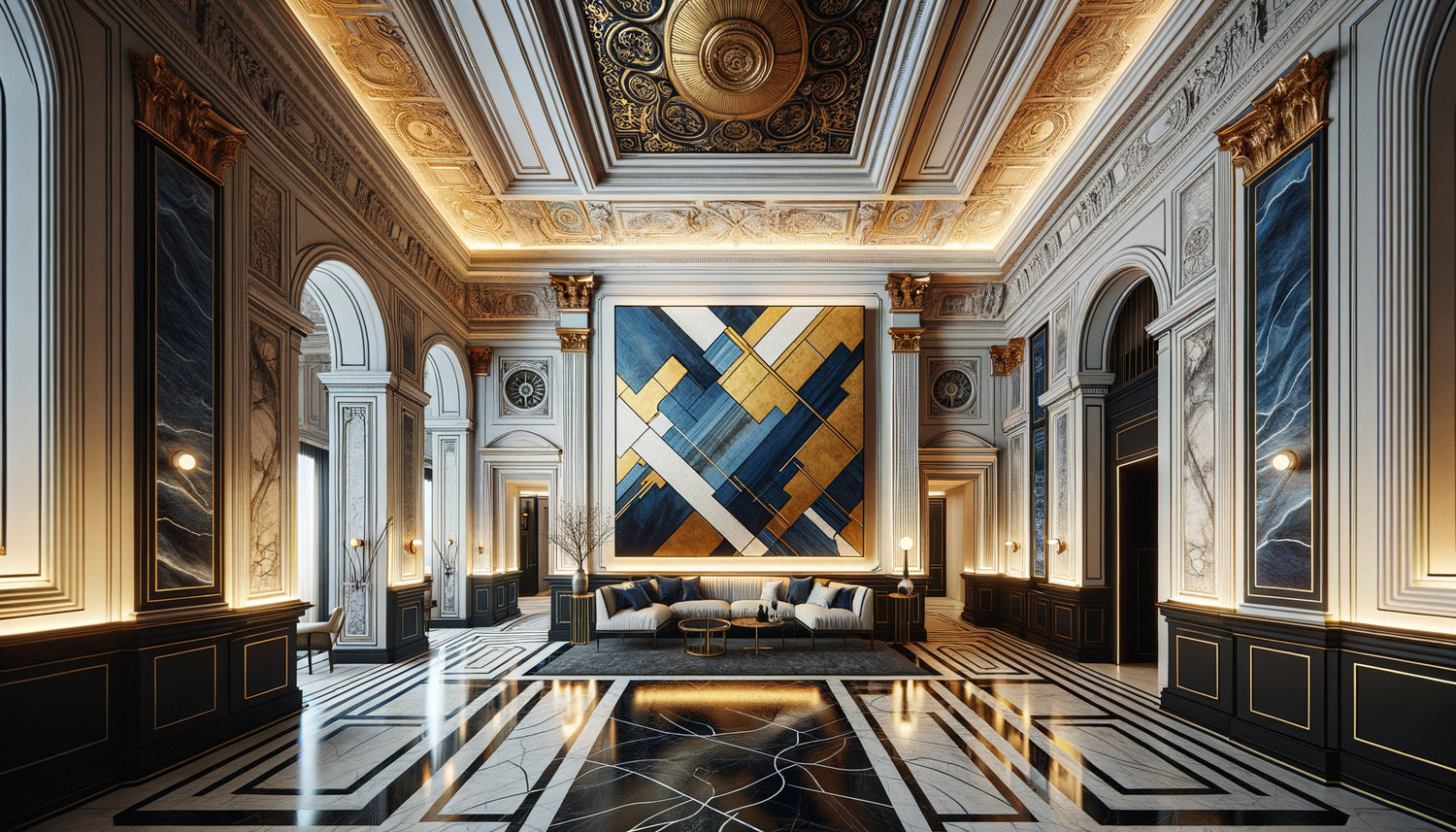
Haussmannian, Art Deco or neo-classical style hotels have a strong architectural structure. These buildings don't need to repeat their historical message with reproductions of the era. On the contrary, abstract art creates creative tension that makes eras dialogue. It is this conversation between past and present that fascinates contemporary travelers seeking authenticity AND modernity.
I observed that abstract paintings with geometric compositions work particularly well in Art Deco spaces. The clean lines and structured shapes echo the aesthetics of the 1920s-1930s. In a Brussels establishment, an abstract black and gold canvas with angular motifs created a perfect bridge between the original wrought ironwork and the contemporary comfort of the renovated spaces.
Abstraction as breathing space in loaded architectures
Here's a truth that few dare to say: some architectural styles are visually saturated. Baroque, rococo or neo-Victorian hotels already present a considerable ornamental density. Adding detailed figurative paintings would be like layering noise on noise.
In these contexts, abstract wall art acts as a visual breathing space. I’ve seen this strategy work beautifully in a Venetian boutique-hotel with walls covered in gilded stucco. The owners had chosen minimalist abstractions in neutral tones – off-white, pearl gray, beige – which offered respite for the eye without breaking the overall harmony.
The common mistake? Wanting art to imitate architecture. The best pairings are born from controlled contrast. In a Norman castle-hotel I visited, an abstract canvas with broad strokes of cobalt blue stood in a salon with antique tapestries. This boldness created precisely the focal point that the room needed, drawing the eye before letting it explore the surrounding historical details.

Contemporary styles and abstraction: a deceptive obviousness
One might think that hotels with contemporary, minimalist or industrial design are the natural terrain of abstract art. This is partially true, but this obviousness hides a trap: banality.
I’ve stayed in too many design establishments where abstract paintings seemed to come from a generic catalog. Predictable compositions in gray-white-black tones that add nothing to the experience. In these clean contexts, abstract art must precisely provide what the architecture does not: warmth, surprise, emotion.
A Rotterdam design hotel I studied had brilliantly solved this equation. In their ultra-minimal lobby, they installed a series of abstract paintings with pronounced tactile textures – thick impasto, mixed media, substantial reliefs. These works compensated for the potential coldness of polished concrete and brushed steel by introducing a sensory and human dimension.
For industrial style hotels – exposed brick, metal beams, visible pipes – I noticed that abstractions in saturated colors create a remarkable impact. A Berlin establishment had chosen canvases with vivid reds and incandescent oranges that instantly warmed the austerity of raw materials. Abstraction thus became the element of visual comfort in a deliberately raw environment.
It's not about style, but narrative intention
After analyzing dozens of successful and failed integrations, I identified the true compatibility criterion: the narrative intention of the establishment. Each hotel tells a story – that of its territory, its history, its vision of hospitality. Abstract paintings work well when they enrich this narration.
In an alpine chalet-style hotel, I discovered a collection of abstractions inspired by mountain landscapes. Not literal representations, but gestural interpretations – white streaks evoking snow drifts, deep blues recalling glaciers, abstract rocky textures. These works functioned perfectly because they translated the essence of the place into a contemporary language.
Conversely, I visited a renovated Japanese ryokan where the owner had imposed Western abstract paintings with no connection to Japanese aesthetics. The result was dissonant, not because of the traditional architectural style, but because these works broke the continuity of narrative and spirituality of the place. Abstractions inspired by sumi-e or Zen philosophy would have made a different story.

The three golden rules for integrating abstraction into any architectural style
Rule 1: Dialogue with the existing palette
The most successful abstract wall paintings I have observed extract and reinterpret the colors of the host architecture. In a Mediterranean establishment with ochre and terracotta walls, abstractions in earth tones, saffron and faded blue created chromatic continuity while bringing a modern reading. This approach works in 90% of cases, regardless of architectural style.
Rule 2: Adapt the scale to the spatial ambition
A palace with cathedral-like volumes calls for monumental abstract paintings capable of holding the scale. I have seen works 3 meters high perfectly comfortable in Haussmannian lobbies. Conversely, an intimate boutique hotel requires more modest formats that preserve the feeling of a cocoon. Scale errors betray faster than a stylistic incompatibility.
Rule 3: Create visual resting points
In richly layered architectures (baroque, eclectic, maximalist), abstract paintings with streamlined compositions offer a breath of fresh air. In minimalist architectures, textured or colorful abstractions bring sensory richness. It's always a question of balance and complementarity rather than repetition.
Special cases: when abstraction requires more subtlety
Some architectural contexts require a more nuanced approach. Listed historical buildings are subject to heritage constraints. I advised an establishment in a 17th-century convent where we opted for removable abstract paintings on independent display stands, thus respecting the integrity of the historic walls while modernizing the customer experience.
Very distinctive architectural styles – Moorish, colonial, regional vernacular – require that abstract art establishes cultural bridges. In a Moroccan riad, geometric abstractions inspired by traditional zellige created this link between heritage and contemporary design. Abstraction then became a translation rather than an import.
I have also observed that themed hotels represent the most delicate challenge. An establishment inspired by the marine universe where every detail evokes the ocean risks seeing abstract paintings perceived as out of place, unless they interpret abstractly the movements of water, the textures of sand, the colors of seabeds. Thematic consistency takes precedence over formal freedom.
Transform your establishment into a memorable visual destination
Discover our exclusive collection of luxury hotel wall art that creates authentic dialogues between your unique architecture and contemporary art.
What if abstraction was ultimately the most adaptable of languages?
After all these observations, one conviction has emerged: abstract wall paintings are perhaps the most universal artistic choice for hospitality, precisely because they do not dictate a unique reading. Their interpretive ambiguity makes them welcoming to an international clientele with diverse cultural references.
A Japanese client, a Brazilian traveler and a Scandinavian visitor will not read the same thing in a gestural abstraction, and that is precisely its strength. Where a figurative painting imposes its narrative, abstraction invites each person to project their own sensitivity. This quality becomes a considerable asset in the hotel context where art must speak to everyone without addressing anyone in particular.
I have seen establishments transform their customer perception simply by replacing classic reproductions with carefully selected abstract paintings. Online reviews evolved, suddenly mentioning the establishment's contemporary, bold, refined character. Abstract art had repositioned the hotel without touching its architecture.
The real question is not whether abstract paintings suit your architectural style. The question is: what abstraction authentically tells your story? A Belle Époque establishment can perfectly accommodate abstract compositions if they extend the spirit of innovation that characterized this era. A traditional hotel can reinvent itself with abstract works that extract the essence of its terroir.
Imagine your guests stopping in your lobby, not to check their phone while waiting, but to contemplate this abstract canvas that captures the morning light. Imagine them photographing this space becoming instagrammable, not by calculation, but by authentic beauty. Imagine them remembering your establishment not as the hotel where I slept in Lyon, but as that magnificent place with that unsettling work in the stairwell.
That's the magic of well-chosen abstract wall paintings: they transform architecture into experience, accommodation into destination, and your establishment into a lasting memory. It doesn't matter whether your walls date from 1880 or 2020 – what counts is the emotion they evoke today.