I still remember that client pushing open the door of my gallery for the first time, her eyes shining but her gaze hesitant. "I want to start a collection of historical paintings, but where do I begin?" I hear this question every week. And rightly so: starting a collection can seem daunting given the vertiginous richness of art history.
Here's what historical art brings to your interior: a narrative depth that transforms your walls into windows on other eras, a cultural value that grows with time, and that unique satisfaction of owning a fragment of history reinterpreted for our modernity.
Many beginners remain paralyzed, fearing making the "wrong" choice, not understanding enough about art, or investing in something that will no longer speak to them in a few years. Rest assured: I have guided hundreds of collectors at their beginnings, and most start exactly where you are today. The key is not to be an expert, but to choose works that resonate with your sensibility while respecting a few fundamental principles. I'm going to reveal the categories of historical paintings that consistently work for a first coherent and enriching collection.
Portraits of iconic figures: your window into the intimacy of the past
Historical portraits are the ideal entry point for any beginner's collection. Why? Because they create an immediate human connection. When looking at the gaze of an 18th-century character, you are not just contemplating a pictorial technique – you are meeting the eyes of someone who lived, dreamed, and suffered.
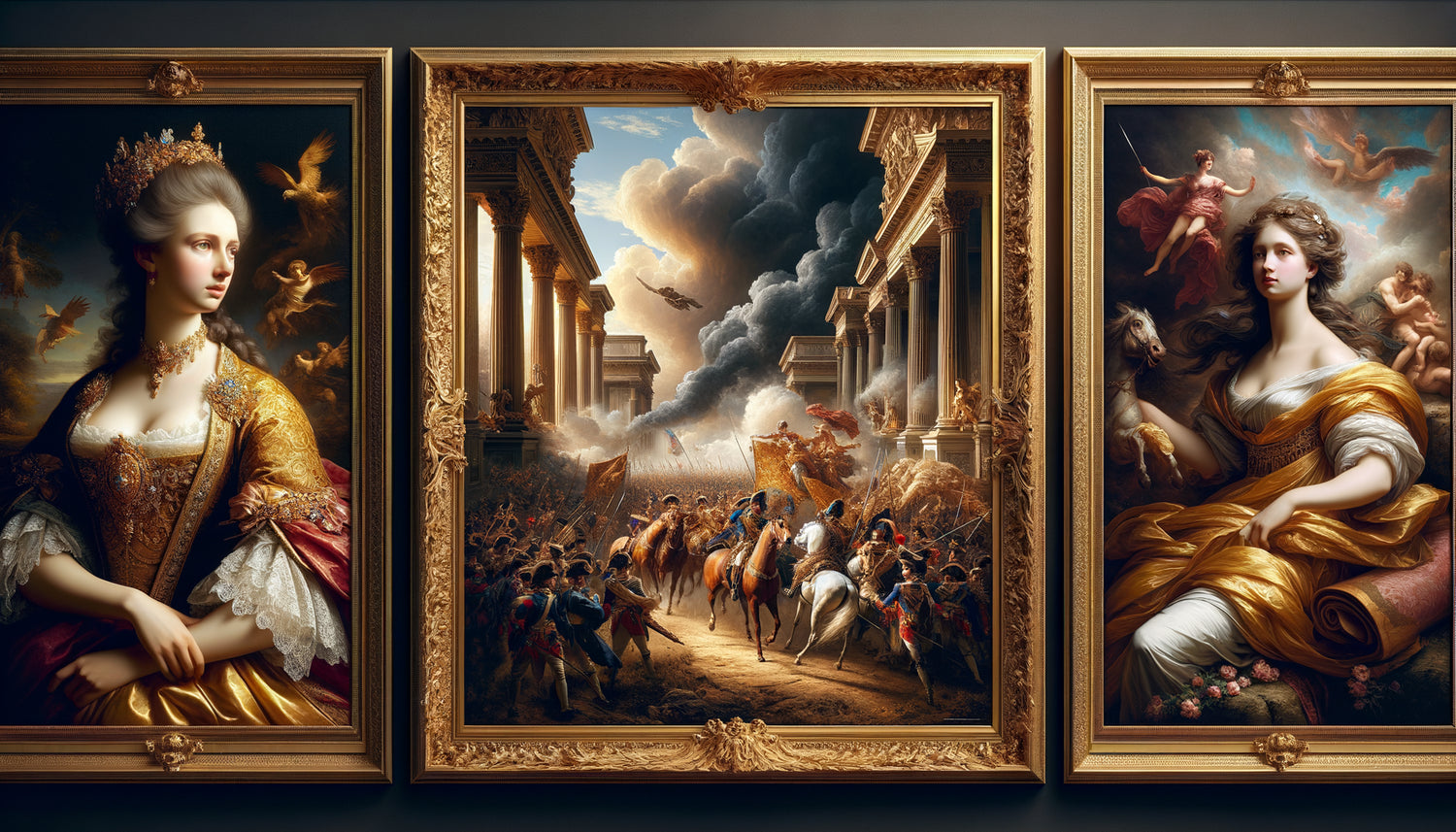
To begin, prioritize portraits of personalities whose history fascinates you. A quality reproduction of a portrait of Marie Antoinette, Napoleon, or Louis XIV instantly brings a narrative dimension to your space. These historical paintings work particularly well in offices, libraries, or majestic entrances.
The advantage of portraits? They transcend decorative trends. A face remains timeless. And unlike complex scenes, a portrait is immediately readable: your guests do not need an art history education to appreciate it. Look for reproductions that respect the original tones – these ochres, Prussian blues, tarnished golds – rather than overly saturated versions that betray the era.
Battle scenes and major events: the spectacle of History
If you are looking for an immediate visual impact, battle scenes and major historical events are unmatched. These paintings embody movement, drama, and narrative tension. The Battle of Austerlitz, Napoleon's Coronation, the Storming of the Bastille: all pivotal moments that literally explode onto the canvas.
These monumental historical paintings require space. They work ideally in large living rooms, above an imposing sofa, or in a dining room where they become the natural centerpiece of dinners. Their visual complexity – dozens of characters, rearing horses, cannon smoke – captures and holds the gaze.
For a beginner's collection, I recommend starting with a single grand epic scene rather than several small ones. This painting then becomes your masterpiece, around which you will gradually build the rest of your collection. Check the quality of the details: faces should remain distinct, even in the fray, and the depth of field well marked to avoid a “cluttered” effect.

Mythology and allegories: when history meets symbolism
Mythological scenes represent a fascinating territory for budding collectors. These allegorical historical paintings – think of representations of Venus, Apollo, or the Muses – offer a double reading: immediate formal beauty and symbolic layers to discover gradually.
What makes these works particularly suitable for beginners? Their decorative versatility. A Botticelli Venus or a neoclassical Apollo blend just as well into a minimalist contemporary interior as into a more classic decor. Mythological nudes, treated with the distance of allegory, bring an culturally acceptable sensuality, even in formal spaces.
Prioritize Renaissance or Neoclassical periods to start: their balanced compositions and harmonious colors age remarkably well. More theatrical Baroque works require more confidence in placement and lighting. A valuable tip: always pair these paintings with directional lighting that sculpts volumes and reveals the depth of complexions.
Documented historical landscapes: traveling through time and space
Too often neglected by beginner collectors, historical landscapes are nevertheless an extraordinarily rich category. I'm not talking about any landscape, but documented views: Paris during the Second Empire, Venice in the 18th century, the Norman countryside in the Middle Ages.
These topographical historical paintings offer a double pleasure: contemplating the beauty of a landscape composition while discovering what a place really looked like before the photographic era. Imagine a view of the old London Bridge before its demolition, or Versailles wheat fields now disappeared under concrete.
For a cohesive collection, I suggest choosing either a single city across different eras (creating an exciting temporal narrative), or several locations from the same period (offering a coherent geographical panorama). These artworks work wonderfully in hallways, staircases, or passageways where their contemplative dimension naturally finds its place.
The question of authenticity and reproduction
Let's frankly discuss a topic that many avoid: as a beginner collector, you will likely work with high-quality reproductions rather than originals. And that is perfectly legitimate. A high-definition museum reproduction of a Velázquez or a David allows you to live daily with masterpieces otherwise inaccessible.
The key lies in the quality of execution. Look for reproductions on textured canvas, with UV-resistant pigments, and if possible a varnish finish that recreates the depth of original glazes. These details transform a simple poster into a true historical decorative artwork that brings real presence to your interior.

Building coherence: thematic versus chronological
After a few acquisitions, the question of coherence naturally arises. Two approaches work remarkably well to structure a beginner's collection of historical artworks.
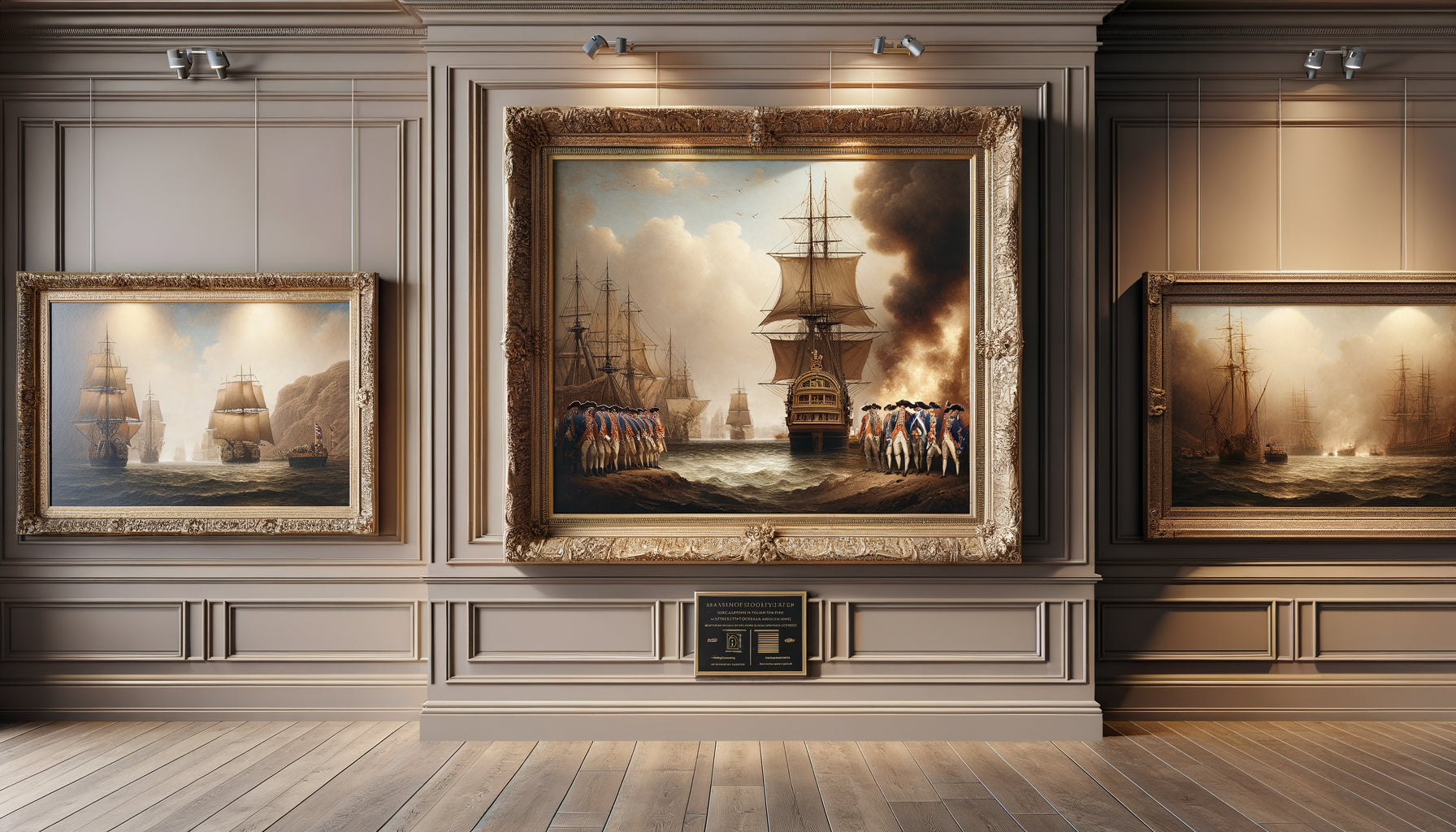
The thematic approach consists of gathering works around a common thread: female figures of power, equestrian representations, historical maritime scenes. This method creates an immediately readable collection, where each new artwork enriches the dialogue between existing ones.
The chronological approach traces a temporal journey: from the Middle Ages to the Belle Époque, your collection becomes a visual frieze of artistic evolution. More intellectually demanding, it offers a particular satisfaction when it begins to take shape.
My advice? Start thematically for the time it takes to acquire 4 to 6 artworks, then gradually refine towards chronological coherence if your passion deepens. This initial flexibility avoids you from locking yourself too early into rigid constraints.
The mistakes to absolutely avoid when starting a collection
After two decades of advising collectors, I regularly see the same pitfalls. First mistake: buying too small out of shyness. A historical painting of 30x40 cm gets lost on a modern wall. Dare to use formats of at least 60x80 cm for your masterpiece.
Second mistake: neglecting the frame. A beautiful painting in a low-end frame instantly loses 70% of its presence. Invest in gilded molding frames for classic periods, or black matte frames for an assumed contemporary contrast.
Third mistake: accumulating without thinking. It is better to have three historical paintings perfectly chosen and arranged than fifteen disparate works that create visual chaos. Collecting art is a marathon, not a sprint. Give yourself time to live with each acquisition before adding the next.
Finally, don't ignore lighting. Historical paintings, with their subtle glazes and worked shadows, are fully revealed under soft directional lighting. A track with adjustable spotlights literally transforms the perception of your works.
Ready to bring your passion for History to life?
Discover our exclusive collection of historical paintings that will transform your walls into true windows to the past.
Your collection as a reflection of your identity
Beyond aesthetic or historical considerations, your collection of historical paintings tells a story: yours. The periods you favor, the characters you choose, the scenes that captivate your attention – all this gradually draws a fascinating cultural self-portrait.
I think back to that client at the beginning, the one who timidly pushed open my door. She started with a portrait of Catherine de Medici, then gradually added other female figures of power: Cleopatra, Elizabeth I, Empress Sissi. Five years later, her collection comprises fifteen pieces that form a powerful dialogue on female leadership through the ages. She had not anticipated this coherence – it revealed itself naturally, guided by a deep sensitivity.
Start modestly, but start really. Choose that first historical painting that moves you viscerally, without over-intellectualizing. Hang it in a place where you will see it daily. Live with it for a few weeks. Then observe: what questions does it raise? What echoes is it seeking? This attentive listening will naturally guide you towards your next acquisitions, gradually building a collection as unique as you are.
Frequently asked questions about historical paintings for beginners
What budget should I allocate to start a collection of historical paintings?
Contrary to popular belief, starting a collection of historical paintings does not require a colossal budget. For museum-quality reproductions, expect between 150 and 400 euros for a medium format (70x90 cm), frame included. This range guarantees you a textured canvas print with durable pigments and a decent framing. If your budget allows, investing 600 to 1000 euros in your masterpiece will give an exceptional presence that fully justifies the expense. The classic mistake is to buy five paintings at 50 euros rather than one at 250 euros: quality always prevails over quantity when starting a collection. Also plan a lighting budget (adjustable LED spotlights) of around 80 to 150 euros which will enhance your acquisitions. Consider your first historical paintings as long-term cultural investments rather than simple decorative purchases – this perspective radically changes your relationship with spending.
How do I know if a historical painting suits my current decor style?
The beauty of historical paintings lies in their astonishing stylistic adaptability, provided that some integration principles are respected. In a clean contemporary interior, opt for close-up portraits or mythological scenes with simple compositions, framed in black matte frames that create an assumed contrast. The “modern gallery” effect works remarkably well. For a classic or Haussmannian interior, battle scenes, historical landscapes and grand portraits naturally find their place with traditional gold frames. The secret? Create a dialogue between old and new rather than a museum reconstruction. A large 18th-century portrait above a Scandinavian sofa creates a fascinating visual tension. Test virtually before buying: photograph your wall and digitally overlay the painting you are considering. This simple technique avoids 80% of post-purchase disappointments. Remember that great collectors boldly mix eras – it is at the heart of the art of collecting.
Should I prioritize a particular historical period for my first collection?
Rather than choosing intellectually a period, let your intuition guide you towards the era that naturally fascinates you. Passionate about the Renaissance? The balanced compositions and golden luminosity of this period will create a serene and harmonious collection. Drawn to monarchical splendor? Eighteenth-century France offers sumptuous portraits and extraordinary court scenes. A fan of Napoleonic epics? The Empire provides dramatic scenes and incomparable heroic portraits. The advantage of focusing on a single period at the beginning of a collection: you quickly develop a visual expertise that refines your later choices. You recognize dress codes, pictorial conventions, stylistic signatures. This initial specialization is not definitive – many collectors gradually broaden their chronological spectrum – but it usefully structures the first acquisitions. If no period really imposes itself, start with the 19th century: close enough to remain accessible, far enough to retain that scent of history which makes all historical paintings so charming.