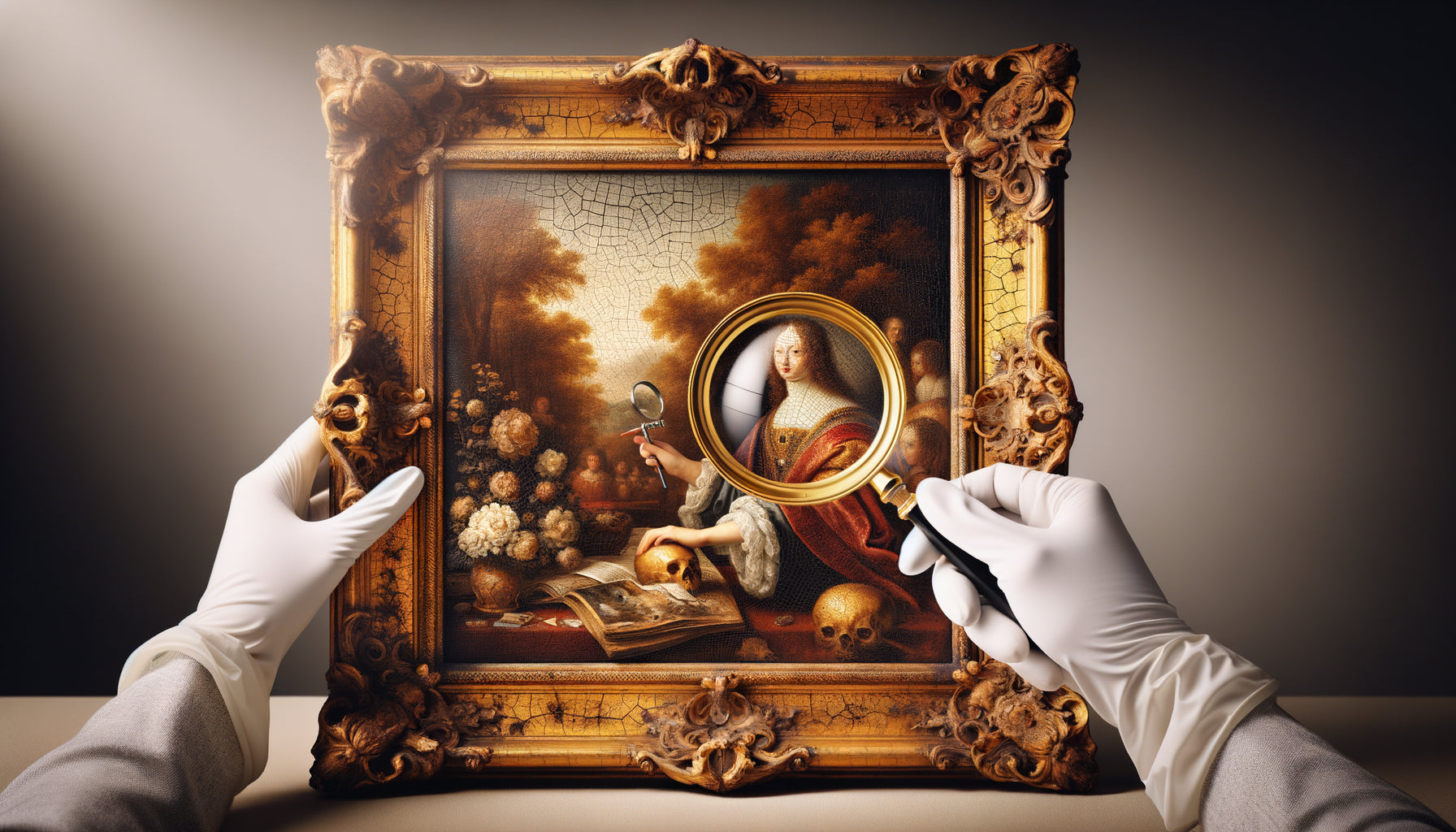
That morning, in a small Lyon auction house, I watched a collector blanch as he faced his supposed Delacroix. The verdict had just come in: fake. Three hundred thousand euros vanished. I've seen this scene repeat itself too often during my interventions with expert houses and private collectors. Because behind every antique painting sometimes lies a less glorious story than the one told on the label. Fake historical paintings flood the art market, and even discerning buyers can fall into the trap. Here’s what rigorous authentication brings: peace of mind regarding your investment, the certainty of owning a genuine heritage work, and protection against sophisticated scams that evolve as quickly as detection technologies. You may feel this fascination mixed with worry in front of an antique painting, this nagging question: is it authentic? I understand this frustration. Rest assured: some signs never deceive, and I'm going to reveal those that forgers cannot imitate, even with all their talent.
The signature: the first trap of counterfeits
Fake historical paintings often reveal their nature upon examination of the signature. I have developed an infallible reflex: to observe the fluidity of the gesture. An authentic signature breathes spontaneity, the habit of an artist who has signed hundreds of canvases. Even talented forgers hesitate. This microsecond of doubt translates into an almost imperceptible tremor, a too-firm line, a jerky movement.
On a genuine historical painting, the signature integrates the natural cracks in the varnish. It ages with the work. A fake painting often has a signature whose cracks seem artificial, too regular, or worse: applied on top. During an appraisal in Geneva, I unmasked a supposed Courbet thanks to this detail. The cracked signature rested on a recent layer of varnish. A fatal inconsistency.
Stylistic evolution betrays the copyists
Each great master has experienced an evolution in his way of signing. Young Rembrandt did not sign like mature Rembrandt. Forgeries often use a typical signature, without taking into account the supposed period of the work. This chronological error is a major warning signal for any expert in antique paintings.
The materials: silent witnesses of time
The canvas itself tells a story that fake historical paintings struggle to reproduce. I have learned to listen to this mute narrative. The linen of the 17th century has an irregular weave, hand-spun, with characteristic variations in thickness. Modern industrial canvases, even artificially aged, present a too-perfect regularity.
The frame reveals even more eloquent secrets. The old woods bear the marks of hand-cut, with traces of tools from the era. On an authentic antique painting, the wood has developed a deep patina, a natural oxidation impossible to reproduce in just a few years. I systematically examine the nails and staples: their metallic composition, their forging technique precisely date the assembly.
Pigments Never Lie
This is where forgers make their most costly mistakes. Some pigments simply did not exist at certain times. Titanium white only appeared in the early 20th century. Prussian blue dates from 1704. A painting supposedly painted in 1650 containing titanium white? Guaranteed fake. Spectrometric analysis, which we practice in our laboratory, identifies these chemical anachronisms without any ambiguity.

The Crackle Network: The Fingerprint of Age
I like to compare the crackle network of a painting to lines of life. Each work ages according to its chemical composition, its environment, its movements. On a genuine historical painting, these cracks form an organic, coherent system that penetrates all layers of paint down to the primer.
Fake historical paintings attempt to reproduce these cracks by various methods: oven baking, application of cracked varnish, thermal shocks. But these imitations remain superficial. Under raking light, a fake reveals cracks that are too uniform, too parallel, which only affect the surface. An authentic painting shows natural variations: cracks in islands, in spiderwebs, dense in areas of tension of the support.
During an appraisal in Brussels, I examined a supposed 17th-century Flemish portrait. The cracks seemed convincing on the surface. A digital microscope examination revealed that they stopped at the first layer of varnish. The underlying paint was as smooth as a mirror. Immediate verdict: recent forgery artificially aged.
The Painting Technique: Gestures Impossible to Copy Perfectly
Each era, each school has its characteristic techniques. Flemish masters layered their glazes in a precise order, with drying times respected. A hurried forger often neglects these protocols, creating inconsistencies in the stratigraphy of the paint.
I observe the touch, this unique gesture specific to each artist. Caravaggio applied his shadows with dramatic energy. Vermeer worked in thin, almost transparent layers. Historical fake paintings copy the final appearance, but rarely the methodical construction that leads to it. A cross-section under a microscope reveals this deception: the layers are disordered, the binders inappropriate for the time.
Authentic Pentimenti versus Suspicious Corrections
The masters modified their composition during creation. These pentimenti appear under X-ray or infrared reflectography. On an authentic painting, they bear witness to the creative process, consistent with the artist's style. A fake painting may present artificial pentimenti to simulate authenticity, but they lack compositional logic.

Provenance: An Inquiry into the History of the Work
Beyond the material aspects, the traceability of a historical painting constitutes its documentary DNA. I have learned to be skeptical of miraculous provenances: “found in an attic,” “unlisted private collection,” “exported during the war.” These romantic tales often hide a complete lack of verifiable history.
An authentic painting leaves traces: raisonné catalogs, exhibitions, mentions in correspondence, collection marks on the back. I systematically examine the reverse: gallery labels, customs stamps, inventory numbers. Historical fake paintings frequently have backs that are too clean, or paradoxically, too loaded with suspicious labels to compensate for the lack of solid documentation.
Modern Technologies in Service of Truth
My work has been transformed by technological advances. UV fluorescence reveals restorations and overpaint invisible to the naked eye. A fake painting will often show a homogeneous fluorescence, while an original reveals its complex history: retouching, cleaning, modifications.
X-ray radiography penetrates all layers of paint, revealing the support, repairs, and sometimes even earlier works reused. Ancient artists often recycled their canvases. This historical practice creates complex radiographic signatures, impossible for a modern forger starting with a new support to falsify.
Radiocarbon dating, although costly, accurately dates organic materials. It exposes even the most sophisticated forgeries by establishing the actual age of wood, canvas, or even some binders. Recently, this technique revealed that a supposed Rembrandt had been painted on a canvas manufactured in 1953.
You deserve authenticity to enhance your interior
Discover our exclusive collection of historical paintings, combining artistic heritage and authenticity guarantee.
Your vigilance: best protection against forgeries
After fifteen years of tracking fake historical paintings, I remain convinced that the intuition of an informed amateur is worth its weight in gold. If something seems strange – a price too attractive, an evasive seller, incomplete documentation – listen to that little voice. The most beautiful scams are based on urgency and emotion.
Always demand a detailed certificate of authenticity, written by a recognized expert. Be wary of vague attributions: « school of », « entourage of », « manner of ». These formulas often serve as cover for works of secondary quality, or even disguised forgeries. An authentic painting assumes its identity with precision.
Imagine yourself in your living room, contemplating this work that you thought was authentic, this window into a bygone era. Now, you have the keys to transform this vision into a serene reality. Authentication is not a constraint, but your best ally for investing intelligently in artistic heritage. Start with these simple checks: examine cracks under raking light, research documented history, consult an independent expert before any significant purchase. Your keen eye and knowledge will make all the difference between a wise investment and an expensive disillusionment.
Frequently asked questions about authenticating historical paintings
Can a fake painting be detected without professional equipment?
Absolutely, and it’s even recommended as a first step. Several clues are visible to the naked eye or with a simple magnifying glass. First, examine cracks under raking light: they should be deep, irregular, and penetrate all layers. Then observe the signature: it should show the same wear and tear and cracks as the rest of the artwork. Check the back of the painting: old frames show traces of manual cutting and a deep patina. If you notice a too-regular canvas, superficial cracks, or a fresh signature, consult an expert. Your careful observation is the first line of defense against fake historical paintings, even before resorting to costly analyses.
How much does a professional authenticity assessment cost?
Rates vary considerably depending on the complexity of the analysis. A basic visual assessment by a generalist starts around 200-500 euros. For an opinion from a specialized expert on a particular artist, expect between 800 and 3000 euros. Complete scientific analyses – including radiography, UV fluorescence, pigment spectrometry – can reach 5000 to 15000 euros for major works. This may seem significant, but consider this: that sum protects you from buying a fake worth tens or hundreds of thousands of euros. For a painting with a presumed value exceeding 10000 euros, professional authentication represents an essential insurance. Start with a visual assessment, then invest in more in-depth analyses if the work warrants it and the initial clues are encouraging.
Do galleries and auction houses guarantee the authenticity of paintings?
The nuanced answer deserves your attention. Reputable auction houses like Christie's, Sotheby's or established auctioneers carry out serious checks and risk their reputation. They generally offer a certificate of authenticity with the possibility of return under certain conditions. However, even these institutions can be mistaken – art history is full of spectacular errors. Independent galleries vary enormously in terms of rigor. Some are impeccable, others less scrupulous. Never rely solely on the seller's word, no matter how prestigious they may be. Demand a written certificate of authenticity, detailed, established by an independent expert from the seller. Verify that this expert is recognized in the relevant specialty. And carefully read the terms and conditions of sale: the terms “attributed to” or “school of” indicate a less certain authentication than a firm attribution.