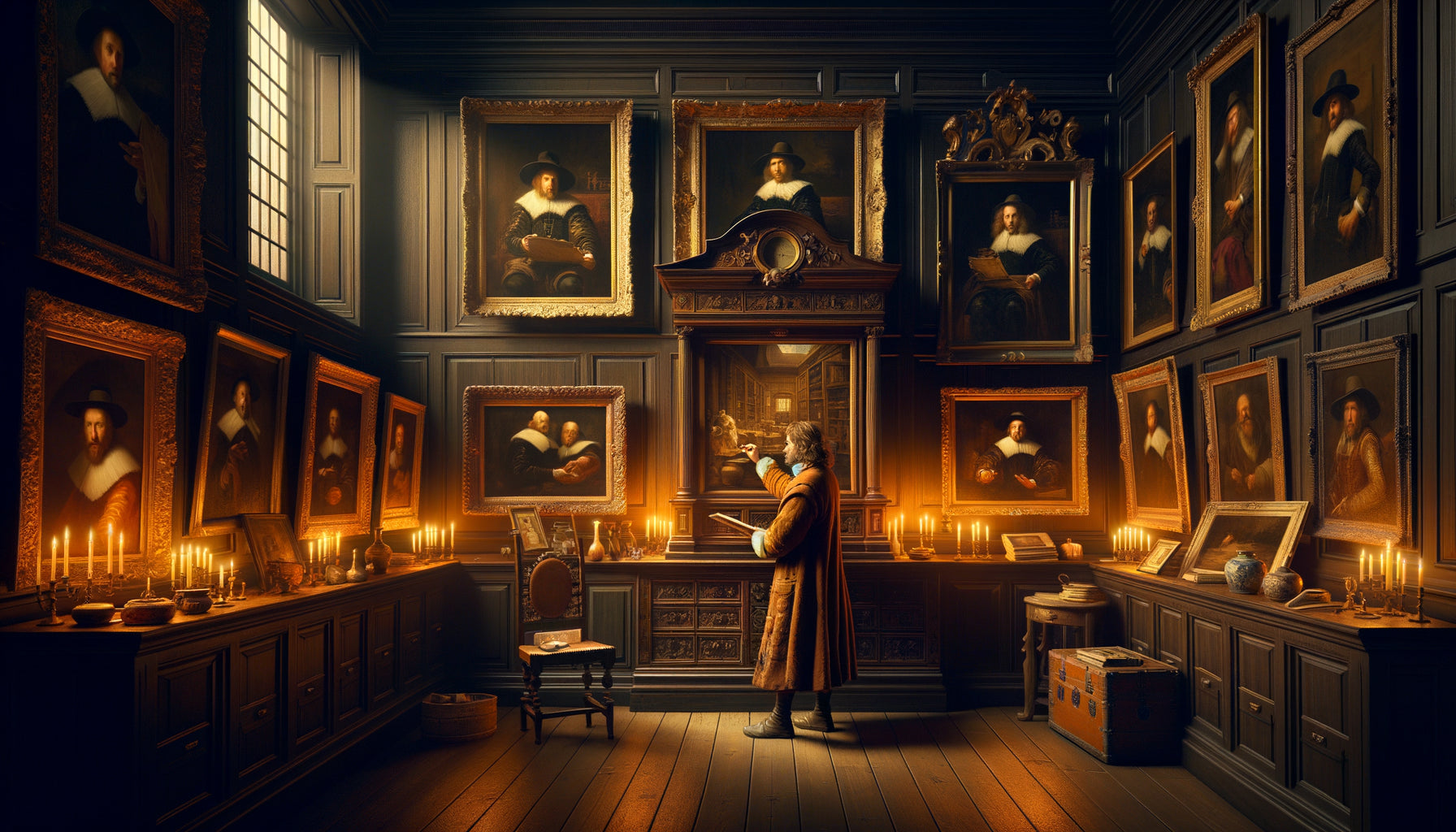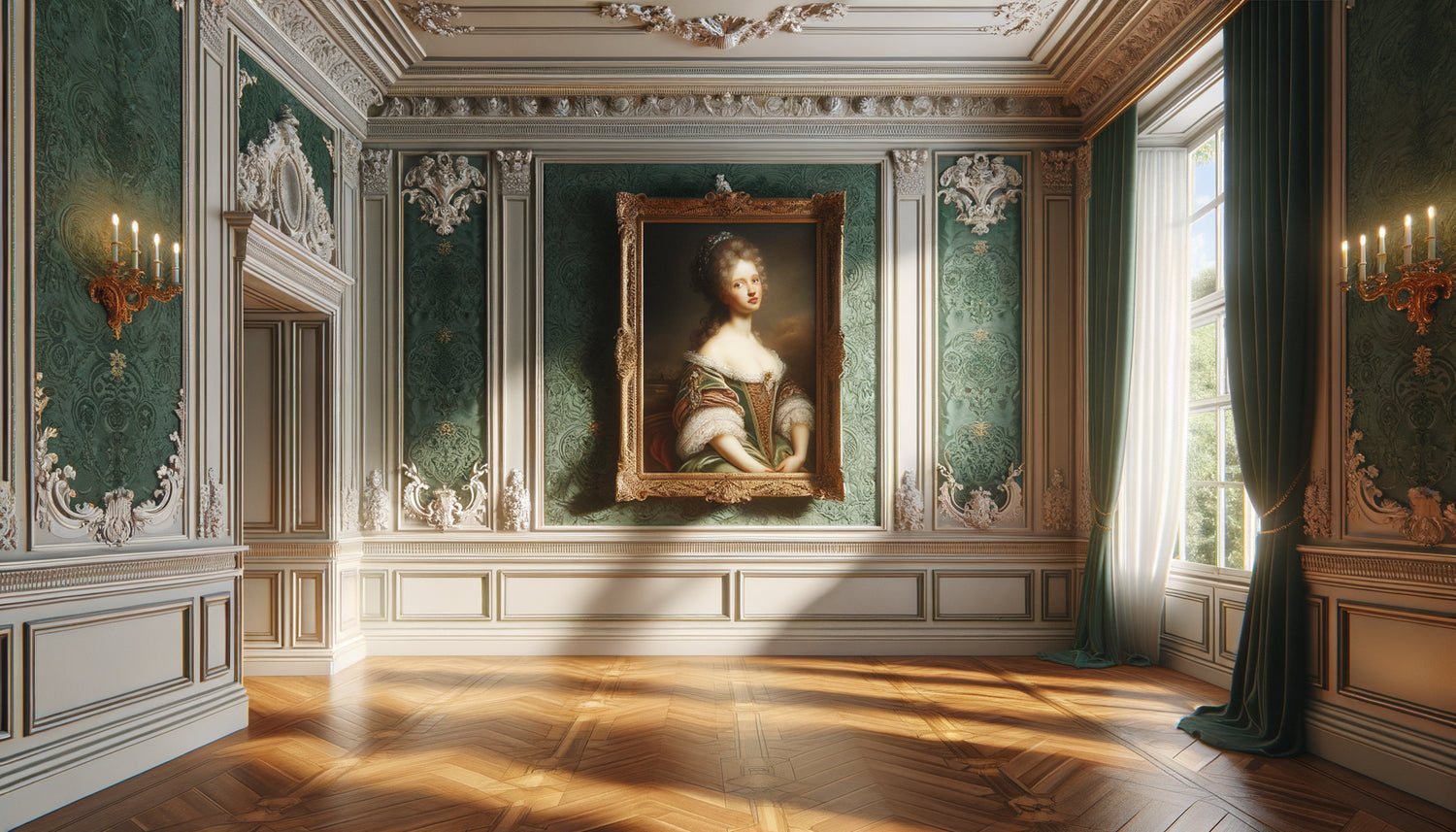
Three years ago, I had the privilege of accompanying a Geneva collector in acquiring an 18th-century portrait for her Empire salon. She confided in me that she had spent months hesitating, paralyzed by the fear of making the wrong choice. Yet, as soon as we hung this canvas above her marble fireplace, everything transformed. It was no longer simply a furnished room, but a space inhabited by History.
Here's what a well-chosen historical painting brings to your classic interior: a narrative depth that transcends simple decoration, an aesthetic legitimacy that anchors your space in the long term, and a silent conversation between your present and past centuries.
The challenge? Faced with the immensity of periods, styles, and formats available, many give up, fearing a faux pas or investing in an unsuitable work. This hesitation is understandable. After fifteen years spent between auction houses and restoration workshops, I can assure you that there is a rational method for selecting the historical painting that will enhance your decor without betraying the authenticity of your approach. I'm going to give you the keys to an informed and lasting choice.
Stylistic harmony: when the era of the painting dialogues with your architecture
The first rule I teach my clients? A historical painting should never contradict the soul of your room. If you own a Haussmannian apartment with delicate moldings and herringbone parquet floors, a neoclassical portrait or a romantic scene from the 19th century will create an organic coherence. Conversely, in a home with Louis XV woodwork, prioritize Arcadian landscapes or gallant scenes from the 18th century.
This logic is not about rigid purism, but an aesthetic conversation. I recently placed a historical painting depicting a Napoleonic battle in a Restoration interior: the contrast between the violence of the subject and the softness of the architectural lines created a fascinating tension. The important thing is not perfect synchronization of dates, but complementarity of visual languages.
Fundamental stylistic correspondences
For a Louis XV or Regency interior, look for historical paintings with asymmetrical compositions, pastel colors, and mythological or rural subjects. The Louis XVI style calls for more neoclassical rigor: clean lines, antique subjects, a restrained palette dominated by grays, off-whites, and Sèvres blues.
Empire and Restoration interiors find their echo in large narrative compositions: historical scenes, full-length portraits, patriotic allegories. For more eclectic decors inspired by the Victorian or Second Empire periods, dare to use Orientalist historical paintings or abundant genre scenes.
The power of subject matter: choosing a narrative that resonates with your daily life
One evening, while visiting a Bordelaise townhouse, I discovered an immense historical painting depicting a shipwreck in the dining room. The owner, a sailing enthusiast, explained to me how this frozen storm on canvas resonated with his own maritime adventures. This anecdote illustrates an essential truth: the subject of a historical painting must resonate with your intimate world.
Don't choose a hunting scene if you are vegetarian by conviction, nor a military portrait if you are a pacifist. This consistency between your values and the chosen iconography guarantees a lasting relationship with the work. I have seen too many clients tire of historical paintings that were magnificent but emotionally distant.
The main thematic families
Portraits bring a human presence, almost ghostly, which populates the space with aristocratic memories. They work particularly well in libraries, music rooms or entrance halls. Historical landscapes – Roman ruins, idealized countryside, views of ancient cities – create temporal windows to vanished worlds, perfect for hallways or dining rooms.
Mythological and religious scenes are suitable for contemplative spaces: offices, bedrooms, cabinets of curiosities. Finally, still lifes and vanitas, with their meditation on transience, naturally find their place in private spaces where one retires to reflect.

Dimensions and scale: the mistake made by 80% of buyers
Last week, a Parisian couple called me, desperate: they had just acquired a superb historical painting depicting a court scene, but it literally overwhelmed their living room. The work was splendid, the price justified, but the unsuitable proportions turned an asset into an expensive mistake.
Here is my infallible method: first measure the available space, then subtract 20% safety margin. A historical painting should breathe, surrounded by at least 15 centimeters of bare wall on each side. Above a sofa or console, the work should occupy between 60 and 75% of the width of the furniture.
The art of strategic placement
For rooms with high Haussmannian ceilings (2.80 m and above), don't hesitate to layer two historical paintings of complementary sizes. This technique, very popular in the 19th century, creates an aristocratic visual density. In more modest proportioned rooms, prioritize a single medium-sized work, positioned at eye level (the center of the painting at 1.60 m from the floor).
Vertical formats visually elongate the space and are suitable for narrow walls between two windows. Panoramic horizontal formats work beautifully above fireplaces or buffets, creating a reassuring axis of symmetry.
Authenticity versus reproduction: a question of intention, not budget
I must dispel a persistent myth: a well-framed excellent reproduction is better than a mediocre or questionable original. I have furnished sumptuous interiors with high-definition reproductions of old masters, framed in period molding, and no one noticed. The essential thing? Honesty of approach.
If you opt for an original, invest in expertise. Authentic historical paintings require a certificate of authenticity, a traceable provenance and, ideally, a condition report written by a restorer. Do not be impressed by an illegible signature or an unverifiable family history.
Museum-quality reproductions
Current technologies allow for astonishingly faithful reproductions. Look for giclée prints on cotton canvas with UV-resistant pigment inks. The framing makes all the difference: prioritize genuine antique frames or artisanal reproductions with patina, gold leaf and sculpted moldings.
A historical painting in reproduction becomes a perfectly legitimate choice in three situations: when the original is financially inaccessible, when it is in a museum, or when you want to test a work before investing in the authentic one.

The framing: the detail that transforms a work into a treasure
I have spent hours with Parisian gilders observing the magic of transformation. An ordinary historical painting, once set in a restored period frame, instantly acquires tenfold nobility. Conversely, a masterpiece canvas mistreated by a modern anonymous frame loses 70% of its impact.
For a classic interior, the frame is not chosen at random: it must belong to the same stylistic family as the painting and dialogue with the surrounding woodwork. A Louis XV portrait calls for a rocaille molding with sinuous curves, gilded with leaf and sculpted spandrels. A neoclassical scene requires the rigor of a channel and bead frame, in a paler gold.
The finishes that make the difference
Invest in a marie-louise frame (this beveled gilded mat), which creates an elegant breathing space between the artwork and the frame. For historical paintings of great value, museum-quality anti-reflective glass protects without altering colors. The patina of the frame – these delicate signs of age that tell the story of time – must be preserved or recreated with subtlety by a skilled artisan.
Never forget this golden rule: the frame of a historical painting represents between 30 and 50% of the final visual impact. It is the garment of the work, its presentation to the world, its interface with your architecture.
Museum lighting: reveal the hidden soul of your historical painting
The revelation always happens at the same moment: when I install the track spotlights and light touches the surface of the historical painting for the first time, my clients hold their breath. Glazes appear, impasto creates subtle shadows, gilding comes to life. The work that seemed dull suddenly ignites.
Inadequate lighting literally kills a painting. Fluorescent tubes green the complexions, halogens burn the varnishes, cheap LEDs create a disastrous clinical rendering. To sublimate your historical paintings, invest in museum LED spotlights with CRI greater than 95 and color temperature at 3000K (warm white).
Conservators' lighting techniques
Position your light sources at a 30° angle to the plane of the painting, at a distance equivalent to 1.5 times its height. This angle eliminates reflections while creating a sculptural modeling. For historical paintings in large format, multiply the points of light for uniform coverage without shadows.
Install dimmers: the light intensity must adapt to the ambient brightness. In the evening, a more intimate light reveals the mysterious depths of the work. During the day, brighter lighting compensates for competition from natural light.
Ready to transform your classic interior into a private gallery?
Discover our exclusive collection of historical paintings that converse with the history of your home and reveal the soul of your spaces.
Your interior awaits its story
Imagine yourself in six months, welcoming guests into your living room. Their gaze naturally falls on this historical painting that you have chosen with discernment. They don't say anything immediately, but you perceive their silent admiration. It is not ostentation that impresses them, but the evidence: this work seems to have always belonged to this wall, as if it had waited decades to find its exact place.
This coherence is not a matter of chance, but of an informed choice. You have understood that selecting a historical painting for a classic interior is not a question of unlimited budget or academic expertise, but of sensitivity, patience and method. Start by observing your space with new eyes. Identify the wall that calls for a presence, then let yourself be guided by your disciplined intuition.
History awaits your invitation to inhabit your daily life. Offer it this privilege.
Frequently Asked Questions
Is it necessary to choose a historical painting from the same era as your interior?
Absolutely not, and that's liberating! While concordance of eras creates an obvious harmony, the most beautiful classic interiors I have arranged actually play on unexpected temporal dialogues. A Renaissance portrait in a Napoleon III living room, for example, creates a fascinating historical depth. The essential thing is to respect a coherence of formal language: prioritize balanced compositions, noble palettes, timeless subjects. Your historical painting must converse with the architecture, not necessarily share its year of birth. Trust your eye: if the whole seems natural after several days of cohabitation, then the agreement works. Beauty often transcends the rigid categories of art historians.
How do you know if a historical painting is authentic before buying it?
This question has haunted me since my beginnings, as I have seen too many disappointments. Here is my systematic verification method: always demand a certificate of authenticity issued by a recognized expert, not the seller themselves. Examine the back of the canvas: old frames show tenon and mortise joints, forged nails, patinated wood. Beware of uniformly glossy varnishes (a sign of aggressive restoration) or too regular cracks (sometimes artificial). For a historical painting of significant value, invest in technical analysis: radiography, UV examination, pigment analysis. These tests cost between 300 and 800 euros, but will save you from errors costing several thousand euros. Finally, always buy from established galleries or reputable auction houses that commit their professional responsibility.
What budget to plan for a quality historical painting with its frame?
The range is dizzyingly wide, and that's excellent news for all budgets. A high-quality museum reproduction with correct artisanal framing starts at 400-800 euros for a medium format (60x80 cm). If you are aiming for authenticity, an historical painting original from the French or Italian school of the 19th century, correctly attributed but by a minor artist, starts around 1500-3000 euros. Add 30 to 50% for a restored period frame or a custom reproduction of quality. Works by recognized masters or pieces dating back before the 18th century quickly rise towards 10,000 euros and beyond. My advice? First set your maximum budget, then look for the best accessible quality within that limit. A modest but authentic historical painting, beautifully framed and perfectly suited to your space, will always surpass a prestigious but poorly integrated work.